Sheryl Ryan, PhD, OTR/L
Week 1
Chapter 1
 Describe the history of community
based practice in OT
 Describe the roles of OT in CBP
 Describe characteristics of effective
CBP OTs
 Describe the history of paradigm
shifts in OT
 Identify key characteristics of a
community practice paradigm for OT
Chapter 2
 Describe the basic constructs
associated with community and public
health, prevention, and health
promotion
 Identify the determinants of health in
a community
 Discuss strategies for primary,
secondary, and tertiary prevention
 Describe the contributions OT can
make to Healthy People 2020
 Discuss OT’s role in the context of
health promotion, community, and
public health
Work on course vocabulary in
small groups
Guest Speaker from IF or LC
Review Syllabus and
Expectations
Lecture
Healthy People 2020 Activity
Journal Search
Chapter 1
 Community based practice
 Community centered
initiative/intervention
 Community health promotion
 Community level intervention
 Dynamical systems approach
 Ecological approach
 Paradigm shift
 Strengths-based occupational therapy
Chapter 2
 Community health
 Public health
 Community health interventions
 Determinants of health
 Health promotion
 Health disparities
 Incidence vs prevalence
 Epidemiology
 Preventive occupation
 Primary prevention
 Secondary prevention
 Tertiary prevention
IF or Life College
Economical
 Health care costs have risen sharply
 Private insurance has high costs
 Community Based Practice can lower
costs
 Vaccination clinics
 Screening for disease
 Education
 Health programs
 Wellness and prevention
Philosophical
 People with disabilities would be best
served in their natural environment
within their community. (Scaffa,
2001).
 Includes
 Families
 Cultural values
 Community resources
 Positivity
 The AOTA Centennial Vision
 “We envision that OT is a powerful,
widely recognized, science-driven,
and evidence-based profession with a
globally connected and diverse
workforce meeting society’s
occupational needs.”
 (Baum, 2006, p.610)
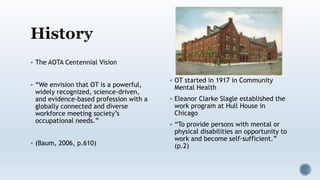
 OT started in 1917 in Community
Mental Health
 Eleanor Clarke Slagle established the
work program at Hull House in
Chicago
 “To provide persons with mental or
physical disabilities an opportunity to
work and become self-sufficient.”
(p.2)
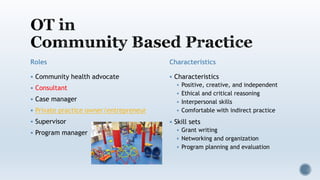
Roles
 Community health advocate
 Consultant
 Case manager
 Private practice owner/entrepreneur
 Supervisor
 Program manager
Characteristics
 Characteristics
 Positive, creative, and independent
 Ethical and critical reasoning
 Interpersonal skills
 Comfortable with indirect practice
 Skill sets
 Grant writing
 Networking and organization
 Program planning and evaluation
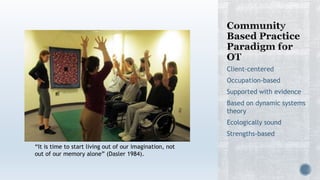
Client-centered
Occupation-based
Supported with evidence
Based on dynamic systems
theory
Ecologically sound
Strengths-based
“It is time to start living out of our imagination, not
out of our memory alone” (Dasler 1984).
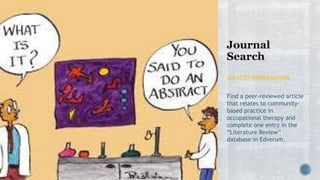
List of OT related journals
Find a peer-reviewed article
that relates to community-
based practice in
occupational therapy and
complete one entry in the
“Literature Review”
database in Edverum.
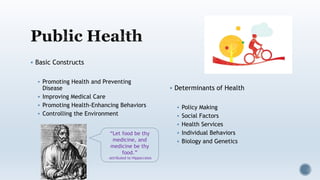
 Basic Constructs
 Promoting Health and Preventing
Disease
 Improving Medical Care
 Promoting Health-Enhancing Behaviors
 Controlling the Environment
 Determinants of Health
 Policy Making
 Social Factors
 Health Services
 Individual Behaviors
 Biology and Genetics
“Let food be thy
medicine, and
medicine be thy
food.”
-attributed to Hippocrates
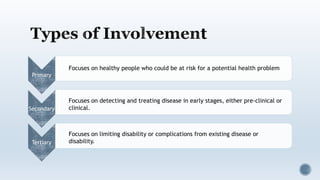
Primary
Secondary
Tertiary
Focuses on healthy people who could be at risk for a potential health problem
Focuses on detecting and treating disease in early stages, either pre-clinical or
clinical.
Focuses on limiting disability or complications from existing disease or
disability.
Small Group Activity
 Meyer, Susan K. (2010). Community Practice in Occupational Therapy: A Guide to
Serving the Community. Boston, MA: Jones and Bartlett Publishers.
 Scaffa, Marjorie E, and Reitz, S. Maggie. (2014). Occupational Therapy in
Community-Based Practice Settings, 2nd Edition. Philadelphia, PA: F.A. Davis
Company.

Ot5101 week1

  • 1.
  • 2.
  • 3.
    Chapter 1  Describethe history of community based practice in OT  Describe the roles of OT in CBP  Describe characteristics of effective CBP OTs  Describe the history of paradigm shifts in OT  Identify key characteristics of a community practice paradigm for OT Chapter 2  Describe the basic constructs associated with community and public health, prevention, and health promotion  Identify the determinants of health in a community  Discuss strategies for primary, secondary, and tertiary prevention  Describe the contributions OT can make to Healthy People 2020  Discuss OT’s role in the context of health promotion, community, and public health
  • 4.
    Work on coursevocabulary in small groups Guest Speaker from IF or LC Review Syllabus and Expectations Lecture Healthy People 2020 Activity Journal Search
  • 5.
    Chapter 1  Communitybased practice  Community centered initiative/intervention  Community health promotion  Community level intervention  Dynamical systems approach  Ecological approach  Paradigm shift  Strengths-based occupational therapy Chapter 2  Community health  Public health  Community health interventions  Determinants of health  Health promotion  Health disparities  Incidence vs prevalence  Epidemiology  Preventive occupation  Primary prevention  Secondary prevention  Tertiary prevention
  • 7.
    IF or LifeCollege
  • 9.
    Economical  Health carecosts have risen sharply  Private insurance has high costs  Community Based Practice can lower costs  Vaccination clinics  Screening for disease  Education  Health programs  Wellness and prevention Philosophical  People with disabilities would be best served in their natural environment within their community. (Scaffa, 2001).  Includes  Families  Cultural values  Community resources  Positivity
  • 10.
     The AOTACentennial Vision  “We envision that OT is a powerful, widely recognized, science-driven, and evidence-based profession with a globally connected and diverse workforce meeting society’s occupational needs.”  (Baum, 2006, p.610)  OT started in 1917 in Community Mental Health  Eleanor Clarke Slagle established the work program at Hull House in Chicago  “To provide persons with mental or physical disabilities an opportunity to work and become self-sufficient.” (p.2)
  • 11.
    Roles  Community healthadvocate  Consultant  Case manager  Private practice owner/entrepreneur  Supervisor  Program manager Characteristics  Characteristics  Positive, creative, and independent  Ethical and critical reasoning  Interpersonal skills  Comfortable with indirect practice  Skill sets  Grant writing  Networking and organization  Program planning and evaluation
  • 12.
    Client-centered Occupation-based Supported with evidence Basedon dynamic systems theory Ecologically sound Strengths-based “It is time to start living out of our imagination, not out of our memory alone” (Dasler 1984).
  • 13.
    List of OTrelated journals Find a peer-reviewed article that relates to community- based practice in occupational therapy and complete one entry in the “Literature Review” database in Edverum.
  • 14.
     Basic Constructs Promoting Health and Preventing Disease  Improving Medical Care  Promoting Health-Enhancing Behaviors  Controlling the Environment  Determinants of Health  Policy Making  Social Factors  Health Services  Individual Behaviors  Biology and Genetics “Let food be thy medicine, and medicine be thy food.” -attributed to Hippocrates
  • 15.
    Primary Secondary Tertiary Focuses on healthypeople who could be at risk for a potential health problem Focuses on detecting and treating disease in early stages, either pre-clinical or clinical. Focuses on limiting disability or complications from existing disease or disability.
  • 16.
  • 17.
     Meyer, SusanK. (2010). Community Practice in Occupational Therapy: A Guide to Serving the Community. Boston, MA: Jones and Bartlett Publishers.  Scaffa, Marjorie E, and Reitz, S. Maggie. (2014). Occupational Therapy in Community-Based Practice Settings, 2nd Edition. Philadelphia, PA: F.A. Davis Company.

Editor's Notes

  • #4 Healthy People 2020 Case Studies from APTR http://www.aptrweb.org/?SP_AlliedHealth Major Players in Community Based Health: Association for Prevention, Teaching, and Research (APTR) Association of Schools and Programs of Public Health (ASPPH) Council on Education for Public Health (CEPH) Society for Public Health Education (SOPHE)
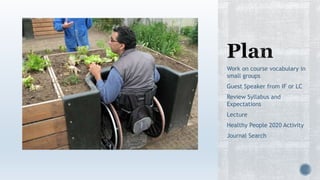
  • #5 Photo credit: http://www.universaldesignstyle.com/wp-content/uploads/2013/01/terrafm25.jpg
  • #6 Groups of 3 students. Each group defines 2 terms on Shared Google Doc.
  • #8 Update specifically once it is scheduled!
  • #9 https://youtu.be/iJigZ1rBBn4?list=PL93ED272C8E69A6AD (3 mins) Community Garden OT
  • #11 See Table 1-1 Has Historical timeline of community practice in OT OT roots in Community Mental Health Treatments conducted in homes, community centers, public health services Benefits of CBP: Decreased costs Prevention Health promotion
  • #12 We Rock the Spectrum gym – 2 minute Video: https://www.youtube.com/watch?v=n6W2Ec6RqkQ Social Entrepreneur – 2 minute Video: https://www.youtube.com/watch?v=7YN7XyqVWx0&feature=youtu.be Roles Community health advocate – advocates, lobbyists, legislation, policies to promote health Consultant – expert advice on program development and evaluation, organizational issues, clinical concerns Case manager – ensure access to community services and resources, assist in development independent living skills Private practice owner/entrepreneur – requires financial management, marketing, leadership, organizational skills Supervisor – training, supporting, and evaluating staff, manage budgets Program manager – OT moves from structured to non-structured work environment, must be comfortable with novelty OT may lack mentorship, work alone, and require strong problem solving skills Characteristics Page 9 Box 1-1 Video 2 minutes: https://www.youtube.com/watch?v=7YN7XyqVWx0&feature=youtu.be
  • #13 Watch Tedx Talk: Amy Gibson;, Exploring the Meaning of Human Potential - https://youtu.be/uM7vA02YIrA (18 minute TED talk) Power of Civic Engagement. May not have time to watch. http://www.washington.edu/wholeu/wp-content/uploads/2014/07/IMG_0441-1.jpg Dasler, PJ. (1984) Deinstitutionalizing the occupational therapist. Occupational Therapy in Health Care, 1(1), 31-40.
  • #16 Examples: type 2 diabetes Primary: Community based exercise and healthy living programs for all members Secondary: Exercise and healthy living programs for individuals with obesity and/or high cholesterol Tertiary: Exercise and healthy living programs for individuals diagnosed with type 2 diabetes
  • #17 Chapter 2 BOX 2-1: Healthy People 2020 Focus Areas – Which ones relevant to OT and how? BOX 2-2: Selected Objectives Addressing the Needs of People with Disabilities – Which ones relevant to OT and how? In groups of 2, choose 1 from each list and discuss