Sheryl Ryan, PhD, OTR/L
Week 4
Chapter 6
 Identify and discuss similarities and
differences between intervention
planning for individuals and the
development of community-based
programs.
 Describe the best practices to use in
the development of a mission
statement.
 Describe the characteristics of an
effective team and the stages of team
development.
 Identify and discuss issues related to
program sustainability
Work on course vocabulary in
small groups
Chapter 6 discussion
Case: Fall Prevention
SMART Goals
Issue Impact Tree
Activity: Vision, Mission, and
Implementation Plan
https://tjqmbb.org/index.php/program/
Chapter 6
 Advisory board
 Board of directors
 Direct costs
 Goal
 Grant
 Indirect costs
 Mission statement
 Objective
 Partnership
 Sliding scale
 SMART goals
 Sustainability
 Team
 Vision statement
Chapter 6
Similarities
 Conduct assessments
 Use clinical reasoning
 Determine appropriate goals
 Implement activities to reach the
goals
 Evaluate effectiveness
Additional Considerations
 Same skills applied in a community
context
 Systems approach rather than
individual approach
 Entrepreneurial skills
 Leading teams
 Recruiting participants
 Establishing partnerships
 Budgeting
 Managing programs
Preplanning (Exploration)
Needs Assessment
Program Planning
Program Implementation
Program Evaluation
Sustainability Plan
Dissemination Plan
(Scaffa & Reitz, 2014)
Tai Chi
 Moving for Better Balance
 https://www.youtube.com/watch?v=
PIN1KPoiuac
http://www.thegreatcourses.com/courses/mastering-tai-chi.html
Fall Prevention videos
 UMC Health System
 https://www.youtube.com/watch?v=A7EcprAXtRE
 Fall Prevention Song
 https://www.youtube.com/watch?v=7ftrK-XM-88
Vision Statement
 Human Rights Campaign:
 Equality for everyone (3)
 Feeding America:
 A hunger-free America (4 words)
 Alzheimer’s Association:
 A world without Alzheimer’s (4)
 Oxfam:
 A just world without poverty (5 words)
 https://topnonprofits.com/examples/vision-
statements/
Mission Statement
3M To solve unsolved problems
innovatively
Amnesty
Inter-
national
Our mission is a world in which
every person enjoys all the
human rights enshrined in the
Universal Declaration of
Human Rights and other
international human rights
standards
Groups read this program
summary and write a
vision and mission
statement that reflects
the goals and purpose of
the program
Photo: https://thesuperiortherapy.com/how-does-balance-effect-my-si-joint/
Link: https://www.ncoa.org/resources/program-summary-a-matter-of-balance/
Goals
Objectives
Activities
Desired outcomes
Specific
Measurable
Attainable
Relevant
Time bound
https://www.youtube.com/watch?v=
d6o5PyJM3bY
http://www.jenningswire.com/business/create-smart-goals-score-big/
Implications:
-Reduce risk for injuries
- Develop community
partnerships
- Run exercises programs
to improve balance
Issue: Fall
prevention
program
2nd level
Implications: Client
education
- Fall prevention
education
- OTR can assess
and follow-up
2nd Level
Implications:
Advocacy
- Raise awareness in
community
- Advocacy for
support and funding
2nd level Implications:
Exercise program
-OTR to train staff and
volunteers
-OTR to assess
occupational
performance with COPM
-Evidence based
programs chosen
 Who will the program serve?
 How will participants be recruited
and retained?
 How will participants qualify?
 How does a participant enter the
program?
 What is the frequency and duration
of the program?
 Where will it take place?
 What supplies and equipment are
needed?
 Consider accessibility
 What staffing and personnel are
needed?
 How will staff be monitored or
assessed?
 Budgeting: What funding amount is needed to sustain the program?
 Donations
 Sponsorships
 Grants
 Fees-for-services
http://www.clipartpanda.com/categories/money-tree-wallpaper
What skills do team
members need?
What are the benefits of
working in teams?
Scaffa and Reitz, 2014, p. 89
https://www.cartoonstock.com/directory/t/team.asp
Forming
Storming
Norming
Performing
“Partnerships should be thoughtfully developed and maintained, especially if a community is
underserved. Once a partnership is developed, it needs to be maintained” (Scaffa and Reitz,
2014, p. 91).
Board of Directors
 Group that guides the organization in
its mission, finances, and
programming.
 Traditional officer roles
 Work directly with executive director
 Fiscally responsible for organization
 Expert guidance
 Monetary donations
Advisory Board
 Community members and program
stakeholders who provide feedback to
a program.
 Experts
 Quality assurance function
 Infrequent meetings
“In order to sustain programs and ensure they meet community needs,
community members should be actively involved in the program” (Scaffa
and Reitz, 2014, p. 91).
 Community support
 Stable funding
 Partnerships
 Organizational capacity
 “Infrastructure”
 Leadership
 Staff
 Monitors itself
 Makes adaptations
 Demonstrates its value to the public
 Has clear future goals and a plan
Begin with the end in
mind!
Program
sustainability should
be part of the design
and implementation,
not an afterthought.
Resource: https://cphss.wustl.edu/Products/Documents/SustainabilityTool_5.22.12.pdf
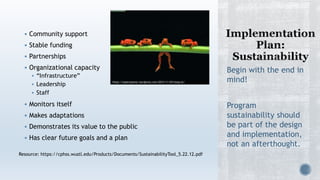
https://stpetripastor.wordpress.com/2012/11/29/hang-on/
 Meyer, Susan K. (2010). Community Practice in Occupational Therapy: A Guide to
Serving the Community. Boston, MA: Jones and Bartlett Publishers.
 Scaffa, Marjorie E, and Reitz, S. Maggie. (2014). Occupational Therapy in
Community-Based Practice Settings, 2nd Edition. Philadelphia, PA: F.A. Davis
Company.

Ot5101 005 week4

  • 1.
  • 2.
  • 3.
    Chapter 6  Identifyand discuss similarities and differences between intervention planning for individuals and the development of community-based programs.  Describe the best practices to use in the development of a mission statement.  Describe the characteristics of an effective team and the stages of team development.  Identify and discuss issues related to program sustainability
  • 4.
    Work on coursevocabulary in small groups Chapter 6 discussion Case: Fall Prevention SMART Goals Issue Impact Tree Activity: Vision, Mission, and Implementation Plan https://tjqmbb.org/index.php/program/
  • 5.
    Chapter 6  Advisoryboard  Board of directors  Direct costs  Goal  Grant  Indirect costs  Mission statement  Objective  Partnership  Sliding scale  SMART goals  Sustainability  Team  Vision statement
  • 7.
  • 8.
    Similarities  Conduct assessments Use clinical reasoning  Determine appropriate goals  Implement activities to reach the goals  Evaluate effectiveness Additional Considerations  Same skills applied in a community context  Systems approach rather than individual approach  Entrepreneurial skills  Leading teams  Recruiting participants  Establishing partnerships  Budgeting  Managing programs
  • 9.
    Preplanning (Exploration) Needs Assessment ProgramPlanning Program Implementation Program Evaluation Sustainability Plan Dissemination Plan (Scaffa & Reitz, 2014)
  • 10.
    Tai Chi  Movingfor Better Balance  https://www.youtube.com/watch?v= PIN1KPoiuac http://www.thegreatcourses.com/courses/mastering-tai-chi.html Fall Prevention videos  UMC Health System  https://www.youtube.com/watch?v=A7EcprAXtRE  Fall Prevention Song  https://www.youtube.com/watch?v=7ftrK-XM-88
  • 11.
    Vision Statement  HumanRights Campaign:  Equality for everyone (3)  Feeding America:  A hunger-free America (4 words)  Alzheimer’s Association:  A world without Alzheimer’s (4)  Oxfam:  A just world without poverty (5 words)  https://topnonprofits.com/examples/vision- statements/ Mission Statement 3M To solve unsolved problems innovatively Amnesty Inter- national Our mission is a world in which every person enjoys all the human rights enshrined in the Universal Declaration of Human Rights and other international human rights standards
  • 12.
    Groups read thisprogram summary and write a vision and mission statement that reflects the goals and purpose of the program Photo: https://thesuperiortherapy.com/how-does-balance-effect-my-si-joint/ Link: https://www.ncoa.org/resources/program-summary-a-matter-of-balance/
  • 13.
  • 14.
  • 15.
    Implications: -Reduce risk forinjuries - Develop community partnerships - Run exercises programs to improve balance Issue: Fall prevention program 2nd level Implications: Client education - Fall prevention education - OTR can assess and follow-up 2nd Level Implications: Advocacy - Raise awareness in community - Advocacy for support and funding 2nd level Implications: Exercise program -OTR to train staff and volunteers -OTR to assess occupational performance with COPM -Evidence based programs chosen
  • 16.
     Who willthe program serve?  How will participants be recruited and retained?  How will participants qualify?  How does a participant enter the program?  What is the frequency and duration of the program?  Where will it take place?  What supplies and equipment are needed?  Consider accessibility  What staffing and personnel are needed?  How will staff be monitored or assessed?
  • 17.
     Budgeting: Whatfunding amount is needed to sustain the program?  Donations  Sponsorships  Grants  Fees-for-services http://www.clipartpanda.com/categories/money-tree-wallpaper
  • 18.
    What skills doteam members need? What are the benefits of working in teams? Scaffa and Reitz, 2014, p. 89 https://www.cartoonstock.com/directory/t/team.asp Forming Storming Norming Performing
  • 19.
    “Partnerships should bethoughtfully developed and maintained, especially if a community is underserved. Once a partnership is developed, it needs to be maintained” (Scaffa and Reitz, 2014, p. 91).
  • 20.
    Board of Directors Group that guides the organization in its mission, finances, and programming.  Traditional officer roles  Work directly with executive director  Fiscally responsible for organization  Expert guidance  Monetary donations Advisory Board  Community members and program stakeholders who provide feedback to a program.  Experts  Quality assurance function  Infrequent meetings “In order to sustain programs and ensure they meet community needs, community members should be actively involved in the program” (Scaffa and Reitz, 2014, p. 91).
  • 21.
     Community support Stable funding  Partnerships  Organizational capacity  “Infrastructure”  Leadership  Staff  Monitors itself  Makes adaptations  Demonstrates its value to the public  Has clear future goals and a plan Begin with the end in mind! Program sustainability should be part of the design and implementation, not an afterthought. Resource: https://cphss.wustl.edu/Products/Documents/SustainabilityTool_5.22.12.pdf https://stpetripastor.wordpress.com/2012/11/29/hang-on/
  • 22.
     Meyer, SusanK. (2010). Community Practice in Occupational Therapy: A Guide to Serving the Community. Boston, MA: Jones and Bartlett Publishers.  Scaffa, Marjorie E, and Reitz, S. Maggie. (2014). Occupational Therapy in Community-Based Practice Settings, 2nd Edition. Philadelphia, PA: F.A. Davis Company.

Editor's Notes

  • #6 Groups of 3 students. Each group defines 2 terms on Shared Google Doc.
  • #7  3 minVideo: https://www.youtube.com/watch?v=sm-DhBtxy8U Dr. Fuzhong Li, Tai Chi
  • #10 Program planning and implementation are the topics of today
  • #11 A Matter of Balance – Case Study
  • #12 Vision statements are very concise and describe the ultimate goal for your program or organization Mission statements To be effective a mission statement needs to be: Understandable and Concise Stated in terms of output versus input or throughput Names your customer Names your primary product or service Be broad and continuing (What the program Does For Whom In what Context)
  • #13 Site: https://www.ncoa.org/resources/program-summary-a-matter-of-balance/ Photo: https://thesuperiortherapy.com/how-does-balance-effect-my-si-joint/
  • #14 Activities – How the goals and objectives will be met Desired outcomes – How you will know the goals and objectives were met Go back to the Matter of Balance program plan and identify goal, objective, activities, desired outcomes… Elements of the implementation plan
  • #15 Photo: http://www.jenningswire.com/business/create-smart-goals-score-big/ 7 minute SMART goal video: https://www.youtube.com/watch?v=d6o5PyJM3bY For A Matter of Balance Program – develop a SMART goal and 2-3 objectives that are also SMART and related to the goal
  • #16 Program planning and design should include SMART goals and Issue Impact Tree analysis
  • #17 Which of these are answered in the Matter of Balance program plan? How would you answer the rest?
  • #18 Using Matter of Balance case: What are the costs? How are they paid? Consider your LC/IF plan: What is needed? Where will you get it? Where will the money come from? Start-up? Ongoing? Don’t forget Indirect (or hidden) costs!
  • #19 Photo: https://www.cartoonstock.com/directory/t/team.asp Skills: make decisions, solve problems, develop a focus, maintain the focus, accomplish outcomes Benefits: provides different perspectives on program design and implementation, enhances program success and sustainability, expands expertise and resources Forming: Establish goals and tasks for team; members get to know each other Storming: Team members begin to voice opinions; Dysfunction can occur with arguments about goals or roles Norming: Agreement of the team expectations; Trust develops; Team roles become clearly understood Performing: Shared leadership among team members; Tasks are completed effectively and efficiently
  • #20 This is the rationale for assigning the whole class to 1 of 3 community based programs
  • #21 “In order to sustain programs and ensure they meet community needs, community members should be actively involved in the program” (S&R 2014, 91). Consider: How many? For what purpose? Matter of Balance Case Study: What kind of board would this program need? Who (professions and qualifications) would you want on this board, ideally? Look at the Boards of IF and LC – Make observations about what kind of board and qualifications of board members.
  • #22 Resource: https://cphss.wustl.edu/Products/Documents/SustainabilityTool_5.22.12.pdf Photo: https://stpetripastor.wordpress.com/2012/11/29/hang-on/