Wafa Al-Ahmed
Laboratory Leader
Bsc, PgD, MLS(ASCP)
Instagram: laboratoryteam
1
INTRODUCTION
 Safety
 Institutions policies “OSHA” (Occupational Safety & Health Administration)
 Commitment to risk reduction
 Responsibilities of safety officer
 Safety advisor
 Procedures documentation
 Coordinate with QA department
 Update policy changes
 Internal safety inspections
 Ensure proper equipment maintenance
 Documentation of hazards & safety problems
2
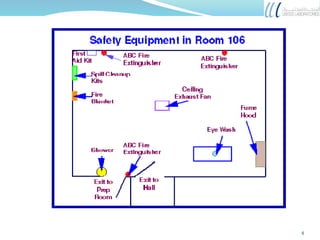
 Exits and corridors
 Ventilations
 Fire Extinguishers
 Eye Wash Stations
 Safety Shower
 Fire Blanket
 Hand-washing sink
 Master electricity shut off
 First-aid kit
 Bio-hazardous waste container
 Sharps containers
 Routine garbage containers
 Safety cabinets
 Fume hood
 Chemical disposal containers
 Spill kit
 MSDS File
Laboratory safety requirements
3
4
Personal safety practices
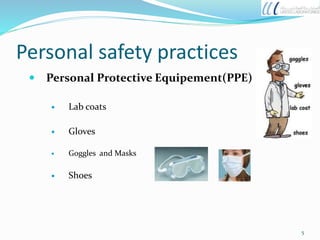
 Personal Protective Equipement(PPE)
 Lab coats
 Gloves
 Goggles and Masks
 Shoes
5
Personal safety practices
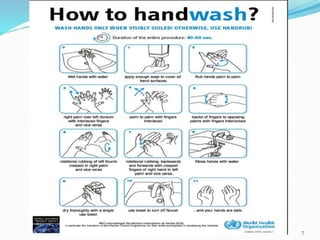
 Personal hygiene
 Hand washing is the most important method of
infection control and prevention available.
6
7
Personal safety practices
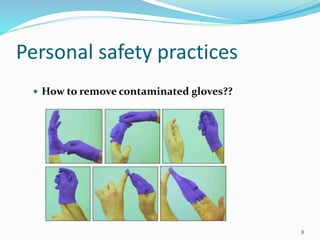
 How to remove contaminated gloves??
8
Personal safety practices
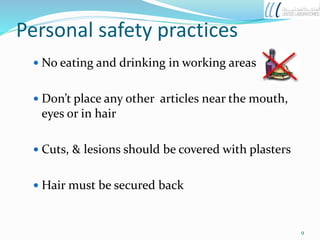
 No eating and drinking in working areas
 Don’t place any other articles near the mouth,
eyes or in hair
 Cuts, & lesions should be covered with plasters
 Hair must be secured back
9
Safety practices
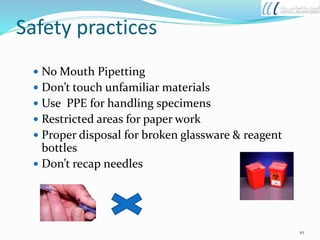
 No Mouth Pipetting
 Don’t touch unfamiliar materials
 Use PPE for handling specimens
 Restricted areas for paper work
 Proper disposal for broken glassware & reagent
bottles
 Don’t recap needles
10
Safety practices
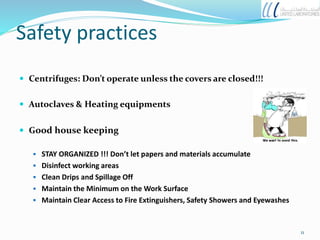
 Centrifuges: Don’t operate unless the covers are closed!!!
 Autoclaves & Heating equipments
 Good house keeping
 STAY ORGANIZED !!! Don’t let papers and materials accumulate
 Disinfect working areas
 Clean Drips and Spillage Off
 Maintain the Minimum on the Work Surface
 Maintain Clear Access to Fire Extinguishers, Safety Showers and Eyewashes
11
Classification of Hazards
1. Biological Hazards
2.Physical Hazards
 Fire & Autoclave
 Compressed Gas Cylinders
 Electrical
 Radiation
 Sharps
-Broken Glassware
-Razorblades & needles
3.Chemical Hazards
 Flammable Chemicals
 Reactive Chemicals
 Corrosive Chemicals
 Toxic Chemicals
12
BIOHAZARDS
13
Definition
Biohazards are infectious agents or hazardous
biological materials that present a potential risk to
the health of humans, animals or the environment.
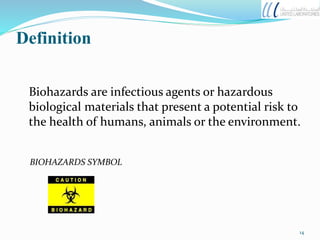
BIOHAZARDS SYMBOL
14
Biohazard Materials
 Infectious Organisms
(e.g. parasites, viruses, bacteria and fungi)
 Biologically active agents
(i.e. toxins, allergens, venoms)
 Certain types of recombinant DNA
(e.g. all human blood, blood products, body
fluids/tissue, cell lines and tissue cultures).
15
Infectious Organisms
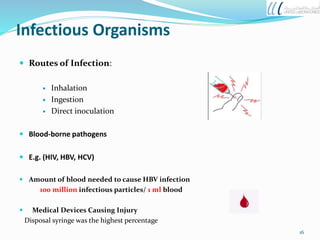
 Routes of Infection:
 Inhalation
 Ingestion
 Direct inoculation
 Blood-borne pathogens
 E.g. (HIV, HBV, HCV)
 Amount of blood needed to cause HBV infection
100 million infectious particles/ 1 ml blood
 Medical Devices Causing Injury
Disposal syringe was the highest percentage
16
Needle stick Safety protocol
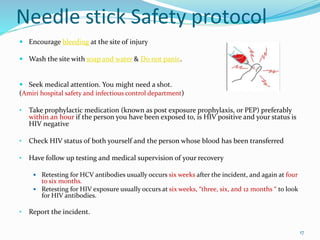
 Encourage bleeding at the site of injury
 Wash the site with soap and water & Do not panic.
 Seek medical attention. You might need a shot.
(Amiri hospital safety and infectious control department)
• Take prophylactic medication (known as post exposure prophylaxis, or PEP) preferably
within an hour if the person you have been exposed to, is HIV positive and your status is
HIV negative
• Check HIV status of both yourself and the person whose blood has been transferred
• Have follow up testing and medical supervision of your recovery
 Retesting for HCV antibodies usually occurs six weeks after the incident, and again at four
to six months.
 Retesting for HIV exposure usually occurs at six weeks, “three, six, and 12 months “ to look
for HIV antibodies.
• Report the incident.
17
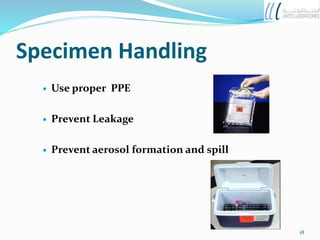
Specimen Handling
 Use proper PPE
 Prevent Leakage
 Prevent aerosol formation and spill
18
BIOHAZARDS LEVEL:
 Biohazard Level 1:
 Bacteria and viruses including Bacillus subtilis, canine hepatitis, Escherichia coli,
varicella (chicken pox), as well as some cell cultures and non-infectious bacteria.
 Biohazard Level 2:
 Bacteria and viruses that cause mild disease
 Or difficult to contact via aerosol in a lab setting
 E.g. HAV, HBV, HCV, influenza A, salmonella, mumps, measles, scrapie, dengue fever,
and HIV.
 Biohazard Level 3:
 Organisms that cause severe to fatal disease
 Vaccines & treatments exist
 E.g. Anthrax, West Nile virus, SARS virus, tuberculosis, typhus, yellow fever, and
malaria.
 Biohazard Level 4:
 Organisms that cause severe to fatal disease
 Vaccines & treatments not available
 Dengue hemorrhagic fever, Marburg virus, Ebola virus, hantaviruses, Lassa fever
virus, and other hemorrhagic diseases.
19
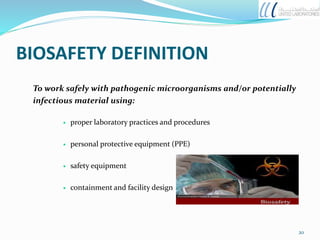
BIOSAFETY DEFINITION
To work safely with pathogenic microorganisms and/or potentially
infectious material using:
 proper laboratory practices and procedures
 personal protective equipment (PPE)
 safety equipment
 containment and facility design
20
SAFETY EQUIPMENT
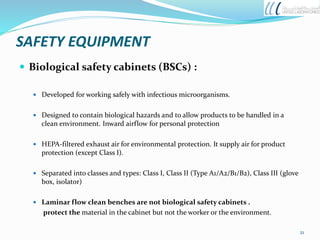
 Biological safety cabinets (BSCs) :
 Developed for working safely with infectious microorganisms.
 Designed to contain biological hazards and to allow products to be handled in a
clean environment. Inward airflow for personal protection
 HEPA-filtered exhaust air for environmental protection. It supply air for product
protection (except Class I).
 Separated into classes and types: Class I, Class II (Type A1/A2/B1/B2), Class III (glove
box, isolator)
 Laminar flow clean benches are not biological safety cabinets .
protect the material in the cabinet but not the worker or the environment.
21
Proper Use of BSC
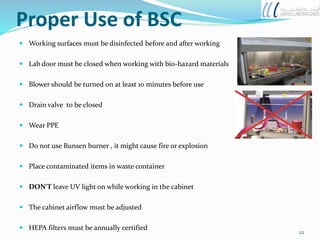
 Working surfaces must be disinfected before and after working
 Lab door must be closed when working with bio-hazard materials
 Blower should be turned on at least 10 minutes before use
 Drain valve to be closed
 Wear PPE
 Do not use Bunsen burner , it might cause fire or explosion
 Place contaminated items in waste container
 DON'T leave UV light on while working in the cabinet
 The cabinet airflow must be adjusted
 HEPA filters must be annually certified
22
Spill Kit
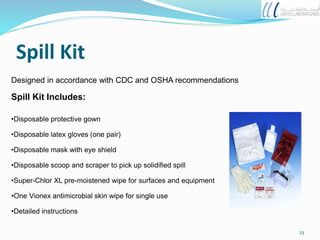
Designed in accordance with CDC and OSHA recommendations
Spill Kit Includes:
•Disposable protective gown
•Disposable latex gloves (one pair)
•Disposable mask with eye shield
•Disposable scoop and scraper to pick up solidified spill
•Super-Chlor XL pre-moistened wipe for surfaces and equipment
•One Vionex antimicrobial skin wipe for single use
•Detailed instructions
23
Spills…
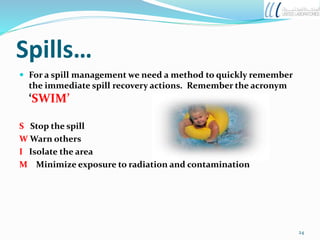
 For a spill management we need a method to quickly remember
the immediate spill recovery actions. Remember the acronym
‘SWIM’
S Stop the spill
W Warn others
I Isolate the area
M Minimize exposure to radiation and contamination
24
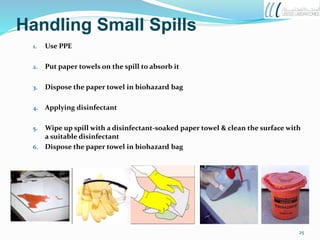
Handling Small Spills
1. Use PPE
2. Put paper towels on the spill to absorb it
3. Dispose the paper towel in biohazard bag
4. Applying disinfectant
5. Wipe up spill with a disinfectant-soaked paper towel & clean the surface with
a suitable disinfectant
6. Dispose the paper towel in biohazard bag
25
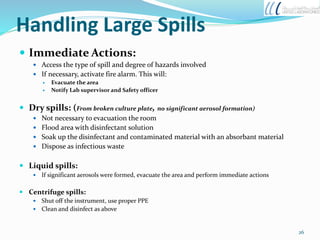
Handling Large Spills
 Immediate Actions:
 Access the type of spill and degree of hazards involved
 If necessary, activate fire alarm. This will:
 Evacuate the area
 Notify Lab supervisor and Safety officer
 Dry spills: (From broken culture plate, no significant aerosol formation)
 Not necessary to evacuation the room
 Flood area with disinfectant solution
 Soak up the disinfectant and contaminated material with an absorbant material
 Dispose as infectious waste
 Liquid spills:
 If significant aerosols were formed, evacuate the area and perform immediate actions
 Centrifuge spills:
 Shut off the instrument, use proper PPE
 Clean and disinfect as above
26
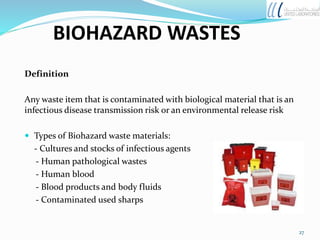
BIOHAZARD WASTES
Definition
Any waste item that is contaminated with biological material that is an
infectious disease transmission risk or an environmental release risk
 Types of Biohazard waste materials:
- Cultures and stocks of infectious agents
- Human pathological wastes
- Human blood
- Blood products and body fluids
- Contaminated used sharps
27
BIOHAZARDOUS WASTES: GUIDELINES
 Managing laboratory wastes as biohazards (knowing how to handle the
waste item)
 Transporting biohazardous wastes (ability to use extra containers if
required)
 Biohazardous waste treatment (inactivate biological material to reduce
hazards)
 Autoclave validation and biohazardous waste procedures (daily and
weekly validation tests)
28
BIOHAZARDOUS WASTES
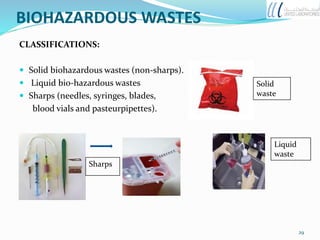
CLASSIFICATIONS:
 Solid biohazardous wastes (non-sharps).
 Liquid bio-hazardous wastes
 Sharps (needles, syringes, blades,
blood vials and pasteurpipettes).
Solid
waste
Liquid
waste
Sharps
29
Policy of infectious waste management - ULC
 The waste is segregated at point of origin:
(Blood, serum, urine, swabs collected in Yellow bags with biohazard
symbol)
 Infectious waste (culture plates/ tubes) are autoclaved
 Waste from toilets areas collected in Red bags
 Sharps: Puncture proof Yellow plastic containers with biohazard symbol
 All these wastes taken in covered vehicles to Minna Abdullah (Shoab) for
final disposal( incineration)
 Waste management workers of TANZIFCO are instructed and supervised
regularly with respect to safety and transportation of infectious waste.
30
BIOHAZARDOUS WASTES
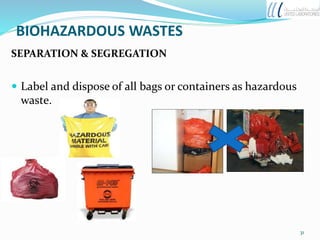
SEPARATION & SEGREGATION
 Label and dispose of all bags or containers as hazardous
waste.
31
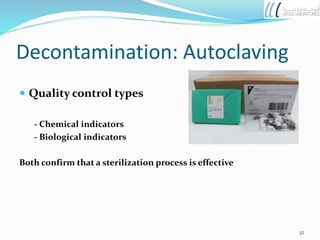
Decontamination: Autoclaving
 Quality control types
- Chemical indicators
- Biological indicators
Both confirm that a sterilization process is effective
32
Biological Indicator
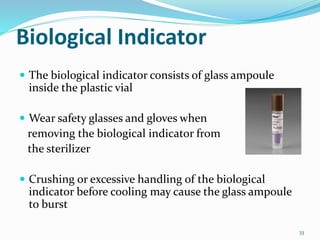
 The biological indicator consists of glass ampoule
inside the plastic vial
 Wear safety glasses and gloves when
removing the biological indicator from
the sterilizer
 Crushing or excessive handling of the biological
indicator before cooling may cause the glass ampoule
to burst
33
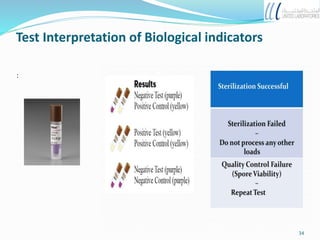
Test Interpretation of Biological indicators
:
34
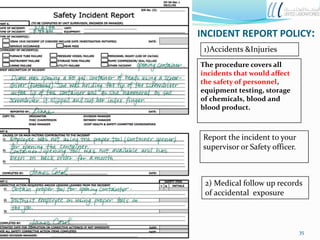
INCIDENT REPORT POLICY:
The procedure covers all
incidents that would affect
the safety of personnel,
equipment testing, storage
of chemicals, blood and
blood product.
Report the incident to your
supervisor or Safety officer.
1)Accidents &Injuries
2) Medical follow up records
of accidental exposure
35
First- Aid Policies
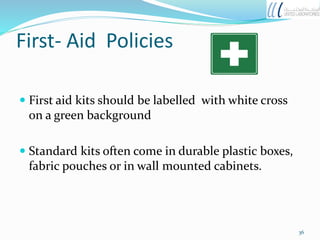
 First aid kits should be labelled with white cross
on a green background
 Standard kits often come in durable plastic boxes,
fabric pouches or in wall mounted cabinets.
36
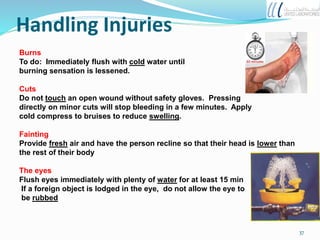
Handling Injuries
Burns
To do: Immediately flush with cold water until
burning sensation is lessened.
Cuts
Do not touch an open wound without safety gloves. Pressing
directly on minor cuts will stop bleeding in a few minutes. Apply
cold compress to bruises to reduce swelling.
Fainting
Provide fresh air and have the person recline so that their head is lower than
the rest of their body
The eyes
Flush eyes immediately with plenty of water for at least 15 min
If a foreign object is lodged in the eye, do not allow the eye to
be rubbed
37
Handling Injuries
Poisoning
Find out what substance was responsible for the poisoning
and report immediately to supervisor /safety officer
Spills on the skin
Flush with large quantities of water. For acid spills apply
baking soda solution. For base spills apply vinegar or boric
acid.
Electrical shock
Shut off the current at the source. Remove wire with rubber
gloves. Alert immediately.
38
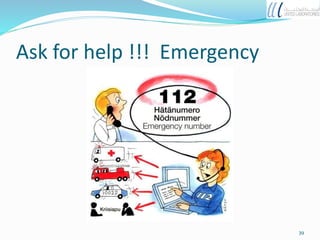
Ask for help !!! Emergency
39
Immunization
 Laboratory staffs should be immunized against
Hepatitis B
 Anti HBs titer should be checked every 5 years.
 Evidences of immunization should be recorded in the
laboratory.
40
References
 Laboratory biosafety manual WHO
 www.osha.gov (Occupational Safety and Health
Administration) Laboratory safety guidance
 ULC Biosafety manual
41
Thank you……
42

biosafety presentation

  • 1.
    Wafa Al-Ahmed Laboratory Leader Bsc,PgD, MLS(ASCP) Instagram: laboratoryteam 1
  • 2.
    INTRODUCTION  Safety  Institutionspolicies “OSHA” (Occupational Safety & Health Administration)  Commitment to risk reduction  Responsibilities of safety officer  Safety advisor  Procedures documentation  Coordinate with QA department  Update policy changes  Internal safety inspections  Ensure proper equipment maintenance  Documentation of hazards & safety problems 2
  • 3.
     Exits andcorridors  Ventilations  Fire Extinguishers  Eye Wash Stations  Safety Shower  Fire Blanket  Hand-washing sink  Master electricity shut off  First-aid kit  Bio-hazardous waste container  Sharps containers  Routine garbage containers  Safety cabinets  Fume hood  Chemical disposal containers  Spill kit  MSDS File Laboratory safety requirements 3
  • 4.
  • 5.
    Personal safety practices Personal Protective Equipement(PPE)  Lab coats  Gloves  Goggles and Masks  Shoes 5
  • 6.
    Personal safety practices Personal hygiene  Hand washing is the most important method of infection control and prevention available. 6
  • 7.
  • 8.
    Personal safety practices How to remove contaminated gloves?? 8
  • 9.
    Personal safety practices No eating and drinking in working areas  Don’t place any other articles near the mouth, eyes or in hair  Cuts, & lesions should be covered with plasters  Hair must be secured back 9
  • 10.
    Safety practices  NoMouth Pipetting  Don’t touch unfamiliar materials  Use PPE for handling specimens  Restricted areas for paper work  Proper disposal for broken glassware & reagent bottles  Don’t recap needles 10
  • 11.
    Safety practices  Centrifuges:Don’t operate unless the covers are closed!!!  Autoclaves & Heating equipments  Good house keeping  STAY ORGANIZED !!! Don’t let papers and materials accumulate  Disinfect working areas  Clean Drips and Spillage Off  Maintain the Minimum on the Work Surface  Maintain Clear Access to Fire Extinguishers, Safety Showers and Eyewashes 11
  • 12.
    Classification of Hazards 1.Biological Hazards 2.Physical Hazards  Fire & Autoclave  Compressed Gas Cylinders  Electrical  Radiation  Sharps -Broken Glassware -Razorblades & needles 3.Chemical Hazards  Flammable Chemicals  Reactive Chemicals  Corrosive Chemicals  Toxic Chemicals 12
  • 13.
  • 14.
    Definition Biohazards are infectiousagents or hazardous biological materials that present a potential risk to the health of humans, animals or the environment. BIOHAZARDS SYMBOL 14
  • 15.
    Biohazard Materials  InfectiousOrganisms (e.g. parasites, viruses, bacteria and fungi)  Biologically active agents (i.e. toxins, allergens, venoms)  Certain types of recombinant DNA (e.g. all human blood, blood products, body fluids/tissue, cell lines and tissue cultures). 15
  • 16.
    Infectious Organisms  Routesof Infection:  Inhalation  Ingestion  Direct inoculation  Blood-borne pathogens  E.g. (HIV, HBV, HCV)  Amount of blood needed to cause HBV infection 100 million infectious particles/ 1 ml blood  Medical Devices Causing Injury Disposal syringe was the highest percentage 16
  • 17.
    Needle stick Safetyprotocol  Encourage bleeding at the site of injury  Wash the site with soap and water & Do not panic.  Seek medical attention. You might need a shot. (Amiri hospital safety and infectious control department) • Take prophylactic medication (known as post exposure prophylaxis, or PEP) preferably within an hour if the person you have been exposed to, is HIV positive and your status is HIV negative • Check HIV status of both yourself and the person whose blood has been transferred • Have follow up testing and medical supervision of your recovery  Retesting for HCV antibodies usually occurs six weeks after the incident, and again at four to six months.  Retesting for HIV exposure usually occurs at six weeks, “three, six, and 12 months “ to look for HIV antibodies. • Report the incident. 17
  • 18.
    Specimen Handling  Useproper PPE  Prevent Leakage  Prevent aerosol formation and spill 18
  • 19.
    BIOHAZARDS LEVEL:  BiohazardLevel 1:  Bacteria and viruses including Bacillus subtilis, canine hepatitis, Escherichia coli, varicella (chicken pox), as well as some cell cultures and non-infectious bacteria.  Biohazard Level 2:  Bacteria and viruses that cause mild disease  Or difficult to contact via aerosol in a lab setting  E.g. HAV, HBV, HCV, influenza A, salmonella, mumps, measles, scrapie, dengue fever, and HIV.  Biohazard Level 3:  Organisms that cause severe to fatal disease  Vaccines & treatments exist  E.g. Anthrax, West Nile virus, SARS virus, tuberculosis, typhus, yellow fever, and malaria.  Biohazard Level 4:  Organisms that cause severe to fatal disease  Vaccines & treatments not available  Dengue hemorrhagic fever, Marburg virus, Ebola virus, hantaviruses, Lassa fever virus, and other hemorrhagic diseases. 19
  • 20.
    BIOSAFETY DEFINITION To worksafely with pathogenic microorganisms and/or potentially infectious material using:  proper laboratory practices and procedures  personal protective equipment (PPE)  safety equipment  containment and facility design 20
  • 21.
    SAFETY EQUIPMENT  Biologicalsafety cabinets (BSCs) :  Developed for working safely with infectious microorganisms.  Designed to contain biological hazards and to allow products to be handled in a clean environment. Inward airflow for personal protection  HEPA-filtered exhaust air for environmental protection. It supply air for product protection (except Class I).  Separated into classes and types: Class I, Class II (Type A1/A2/B1/B2), Class III (glove box, isolator)  Laminar flow clean benches are not biological safety cabinets . protect the material in the cabinet but not the worker or the environment. 21
  • 22.
    Proper Use ofBSC  Working surfaces must be disinfected before and after working  Lab door must be closed when working with bio-hazard materials  Blower should be turned on at least 10 minutes before use  Drain valve to be closed  Wear PPE  Do not use Bunsen burner , it might cause fire or explosion  Place contaminated items in waste container  DON'T leave UV light on while working in the cabinet  The cabinet airflow must be adjusted  HEPA filters must be annually certified 22
  • 23.
    Spill Kit Designed inaccordance with CDC and OSHA recommendations Spill Kit Includes: •Disposable protective gown •Disposable latex gloves (one pair) •Disposable mask with eye shield •Disposable scoop and scraper to pick up solidified spill •Super-Chlor XL pre-moistened wipe for surfaces and equipment •One Vionex antimicrobial skin wipe for single use •Detailed instructions 23
  • 24.
    Spills…  For aspill management we need a method to quickly remember the immediate spill recovery actions. Remember the acronym ‘SWIM’ S Stop the spill W Warn others I Isolate the area M Minimize exposure to radiation and contamination 24
  • 25.
    Handling Small Spills 1.Use PPE 2. Put paper towels on the spill to absorb it 3. Dispose the paper towel in biohazard bag 4. Applying disinfectant 5. Wipe up spill with a disinfectant-soaked paper towel & clean the surface with a suitable disinfectant 6. Dispose the paper towel in biohazard bag 25
  • 26.
    Handling Large Spills Immediate Actions:  Access the type of spill and degree of hazards involved  If necessary, activate fire alarm. This will:  Evacuate the area  Notify Lab supervisor and Safety officer  Dry spills: (From broken culture plate, no significant aerosol formation)  Not necessary to evacuation the room  Flood area with disinfectant solution  Soak up the disinfectant and contaminated material with an absorbant material  Dispose as infectious waste  Liquid spills:  If significant aerosols were formed, evacuate the area and perform immediate actions  Centrifuge spills:  Shut off the instrument, use proper PPE  Clean and disinfect as above 26
  • 27.
    BIOHAZARD WASTES Definition Any wasteitem that is contaminated with biological material that is an infectious disease transmission risk or an environmental release risk  Types of Biohazard waste materials: - Cultures and stocks of infectious agents - Human pathological wastes - Human blood - Blood products and body fluids - Contaminated used sharps 27
  • 28.
    BIOHAZARDOUS WASTES: GUIDELINES Managing laboratory wastes as biohazards (knowing how to handle the waste item)  Transporting biohazardous wastes (ability to use extra containers if required)  Biohazardous waste treatment (inactivate biological material to reduce hazards)  Autoclave validation and biohazardous waste procedures (daily and weekly validation tests) 28
  • 29.
    BIOHAZARDOUS WASTES CLASSIFICATIONS:  Solidbiohazardous wastes (non-sharps).  Liquid bio-hazardous wastes  Sharps (needles, syringes, blades, blood vials and pasteurpipettes). Solid waste Liquid waste Sharps 29
  • 30.
    Policy of infectiouswaste management - ULC  The waste is segregated at point of origin: (Blood, serum, urine, swabs collected in Yellow bags with biohazard symbol)  Infectious waste (culture plates/ tubes) are autoclaved  Waste from toilets areas collected in Red bags  Sharps: Puncture proof Yellow plastic containers with biohazard symbol  All these wastes taken in covered vehicles to Minna Abdullah (Shoab) for final disposal( incineration)  Waste management workers of TANZIFCO are instructed and supervised regularly with respect to safety and transportation of infectious waste. 30
  • 31.
    BIOHAZARDOUS WASTES SEPARATION &SEGREGATION  Label and dispose of all bags or containers as hazardous waste. 31
  • 32.
    Decontamination: Autoclaving  Qualitycontrol types - Chemical indicators - Biological indicators Both confirm that a sterilization process is effective 32
  • 33.
    Biological Indicator  Thebiological indicator consists of glass ampoule inside the plastic vial  Wear safety glasses and gloves when removing the biological indicator from the sterilizer  Crushing or excessive handling of the biological indicator before cooling may cause the glass ampoule to burst 33
  • 34.
    Test Interpretation ofBiological indicators : 34
  • 35.
    INCIDENT REPORT POLICY: Theprocedure covers all incidents that would affect the safety of personnel, equipment testing, storage of chemicals, blood and blood product. Report the incident to your supervisor or Safety officer. 1)Accidents &Injuries 2) Medical follow up records of accidental exposure 35
  • 36.
    First- Aid Policies First aid kits should be labelled with white cross on a green background  Standard kits often come in durable plastic boxes, fabric pouches or in wall mounted cabinets. 36
  • 37.
    Handling Injuries Burns To do:Immediately flush with cold water until burning sensation is lessened. Cuts Do not touch an open wound without safety gloves. Pressing directly on minor cuts will stop bleeding in a few minutes. Apply cold compress to bruises to reduce swelling. Fainting Provide fresh air and have the person recline so that their head is lower than the rest of their body The eyes Flush eyes immediately with plenty of water for at least 15 min If a foreign object is lodged in the eye, do not allow the eye to be rubbed 37
  • 38.
    Handling Injuries Poisoning Find outwhat substance was responsible for the poisoning and report immediately to supervisor /safety officer Spills on the skin Flush with large quantities of water. For acid spills apply baking soda solution. For base spills apply vinegar or boric acid. Electrical shock Shut off the current at the source. Remove wire with rubber gloves. Alert immediately. 38
  • 39.
    Ask for help!!! Emergency 39
  • 40.
    Immunization  Laboratory staffsshould be immunized against Hepatitis B  Anti HBs titer should be checked every 5 years.  Evidences of immunization should be recorded in the laboratory. 40
  • 41.
    References  Laboratory biosafetymanual WHO  www.osha.gov (Occupational Safety and Health Administration) Laboratory safety guidance  ULC Biosafety manual 41
  • 42.