Sheryl Ryan, PhD, OTR/L
Week 3
Chapter 5
 Describe the processes of environmental
scanning and trend analysis
 Define the key steps in community
health/health promotion program
development
 Describe three sources of data for needs
assessments
 Identify four factors that impact the
selection of needs assessment strategies
 Demonstrate understanding of the role of
theories in health promotion program
planning
 Define goal and objective
 Develop program objectives
 Describe the five levels of the ecological
approach to health promotion program
planning
 Develop implementation strategies at the
different levels of intervention
 Identify the purposes for each of the three
levels of program evaluation
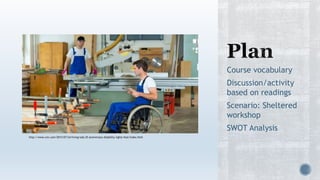
Course vocabulary
Discussion/activity
based on readings
Scenario: Sheltered
workshop
SWOT Analysis
http://www.cnn.com/2015/07/24/living/ada-25-anniversary-disability-rights-feat/index.html
Chapter 5
 Capacity assessment
 Ecological perspective
 Environmental scanning
 Evidence
 Evidence-based planning for health
 Formative evaluation
 Goal
 Group processes
 Impact
 Trend
 Systematic reviews
 Interventions
 Key informant
 Needs assessment
 Objectives
 Outcome
 Preplanning
 Process evaluation
 Program development
 Program planning
 Secondary data
 Societal levels
 Stakeholders
 Summative evaluation
Elwyn Sheltered Workshops
https://www.elwyn.org/services/adults-21/work-centers/
https://www.ssa.gov/work/
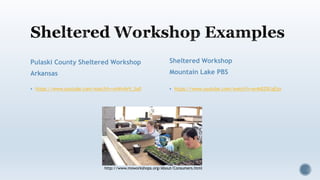
Pulaski County Sheltered Workshop
Arkansas
 https://www.youtube.com/watch?v=xsWvNvV_So0
Sheltered Workshop
Mountain Lake PBS
 https://www.youtube.com/watch?v=amkB2DCqEzo
http://www.moworkshops.org/About/Consumers.html
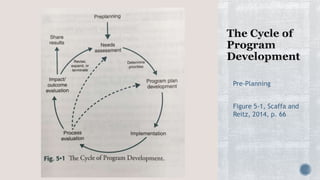
Pre-Planning
Figure 5-1, Scaffa and
Reitz, 2014, p. 66
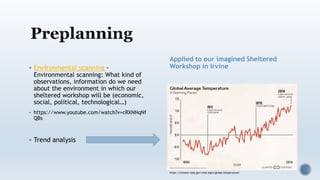
 Environmental scanning -
Environmental scanning: What kind of
observations, information do we need
about the environment in which our
sheltered workshop will be (economic,
social, political, technological…)
 https://www.youtube.com/watch?v=cRXNNqNf
QBs
 Trend analysis
Applied to our imagined Sheltered
Workshop in Irvine
https://climate.nasa.gov/vital-signs/global-temperature/
Key Questions
 Who are the key players?
• Service receivers
• Service providers
• Experts in the field
• Policy makers
• Agency representatives
 What do they hope will come from the
needs assessment?
 Why – What prompted their concern?
How important is it?
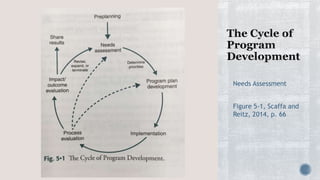
Needs Assessment
Figure 5-1, Scaffa and
Reitz, 2014, p. 66
Parts of a needs assessment
 Profiling the Population and
Community
 Identify service needs of population
 Data Collection
 Survey methods
 Secondary data
 Group processes
 Data Analysis and Interpretation
 Identification of need, risk, access to
services
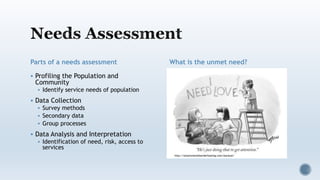
What is the unmet need?
http://attachmentdisorderhealing.com/stardust/
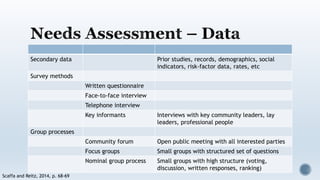
Secondary data Prior studies, records, demographics, social
indicators, risk-factor data, rates, etc
Survey methods
Written questionnaire
Face-to-face interview
Telephone interview
Key informants Interviews with key community leaders, lay
leaders, professional people
Group processes
Community forum Open public meeting with all interested parties
Focus groups Small groups with structured set of questions
Nominal group process Small groups with high structure (voting,
discussion, written responses, ranking)
Scaffa and Reitz, 2014, p. 68-69
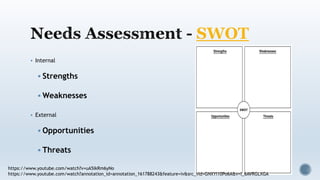
SWOT
 Internal
 Strengths
 Weaknesses
 External
 Opportunities
 Threats
https://www.youtube.com/watch?v=uA5ikRm6yNo
https://www.youtube.com/watch?annotation_id=annotation_161788243&feature=iv&src_vid=GNXYI10Po6A&v=I_6AVRGLXGA
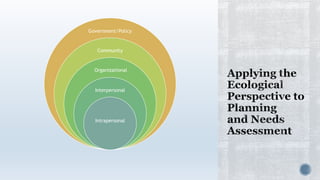
Government/Policy
Community
Organizational
Interpersonal
Intrapersonal
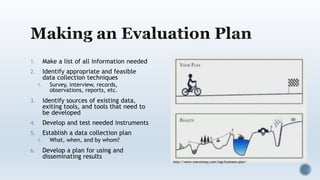
1. Make a list of all information needed
2. Identify appropriate and feasible
data collection techniques
1. Survey, interview, records,
observations, reports, etc.
3. Identify sources of existing data,
exiting tools, and tools that need to
be developed
4. Develop and test needed instruments
5. Establish a data collection plan
1. What, when, and by whom?
6. Develop a plan for using and
disseminating results
http://www.marcelway.com/tag/business-plan/
 Meyer, Susan K. (2010). Community Practice in Occupational Therapy: A Guide to
Serving the Community. Boston, MA: Jones and Bartlett Publishers.
 Scaffa, Marjorie E, and Reitz, S. Maggie. (2014). Occupational Therapy in
Community-Based Practice Settings, 2nd Edition. Philadelphia, PA: F.A. Davis
Company.

OT 5101 week3 planning needs assessment

  • 1.
  • 2.
  • 3.
    Chapter 5  Describethe processes of environmental scanning and trend analysis  Define the key steps in community health/health promotion program development  Describe three sources of data for needs assessments  Identify four factors that impact the selection of needs assessment strategies  Demonstrate understanding of the role of theories in health promotion program planning  Define goal and objective  Develop program objectives  Describe the five levels of the ecological approach to health promotion program planning  Develop implementation strategies at the different levels of intervention  Identify the purposes for each of the three levels of program evaluation
  • 4.
    Course vocabulary Discussion/activity based onreadings Scenario: Sheltered workshop SWOT Analysis http://www.cnn.com/2015/07/24/living/ada-25-anniversary-disability-rights-feat/index.html
  • 5.
    Chapter 5  Capacityassessment  Ecological perspective  Environmental scanning  Evidence  Evidence-based planning for health  Formative evaluation  Goal  Group processes  Impact  Trend  Systematic reviews  Interventions  Key informant  Needs assessment  Objectives  Outcome  Preplanning  Process evaluation  Program development  Program planning  Secondary data  Societal levels  Stakeholders  Summative evaluation
  • 6.
  • 7.
    Pulaski County ShelteredWorkshop Arkansas  https://www.youtube.com/watch?v=xsWvNvV_So0 Sheltered Workshop Mountain Lake PBS  https://www.youtube.com/watch?v=amkB2DCqEzo http://www.moworkshops.org/About/Consumers.html
  • 8.
    Pre-Planning Figure 5-1, Scaffaand Reitz, 2014, p. 66
  • 9.
     Environmental scanning- Environmental scanning: What kind of observations, information do we need about the environment in which our sheltered workshop will be (economic, social, political, technological…)  https://www.youtube.com/watch?v=cRXNNqNf QBs  Trend analysis Applied to our imagined Sheltered Workshop in Irvine https://climate.nasa.gov/vital-signs/global-temperature/
  • 10.
    Key Questions  Whoare the key players? • Service receivers • Service providers • Experts in the field • Policy makers • Agency representatives  What do they hope will come from the needs assessment?  Why – What prompted their concern? How important is it?
  • 11.
    Needs Assessment Figure 5-1,Scaffa and Reitz, 2014, p. 66
  • 12.
    Parts of aneeds assessment  Profiling the Population and Community  Identify service needs of population  Data Collection  Survey methods  Secondary data  Group processes  Data Analysis and Interpretation  Identification of need, risk, access to services What is the unmet need? http://attachmentdisorderhealing.com/stardust/
  • 13.
    Secondary data Priorstudies, records, demographics, social indicators, risk-factor data, rates, etc Survey methods Written questionnaire Face-to-face interview Telephone interview Key informants Interviews with key community leaders, lay leaders, professional people Group processes Community forum Open public meeting with all interested parties Focus groups Small groups with structured set of questions Nominal group process Small groups with high structure (voting, discussion, written responses, ranking) Scaffa and Reitz, 2014, p. 68-69
  • 14.
    SWOT  Internal  Strengths Weaknesses  External  Opportunities  Threats https://www.youtube.com/watch?v=uA5ikRm6yNo https://www.youtube.com/watch?annotation_id=annotation_161788243&feature=iv&src_vid=GNXYI10Po6A&v=I_6AVRGLXGA
  • 15.
  • 16.
    1. Make alist of all information needed 2. Identify appropriate and feasible data collection techniques 1. Survey, interview, records, observations, reports, etc. 3. Identify sources of existing data, exiting tools, and tools that need to be developed 4. Develop and test needed instruments 5. Establish a data collection plan 1. What, when, and by whom? 6. Develop a plan for using and disseminating results http://www.marcelway.com/tag/business-plan/
  • 17.
     Meyer, SusanK. (2010). Community Practice in Occupational Therapy: A Guide to Serving the Community. Boston, MA: Jones and Bartlett Publishers.  Scaffa, Marjorie E, and Reitz, S. Maggie. (2014). Occupational Therapy in Community-Based Practice Settings, 2nd Edition. Philadelphia, PA: F.A. Davis Company.

Editor's Notes

  • #5 Photo: http://www.cnn.com/2015/07/24/living/ada-25-anniversary-disability-rights-feat/index.html
  • #6 Groups of 3 students. Each group defines about 2 terms on Shared Google Doc.
  • #7 Ticket to Work Program: https://www.ssa.gov/work/ Explore: Home Services Elwyn Office Locations California Locations Manufacturing & Outsourcing Solutions Work Centers
  • #9 Starts with pre-planning and needs assessment
  • #10 Photo: https://climate.nasa.gov/vital-signs/global-temperature/ Environmental scanning: What kind of observations, information do we need about the environment in which our sheltered workshop will be (economic, social, political, technological…) Choose Irvine Trend analysis: What trends do we need to know about? (disability rates, work rates of disabled workers, employers of disabled workers, evidence-base for sheltered workshop interventions) Use newspapers, internet, magazines, databases, etc. Categorize information gathered and sort into positive/negative impact on our sheltered workshop idea.
  • #11 Plan with people, with data, for performance over time, for priorities (whose?), for evaluation, for measurable outcomes
  • #12 Starts with pre-planning and needs assessment
  • #13 Photo: http://attachmentdisorderhealing.com/stardust/ Class to Google about adults with disabilities in Irvine: Population/Community Profile: demographics such as age, race, ethnicity, education, religion, income, social and health problems (housing, employment, crime, health info). Include assessment of the capacity of the community to support a program. Data Collection, Analysis, Interpretation – Chart on next slide
  • #14 Discuss advantages and disadvantages of each kind Group processes can involve small or large groups of stakeholders on all sides of the issue/concern Group to choose methods for needs assessment for sheltered workshop in Irvine – and explain why/importance
  • #15 3 minute video - https://www.youtube.com/watch?v=uA5ikRm6yNo 7 minute video -https://www.youtube.com/watch?annotation_id=annotation_161788243&feature=iv&src_vid=GNXYI10Po6A&v=I_6AVRGLXGA
  • #16 Sheltered Workshop in Irvine – SWOT should address all levels Class discusses specific methods for each level pertaining to case Intrapersonal – (individual) educating, training, counseling: lecture, discussion, audiovisual materials, peer group discussions, simulation and games, skill development, mass media Interpersonal – (small group) educating, training, facilitating: enhancing/developing social ties, natural helpers Organizational – consulting, networking, training, advocating: organizational development Community – marketing, organizing, developing, advocating: media advocacy, community coalitions, community organization, community empowerment Government/Policy – advocacy, lobbying, political action; policy development/advocacy Class discuss Structured Workshop case: Possible planning/evaluation activities for each of the levels Possible interventions at each of the five levels