SUBMITTED BY
SUBMITTED BY
Statistical modeling in pharmaceutical
research and development
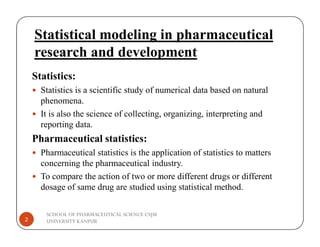
Statistics:
 Statistics is a scientific study of numerical data based on natural
phenomena.
 It is also the science of collecting, organizing, interpreting and
reporting data.
SCHOOL OF PHARMACEUTICAL SCIENCE CSJM
UNIVERSITY KANPUR
2
reporting data.
Pharmaceutical statistics:
 Pharmaceutical statistics is the application of statistics to matters
concerning the pharmaceutical industry.
 To compare the action of two or more different drugs or different
dosage of same drug are studied using statistical method.
Statistical modeling:
 The new major challenge that the pharmaceutical industry is
facing in the discovery and development of the new drugs is to
reduce costs and time needed from discovery to market, while at
the same time raising standards of quality.
 If the pharmaceutical industry cannot find a solution to reduce
both the costs and time, then its whole business model will be
expose to danger or risk.
SCHOOL OF PHARMACEUTICAL SCIENCE CSJM
UNIVERSITY KANPUR
3
expose to danger or risk.
 The development of the models in the pharmaceutical industry
certainly one of the significant proposed to face the challenges of
cost, speed and quality.
 The perspective to develop new technologies give rise to hope of
establishment new model in the pharmaceutical industries
significant to overcome the challenges of cost, speed as well as
quality .
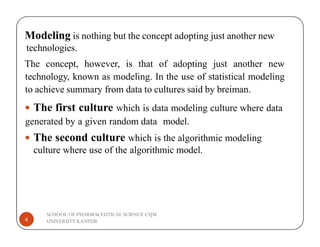
Modeling is nothing but the concept adopting just another new
technologies.
The concept, however, is that of adopting just another new
technology, known as modeling. In the use of statistical modeling
to achieve summary from data to cultures said by breiman.
 The first culture which is data modeling culture where data
generated by a given random data model.
SCHOOL OF PHARMACEUTICAL SCIENCE CSJM
UNIVERSITY KANPUR
4
generated by a given random data model.
 The second culture which is the algorithmic modeling
culture where use of the algorithmic model.
Objectives of statistical modeling:
 To improve the quality as well as to reduce cost and time
in experimental cycle.
 Enhancing the model will help to get knowledge that
experiment on successive drug as well as enhancing of
SCHOOL OF PHARMACEUTICAL SCIENCE CSJM
UNIVERSITY KANPUR
5
experiment on successive drug as well as enhancing of
model ability to show real condition.
 Without models, the final purpose of an experiment was
one single drug or its behavior. With the use of models,
the objective of experiment will be the drug and the
models at the same level.
Type of statistical modeling:
1. Descriptive modeling
2. Mechanistic modeling
1. Descriptive modeling:
 Descriptive modeling is a mathematical process that describes
real world events and the relationship between factors
SCHOOL OF PHARMACEUTICAL SCIENCE CSJM
UNIVERSITY KANPUR
6
real world events and the relationship between factors
responsible for them. The goal of this model is to provide
appropriate description of data to understand the concept of
data generating mechanism and the family of model is selected
based to denote the data structure.
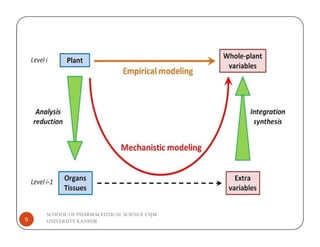
 Empirical models are based on direct observation,
measurement and extensive data records.
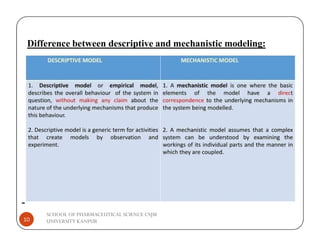
 Descriptive model or empirical model, describes the
overall behaviour of the system in question, without
making any claim about the nature of the underlying
mechanisms that produce this behaviour.
 Descriptive model is a generic term for activities that
create models by observation and experiment.
SCHOOL OF PHARMACEUTICAL SCIENCE CSJM
UNIVERSITY KANPUR
7
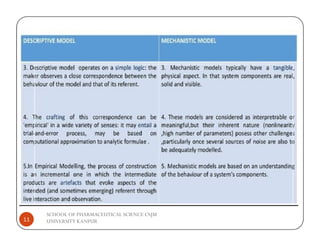
Descriptive model operates on a simple logic: the
maker observes a close correspondence between the
behaviour of the model and that of its referent.
2.Mechanistic modeling:
 Mechanistic models are based on the fundamental laws of natural
sciences, Physical & biochemical principles constitute the model
equations.
 Whenever the interest lies in the understanding of the mechanisms
of action, it is critical to be able to count on a strong
collaboration between scientists, specialists in the field, and
SCHOOL OF PHARMACEUTICAL SCIENCE CSJM
UNIVERSITY KANPUR
8
collaboration between scientists, specialists in the field, and
statisticians or mathematicians.
 A mechanistic model assumes that a complex system can be
understood by examining the workings of its individual parts and
the manner in which they are coupled. Mechanistic models typically
have a tangible, physical aspect. In that system components are real,
solid and visible.
SCHOOL OF PHARMACEUTICAL SCIENCE CSJM
UNIVERSITY KANPUR
9
Difference between descriptive and mechanistic modeling:
SCHOOL OF PHARMACEUTICAL SCIENCE CSJM
UNIVERSITY KANPUR
10
SCHOOL OF PHARMACEUTICAL SCIENCE CSJM
UNIVERSITY KANPUR
11
SCHOOL OF PHARMACEUTICAL SCIENCE CSJM
UNIVERSITY KANPUR
12

Statistical modeling in pharmaceutical research and development.

  • 1.
  • 2.
    Statistical modeling inpharmaceutical research and development Statistics:  Statistics is a scientific study of numerical data based on natural phenomena.  It is also the science of collecting, organizing, interpreting and reporting data. SCHOOL OF PHARMACEUTICAL SCIENCE CSJM UNIVERSITY KANPUR 2 reporting data. Pharmaceutical statistics:  Pharmaceutical statistics is the application of statistics to matters concerning the pharmaceutical industry.  To compare the action of two or more different drugs or different dosage of same drug are studied using statistical method.
  • 3.
    Statistical modeling:  Thenew major challenge that the pharmaceutical industry is facing in the discovery and development of the new drugs is to reduce costs and time needed from discovery to market, while at the same time raising standards of quality.  If the pharmaceutical industry cannot find a solution to reduce both the costs and time, then its whole business model will be expose to danger or risk. SCHOOL OF PHARMACEUTICAL SCIENCE CSJM UNIVERSITY KANPUR 3 expose to danger or risk.  The development of the models in the pharmaceutical industry certainly one of the significant proposed to face the challenges of cost, speed and quality.  The perspective to develop new technologies give rise to hope of establishment new model in the pharmaceutical industries significant to overcome the challenges of cost, speed as well as quality .
  • 4.
    Modeling is nothingbut the concept adopting just another new technologies. The concept, however, is that of adopting just another new technology, known as modeling. In the use of statistical modeling to achieve summary from data to cultures said by breiman.  The first culture which is data modeling culture where data generated by a given random data model. SCHOOL OF PHARMACEUTICAL SCIENCE CSJM UNIVERSITY KANPUR 4 generated by a given random data model.  The second culture which is the algorithmic modeling culture where use of the algorithmic model.
  • 5.
    Objectives of statisticalmodeling:  To improve the quality as well as to reduce cost and time in experimental cycle.  Enhancing the model will help to get knowledge that experiment on successive drug as well as enhancing of SCHOOL OF PHARMACEUTICAL SCIENCE CSJM UNIVERSITY KANPUR 5 experiment on successive drug as well as enhancing of model ability to show real condition.  Without models, the final purpose of an experiment was one single drug or its behavior. With the use of models, the objective of experiment will be the drug and the models at the same level.
  • 6.
    Type of statisticalmodeling: 1. Descriptive modeling 2. Mechanistic modeling 1. Descriptive modeling:  Descriptive modeling is a mathematical process that describes real world events and the relationship between factors SCHOOL OF PHARMACEUTICAL SCIENCE CSJM UNIVERSITY KANPUR 6 real world events and the relationship between factors responsible for them. The goal of this model is to provide appropriate description of data to understand the concept of data generating mechanism and the family of model is selected based to denote the data structure.  Empirical models are based on direct observation, measurement and extensive data records.
  • 7.
     Descriptive modelor empirical model, describes the overall behaviour of the system in question, without making any claim about the nature of the underlying mechanisms that produce this behaviour.  Descriptive model is a generic term for activities that create models by observation and experiment. SCHOOL OF PHARMACEUTICAL SCIENCE CSJM UNIVERSITY KANPUR 7 Descriptive model operates on a simple logic: the maker observes a close correspondence between the behaviour of the model and that of its referent.
  • 8.
    2.Mechanistic modeling:  Mechanisticmodels are based on the fundamental laws of natural sciences, Physical & biochemical principles constitute the model equations.  Whenever the interest lies in the understanding of the mechanisms of action, it is critical to be able to count on a strong collaboration between scientists, specialists in the field, and SCHOOL OF PHARMACEUTICAL SCIENCE CSJM UNIVERSITY KANPUR 8 collaboration between scientists, specialists in the field, and statisticians or mathematicians.  A mechanistic model assumes that a complex system can be understood by examining the workings of its individual parts and the manner in which they are coupled. Mechanistic models typically have a tangible, physical aspect. In that system components are real, solid and visible.
  • 9.
    SCHOOL OF PHARMACEUTICALSCIENCE CSJM UNIVERSITY KANPUR 9
  • 10.
    Difference between descriptiveand mechanistic modeling: SCHOOL OF PHARMACEUTICAL SCIENCE CSJM UNIVERSITY KANPUR 10
  • 11.
    SCHOOL OF PHARMACEUTICALSCIENCE CSJM UNIVERSITY KANPUR 11
  • 12.
    SCHOOL OF PHARMACEUTICALSCIENCE CSJM UNIVERSITY KANPUR 12