Ms. Shubhangi B Khade(M pharmacy)
Sanjivani College of Pharmaceutical Education & Research(Autonomous),
Kopargaon, Ahmednagar.
Contents
 Introduction
 Definition
 Advantages and disadvantages
 Microspheres/ microcapsules
 Microparticles
 Methods of Encapsulation
 Applications
Introduction
 Microencapsulation is defined as a process of enclosing or enveloping solids,
liquids within second material with a continuous coating of polymeric
materials yielding microscopic particles (ranging from less than 1 micron to
several hundred microns in size).
 In this process, small discrete solid particles or small liquid droplets and
dispersions are surrounded and enclosed by applying thin coating for the
purposes of providing environmental protection and controlling the release
characteristics or availability of coated active ingredients
 Microencapsulation process is widely employed to modify and delayed drug
release form different pharmaceutical dosage forms.
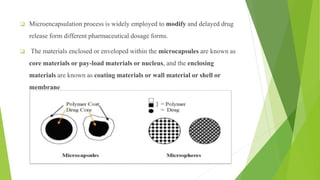
 The materials enclosed or enveloped within the microcapsules are known as
core materials or pay-load materials or nucleus, and the enclosing
materials are known as coating materials or wall material or shell or
membrane
Advantages
 To Increase of bioavailability.
 To produce a targeted drug delivery
 To provide environmental protection of the core material from moisture,
light, and oxygen.
 It enhances the solubility of poorly soluble drugs and the safe handling of
toxic medications.
 It Masks the taste of bitter drugs to make them more palatable and improving
patient compliance.
 To decrease evaporation rate of the core material.(Reduction of volatility)
Disadvantages
 The cost of the materials used and the formulation process might be higher
than standard formulations.
 Reproducibility is less
 The effect of the polymer matrix, polymer additives, and their degradation
products on the environment in response to heat, hydrolysis, or biological
agents vary significantly.
 The core particle’s stability is affected by the change in the process conditions
like change in temperature, pH, solvent addition, or evaporation of the solvent
 Microparticles:
“Microparticles” refers to the particles having the diameter range of 1-1000 μm,
irrespective of the precise exterior and/or interior structures.
 Microspheres:
“Microspheres” particularly refers to the spherically shaped microparticles within
the broad category of microparticles.
 Microcapsules:
“Microcapsules” refers to microparticles having a core surrounded by the coat
or wall material(s) distinctly different from that of the core or pay-load or
nucleus, which may be solid, liquid, or even gas.
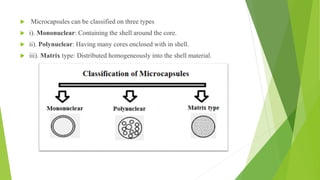
 Microcapsules can be classified on three types
 i). Mononuclear: Containing the shell around the core.
 ii). Polynuclear: Having many cores enclosed with in shell.
 iii). Matrix type: Distributed homogeneously into the shell material.
Microspheres
 Microspheres are small spherical particles, with diameters 1 μm to 1000 μm.
 They are spherical free flowing particles consisting of proteins or synthetic
polymers which are biodegradable in nature.
 There are two types of microspheres
1. Microcapsules are those in which entrapped substance is distinctly surrounded
by distinct capsule wall
2. Micromatrices in which entrapped substance is dispersed throughout the
matrix
 Microspheres are sometimes referred to as microparticles.
Ideal characteristics of microspheres:
 The ability to incorporate reasonably high concentrations of the drug.
 Stability of the preparation after synthesis with a clinically acceptable shelf
life.
 Controlled particle size and dispersability in aqueous vehicles for injection.
 Release of active reagent with a good control over a wide time scale.
 Biocompatibility
Advantages of microspheres:
1. Particle size reduction for enhancing solubility of the poorly soluble drug.
2. provide constant and prolonged therapeutic effect.
3. provide constant drug concentration in blood there by increasing patent
compliance,
4. Decrease dose and toxicity.
5. Protect the drug from enzymatic and photolytic cleavage hence found to be
best for drug delivery of protein.
6. Reduce the dosing frequency and thereby improve the patient compliance
7. Better drug utilization will improve the bioavailability and reduce the
incidence or intensity of adverse effects.
8. Microsphere morphology allows a controllable variability in degradation and
drug release.
9. Convert liquid to solid form & to mask the bitter taste.
10. Protects the GIT from irritant effects of the drug.
11. Biodegradable microspheres have the advantage over large polymer implants
in that they do not require surgical procedures for implantation and removal.
12. Controlled release delivery biodegradable microspheres are used to control
drug release rates thereby decreasing toxic side effects, and eliminating the
inconvenience of repeated injections
TYPES OF MICROSPHERES:
1. Bioadhesive microspheres
2. Magnetic microspheres
3. Floating microspheres
4. Radioactive microspheres
5. Polymeric microspheres
i)Biodegradable polymeric microspheres
ii)Synthetic polymeric microspheres
METHOD OF PREPARATION:
1. Spray Drying
2. Solvent Evaporation
3. Single emulsion technique
4. Double emulsion technique
5. Phase separation coacervation technique
6. Spray drying and spray congealing
7. Solvent extraction
8. Quassi emulsion solvent diffusion
MATERIALS USED IN THE PREPARATION OF
MICROSPHERE:
 1. Natural polymers- Natural polymers obtained from different sources like
carbohydrates proteins and chemically modified Carbohydrates Carbohydrates:
Agarose, Carrageenan, Chitosan, Starch
 Proteins: Albumin, Collagen and Gelatin Chemically modified carbohydrates:
Poly dextran, Poly starch.
 2. Synthetic Polymers Synthetic polymers are divided into two types.
Biodegradable polymers
 E.g. Lactides, Glycolides & their co-polymers,Poly anhydrides,Poly alkyl cyano
acrylates
Non-biodegradable polymers
E.g. Poly methyl methacrylate (PMMA), Glycidyl methacrylate, Acrolein, Epoxy
polymers
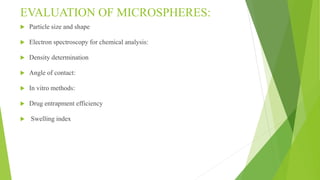
EVALUATION OF MICROSPHERES:
 Particle size and shape
 Electron spectroscopy for chemical analysis:
 Density determination
 Angle of contact:
 In vitro methods:
 Drug entrapment efficiency
 Swelling index
APPLICATION OF MICROSPHERES IN
PHARMACEUTICAL INDUSTRY:
1. Ophthalmic Drug Delivery
2. Oral drug delivery
3. Gene delivery
4. Nasal drug delivery
5. Intratumoral and local drug delivery
6. Buccal drug delivery
7. Gastrointestinal drug delivery
8. Transdermal drug delivery
9. Colonic drug delivery
10. Vaginal drug delivery
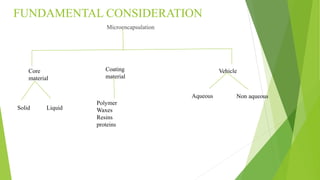
FUNDAMENTAL CONSIDERATION
Microencapsulation
Core
material
Coating
material
Vehicle
Solid Liquid
Polymer
Waxes
Resins
proteins
Aqueous Non aqueous
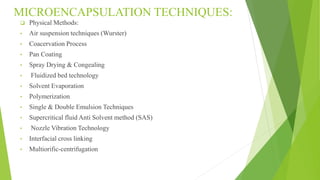
MICROENCAPSULATION TECHNIQUES:
 Physical Methods:
• Air suspension techniques (Wurster)
• Coacervation Process
• Pan Coating
• Spray Drying & Congealing
• Fluidized bed technology
• Solvent Evaporation
• Polymerization
• Single & Double Emulsion Techniques
• Supercritical fluid Anti Solvent method (SAS)
• Nozzle Vibration Technology
• Interfacial cross linking
• Multiorific-centrifugation
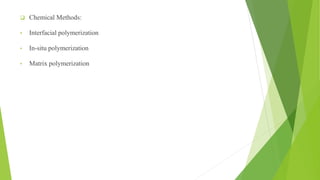
 Chemical Methods:
• Interfacial polymerization
• In-situ polymerization
• Matrix polymerization
Physical Methods
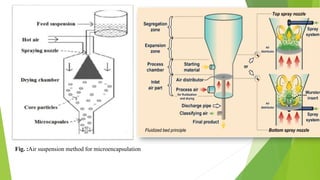
 Air suspension
• This process is also known as Wurster Air Suspension and is based on Fluidized
Bed coating process.
• Microencapsulation by air suspension method consists of the dispersing of
solids, particulate core materials in a supporting air stream and the spray
coating on the air suspended particles.
• Solutions and suspensions of coating materials in both water and volatile organic
solvents are employed.
• Within the coating chamber, particulate core materials are suspended on an
upward moving air stream.
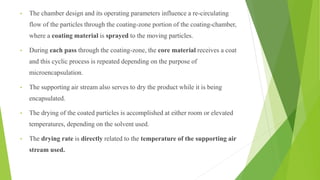
• The chamber design and its operating parameters influence a re-circulating
flow of the particles through the coating-zone portion of the coating-chamber,
where a coating material is sprayed to the moving particles.
• During each pass through the coating-zone, the core material receives a coat
and this cyclic process is repeated depending on the purpose of
microencapsulation.
• The supporting air stream also serves to dry the product while it is being
encapsulated.
• The drying of the coated particles is accomplished at either room or elevated
temperatures, depending on the solvent used.
• The drying rate is directly related to the temperature of the supporting air
stream used.
Fig. :Air suspension method for microencapsulation
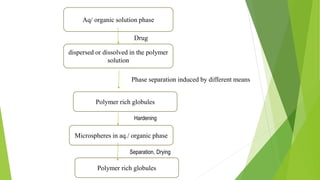
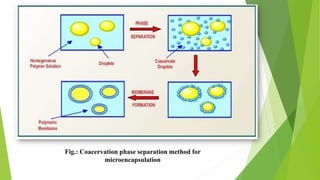
Coacervation phase separation
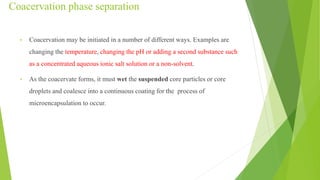
• Coacervation may be initiated in a number of different ways. Examples are
changing the temperature, changing the pH or adding a second substance such
as a concentrated aqueous ionic salt solution or a non-solvent.
• As the coacervate forms, it must wet the suspended core particles or core
droplets and coalesce into a continuous coating for the process of
microencapsulation to occur.
Aq/ organic solution phase
dispersed or dissolved in the polymer
solution
Microspheres in aq./ organic phase
Drug
Phase separation induced by different means
Polymer rich globules
Hardening
Separation, Drying
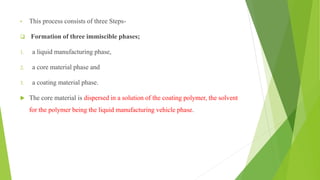
• This process consists of three Steps-
 Formation of three immiscible phases;
1. a liquid manufacturing phase,
2. a core material phase and
3. a coating material phase.
 The core material is dispersed in a solution of the coating polymer, the solvent
for the polymer being the liquid manufacturing vehicle phase.
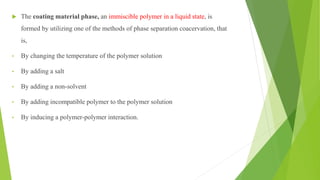
 The coating material phase, an immiscible polymer in a liquid state, is
formed by utilizing one of the methods of phase separation coacervation, that
is,
• By changing the temperature of the polymer solution
• By adding a salt
• By adding a non-solvent
• By adding incompatible polymer to the polymer solution
• By inducing a polymer-polymer interaction.
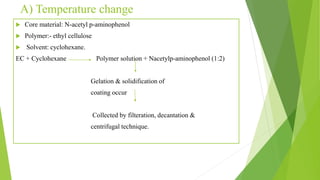
A) Temperature change
 Core material: N-acetyl p-aminophenol
 Polymer:- ethyl cellulose
 Solvent: cyclohexane.
EC + Cyclohexane Polymer solution + Nacetylp-aminophenol (1:2)
Gelation & solidification of
coating occur
Collected by filteration, decantation &
centrifugal technique.
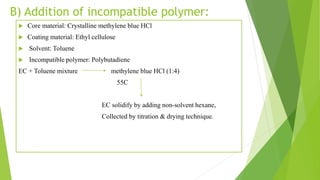
B) Addition of incompatible polymer:
 Core material: Crystalline methylene blue HCl
 Coating material: Ethyl cellulose
 Solvent: Toluene
 Incompatible polymer: Polybutadiene
EC + Toluene mixture methylene blue HCl (1:4)
55C
EC solidify by adding non-solvent hexane,
Collected by titration & drying technique.
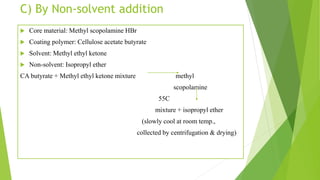
C) By Non-solvent addition
 Core material: Methyl scopolamine HBr
 Coating polymer: Cellulose acetate butyrate
 Solvent: Methyl ethyl ketone
 Non-solvent: Isopropyl ether
CA butyrate + Methyl ethyl ketone mixture methyl
scopolamine
55C
mixture + isopropyl ether
(slowly cool at room temp.,
collected by centrifugation & drying)
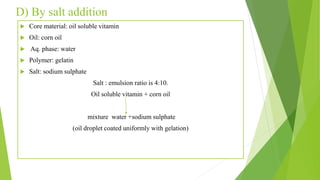
D) By salt addition
 Core material: oil soluble vitamin
 Oil: corn oil
 Aq. phase: water
 Polymer: gelatin
 Salt: sodium sulphate
Salt : emulsion ratio is 4:10.
Oil soluble vitamin + corn oil
mixture water +sodium sulphate
(oil droplet coated uniformly with gelation)
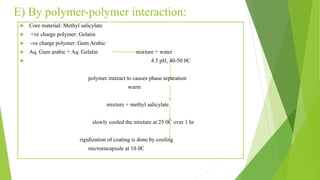
E) By polymer-polymer interaction:
 Core material: Methyl salicylate
 +ve charge polymer: Gelatin
 -ve charge polymer: Gum Arabic
 Aq. Gum arabic + Aq. Gelatin mixture + water
 4.5 pH, 40-50 0C
polymer interact to causes phase separation
warm
mixture + methyl salicylate
slowly cooled the mixture at 25 0C over 1 hr
rigidization of coating is done by cooling
microencapsule at 10 0C
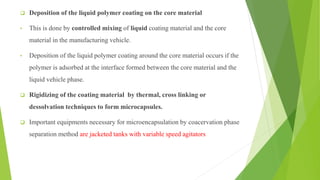
 Deposition of the liquid polymer coating on the core material
• This is done by controlled mixing of liquid coating material and the core
material in the manufacturing vehicle.
• Deposition of the liquid polymer coating around the core material occurs if the
polymer is adsorbed at the interface formed between the core material and the
liquid vehicle phase.
 Rigidizing of the coating material by thermal, cross linking or
dessolvation techniques to form microcapsules.
 Important equipments necessary for microencapsulation by coacervation phase
separation method are jacketed tanks with variable speed agitators
Fig.: Coacervation phase separation method for
microencapsulation
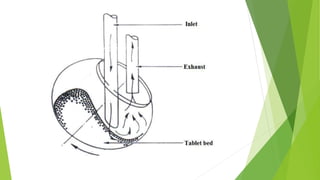
Pan coating
 For relatively large particles, which are greater than 600 μ in size,
microencapsulation can be done by pan coating method,
 In this method, various spherical core materials, such as nonpareil sugar seeds
are coated with a variety of polymers
 In practice, the coating is applied as a solution or as an atomized spray to the
desired solid core material in the coating pan.
 To remove the coating solvent warm air is passed over the coated material.
 By using this technique larger sized particles will be coated effectively
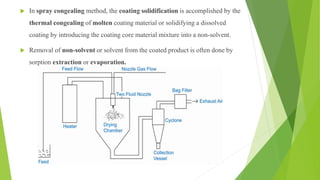
Spray Drying And Congealing
 methods of microencapsulation are almost similar
 both the methods entail the dispersion of core material in a liquefied coating agent
and spraying or introducing the core coating mixture into some environmental
condition.
 The main difference in-between these two microencapsulation methods are the means
by which the coating solidification is carried out.
 In spray drying method, the coating solidification is influenced by the quick
evaporation of a solvent, in which the coating material is dissolved
 In spray congealing method, the coating solidification is accomplished by the
thermal congealing of molten coating material or solidifying a dissolved
coating by introducing the coating core material mixture into a non-solvent.
 Removal of non-solvent or solvent from the coated product is often done by
sorption extraction or evaporation.
Fluidized-bed technology
 used for the encapsulation of solid core materials, including liquids absorbed
into porous solids .
 Solid particles to be encapsulated are suspended on a jet of air and afterward,
are covered by a spray of liquid coating material.
 The capsules are traveled to an area where their shells are solidified by cooling
or solvent vaporization .
 The processes of suspending, spraying, and cooling are repeated until the
attainment of the desired thickness of the capsule-wall.
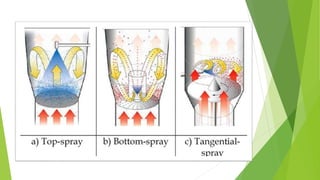
 This is known as Wurster process when the spray nozzle is located at the
bottom of the fluidized-bed of particles
Solvent Evaporation
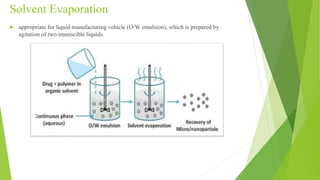
 appropriate for liquid manufacturing vehicle (O/W emulsion), which is prepared by
agitation of two immiscible liquids.
 The solvent evaporation method involves dissolving microcapsule coating
(polymer) in a volatile solvent, which is immiscible with the liquid
manufacturing vehicle phase.
 A core material (drug) to be microencapsulated is dissolved or dispersed in the
coating polymer solution.
 With agitation, the core–coating material mixture is dispersed in the liquid
manufacturing vehicle phase to obtain the appropriate sized microcapsules.
 Agitation of system is continued until the solvent partitions into the aqueous
phase and is removed by evaporation. This process results in hardened
microcapsules.
 The most common method is the use of a propeller style blade attached to a
variable speed motor
Process variables for solvent Evaporation
 rate of solvent evaporation for the coating polymer(s)
 temperature cycles
 agitation rates
 The most important factors that should be considered for the preparation of
microcapsules by solvent evaporation method include choice of vehicle phase
and solvent for the polymer coating, and solvent recovery systems.
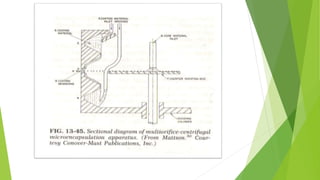
 utilizes the centrifugal forces to hurl a core particle trough an enveloping
membrane
 Various processing variables of multiorific-centrifugation method include
 (i) rotational speed of the cylinder,
 (ii) flow rate of the core and coating materials, and
 (iii) concentration, viscosity and surface tension of the core material
Multiorific-centrifugation
Applications of Microencapsulation
 can be used to formulate various sustained controlled release dosage forms by
modifying or delaying release of encapsulated active agents or core materials
 employed to formulate enteric-coated dosage forms,
 Gastric irritant drugs are being microencapsulated to reduce the chances of
gastric irritation.
 The taste of bitter drug candidates can be masked
 liquids and gases can be changed into solid particles in the form of microcapsules.
 provides environmental protection to the encapsulated active agents from various
environmental issues, such as light, heat, humidity, oxidation,
Microencapsulation Unit 2 Novel Drug Delivery System

Microencapsulation Unit 2 Novel Drug Delivery System

  • 1.
    Ms. Shubhangi BKhade(M pharmacy) Sanjivani College of Pharmaceutical Education & Research(Autonomous), Kopargaon, Ahmednagar.
  • 2.
    Contents  Introduction  Definition Advantages and disadvantages  Microspheres/ microcapsules  Microparticles  Methods of Encapsulation  Applications
  • 3.
    Introduction  Microencapsulation isdefined as a process of enclosing or enveloping solids, liquids within second material with a continuous coating of polymeric materials yielding microscopic particles (ranging from less than 1 micron to several hundred microns in size).  In this process, small discrete solid particles or small liquid droplets and dispersions are surrounded and enclosed by applying thin coating for the purposes of providing environmental protection and controlling the release characteristics or availability of coated active ingredients
  • 4.
     Microencapsulation processis widely employed to modify and delayed drug release form different pharmaceutical dosage forms.  The materials enclosed or enveloped within the microcapsules are known as core materials or pay-load materials or nucleus, and the enclosing materials are known as coating materials or wall material or shell or membrane
  • 5.
    Advantages  To Increaseof bioavailability.  To produce a targeted drug delivery  To provide environmental protection of the core material from moisture, light, and oxygen.  It enhances the solubility of poorly soluble drugs and the safe handling of toxic medications.  It Masks the taste of bitter drugs to make them more palatable and improving patient compliance.  To decrease evaporation rate of the core material.(Reduction of volatility)
  • 6.
    Disadvantages  The costof the materials used and the formulation process might be higher than standard formulations.  Reproducibility is less  The effect of the polymer matrix, polymer additives, and their degradation products on the environment in response to heat, hydrolysis, or biological agents vary significantly.  The core particle’s stability is affected by the change in the process conditions like change in temperature, pH, solvent addition, or evaporation of the solvent
  • 7.
     Microparticles: “Microparticles” refersto the particles having the diameter range of 1-1000 μm, irrespective of the precise exterior and/or interior structures.  Microspheres: “Microspheres” particularly refers to the spherically shaped microparticles within the broad category of microparticles.  Microcapsules: “Microcapsules” refers to microparticles having a core surrounded by the coat or wall material(s) distinctly different from that of the core or pay-load or nucleus, which may be solid, liquid, or even gas.
  • 8.
     Microcapsules canbe classified on three types  i). Mononuclear: Containing the shell around the core.  ii). Polynuclear: Having many cores enclosed with in shell.  iii). Matrix type: Distributed homogeneously into the shell material.
  • 9.
    Microspheres  Microspheres aresmall spherical particles, with diameters 1 μm to 1000 μm.  They are spherical free flowing particles consisting of proteins or synthetic polymers which are biodegradable in nature.  There are two types of microspheres 1. Microcapsules are those in which entrapped substance is distinctly surrounded by distinct capsule wall 2. Micromatrices in which entrapped substance is dispersed throughout the matrix  Microspheres are sometimes referred to as microparticles.
  • 10.
    Ideal characteristics ofmicrospheres:  The ability to incorporate reasonably high concentrations of the drug.  Stability of the preparation after synthesis with a clinically acceptable shelf life.  Controlled particle size and dispersability in aqueous vehicles for injection.  Release of active reagent with a good control over a wide time scale.  Biocompatibility
  • 11.
    Advantages of microspheres: 1.Particle size reduction for enhancing solubility of the poorly soluble drug. 2. provide constant and prolonged therapeutic effect. 3. provide constant drug concentration in blood there by increasing patent compliance, 4. Decrease dose and toxicity. 5. Protect the drug from enzymatic and photolytic cleavage hence found to be best for drug delivery of protein. 6. Reduce the dosing frequency and thereby improve the patient compliance
  • 12.
    7. Better drugutilization will improve the bioavailability and reduce the incidence or intensity of adverse effects. 8. Microsphere morphology allows a controllable variability in degradation and drug release. 9. Convert liquid to solid form & to mask the bitter taste. 10. Protects the GIT from irritant effects of the drug. 11. Biodegradable microspheres have the advantage over large polymer implants in that they do not require surgical procedures for implantation and removal. 12. Controlled release delivery biodegradable microspheres are used to control drug release rates thereby decreasing toxic side effects, and eliminating the inconvenience of repeated injections
  • 13.
    TYPES OF MICROSPHERES: 1.Bioadhesive microspheres 2. Magnetic microspheres 3. Floating microspheres 4. Radioactive microspheres 5. Polymeric microspheres i)Biodegradable polymeric microspheres ii)Synthetic polymeric microspheres
  • 14.
    METHOD OF PREPARATION: 1.Spray Drying 2. Solvent Evaporation 3. Single emulsion technique 4. Double emulsion technique 5. Phase separation coacervation technique 6. Spray drying and spray congealing 7. Solvent extraction 8. Quassi emulsion solvent diffusion
  • 15.
    MATERIALS USED INTHE PREPARATION OF MICROSPHERE:  1. Natural polymers- Natural polymers obtained from different sources like carbohydrates proteins and chemically modified Carbohydrates Carbohydrates: Agarose, Carrageenan, Chitosan, Starch  Proteins: Albumin, Collagen and Gelatin Chemically modified carbohydrates: Poly dextran, Poly starch.  2. Synthetic Polymers Synthetic polymers are divided into two types. Biodegradable polymers  E.g. Lactides, Glycolides & their co-polymers,Poly anhydrides,Poly alkyl cyano acrylates Non-biodegradable polymers E.g. Poly methyl methacrylate (PMMA), Glycidyl methacrylate, Acrolein, Epoxy polymers
  • 16.
    EVALUATION OF MICROSPHERES: Particle size and shape  Electron spectroscopy for chemical analysis:  Density determination  Angle of contact:  In vitro methods:  Drug entrapment efficiency  Swelling index
  • 17.
    APPLICATION OF MICROSPHERESIN PHARMACEUTICAL INDUSTRY: 1. Ophthalmic Drug Delivery 2. Oral drug delivery 3. Gene delivery 4. Nasal drug delivery 5. Intratumoral and local drug delivery 6. Buccal drug delivery 7. Gastrointestinal drug delivery 8. Transdermal drug delivery 9. Colonic drug delivery 10. Vaginal drug delivery
  • 18.
  • 19.
    MICROENCAPSULATION TECHNIQUES:  PhysicalMethods: • Air suspension techniques (Wurster) • Coacervation Process • Pan Coating • Spray Drying & Congealing • Fluidized bed technology • Solvent Evaporation • Polymerization • Single & Double Emulsion Techniques • Supercritical fluid Anti Solvent method (SAS) • Nozzle Vibration Technology • Interfacial cross linking • Multiorific-centrifugation
  • 20.
     Chemical Methods: •Interfacial polymerization • In-situ polymerization • Matrix polymerization
  • 21.
    Physical Methods  Airsuspension • This process is also known as Wurster Air Suspension and is based on Fluidized Bed coating process. • Microencapsulation by air suspension method consists of the dispersing of solids, particulate core materials in a supporting air stream and the spray coating on the air suspended particles. • Solutions and suspensions of coating materials in both water and volatile organic solvents are employed. • Within the coating chamber, particulate core materials are suspended on an upward moving air stream.
  • 22.
    • The chamberdesign and its operating parameters influence a re-circulating flow of the particles through the coating-zone portion of the coating-chamber, where a coating material is sprayed to the moving particles. • During each pass through the coating-zone, the core material receives a coat and this cyclic process is repeated depending on the purpose of microencapsulation. • The supporting air stream also serves to dry the product while it is being encapsulated. • The drying of the coated particles is accomplished at either room or elevated temperatures, depending on the solvent used. • The drying rate is directly related to the temperature of the supporting air stream used.
  • 23.
    Fig. :Air suspensionmethod for microencapsulation
  • 24.
    Coacervation phase separation •Coacervation may be initiated in a number of different ways. Examples are changing the temperature, changing the pH or adding a second substance such as a concentrated aqueous ionic salt solution or a non-solvent. • As the coacervate forms, it must wet the suspended core particles or core droplets and coalesce into a continuous coating for the process of microencapsulation to occur.
  • 25.
    Aq/ organic solutionphase dispersed or dissolved in the polymer solution Microspheres in aq./ organic phase Drug Phase separation induced by different means Polymer rich globules Polymer rich globules Hardening Separation, Drying
  • 26.
    • This processconsists of three Steps-  Formation of three immiscible phases; 1. a liquid manufacturing phase, 2. a core material phase and 3. a coating material phase.  The core material is dispersed in a solution of the coating polymer, the solvent for the polymer being the liquid manufacturing vehicle phase.
  • 27.
     The coatingmaterial phase, an immiscible polymer in a liquid state, is formed by utilizing one of the methods of phase separation coacervation, that is, • By changing the temperature of the polymer solution • By adding a salt • By adding a non-solvent • By adding incompatible polymer to the polymer solution • By inducing a polymer-polymer interaction.
  • 28.
    A) Temperature change Core material: N-acetyl p-aminophenol  Polymer:- ethyl cellulose  Solvent: cyclohexane. EC + Cyclohexane Polymer solution + Nacetylp-aminophenol (1:2) Gelation & solidification of coating occur Collected by filteration, decantation & centrifugal technique.
  • 29.
    B) Addition ofincompatible polymer:  Core material: Crystalline methylene blue HCl  Coating material: Ethyl cellulose  Solvent: Toluene  Incompatible polymer: Polybutadiene EC + Toluene mixture methylene blue HCl (1:4) 55C EC solidify by adding non-solvent hexane, Collected by titration & drying technique.
  • 30.
    C) By Non-solventaddition  Core material: Methyl scopolamine HBr  Coating polymer: Cellulose acetate butyrate  Solvent: Methyl ethyl ketone  Non-solvent: Isopropyl ether CA butyrate + Methyl ethyl ketone mixture methyl scopolamine 55C mixture + isopropyl ether (slowly cool at room temp., collected by centrifugation & drying)
  • 31.
    D) By saltaddition  Core material: oil soluble vitamin  Oil: corn oil  Aq. phase: water  Polymer: gelatin  Salt: sodium sulphate Salt : emulsion ratio is 4:10. Oil soluble vitamin + corn oil mixture water +sodium sulphate (oil droplet coated uniformly with gelation)
  • 32.
    E) By polymer-polymerinteraction:  Core material: Methyl salicylate  +ve charge polymer: Gelatin  -ve charge polymer: Gum Arabic  Aq. Gum arabic + Aq. Gelatin mixture + water  4.5 pH, 40-50 0C polymer interact to causes phase separation warm mixture + methyl salicylate slowly cooled the mixture at 25 0C over 1 hr rigidization of coating is done by cooling microencapsule at 10 0C
  • 33.
     Deposition ofthe liquid polymer coating on the core material • This is done by controlled mixing of liquid coating material and the core material in the manufacturing vehicle. • Deposition of the liquid polymer coating around the core material occurs if the polymer is adsorbed at the interface formed between the core material and the liquid vehicle phase.  Rigidizing of the coating material by thermal, cross linking or dessolvation techniques to form microcapsules.  Important equipments necessary for microencapsulation by coacervation phase separation method are jacketed tanks with variable speed agitators
  • 34.
    Fig.: Coacervation phaseseparation method for microencapsulation
  • 35.
    Pan coating  Forrelatively large particles, which are greater than 600 μ in size, microencapsulation can be done by pan coating method,  In this method, various spherical core materials, such as nonpareil sugar seeds are coated with a variety of polymers  In practice, the coating is applied as a solution or as an atomized spray to the desired solid core material in the coating pan.  To remove the coating solvent warm air is passed over the coated material.  By using this technique larger sized particles will be coated effectively
  • 37.
    Spray Drying AndCongealing  methods of microencapsulation are almost similar  both the methods entail the dispersion of core material in a liquefied coating agent and spraying or introducing the core coating mixture into some environmental condition.  The main difference in-between these two microencapsulation methods are the means by which the coating solidification is carried out.  In spray drying method, the coating solidification is influenced by the quick evaporation of a solvent, in which the coating material is dissolved
  • 38.
     In spraycongealing method, the coating solidification is accomplished by the thermal congealing of molten coating material or solidifying a dissolved coating by introducing the coating core material mixture into a non-solvent.  Removal of non-solvent or solvent from the coated product is often done by sorption extraction or evaporation.
  • 39.
    Fluidized-bed technology  usedfor the encapsulation of solid core materials, including liquids absorbed into porous solids .  Solid particles to be encapsulated are suspended on a jet of air and afterward, are covered by a spray of liquid coating material.  The capsules are traveled to an area where their shells are solidified by cooling or solvent vaporization .  The processes of suspending, spraying, and cooling are repeated until the attainment of the desired thickness of the capsule-wall.  This is known as Wurster process when the spray nozzle is located at the bottom of the fluidized-bed of particles
  • 41.
    Solvent Evaporation  appropriatefor liquid manufacturing vehicle (O/W emulsion), which is prepared by agitation of two immiscible liquids.
  • 42.
     The solventevaporation method involves dissolving microcapsule coating (polymer) in a volatile solvent, which is immiscible with the liquid manufacturing vehicle phase.  A core material (drug) to be microencapsulated is dissolved or dispersed in the coating polymer solution.  With agitation, the core–coating material mixture is dispersed in the liquid manufacturing vehicle phase to obtain the appropriate sized microcapsules.  Agitation of system is continued until the solvent partitions into the aqueous phase and is removed by evaporation. This process results in hardened microcapsules.  The most common method is the use of a propeller style blade attached to a variable speed motor
  • 43.
    Process variables forsolvent Evaporation  rate of solvent evaporation for the coating polymer(s)  temperature cycles  agitation rates  The most important factors that should be considered for the preparation of microcapsules by solvent evaporation method include choice of vehicle phase and solvent for the polymer coating, and solvent recovery systems.
  • 44.
     utilizes thecentrifugal forces to hurl a core particle trough an enveloping membrane  Various processing variables of multiorific-centrifugation method include  (i) rotational speed of the cylinder,  (ii) flow rate of the core and coating materials, and  (iii) concentration, viscosity and surface tension of the core material Multiorific-centrifugation
  • 46.
    Applications of Microencapsulation can be used to formulate various sustained controlled release dosage forms by modifying or delaying release of encapsulated active agents or core materials  employed to formulate enteric-coated dosage forms,  Gastric irritant drugs are being microencapsulated to reduce the chances of gastric irritation.  The taste of bitter drug candidates can be masked  liquids and gases can be changed into solid particles in the form of microcapsules.  provides environmental protection to the encapsulated active agents from various environmental issues, such as light, heat, humidity, oxidation,