1
Study and drawing of
microstructures of steels
Student Name: Rawa Abdullah Taha
Class: two – Group A
Course Title: Metallurgy Lab
Department: Mechanic and Mechatronics
College of Engineering
Salahaddin University - Erbil
Academic Year 2019 – 2020
2
ABSTRACT
When describing the structure of a material, we make a clear difference
between it's crystal structure and it's microstructure. The term ‘crystal
structure’ is used to describe the average positions of atoms within the
unit cell, and is wholly specified by the lattice type and the fractional
coordinates of the atoms (as determined, for example, by X-ray
diffraction). In other words, the crystal structure describes the entrance of
the material on an atomic (or Å) length scale. The term ‘microstructure’
is used to describe the appearance of the material on the nm-cm length
scale.Microscopy can give information concerning a material’s
composition, preceding treatment and properties. Steels represent the
most widely-used metallic alloy, taking a wide range of microstructures
and mechanical properties. By examining the mechanical properties of
steels in conjunction with microstructure this book provides a valuable
description of the growth and behavior of these materials - the very
foundation of their widespread use. Updated throughout and including
new chapters on nanostructured steels, and new alloys and technologies
for the energy and automobile industries, the book is clearly written and
illustrated, with extensive bibliographies and real-life examples. An
essential reference, both compact and readily comprehensive, for
metallurgists and engineers in both industry and academia.
3
TABLE OF CONTENTS
Abstract 2
Table of Contents 3
Introduction 4
Introduction 5
Methods 6
Conclusion 7
References 8
4
INTRODUCTION
engineering material for nearlysizeas a highaccessibleSteel has been
ndtrack record alaudabletwo centuries. During this time it has had a very
to engineering progress, especially in providing thecriticalone which is
infrastructure in underdeveloped and developing parts of the world,
which still dwarf in size and population the more developed nations. This
continues to increase, leading tois why the volume of steel production
more economic ways of manufacturing usingstudythe continual need to
energy consumption and preserve naturalminimizesteel in order to
commendable efforts by scientists and engineers toIn spite ofresources.
property relationships in-microstructure-fully the processingunderstand
steels, these continue to present new challenges to researchers because of
the complexity of the phase transformation reactions and the wide
. Thus, anspectrum of microstructures and properties achievable
important theme and objective of this book is to follow the development
of our understanding of phase transformations in iron alloys and steels
through to the development of modern commercial steels, and in
ection between phase transformationparticular to highlight the clear conn
studies, no matter how isolated and remote they may seem at the outset,
.to the emergence of new steels with enhanced engineering properties
The microstructures of iron and steels is complicated and diverse which is
uenced by composition, homogeneity, heat treatment, processing andinfl
section size. Microstructure of castings looks different than those of the
products even if the composition is same and even if the sameshaped
The most important transformations in steels, and.heat treatment is given
the area where almost all research has been concentrated, are those which
result in the final microstructure and properties. These involve
decomposition of the high temperature g-phase, austenite, which takes
place on cooling and, dependent upon steel alloying and cooling
conditions and also whether mechanical working occurs, could follow
different paths resulting in a large variety of lower temperature phase
types and their mixtures. These transformations could be classified based
upon microstructure, thermodynamics or mechanisms and in the present
book the phase transformations are classified according to their
mechanism. In this scheme the phase transformations in steels are
5
customarily divided into two major groups, which are named according to
whether long-range diffusion of atoms occurs or not, namely diffusional
or non-diffusional (diffusion less). Each type of phase transformation is
then characterized by a set of specific features, including but not limited
to composition, crystal structure, shape change and carbon mobility. It is
generally accepted that the formation mechanisms of proeutectoid grain
boundary allotriomorphs (of a-ferrite and cementite) and pearlite are
diffusional. These reactions take place within the higher temperature
region of the low temperature phase field with slow kinetics and
generally do not require significant undercooling below the g Æ a
transition temperature.
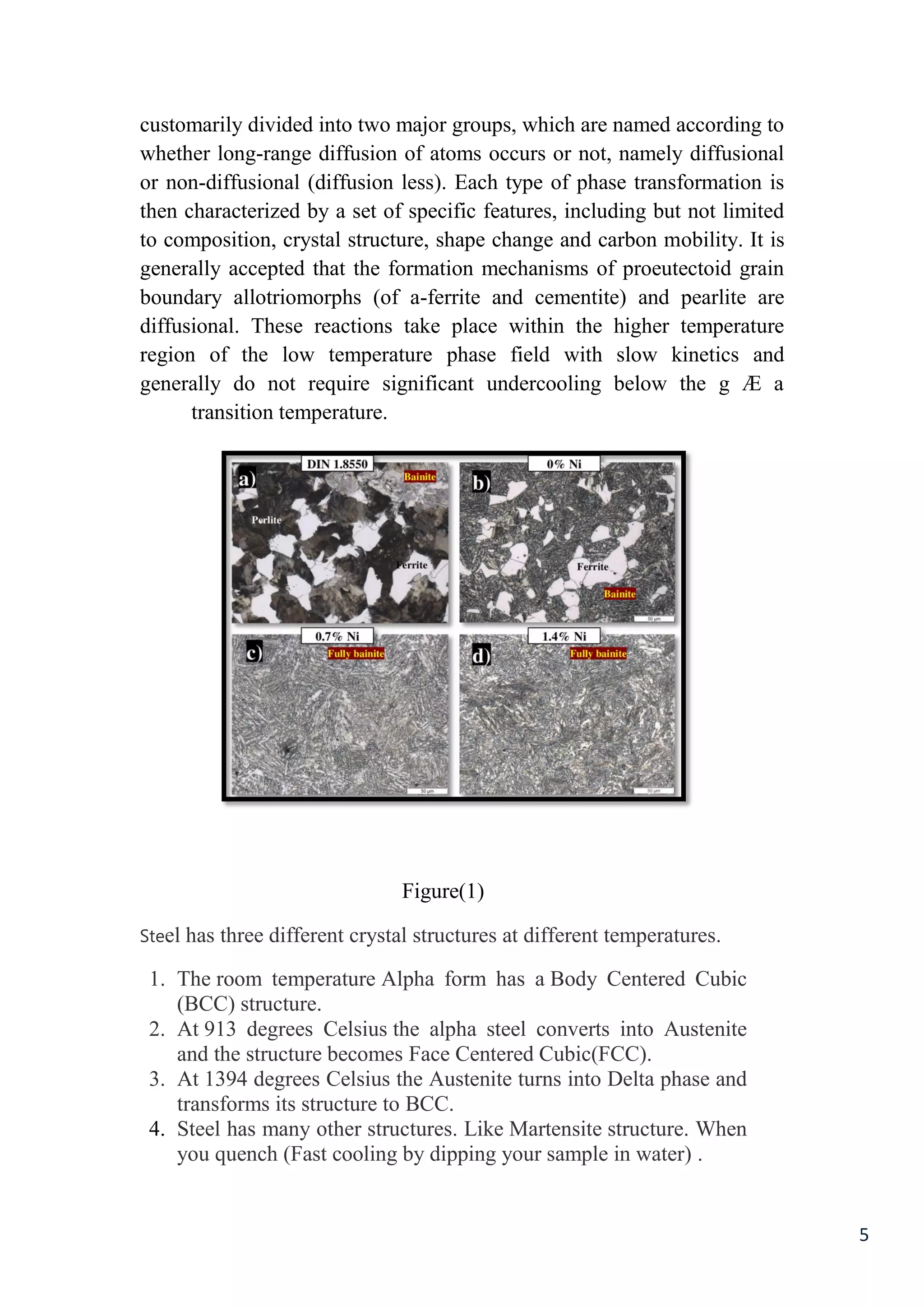
Figure(1)
Steel has three different crystal structures at different temperatures.
1. The room temperature Alpha form has a Body Centered Cubic
(BCC) structure.
2. At 913 degrees Celsius the alpha steel converts into Austenite
and the structure becomes Face Centered Cubic(FCC).
3. At 1394 degrees Celsius the Austenite turns into Delta phase and
transforms its structure to BCC.
4. Steel has many other structures. Like Martensite structure. When
you quench (Fast cooling by dipping your sample in water) .
6
METHODS
It is an alloy made from Iron and Carbon. There are over 3,500 different
types of steel, which can be separated into four groups depending on its
chemical content or metal alloy contents.
Steel is an alloy but it is the level of impurities and elements such
as nickel, magnesium, molybdenum, silicon, copper, vanadium that helps
to determine the grade of each steel.
1. Carbon Steel
 Mild or Low Carbon Steels, contain up to 0.32 %C
 Medium Carbon Steels, containing 0.30-0.59 %C
 High Carbon Steels, known to contain over 0.6-0.99 %C
 Ultra-high Carbon Steels that usually contain about 1.0–2.0 %C
2. Alloy Steels
 Alloy steels contain common alloy metals in varying proportions,
which makes this type of steel suitable for specific applications.
3. Tool Steels
 This type of steel is alloyed at very high temperatures and often
contains hard metals like tungsten, cobalt.
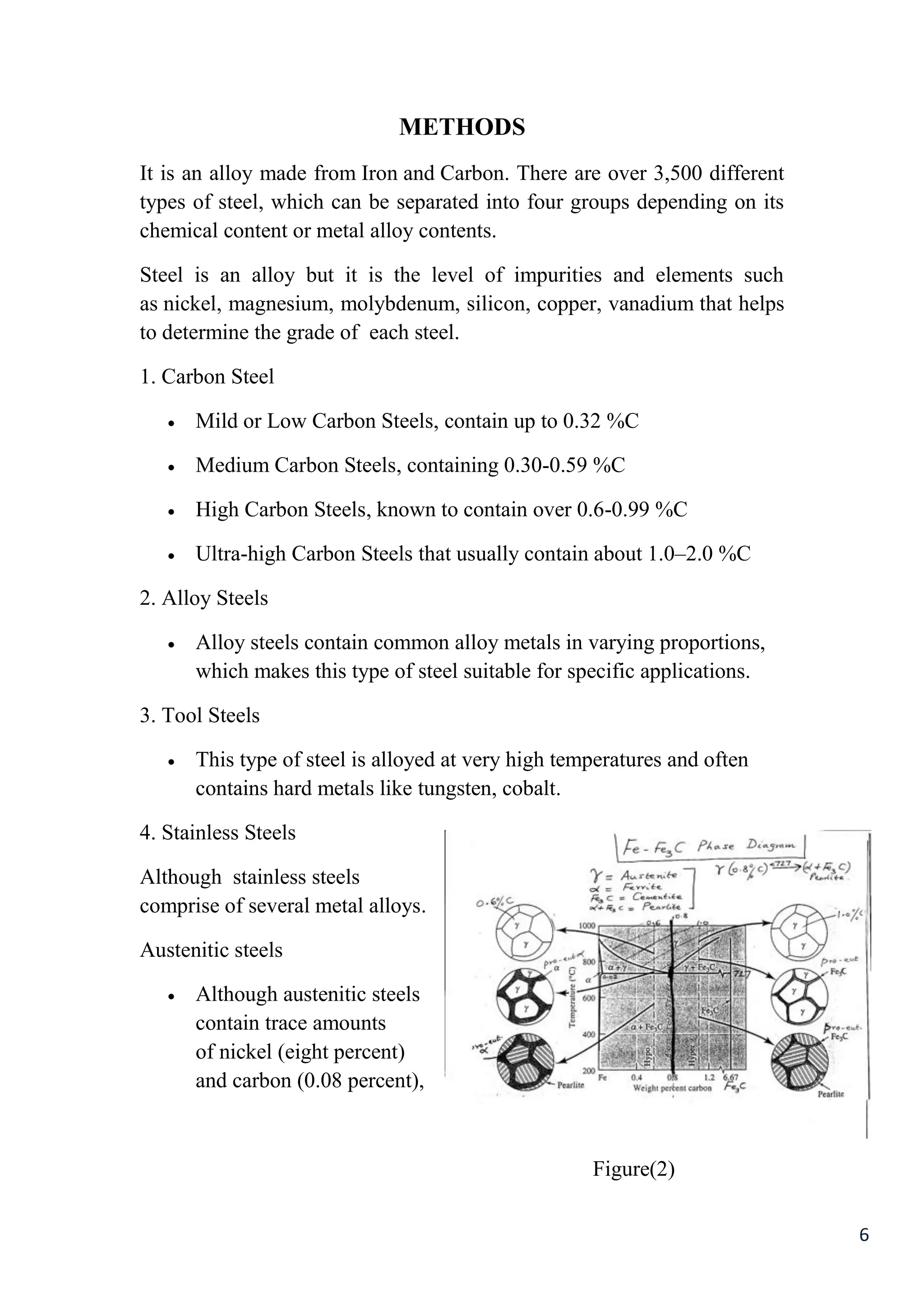
4. Stainless Steels
Although stainless steels
comprise of several metal alloys.
Austenitic steels
 Although austenitic steels
contain trace amounts
of nickel (eight percent)
and carbon (0.08 percent),
Figure(2)
7
CONCLUSION
In my report I firstly I talked briefly about the abstract for this subject
that is study and drawing of microstructures of steels , then I talked about
the history of this subject that when the people knows about it and
explained the subject with an introduction and I showed the images for
more information ,I talked the types of steel and which one that we use it.
8
REFERENCES
[1]. William Stephen Tait, in Handbook Of Environmentan Degradation
Of Materials(second edition),2012.
[2]. Subhasish Mohapatra, B.Tech In Metallurgy and Materials
Engineering,
[3]. Smith, William F.; Hashemi, Javad (2006). Foundations of Materials
Science and Engineering (4th ed.). McGraw-Hill.
[4]. Durand-Charre, Madeleine (2004). Microstructure of Steels and Cast
Irons. Springer.
[5]. Sufiiarov V Sh, Popovich A A, Borisov E V, Polozov I A 2015
Selective laser melting of heatresistant Ni-based alloy. Non-ferrous
Metals
[6]. Stepanova E Yu, Burnashev M A, Stepanov Yu S 2017 Additive and
hybrid technology in the manufacture of tools and tooling: state of the
economy, prospects. Izvestiya TulGU
[7]. Bazyleva O A, Bondarenko Yu A, Morozova G I and Timofeeva O B
2014 Structure, chemical composition, and phase composition of
intermetallic alloy VKNA-1V after high-temperature heat treatment and
process heating, J. Metal Science and Heat Treatment.

Metallurgy Lab

  • 1.
    1 Study and drawingof microstructures of steels Student Name: Rawa Abdullah Taha Class: two – Group A Course Title: Metallurgy Lab Department: Mechanic and Mechatronics College of Engineering Salahaddin University - Erbil Academic Year 2019 – 2020
  • 2.
    2 ABSTRACT When describing thestructure of a material, we make a clear difference between it's crystal structure and it's microstructure. The term ‘crystal structure’ is used to describe the average positions of atoms within the unit cell, and is wholly specified by the lattice type and the fractional coordinates of the atoms (as determined, for example, by X-ray diffraction). In other words, the crystal structure describes the entrance of the material on an atomic (or Å) length scale. The term ‘microstructure’ is used to describe the appearance of the material on the nm-cm length scale.Microscopy can give information concerning a material’s composition, preceding treatment and properties. Steels represent the most widely-used metallic alloy, taking a wide range of microstructures and mechanical properties. By examining the mechanical properties of steels in conjunction with microstructure this book provides a valuable description of the growth and behavior of these materials - the very foundation of their widespread use. Updated throughout and including new chapters on nanostructured steels, and new alloys and technologies for the energy and automobile industries, the book is clearly written and illustrated, with extensive bibliographies and real-life examples. An essential reference, both compact and readily comprehensive, for metallurgists and engineers in both industry and academia.
  • 3.
    3 TABLE OF CONTENTS Abstract2 Table of Contents 3 Introduction 4 Introduction 5 Methods 6 Conclusion 7 References 8
  • 4.
    4 INTRODUCTION engineering material fornearlysizeas a highaccessibleSteel has been ndtrack record alaudabletwo centuries. During this time it has had a very to engineering progress, especially in providing thecriticalone which is infrastructure in underdeveloped and developing parts of the world, which still dwarf in size and population the more developed nations. This continues to increase, leading tois why the volume of steel production more economic ways of manufacturing usingstudythe continual need to energy consumption and preserve naturalminimizesteel in order to commendable efforts by scientists and engineers toIn spite ofresources. property relationships in-microstructure-fully the processingunderstand steels, these continue to present new challenges to researchers because of the complexity of the phase transformation reactions and the wide . Thus, anspectrum of microstructures and properties achievable important theme and objective of this book is to follow the development of our understanding of phase transformations in iron alloys and steels through to the development of modern commercial steels, and in ection between phase transformationparticular to highlight the clear conn studies, no matter how isolated and remote they may seem at the outset, .to the emergence of new steels with enhanced engineering properties The microstructures of iron and steels is complicated and diverse which is uenced by composition, homogeneity, heat treatment, processing andinfl section size. Microstructure of castings looks different than those of the products even if the composition is same and even if the sameshaped The most important transformations in steels, and.heat treatment is given the area where almost all research has been concentrated, are those which result in the final microstructure and properties. These involve decomposition of the high temperature g-phase, austenite, which takes place on cooling and, dependent upon steel alloying and cooling conditions and also whether mechanical working occurs, could follow different paths resulting in a large variety of lower temperature phase types and their mixtures. These transformations could be classified based upon microstructure, thermodynamics or mechanisms and in the present book the phase transformations are classified according to their mechanism. In this scheme the phase transformations in steels are
  • 5.
    5 customarily divided intotwo major groups, which are named according to whether long-range diffusion of atoms occurs or not, namely diffusional or non-diffusional (diffusion less). Each type of phase transformation is then characterized by a set of specific features, including but not limited to composition, crystal structure, shape change and carbon mobility. It is generally accepted that the formation mechanisms of proeutectoid grain boundary allotriomorphs (of a-ferrite and cementite) and pearlite are diffusional. These reactions take place within the higher temperature region of the low temperature phase field with slow kinetics and generally do not require significant undercooling below the g Æ a transition temperature. Figure(1) Steel has three different crystal structures at different temperatures. 1. The room temperature Alpha form has a Body Centered Cubic (BCC) structure. 2. At 913 degrees Celsius the alpha steel converts into Austenite and the structure becomes Face Centered Cubic(FCC). 3. At 1394 degrees Celsius the Austenite turns into Delta phase and transforms its structure to BCC. 4. Steel has many other structures. Like Martensite structure. When you quench (Fast cooling by dipping your sample in water) .
  • 6.
    6 METHODS It is analloy made from Iron and Carbon. There are over 3,500 different types of steel, which can be separated into four groups depending on its chemical content or metal alloy contents. Steel is an alloy but it is the level of impurities and elements such as nickel, magnesium, molybdenum, silicon, copper, vanadium that helps to determine the grade of each steel. 1. Carbon Steel  Mild or Low Carbon Steels, contain up to 0.32 %C  Medium Carbon Steels, containing 0.30-0.59 %C  High Carbon Steels, known to contain over 0.6-0.99 %C  Ultra-high Carbon Steels that usually contain about 1.0–2.0 %C 2. Alloy Steels  Alloy steels contain common alloy metals in varying proportions, which makes this type of steel suitable for specific applications. 3. Tool Steels  This type of steel is alloyed at very high temperatures and often contains hard metals like tungsten, cobalt. 4. Stainless Steels Although stainless steels comprise of several metal alloys. Austenitic steels  Although austenitic steels contain trace amounts of nickel (eight percent) and carbon (0.08 percent), Figure(2)
  • 7.
    7 CONCLUSION In my reportI firstly I talked briefly about the abstract for this subject that is study and drawing of microstructures of steels , then I talked about the history of this subject that when the people knows about it and explained the subject with an introduction and I showed the images for more information ,I talked the types of steel and which one that we use it.
  • 8.
    8 REFERENCES [1]. William StephenTait, in Handbook Of Environmentan Degradation Of Materials(second edition),2012. [2]. Subhasish Mohapatra, B.Tech In Metallurgy and Materials Engineering, [3]. Smith, William F.; Hashemi, Javad (2006). Foundations of Materials Science and Engineering (4th ed.). McGraw-Hill. [4]. Durand-Charre, Madeleine (2004). Microstructure of Steels and Cast Irons. Springer. [5]. Sufiiarov V Sh, Popovich A A, Borisov E V, Polozov I A 2015 Selective laser melting of heatresistant Ni-based alloy. Non-ferrous Metals [6]. Stepanova E Yu, Burnashev M A, Stepanov Yu S 2017 Additive and hybrid technology in the manufacture of tools and tooling: state of the economy, prospects. Izvestiya TulGU [7]. Bazyleva O A, Bondarenko Yu A, Morozova G I and Timofeeva O B 2014 Structure, chemical composition, and phase composition of intermetallic alloy VKNA-1V after high-temperature heat treatment and process heating, J. Metal Science and Heat Treatment.