Economic
Industrial Revolution
Supervisor :Islam Babela 9-12-2018
University of Zakho
College of administration and Economy
Department of Banking and financial
Prepared by :
Adar Hussein haji
Barzan Rashid Abde
Heja Jahwer Xorshed
Omed Adnan Kalho
Rawand Jumha Fatah
Somaya Hishyar Abdlsalam
List of content
• The industrial revolution definition
• Where did the industrial revolution begin
• How long did it last ?
- First industrial revolution
-second industrial revolution
• Why did the industrial revolution begin in England ?
• The industrial revolution in Britain
• What were the advantages and the disadvantages in the industrial revolution ?
- Some advantages
- Some disadvantages
• How did it change the structure of the Economic in the industrial revolution
2
The industrial revolution Definition :
3
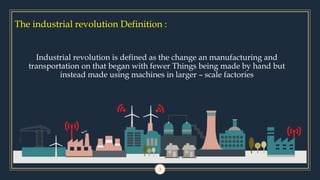
Industrial revolution is defined as the change an manufacturing and
transportation on that began with fewer Things being made by hand but
instead made using machines in larger – scale factories
Where did the industrial revolution begin ?
4
The industrial revolution began in great Britain in the late 1700s
Many of the first innovation that enabled the industrial revolution began in the
textile industry .
Making cloth moved from homes to large Factories .
Britain also had plenty of coal and iron which was important to power make
machines for the factories
How long did it last ?
5
The industrial revolution lasted for over 100 years.
After beginning in Britain in the late 1700s it spread to Europe and the united
states . The industrial revolution can be divited into two phrases :
• First industrial revolution – the first wave of the industrial revolution lasted
from the late 1700s to the mid-1800s . it industrialized the manufacture of textile
and began the move of production from homes to factories. Steam power and
the cotton gin played and important role in this period
• second industrial revolution – the next wave took place from the mid-1800s
to the early 1900s. During this phase large factories and companies began to
use more technologies to mass produce goods. Important innovations during
this period include the use of clectricity, the production line , and the
Bessemer steel process
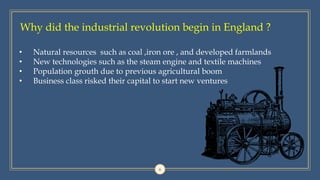
Why did the industrial revolution begin in England ?
6
• Natural resources such as coal ,iron ore , and developed farmlands
• New technologies such as the steam engine and textile machines
• Population grouth due to previous agricultural boom
• Business class risked their capital to start new ventures
7
In the eighteenth century, a series of inventions transformed the manufacture of
cotton in England and gave rise to a new mode of production -the factory
system. During these years, other branches of industry effected comparable
advances, and all these together, mutually reinforcing one another, made
possible further gains on an ever-widening front. The abundance and variety of
these innovations almost defy compilation, but they may be subsumed under
three principles: the substitution of machines-rapid, regular, precise, tireless-for
human skill and effort; the substitution of inanimate for animate sources of
power, in particular, the introduction of engines for converting heat into work,
thereby opening to man a new and almost unlimited supply of energy; the use
of new and far more abundant raw materials, in particular, the substitution of
mineral for vegetable or animal substances.
The industrial revolution in Britain
8
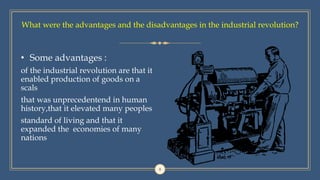
• Some advantages :
of the industrial revolution are that it
enabled production of goods on a
scals
that was unprecedentend in human
history,that it elevated many peoples
standard of living and that it
expanded the economies of many
nations
What were the advantages and the disadvantages in the industrial revolution?
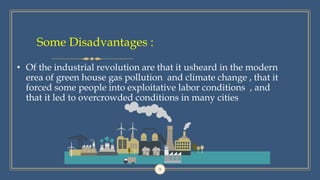
Some Disadvantages :
• Of the industrial revolution are that it usheard in the modern
erea of green house gas pollution and climate change , that it
forced some people into exploitative labor conditions , and
that it led to overcrowded conditions in many cities
9
How did it change the structure of the economic in the industrial revolution ?
10
• The industrial and economics development of the industrial revolution
brough significant social change. Industrialization resulted in an in an
increases in population and the phenomenon og urbanization , as a
growing number of people moved to urban centuries in search of
employment. Some individuals became very wealthy , but some lived
in horrible conditions . A class of prosperous industrial ship owner
and merchants dominated , a ccumulating great wealth , but at the
sometime to working classes had to live with minimum comeforts
in overcrowded environments . Children were sent to work in
factories , where they were exploited and ill-treated women
experienced substantial changes in their lifestyle as they took jobs in
domestic service and the textile industrial ,
11
Leaving the agnicultural work force and spending less time in the family
home . This period also saw the creation of a middle class that enjoyed the
benefits of the free time entertaining themselves in theatres , concret halls
and sports facilities or enjoying the country side in promenades
The References
www.yourdictionary.com
https://www.ducksters.com
https://www.slideshare.net
https://www.enotes.com
the book : Davis S. Land (1969) – the unbound Prometheus
https://www.britishmuseum.org/research
Thank You!

Industrial revolution

  • 1.
    Economic Industrial Revolution Supervisor :IslamBabela 9-12-2018 University of Zakho College of administration and Economy Department of Banking and financial Prepared by : Adar Hussein haji Barzan Rashid Abde Heja Jahwer Xorshed Omed Adnan Kalho Rawand Jumha Fatah Somaya Hishyar Abdlsalam
  • 2.
    List of content •The industrial revolution definition • Where did the industrial revolution begin • How long did it last ? - First industrial revolution -second industrial revolution • Why did the industrial revolution begin in England ? • The industrial revolution in Britain • What were the advantages and the disadvantages in the industrial revolution ? - Some advantages - Some disadvantages • How did it change the structure of the Economic in the industrial revolution 2
  • 3.
    The industrial revolutionDefinition : 3 Industrial revolution is defined as the change an manufacturing and transportation on that began with fewer Things being made by hand but instead made using machines in larger – scale factories
  • 4.
    Where did theindustrial revolution begin ? 4 The industrial revolution began in great Britain in the late 1700s Many of the first innovation that enabled the industrial revolution began in the textile industry . Making cloth moved from homes to large Factories . Britain also had plenty of coal and iron which was important to power make machines for the factories
  • 5.
    How long didit last ? 5 The industrial revolution lasted for over 100 years. After beginning in Britain in the late 1700s it spread to Europe and the united states . The industrial revolution can be divited into two phrases : • First industrial revolution – the first wave of the industrial revolution lasted from the late 1700s to the mid-1800s . it industrialized the manufacture of textile and began the move of production from homes to factories. Steam power and the cotton gin played and important role in this period • second industrial revolution – the next wave took place from the mid-1800s to the early 1900s. During this phase large factories and companies began to use more technologies to mass produce goods. Important innovations during this period include the use of clectricity, the production line , and the Bessemer steel process
  • 6.
    Why did theindustrial revolution begin in England ? 6 • Natural resources such as coal ,iron ore , and developed farmlands • New technologies such as the steam engine and textile machines • Population grouth due to previous agricultural boom • Business class risked their capital to start new ventures
  • 7.
    7 In the eighteenthcentury, a series of inventions transformed the manufacture of cotton in England and gave rise to a new mode of production -the factory system. During these years, other branches of industry effected comparable advances, and all these together, mutually reinforcing one another, made possible further gains on an ever-widening front. The abundance and variety of these innovations almost defy compilation, but they may be subsumed under three principles: the substitution of machines-rapid, regular, precise, tireless-for human skill and effort; the substitution of inanimate for animate sources of power, in particular, the introduction of engines for converting heat into work, thereby opening to man a new and almost unlimited supply of energy; the use of new and far more abundant raw materials, in particular, the substitution of mineral for vegetable or animal substances. The industrial revolution in Britain
  • 8.
    8 • Some advantages: of the industrial revolution are that it enabled production of goods on a scals that was unprecedentend in human history,that it elevated many peoples standard of living and that it expanded the economies of many nations What were the advantages and the disadvantages in the industrial revolution?
  • 9.
    Some Disadvantages : •Of the industrial revolution are that it usheard in the modern erea of green house gas pollution and climate change , that it forced some people into exploitative labor conditions , and that it led to overcrowded conditions in many cities 9
  • 10.
    How did itchange the structure of the economic in the industrial revolution ? 10 • The industrial and economics development of the industrial revolution brough significant social change. Industrialization resulted in an in an increases in population and the phenomenon og urbanization , as a growing number of people moved to urban centuries in search of employment. Some individuals became very wealthy , but some lived in horrible conditions . A class of prosperous industrial ship owner and merchants dominated , a ccumulating great wealth , but at the sometime to working classes had to live with minimum comeforts in overcrowded environments . Children were sent to work in factories , where they were exploited and ill-treated women experienced substantial changes in their lifestyle as they took jobs in domestic service and the textile industrial ,
  • 11.
    11 Leaving the agniculturalwork force and spending less time in the family home . This period also saw the creation of a middle class that enjoyed the benefits of the free time entertaining themselves in theatres , concret halls and sports facilities or enjoying the country side in promenades
  • 12.
    The References www.yourdictionary.com https://www.ducksters.com https://www.slideshare.net https://www.enotes.com the book: Davis S. Land (1969) – the unbound Prometheus https://www.britishmuseum.org/research
  • 13.