CERAMICS Structure and Properties of Ceramics Traditional Ceramics New Ceramics Glass Some Important Elements Related to Ceramics Guide to Processing Ceramics
Ceramic Defined An inorganic compound consisting of a metal (or semi‑metal) and one or more nonmetals Important examples: Silica -  silicon dioxide (SiO 2 ), the main ingredient in most glass products Alumina -  aluminum oxide (Al 2 O 3 ), used in various applications from abrasives to artificial bones More complex compounds such as hydrous aluminum silicate (Al 2 Si 2 O 5 (OH) 4 ), the main ingredient in most clay products
Properties of Ceramic Materials High hardness, electrical and thermal insulating, chemical stability, and high melting temperatures Brittle, virtually no ductility - can cause problems in both processing and performance of ceramic products Some ceramics are translucent, window glass (based on silica) being the clearest example
Ceramic Products Clay construction products - bricks, clay pipe, and building tile  Refractory ceramics ‑ capable of high temperature applications such as furnace walls, crucibles, and molds  Cement used in concrete - used for construction and roads Whiteware products  -  pottery, stoneware, fine china, porcelain, and other tableware, based on mixtures of clay and other minerals
Ceramic Products (continued)  Glass ‑ bottles, glasses, lenses, window pane, and light bulbs  Glass fibers  - thermal insulating wool, reinforced plastics (fiberglass), and fiber optics communications lines  Abrasives - aluminum oxide and silicon carbide in grinding wheels Cutting tool materials - tungsten carbide, aluminum oxide, and cubic boron nitride
Ceramic Products (continued) Ceramic insulators ‑ applications include electrical transmission components, spark plugs, and microelectronic chip substrates  Magnetic ceramics – computer memories Nuclear fuels based on uranium oxide (UO 2 ) Bioceramics - artificial teeth and bones
Three Basic Categories  of Ceramics Traditional ceramics ‑ clay products such as pottery, bricks, common abrasives, and cement New ceramics ‑ more recently developed ceramics based on oxides, carbides, etc., with better mechanical or physical properties than traditional ceramics Glasses ‑ based primarily on silica and distinguished by their noncrystalline structure
Strength Properties of Ceramics Theoretically, the strength of ceramics should be higher than metals because their covalent and ionic bonding types are stronger than metallic bonding  But metallic bonding allows for slip, the mechanism by which metals deform plastically when stressed Bonding in ceramics is more rigid and does not permit slip under stress  The inability to slip makes it much more difficult for ceramics to absorb stresses
Imperfections in  Crystal Structure of Ceramics Ceramics contain the same imperfections in their crystal structure as metals ‑ vacancies, displaced atoms, interstitialcies, and microscopic cracks  Internal flaws tend to concentrate stresses, especially tensile, bending, or impact  Hence, ceramics fail by brittle fracture much more readily than metals Strength is much less predictable due to random imperfections and processing variations
Compressive Strength  of Ceramics The frailties that limit the tensile strength of ceramic materials are not nearly so operative when compressive stresses are applied Ceramics are substantially stronger in compression than in tension  For engineering and structural applications, designers have learned to use ceramic components so that they are loaded in compression rather than tension or bending
Methods to Strengthen  Ceramic Materials Make starting materials more uniform Decrease grain size in polycrystalline ceramic products Minimize porosity Introduce compressive surface stresses  Use fiber reinforcement Heat treat
Physical Properties of Ceramics Density – most ceramics are lighter than metals but heavier than polymers  Melting temperatures - higher than for most metals  Some ceramics decompose rather than melt Electrical and thermal conductivities - lower than for metals; but the range of values is greater, so some ceramics are insulators while others are conductors Thermal expansion - somewhat less than for metals, but effects are more damaging because of brittleness
Traditional Ceramics Based on mineral silicates, silica, and mineral oxides found in nature Primary products are fired clay (pottery, tableware, brick, and tile), cement, and natural abrasives such as alumina Products and the processes to make them date back thousands of years  Glass is also a silicate ceramic material and is sometimes included among traditional ceramics
Raw Materials for  Traditional Ceramics Mineral silicates, such as  clays  and  silica , are among the most abundant substances in nature and are the principal raw materials for traditional ceramics  Another important raw material for traditional ceramics is  alumina These solid crystalline compounds have been formed and mixed in the earth’s crust over billions of years by complex geological processes
Clay as a Ceramic Raw Material Clays consist of fine particles of hydrous aluminum silicate Mostly based on  kaolinite , (Al 2 Si 2 O 5 (OH) 4 ) Mixed with water, clay becomes a plastic substance that is formable and moldable  When heated to a sufficiently elevated temperature ( firing ), clay fuses into a dense, strong material Thus, clay can be shaped while wet and soft, and then fired to obtain the final hard product
Silica as a Ceramic Raw Material Available naturally in various forms, most important is  quartz Main source of quartz is  sandstone   Low cost Hard and chemically stable Principal component in glass, and an important ingredient in other ceramic products including whiteware, refractories, and abrasives
Alumina as a Ceramic Raw Material Bauxite  - most alumina is processed from this mineral, which is an impure mixture of hydrous aluminum oxide and aluminum hydroxide plus similar compounds of iron or manganese Bauxite is also the principal source of aluminum  Corundum  - a more pure but less common form of Al 2 O 3 , which contains alumina in massive amounts  Alumina ceramic is used as an abrasive in grinding wheels and as a refractory brick in furnaces
Traditional Ceramic Products Pottery and Tableware Brick and tile Refractories Abrasives
New Ceramics Ceramic materials developed synthetically over the last several decades Also refers to improvements in processing techniques that provide greater control over structures and properties of ceramic materials  New ceramics are based on compounds other than variations of aluminum silicate New ceramics are usually simpler chemically than traditional ceramics; for example, oxides, carbides, nitrides, and borides
Oxide Ceramics Most important oxide ceramic is alumina Al 2 O 3 Although included among traditional ceramics, alumina is also produced synthetically from bauxite  Through control of particle size and impurities, refinements in processing methods, and blending with small amounts of other ceramic ingredients, strength and toughness of alumina are improved substantially compared to its natural counterpart  Alumina also has good hot hardness, low thermal conductivity, and good corrosion resistance
Products of Oxide Ceramics Abrasives (grinding wheel grit) Bioceramics (artificial bones and teeth) Electrical insulators and electronic components Refractory brick Cutting tool inserts  Spark plug barrels Engineering components
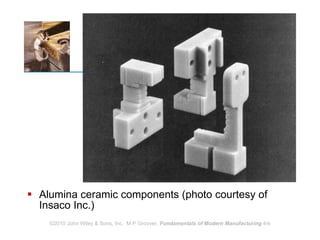
Alumina ceramic components (photo courtesy of Insaco Inc.)
Carbide Ceramics Includes silicon carbide (SiC), tungsten carbide (WC), titanium carbide (TiC), tantalum carbide (TaC), and chromium carbide (Cr 3 C 2 )  Production of SiC dates from a century ago, and it is generally included among traditional ceramics WC, TiC, and TaC are hard and wear resistant and are used in applications such as cutting tools WC, TiC, and TaC must be combined with a metallic binder such as cobalt or nickel in order to fabricate a useful solid product
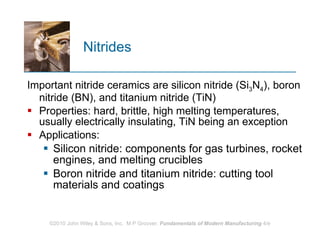
Nitrides Important nitride ceramics are silicon nitride (Si 3 N 4 ), boron nitride (BN), and titanium nitride (TiN)  Properties: hard, brittle, high melting temperatures, usually electrically insulating, TiN being an exception  Applications:  Silicon nitride: components for gas turbines, rocket engines, and melting crucibles Boron nitride and titanium nitride: cutting tool materials and coatings
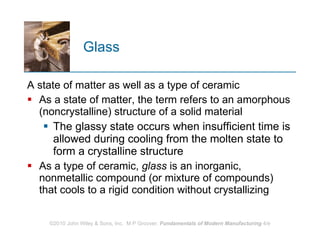
Glass A state of matter as well as a type of ceramic As a state of matter, the term refers to an amorphous (noncrystalline) structure of a solid material The glassy state occurs when insufficient time is allowed during cooling from the molten state to form a crystalline structure  As a type of ceramic,  glass  is an inorganic, nonmetallic compound (or mixture of compounds) that cools to a rigid condition without crystallizing
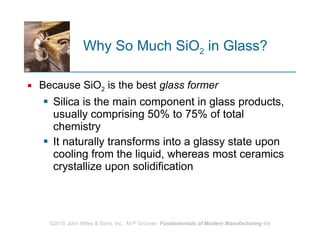
Why So Much SiO 2  in Glass? Because SiO 2  is the best  glass former   Silica is the main component in glass products, usually comprising 50% to 75% of total chemistry  It naturally transforms into a glassy state upon cooling from the liquid, whereas most ceramics crystallize upon solidification
Other Ingredients in Glass Sodium oxide (Na 2 O) Calcium oxide (CaO) Aluminum oxide (Al 2 O 3 ) Magnesium oxide (MgO) Potassium oxide (K 2 O) Lead oxide (PbO) Boron oxide (B 2 O 3 )
Functions of  Other Ingredients in Glass Act as flux (promoting fusion) during heating Increase fluidity in molten glass for processing Improve chemical resistance against attack by acids, basic substances, or water Add color Alter index of refraction for optics
Glass Products Window glass Containers – cups, jars, bottles Light bulbs Laboratory glassware – flasks, beakers, glass tubing Glass fibers – insulation, fiber optics Optical glasses - lenses
Glass‑Ceramics A ceramic material produced by conversion of glass into a polycrystalline structure through heat treatment Proportion of crystalline phase range = 90% to 98%, remainder vitreous material Grain size significantly smaller than the conventional ceramics, which makes glass‑ceramics much stronger than the glasses from which they are made  Due to crystal structure, glass‑ceramics are opaque (usually grey or white), not clear
Processing of Glass Ceramics Heating and forming techniques used in glassworking create product shape Product is cooled and then reheated to cause a dense network of crystal nuclei to form throughout  Nucleation results from small amounts of nucleating agents, such as TiO 2 , P 2 O 5 , and ZrO 2   Once nucleation is started, heat treatment is continued at a higher temperature to cause growth of crystalline phases
Advantages of Glass‑Ceramics  Efficiency of processing in the glassy state Close dimensional control over final shape Good mechanical and physical properties High strength (stronger than glass) Absence of porosity; low thermal expansion High resistance to thermal shock
Applications of Glass-Ceramics Cooking ware (e.g., Corning ware) Heat exchangers Missile radomes
Elements Related to Ceramics Carbon Two alternative forms of engineering and commercial importance:  graphite  and  diamond Silicon and Boron Carbon, silicon, and boron are not ceramic materials, but they sometimes  Compete for applications with ceramics  Have important applications of their own
Graphite Form of carbon with a high content of crystalline carbon in the form of layers Bonding between atoms in layers is covalent and strong, but parallel layers are bonded to each other by weak van der Waals forces Structure makes graphite properties anisotropic  As a powder it is a lubricant, but in traditional solid form it is a refractory As a fiber, it is a high strength structural material (e.g., fiber reinforced plastics)
Diamond Carbon with a cubic crystalline structure with covalent bonding between atoms for  high hardness Applications: cutting tools and grinding wheels for machining hard, brittle materials or materials that are very abrasive; also used in dressing tools to sharpen grinding wheels that consist of other abrasives  Synthetic diamonds date back to 1950s Fabricated by heating graphite to around 3000  C (5400  F) under very high pressures
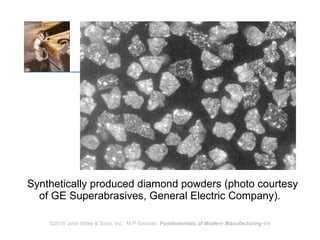
Synthetically produced diamond powders (photo courtesy of GE Superabrasives, General Electric Company).
Silicon Semi-metallic element in the same periodic table group as carbon  One of the most abundant elements in Earth's crust, comprising    26% by weight  Occurs naturally only as chemical compound ‑ in rocks, sand, clay, and soil ‑ either as silicon dioxide or as more complex silicate compounds  Properties: hard, brittle, lightweight, chemically inactive at room temperature, and classified as a semiconductor
Applications and Importance  of Silicon Greatest use in manufacturing are as ceramics (SiO 2  in glass and silicates in clays) and alloying elements in steel, cast iron, aluminum, and copper Pure silicon is of significant technological importance as the base material in semiconductor manufacturing in electronics  The vast majority of integrated circuits produced today are made from silicon
Boron Semi-metallic element in same periodic group as aluminum Comprises only about 0.001% of Earth's crust by weight, commonly occurring as minerals  borax  (Na 2 B 4 O 7 ‑10H 2 O) and  kernite  (Na 2 B 4 O 7 ‑4H 2 O)  Properties: lightweight, semiconducting properties, and very stiff (high modulus of elasticity) in fiber form Applications: B 2 O 3  in certain glasses, as a nitride (cBN) for cutting tools, and in nearly pure form as a fiber in polymer matrix composites
Guide to Processing Ceramics Processing of ceramics can be divided into two basic categories:  Molten ceramics - major category of molten ceramics is glassworking (solidification processes)  Particulate ceramics - traditional and new ceramics (particulate processing)

Ch07

  • 1.
    CERAMICS Structure andProperties of Ceramics Traditional Ceramics New Ceramics Glass Some Important Elements Related to Ceramics Guide to Processing Ceramics
  • 2.
    Ceramic Defined Aninorganic compound consisting of a metal (or semi‑metal) and one or more nonmetals Important examples: Silica - silicon dioxide (SiO 2 ), the main ingredient in most glass products Alumina - aluminum oxide (Al 2 O 3 ), used in various applications from abrasives to artificial bones More complex compounds such as hydrous aluminum silicate (Al 2 Si 2 O 5 (OH) 4 ), the main ingredient in most clay products
  • 3.
    Properties of CeramicMaterials High hardness, electrical and thermal insulating, chemical stability, and high melting temperatures Brittle, virtually no ductility - can cause problems in both processing and performance of ceramic products Some ceramics are translucent, window glass (based on silica) being the clearest example
  • 4.
    Ceramic Products Clayconstruction products - bricks, clay pipe, and building tile Refractory ceramics ‑ capable of high temperature applications such as furnace walls, crucibles, and molds Cement used in concrete - used for construction and roads Whiteware products - pottery, stoneware, fine china, porcelain, and other tableware, based on mixtures of clay and other minerals
  • 5.
    Ceramic Products (continued) Glass ‑ bottles, glasses, lenses, window pane, and light bulbs Glass fibers - thermal insulating wool, reinforced plastics (fiberglass), and fiber optics communications lines Abrasives - aluminum oxide and silicon carbide in grinding wheels Cutting tool materials - tungsten carbide, aluminum oxide, and cubic boron nitride
  • 6.
    Ceramic Products (continued)Ceramic insulators ‑ applications include electrical transmission components, spark plugs, and microelectronic chip substrates Magnetic ceramics – computer memories Nuclear fuels based on uranium oxide (UO 2 ) Bioceramics - artificial teeth and bones
  • 7.
    Three Basic Categories of Ceramics Traditional ceramics ‑ clay products such as pottery, bricks, common abrasives, and cement New ceramics ‑ more recently developed ceramics based on oxides, carbides, etc., with better mechanical or physical properties than traditional ceramics Glasses ‑ based primarily on silica and distinguished by their noncrystalline structure
  • 8.
    Strength Properties ofCeramics Theoretically, the strength of ceramics should be higher than metals because their covalent and ionic bonding types are stronger than metallic bonding But metallic bonding allows for slip, the mechanism by which metals deform plastically when stressed Bonding in ceramics is more rigid and does not permit slip under stress The inability to slip makes it much more difficult for ceramics to absorb stresses
  • 9.
    Imperfections in Crystal Structure of Ceramics Ceramics contain the same imperfections in their crystal structure as metals ‑ vacancies, displaced atoms, interstitialcies, and microscopic cracks Internal flaws tend to concentrate stresses, especially tensile, bending, or impact Hence, ceramics fail by brittle fracture much more readily than metals Strength is much less predictable due to random imperfections and processing variations
  • 10.
    Compressive Strength of Ceramics The frailties that limit the tensile strength of ceramic materials are not nearly so operative when compressive stresses are applied Ceramics are substantially stronger in compression than in tension For engineering and structural applications, designers have learned to use ceramic components so that they are loaded in compression rather than tension or bending
  • 11.
    Methods to Strengthen Ceramic Materials Make starting materials more uniform Decrease grain size in polycrystalline ceramic products Minimize porosity Introduce compressive surface stresses Use fiber reinforcement Heat treat
  • 12.
    Physical Properties ofCeramics Density – most ceramics are lighter than metals but heavier than polymers Melting temperatures - higher than for most metals Some ceramics decompose rather than melt Electrical and thermal conductivities - lower than for metals; but the range of values is greater, so some ceramics are insulators while others are conductors Thermal expansion - somewhat less than for metals, but effects are more damaging because of brittleness
  • 13.
    Traditional Ceramics Basedon mineral silicates, silica, and mineral oxides found in nature Primary products are fired clay (pottery, tableware, brick, and tile), cement, and natural abrasives such as alumina Products and the processes to make them date back thousands of years Glass is also a silicate ceramic material and is sometimes included among traditional ceramics
  • 14.
    Raw Materials for Traditional Ceramics Mineral silicates, such as clays and silica , are among the most abundant substances in nature and are the principal raw materials for traditional ceramics Another important raw material for traditional ceramics is alumina These solid crystalline compounds have been formed and mixed in the earth’s crust over billions of years by complex geological processes
  • 15.
    Clay as aCeramic Raw Material Clays consist of fine particles of hydrous aluminum silicate Mostly based on kaolinite , (Al 2 Si 2 O 5 (OH) 4 ) Mixed with water, clay becomes a plastic substance that is formable and moldable When heated to a sufficiently elevated temperature ( firing ), clay fuses into a dense, strong material Thus, clay can be shaped while wet and soft, and then fired to obtain the final hard product
  • 16.
    Silica as aCeramic Raw Material Available naturally in various forms, most important is quartz Main source of quartz is sandstone Low cost Hard and chemically stable Principal component in glass, and an important ingredient in other ceramic products including whiteware, refractories, and abrasives
  • 17.
    Alumina as aCeramic Raw Material Bauxite - most alumina is processed from this mineral, which is an impure mixture of hydrous aluminum oxide and aluminum hydroxide plus similar compounds of iron or manganese Bauxite is also the principal source of aluminum Corundum - a more pure but less common form of Al 2 O 3 , which contains alumina in massive amounts Alumina ceramic is used as an abrasive in grinding wheels and as a refractory brick in furnaces
  • 18.
    Traditional Ceramic ProductsPottery and Tableware Brick and tile Refractories Abrasives
  • 19.
    New Ceramics Ceramicmaterials developed synthetically over the last several decades Also refers to improvements in processing techniques that provide greater control over structures and properties of ceramic materials New ceramics are based on compounds other than variations of aluminum silicate New ceramics are usually simpler chemically than traditional ceramics; for example, oxides, carbides, nitrides, and borides
  • 20.
    Oxide Ceramics Mostimportant oxide ceramic is alumina Al 2 O 3 Although included among traditional ceramics, alumina is also produced synthetically from bauxite Through control of particle size and impurities, refinements in processing methods, and blending with small amounts of other ceramic ingredients, strength and toughness of alumina are improved substantially compared to its natural counterpart Alumina also has good hot hardness, low thermal conductivity, and good corrosion resistance
  • 21.
    Products of OxideCeramics Abrasives (grinding wheel grit) Bioceramics (artificial bones and teeth) Electrical insulators and electronic components Refractory brick Cutting tool inserts Spark plug barrels Engineering components
  • 22.
    Alumina ceramic components(photo courtesy of Insaco Inc.)
  • 23.
    Carbide Ceramics Includessilicon carbide (SiC), tungsten carbide (WC), titanium carbide (TiC), tantalum carbide (TaC), and chromium carbide (Cr 3 C 2 ) Production of SiC dates from a century ago, and it is generally included among traditional ceramics WC, TiC, and TaC are hard and wear resistant and are used in applications such as cutting tools WC, TiC, and TaC must be combined with a metallic binder such as cobalt or nickel in order to fabricate a useful solid product
  • 24.
    Nitrides Important nitrideceramics are silicon nitride (Si 3 N 4 ), boron nitride (BN), and titanium nitride (TiN) Properties: hard, brittle, high melting temperatures, usually electrically insulating, TiN being an exception Applications: Silicon nitride: components for gas turbines, rocket engines, and melting crucibles Boron nitride and titanium nitride: cutting tool materials and coatings
  • 25.
    Glass A stateof matter as well as a type of ceramic As a state of matter, the term refers to an amorphous (noncrystalline) structure of a solid material The glassy state occurs when insufficient time is allowed during cooling from the molten state to form a crystalline structure As a type of ceramic, glass is an inorganic, nonmetallic compound (or mixture of compounds) that cools to a rigid condition without crystallizing
  • 26.
    Why So MuchSiO 2 in Glass? Because SiO 2 is the best glass former Silica is the main component in glass products, usually comprising 50% to 75% of total chemistry It naturally transforms into a glassy state upon cooling from the liquid, whereas most ceramics crystallize upon solidification
  • 27.
    Other Ingredients inGlass Sodium oxide (Na 2 O) Calcium oxide (CaO) Aluminum oxide (Al 2 O 3 ) Magnesium oxide (MgO) Potassium oxide (K 2 O) Lead oxide (PbO) Boron oxide (B 2 O 3 )
  • 28.
    Functions of Other Ingredients in Glass Act as flux (promoting fusion) during heating Increase fluidity in molten glass for processing Improve chemical resistance against attack by acids, basic substances, or water Add color Alter index of refraction for optics
  • 29.
    Glass Products Windowglass Containers – cups, jars, bottles Light bulbs Laboratory glassware – flasks, beakers, glass tubing Glass fibers – insulation, fiber optics Optical glasses - lenses
  • 30.
    Glass‑Ceramics A ceramicmaterial produced by conversion of glass into a polycrystalline structure through heat treatment Proportion of crystalline phase range = 90% to 98%, remainder vitreous material Grain size significantly smaller than the conventional ceramics, which makes glass‑ceramics much stronger than the glasses from which they are made Due to crystal structure, glass‑ceramics are opaque (usually grey or white), not clear
  • 31.
    Processing of GlassCeramics Heating and forming techniques used in glassworking create product shape Product is cooled and then reheated to cause a dense network of crystal nuclei to form throughout Nucleation results from small amounts of nucleating agents, such as TiO 2 , P 2 O 5 , and ZrO 2 Once nucleation is started, heat treatment is continued at a higher temperature to cause growth of crystalline phases
  • 32.
    Advantages of Glass‑Ceramics Efficiency of processing in the glassy state Close dimensional control over final shape Good mechanical and physical properties High strength (stronger than glass) Absence of porosity; low thermal expansion High resistance to thermal shock
  • 33.
    Applications of Glass-CeramicsCooking ware (e.g., Corning ware) Heat exchangers Missile radomes
  • 34.
    Elements Related toCeramics Carbon Two alternative forms of engineering and commercial importance: graphite and diamond Silicon and Boron Carbon, silicon, and boron are not ceramic materials, but they sometimes Compete for applications with ceramics Have important applications of their own
  • 35.
    Graphite Form ofcarbon with a high content of crystalline carbon in the form of layers Bonding between atoms in layers is covalent and strong, but parallel layers are bonded to each other by weak van der Waals forces Structure makes graphite properties anisotropic As a powder it is a lubricant, but in traditional solid form it is a refractory As a fiber, it is a high strength structural material (e.g., fiber reinforced plastics)
  • 36.
    Diamond Carbon witha cubic crystalline structure with covalent bonding between atoms for high hardness Applications: cutting tools and grinding wheels for machining hard, brittle materials or materials that are very abrasive; also used in dressing tools to sharpen grinding wheels that consist of other abrasives Synthetic diamonds date back to 1950s Fabricated by heating graphite to around 3000  C (5400  F) under very high pressures
  • 37.
    Synthetically produced diamondpowders (photo courtesy of GE Superabrasives, General Electric Company).
  • 38.
    Silicon Semi-metallic elementin the same periodic table group as carbon One of the most abundant elements in Earth's crust, comprising  26% by weight Occurs naturally only as chemical compound ‑ in rocks, sand, clay, and soil ‑ either as silicon dioxide or as more complex silicate compounds Properties: hard, brittle, lightweight, chemically inactive at room temperature, and classified as a semiconductor
  • 39.
    Applications and Importance of Silicon Greatest use in manufacturing are as ceramics (SiO 2 in glass and silicates in clays) and alloying elements in steel, cast iron, aluminum, and copper Pure silicon is of significant technological importance as the base material in semiconductor manufacturing in electronics The vast majority of integrated circuits produced today are made from silicon
  • 40.
    Boron Semi-metallic elementin same periodic group as aluminum Comprises only about 0.001% of Earth's crust by weight, commonly occurring as minerals borax (Na 2 B 4 O 7 ‑10H 2 O) and kernite (Na 2 B 4 O 7 ‑4H 2 O) Properties: lightweight, semiconducting properties, and very stiff (high modulus of elasticity) in fiber form Applications: B 2 O 3 in certain glasses, as a nitride (cBN) for cutting tools, and in nearly pure form as a fiber in polymer matrix composites
  • 41.
    Guide to ProcessingCeramics Processing of ceramics can be divided into two basic categories: Molten ceramics - major category of molten ceramics is glassworking (solidification processes) Particulate ceramics - traditional and new ceramics (particulate processing)