Morse Test
Student Name: Rawa Abdullah Taha
Class: Third – Group A2
Course Title: I.C Engine Lab
Department: Mechanic and Mechatronics
College of Engineering
Salddin University - Erbil
Academic Year 2020 – 2021
Date /5/2021
Objectives:
Determination of the power extracted from the fuel (IP) and the power
lost (FP) within the Si engine by Morse test
Conditions:
The test requires a multi-cylinder engine running at any given speed and
throttle-opening and attached to any type of dynamometers other than the
electric dynamometer.
Introduction:
The determination of Morse test is to achieve the approximate indicated
power of a Multi cylinder engine. It consists of running the engine against
the dynamometer at a particular speed, cutting out the firing of each
cylinder in turn and noting the fall in BP each time while maintaining the
speed constant. When one cylinder is cut off, power developed is reduced
and speed of engine falls. Accordingly, the load on dynamometer is
adjusted so as to restore the speed of the engine. This is done to maintain
FP constant, which is considered to be independent of the load and
proportional to the engine speed. The observed difference in BP between
all cylinder firing and one cylinder cut off is the IP of the cut off cylinder.
Summation of IP of the entire cylinder would then give the IP of the
engine under test. The Morse Test is performed to find the power
developed in each cylinder in a multi cylinder internal combustion
engine. It basically gives the relationship between indicated power and
brake power. It is assumed that friction and pumping losses do not change
and remains same when the cylinder is in firing condition as well as in
inoperative
condition.
Fig(1)
Using these test frictional losses in the IC engine can be easily
calculated. It is a simple approach to find the mechanical efficiency of the
engine. First power developed by all the cylinders is determined
experimentally. Then using the power supply cut off to the spark plug of
cylinder, powers developed by individual cylinders are determined. Then
for the remaining cylinders, power developed by engine is determined
experimentally and obtained value is subtracted from the first value and
this gives power developed in the cylinder whose spark plug was cut off.
In the similar fashion, this test is performed on all the cylinders of the
engine individually. The main intention of carrying out the Morse test in
an IC engine is to provide an easy method of calculating the frictional
losses. It provides a kind of top-down approach in calculating frictional
losses easily and helps calculate mechanical efficiency. The total break
power of the engine is first calculated using a dynamometer. The process
is repeated with one cylinder off at each step. This the difference between
total break power and break power of the remaining cylinders gives the
indicated power of the first cylinder; and so on. In this way, indicated
power of all cylinders are calculated and summed to obtain the indicated
power of the engine Friction power = indicated power - total brake
power. Once friction power is obtained, the mechanical efficiency of the
engine can be calculated.
Theory:
The test is conducted by running the engine at a selected speed (N.) and
throttle-opening (thopg). Assuming an (n) cylinder engine which is
developing a brake power (BP.) as all the cylinders (n) are firing
sequentially according to the firing order. The Indicated power (IP.) is the
sum of (BP.) and friction power (FP.) of the engine or.
𝑩𝑷𝒏 = 𝑰𝑷𝒏 − 𝑭𝑷𝒏 … … … … (𝟏)
In addition to the friction of the mechanical parts of the engine, the
friction power (FPn) Incorporates the friction of water, oils and hydraulic
fluids as they flow in the pipes of the cooling and lubrication systems The
flow of air into and out of the engine also produces friction which varies
with the air flow velocity and the throttle opening. Therefore, the friction
power Is frequently called as the pumping losses. The test demands
power cut-off on one of the cylinders at a time while keeping the throttle-
opening and the engine speed unchanged. This could be achieved by
switching-off the electric energy on that peculiar cylinder and adjusting
the load to maintain the same speed as (n) cylinders are firing. The engine
output is merely the brake power of the firing cylinders only (BPn-1), but
the load however, is the sum of the external load applied by the
dynamometer and the load of the cut-off cylinder.
𝑩𝑷𝒏−𝟏 = 𝑰𝑷𝒏−𝟏 − 𝑭𝑷𝒏 … … … … (𝟐)
Where
BPn-1 is the brake power of the firing cylinders.
IPn-1 Is the indicated power of the firing cylinders.
FPn is the friction power of the engine.
n is the total number of cylinders of the engine.
Substituting eq. 1 from eq. 2 gives the Indicated power of the cut-out
cylinder.
𝑰𝑷𝒊 = 𝑩𝑷𝒏 − 𝑩𝑷𝒏−𝟏 … … … … (𝟑)
Where
i is the sequential rank of the cylinder In the engine (1,2,3,…., n)
The summation of the individual indicated powers (IPi) for all the cutout
cylinders’ gives:
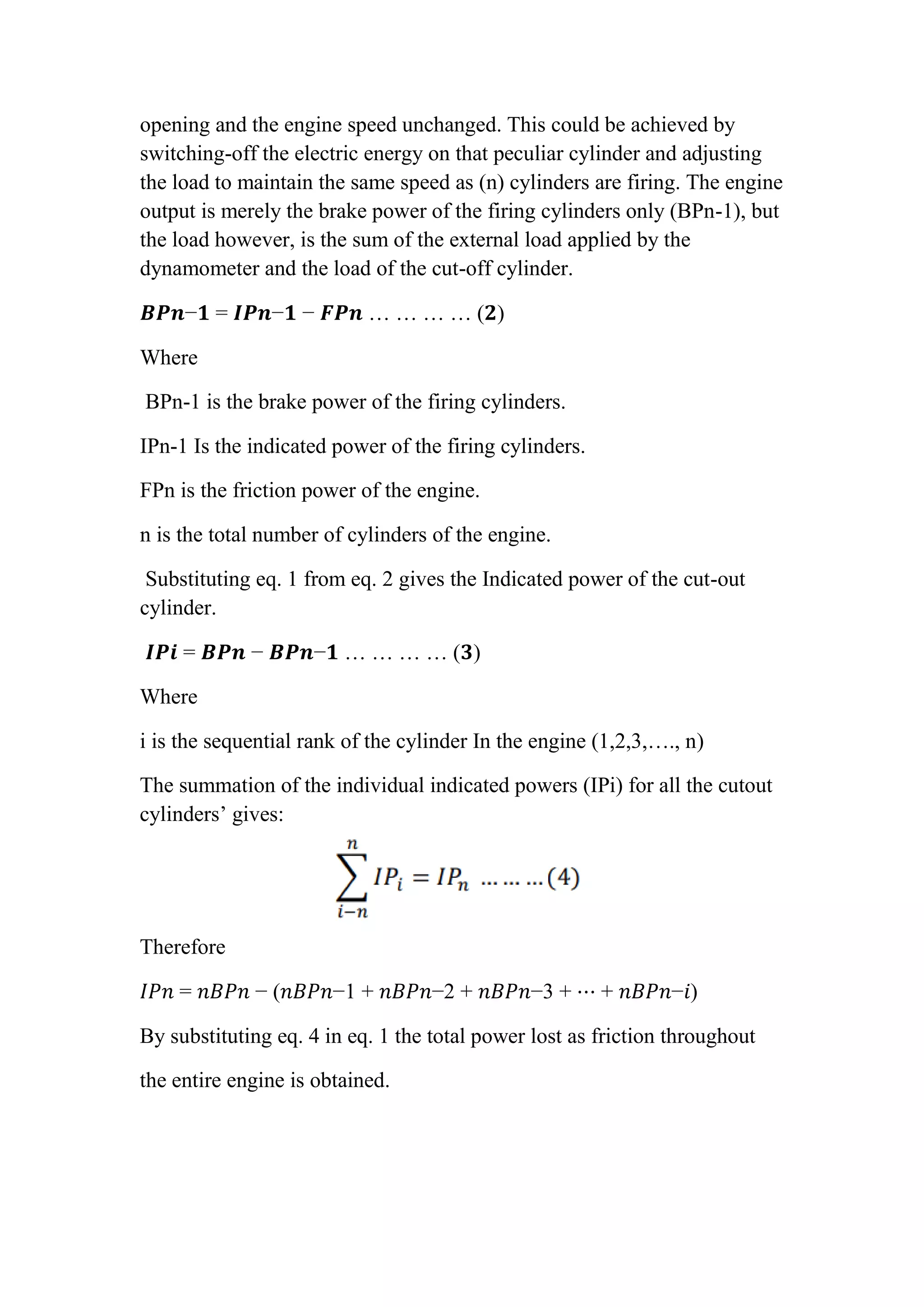
Therefore
𝐼𝑃𝑛 = 𝑛𝐵𝑃𝑛 − (𝑛𝐵𝑃𝑛−1 + 𝑛𝐵𝑃𝑛−2 + 𝑛𝐵𝑃𝑛−3 + ⋯ + 𝑛𝐵𝑃𝑛−𝑖(
By substituting eq. 4 in eq. 1 the total power lost as friction throughout
the entire engine is obtained.
Procedure
1 -Start the engine and allow to worm-up.
2- Under a full throttle operation, adjust the load to obtain a desired
speed.
3-Record the engine speed and the dynamometer load to calculate
)BPn)
4-Remove the high-tension cable from spark plug No.1 and short circuit
to the engine body.
5- Reduce the load on the engine to obtain the original speed while
keeping the throttle unchanged.
6- Record the engine speed and the dynamometer load again to calculate
)BPn-1(
7-Reconnect the high-tension cable to spark plug No.1 and Increase the
load to restore the original speed.
8-Repeat the steps 4 through 7 for the rest of the cylinders to get the
relevant indicated powers.
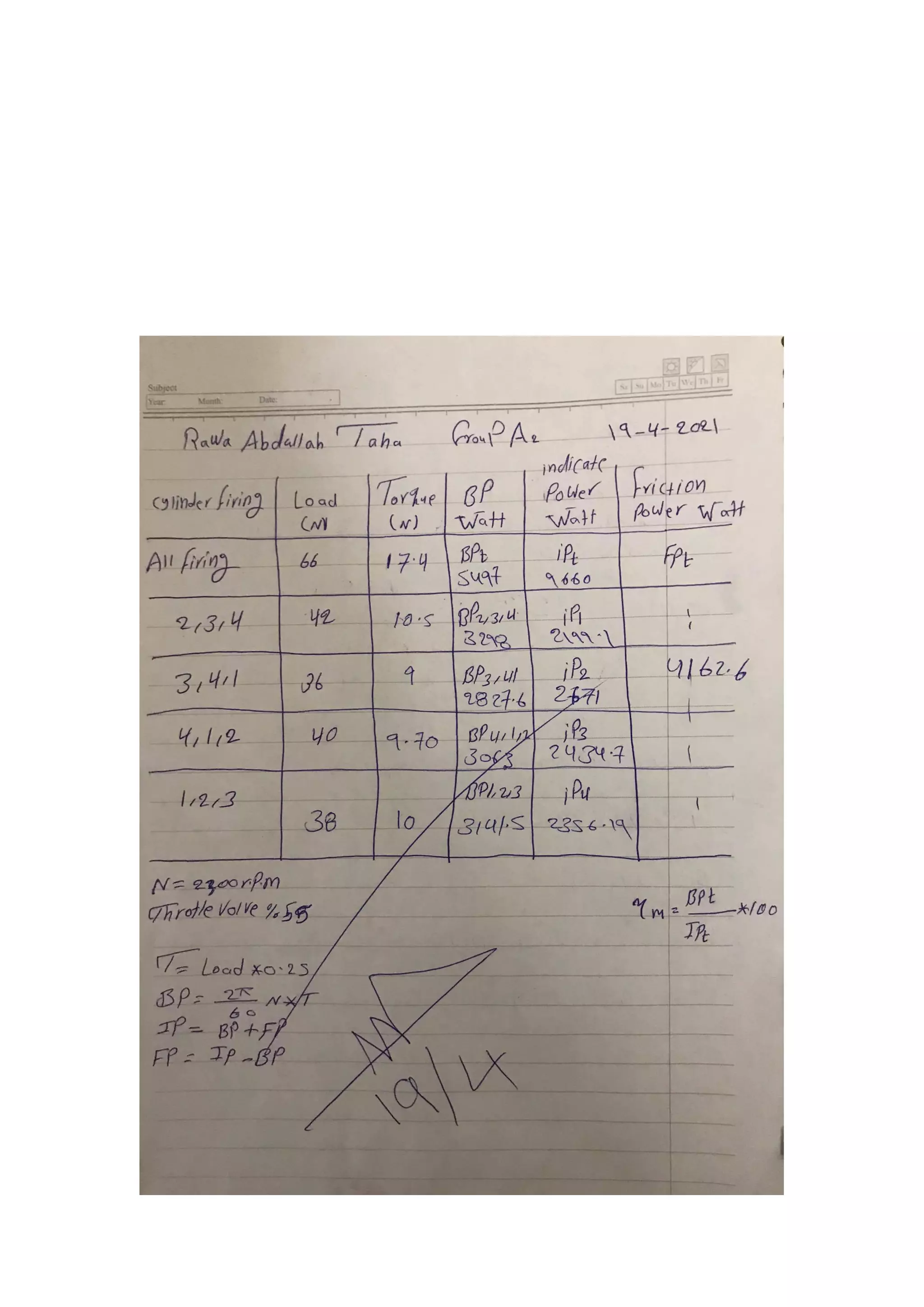
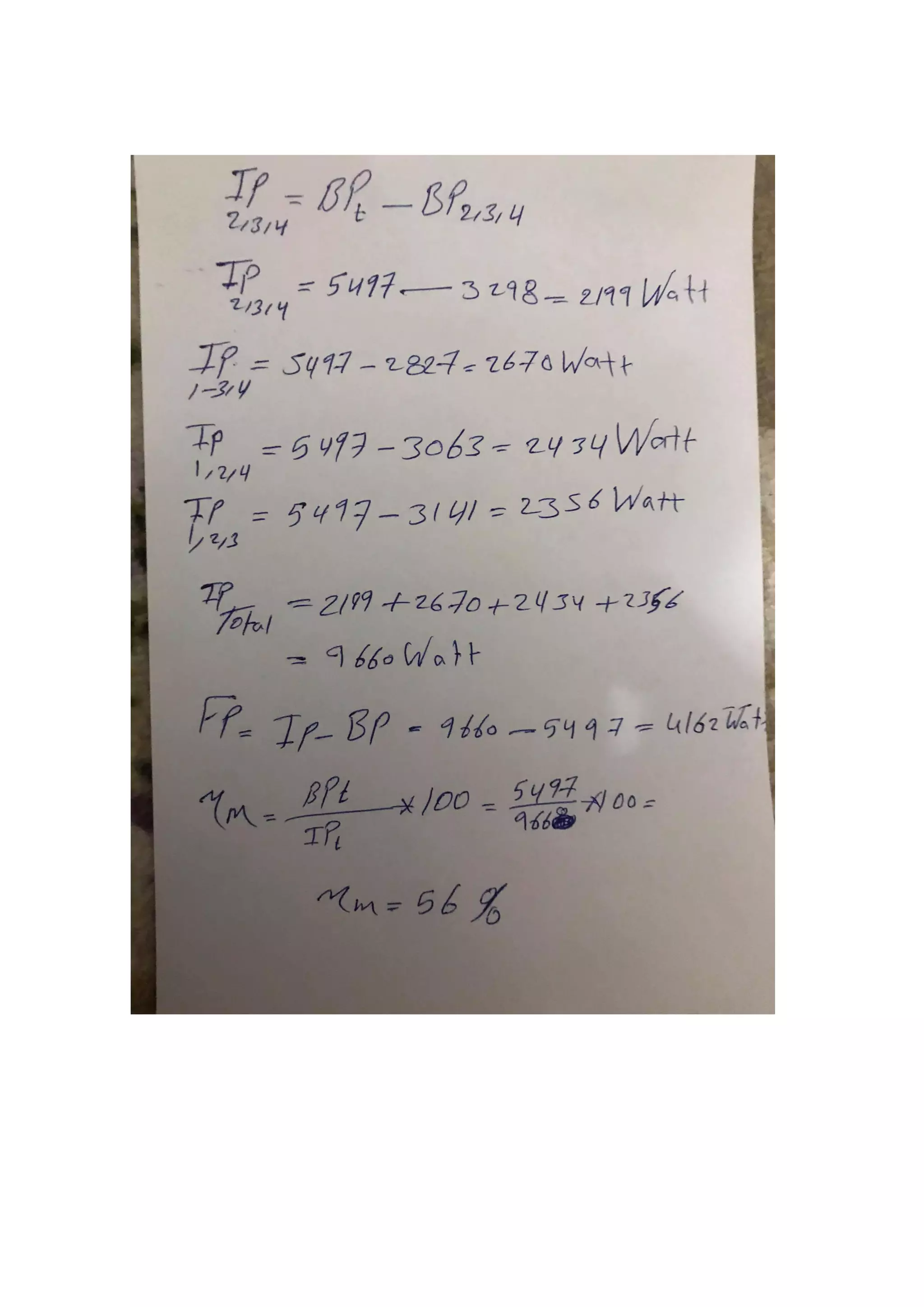
Calculation:
.
Discussion:
1- What is the difference between the Indicated power and the brake
power?
Indicated power measures the power developed on top of the pistons.
Brake power measures the power developed at the output of the
crankshaft. The indicated power is larger than the brake power by an
amount equal to the friction power.
2- What are the reasons for the fluctuations in the output of different
cylinders? (1) Abrasion due to foreign particles in the oil film. (2)
Erosion due to metal contact between the pistons or rings and the cylinder
bore. (3) Corrosion - oxidization or chemical action of the cylinder wall
by the products of combustion.
3- Why engine speed should remain constant throughout the test? The
purpose of Morse Test is to obtain the approximate Indicated Power of a
Multi-Cylinder Engine. It consists of running the engine against a
dynamometer at a particular speed, cutting out the firing of each cylinder
in turn and noting the fall in BP each time while maintaining the speed
constant.
4- What is the pumping work? the pumping work is defined as the work
in the exhaust and intake strokes. It is difficult to define pumping work in
two-stroke engines due to the lack of these two pumping strokes.
5- What are the motoring losses? (1)Mechanical losses: As their name
suggests, mechanical losses are caused by movement of the motor.
(2)Magnetic losses: These losses are associated with magnetic paths of
the motor. (3)Brush losses: During commutation, some losses occur
between the commutator and the brushes.
6- Plot engine IP, BP, FP in [kw], T in [N.m] and nm [%] versus engine
speed N in [rpm).
Reference:
[1] Anyebe, E.A (2009). Combustion Engine and Operations, Automobile
Technology Handbook. 2.
[2] Heywood, J. (2018). Internal Combustion Engine Fundamentals 2E.
McGraw-Hill Education. ISBN 978-1-260-11611-3.
[3] Nunney, Malcolm J. (2007). Light and Heavy Vehicle Technology
(4th ed.). Elsevier Butterworth-Heinemann. ISBN 978-0- 7506-8037-0.
[4]"Ingersoll Rand Engine Starting – Turbine, Vane and Gas Air
Starters". Ingersoll Rand. Archived from the original on 2016-09-13.
Retrieved 2016-09-05.

Morse test r

  • 1.
    Morse Test Student Name:Rawa Abdullah Taha Class: Third – Group A2 Course Title: I.C Engine Lab Department: Mechanic and Mechatronics College of Engineering Salddin University - Erbil Academic Year 2020 – 2021 Date /5/2021
  • 2.
    Objectives: Determination of thepower extracted from the fuel (IP) and the power lost (FP) within the Si engine by Morse test Conditions: The test requires a multi-cylinder engine running at any given speed and throttle-opening and attached to any type of dynamometers other than the electric dynamometer. Introduction: The determination of Morse test is to achieve the approximate indicated power of a Multi cylinder engine. It consists of running the engine against the dynamometer at a particular speed, cutting out the firing of each cylinder in turn and noting the fall in BP each time while maintaining the speed constant. When one cylinder is cut off, power developed is reduced and speed of engine falls. Accordingly, the load on dynamometer is adjusted so as to restore the speed of the engine. This is done to maintain FP constant, which is considered to be independent of the load and proportional to the engine speed. The observed difference in BP between all cylinder firing and one cylinder cut off is the IP of the cut off cylinder. Summation of IP of the entire cylinder would then give the IP of the engine under test. The Morse Test is performed to find the power developed in each cylinder in a multi cylinder internal combustion engine. It basically gives the relationship between indicated power and brake power. It is assumed that friction and pumping losses do not change and remains same when the cylinder is in firing condition as well as in inoperative condition. Fig(1)
  • 3.
    Using these testfrictional losses in the IC engine can be easily calculated. It is a simple approach to find the mechanical efficiency of the engine. First power developed by all the cylinders is determined experimentally. Then using the power supply cut off to the spark plug of cylinder, powers developed by individual cylinders are determined. Then for the remaining cylinders, power developed by engine is determined experimentally and obtained value is subtracted from the first value and this gives power developed in the cylinder whose spark plug was cut off. In the similar fashion, this test is performed on all the cylinders of the engine individually. The main intention of carrying out the Morse test in an IC engine is to provide an easy method of calculating the frictional losses. It provides a kind of top-down approach in calculating frictional losses easily and helps calculate mechanical efficiency. The total break power of the engine is first calculated using a dynamometer. The process is repeated with one cylinder off at each step. This the difference between total break power and break power of the remaining cylinders gives the indicated power of the first cylinder; and so on. In this way, indicated power of all cylinders are calculated and summed to obtain the indicated power of the engine Friction power = indicated power - total brake power. Once friction power is obtained, the mechanical efficiency of the engine can be calculated. Theory: The test is conducted by running the engine at a selected speed (N.) and throttle-opening (thopg). Assuming an (n) cylinder engine which is developing a brake power (BP.) as all the cylinders (n) are firing sequentially according to the firing order. The Indicated power (IP.) is the sum of (BP.) and friction power (FP.) of the engine or. 𝑩𝑷𝒏 = 𝑰𝑷𝒏 − 𝑭𝑷𝒏 … … … … (𝟏) In addition to the friction of the mechanical parts of the engine, the friction power (FPn) Incorporates the friction of water, oils and hydraulic fluids as they flow in the pipes of the cooling and lubrication systems The flow of air into and out of the engine also produces friction which varies with the air flow velocity and the throttle opening. Therefore, the friction power Is frequently called as the pumping losses. The test demands power cut-off on one of the cylinders at a time while keeping the throttle-
  • 4.
    opening and theengine speed unchanged. This could be achieved by switching-off the electric energy on that peculiar cylinder and adjusting the load to maintain the same speed as (n) cylinders are firing. The engine output is merely the brake power of the firing cylinders only (BPn-1), but the load however, is the sum of the external load applied by the dynamometer and the load of the cut-off cylinder. 𝑩𝑷𝒏−𝟏 = 𝑰𝑷𝒏−𝟏 − 𝑭𝑷𝒏 … … … … (𝟐) Where BPn-1 is the brake power of the firing cylinders. IPn-1 Is the indicated power of the firing cylinders. FPn is the friction power of the engine. n is the total number of cylinders of the engine. Substituting eq. 1 from eq. 2 gives the Indicated power of the cut-out cylinder. 𝑰𝑷𝒊 = 𝑩𝑷𝒏 − 𝑩𝑷𝒏−𝟏 … … … … (𝟑) Where i is the sequential rank of the cylinder In the engine (1,2,3,…., n) The summation of the individual indicated powers (IPi) for all the cutout cylinders’ gives: Therefore 𝐼𝑃𝑛 = 𝑛𝐵𝑃𝑛 − (𝑛𝐵𝑃𝑛−1 + 𝑛𝐵𝑃𝑛−2 + 𝑛𝐵𝑃𝑛−3 + ⋯ + 𝑛𝐵𝑃𝑛−𝑖( By substituting eq. 4 in eq. 1 the total power lost as friction throughout the entire engine is obtained.
  • 5.
    Procedure 1 -Start theengine and allow to worm-up. 2- Under a full throttle operation, adjust the load to obtain a desired speed. 3-Record the engine speed and the dynamometer load to calculate )BPn) 4-Remove the high-tension cable from spark plug No.1 and short circuit to the engine body. 5- Reduce the load on the engine to obtain the original speed while keeping the throttle unchanged. 6- Record the engine speed and the dynamometer load again to calculate )BPn-1( 7-Reconnect the high-tension cable to spark plug No.1 and Increase the load to restore the original speed. 8-Repeat the steps 4 through 7 for the rest of the cylinders to get the relevant indicated powers.
  • 7.
  • 9.
    . Discussion: 1- What isthe difference between the Indicated power and the brake power? Indicated power measures the power developed on top of the pistons. Brake power measures the power developed at the output of the crankshaft. The indicated power is larger than the brake power by an amount equal to the friction power. 2- What are the reasons for the fluctuations in the output of different cylinders? (1) Abrasion due to foreign particles in the oil film. (2) Erosion due to metal contact between the pistons or rings and the cylinder bore. (3) Corrosion - oxidization or chemical action of the cylinder wall by the products of combustion. 3- Why engine speed should remain constant throughout the test? The purpose of Morse Test is to obtain the approximate Indicated Power of a Multi-Cylinder Engine. It consists of running the engine against a dynamometer at a particular speed, cutting out the firing of each cylinder in turn and noting the fall in BP each time while maintaining the speed constant. 4- What is the pumping work? the pumping work is defined as the work in the exhaust and intake strokes. It is difficult to define pumping work in two-stroke engines due to the lack of these two pumping strokes. 5- What are the motoring losses? (1)Mechanical losses: As their name suggests, mechanical losses are caused by movement of the motor. (2)Magnetic losses: These losses are associated with magnetic paths of the motor. (3)Brush losses: During commutation, some losses occur between the commutator and the brushes. 6- Plot engine IP, BP, FP in [kw], T in [N.m] and nm [%] versus engine speed N in [rpm).
  • 10.
    Reference: [1] Anyebe, E.A(2009). Combustion Engine and Operations, Automobile Technology Handbook. 2. [2] Heywood, J. (2018). Internal Combustion Engine Fundamentals 2E. McGraw-Hill Education. ISBN 978-1-260-11611-3. [3] Nunney, Malcolm J. (2007). Light and Heavy Vehicle Technology (4th ed.). Elsevier Butterworth-Heinemann. ISBN 978-0- 7506-8037-0. [4]"Ingersoll Rand Engine Starting – Turbine, Vane and Gas Air Starters". Ingersoll Rand. Archived from the original on 2016-09-13. Retrieved 2016-09-05.