Materials Science
Jane Blackford
4 lectures “Metals”
E-mail: jane.blackford@ed.ac.uk
Room: S141, Sanderson Building
Outline
• Introduction
• Strengthening mechanisms
• Classification of metals
ferrous (e.g. steel, cast iron) & non ferrous (e.g. Al, Ni)
• Applications ↔ properties
• Ferrous Metallurgy
bcc ↔ fcc; Fe-C phase diagram
microstructure ↔ properties
effects of %C and heat treatment
• Specific types of steels - tool, stainless, cast iron
• Non-ferrous metals
Introduction - metals
• Extraction
metallurgy -
obtaining metals
from ores
• Physical metallurgy -
how to get the metal
into the most useful
condition of
hardness, strength
and toughness
Metals are crystalline
• in reality they are not perfect
- they contain dislocations
dislocation
A pure metal is very soft and weak
• Because dislocations move easily
(plastic deformation)
• Physical metallurgy aims to restrict
movement of dislocations →
↑ strength and hardness
[shorthand ⊥ = dislocation]
Strengthening mechanisms in metals
• Grain boundaries
• Solid solution
hardening
• Work hardening
• Precipitation hardening
• These mechanisms
influence the
microstructure which
in turn influences the
material properties
Grain boundaries
act as barriers to ⊥ movement
∴ ↓ grain size → ↑strength
Hall Petch σy = σo + k (1/√d)
σy = yield stress
σo and k = material constants
d = grain size
see Callister 7.8
Solid solution hardening
• lattice strain interactions between
impurity atoms and dislocations
increase strength
• see Callister 7.9
Work hardening
• Work hardening = strain hardening
(~ cold work)
• plastic deformation → ↑ in ⊥ density
∴ ↑ repulsive ⊥ - ⊥ strain field
interactions
• strength ↑ with ↑ plastic deformation
• example paper clip
• see Callister 7.10
Precipitation hardening
• Formation of a uniform distribution of
very small particles → ↑ in resistance to
⊥ motion because of lattice strains near
particles
• important in many alloy systems e.g.
tempered martensite, Al alloys
• see Callister 11.7, 11.8
Classification of metal alloys
ferrous non- ferrous
cast iron steels
grey white low alloy high alloy
low medium high
carbon
tool stainless
Steel
• Advantages
• Low cost
• high strength
• relatively high
toughness
• weldable
• Disadvantages
• heavy (high density)
• poor corrosion
resistance
Applications
see table of properties and
applications on handout
Ferrous metallurgy
• Definition : Steel = iron with ≤ 1.7 wt % carbon (C)
• Iron is allotropic/polymorphic i.e. has different crystal
structures in the solid state
912°C 1495 ° C 1538 ° C
• bcc ↔ fcc ↔ bcc ↔ liquid
• solubility of carbon in bcc (α) = 0.02 wt %
and in fcc (γ) = 2.1 wt %
• Iron carbon phase diagram (useful for slow cooling
and predicting microstructures).
• See handout and Callister Chapt 9.
• bcc = body centre cubic
• fcc = face centre cubic
• Properties of steels depend on their
microstructure
• Now consider how different microstructures can be
formed by :
1. Slow cooling from γ to room temperature
2. Fast cooling from γ to room temperature
1. slow cooling:
γ (austenite) → α (ferrite) + Fe3C (cementite)
α + Fe3C = pearlite
As ↑ C → ↑ Fe3C →↑ strength ↑ hardness ↓ ductility
Mechanical properties of SLOW cooled carbon steels
- relate properties to microstructures
- NB can obtain very different properties by fast cooling
- see Callister Chapt. 10
0 0.5 1 % carbon
stress
(MPa)
elongation %
1000
500
0 0
30
UTS
σy
elongation
UTS = ultimate tensile
stress
σy = yield stress
Iron-carbon phase diagram
• see handout including constituents, symbols and
description [Callister Chapt. 9]
Formation of pearlite
0% carbon - pure ferrite
0.4% C ferrite + pearlite
1.4% C ferrite + cementite
Microstructures in
slow cooled steels
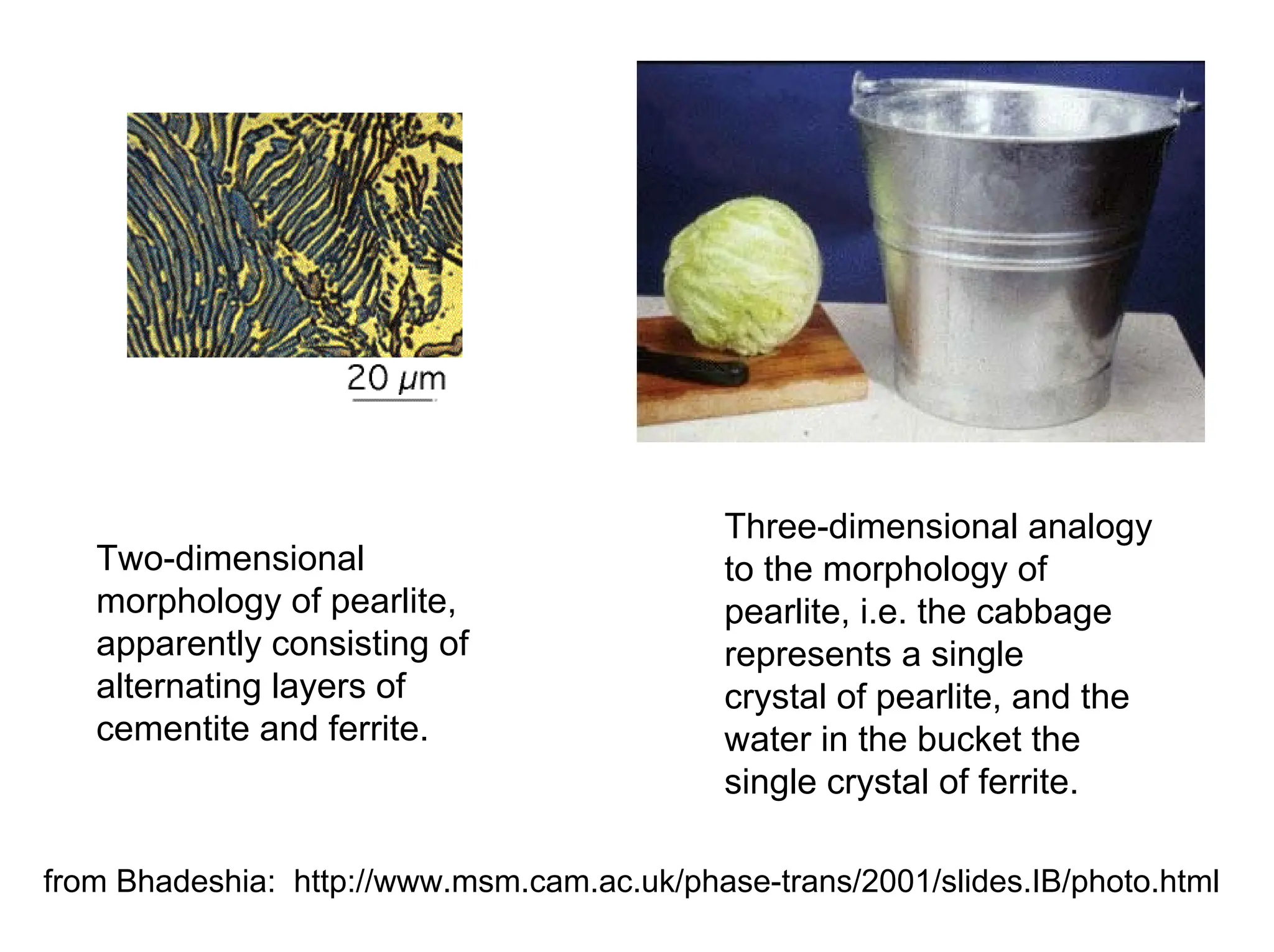
Three-dimensional analogy
to the morphology of
pearlite, i.e. the cabbage
represents a single
crystal of pearlite, and the
water in the bucket the
single crystal of ferrite.
Two-dimensional
morphology of pearlite,
apparently consisting of
alternating layers of
cementite and ferrite.
from Bhadeshia: http://www.msm.cam.ac.uk/phase-trans/2001/slides.IB/photo.html
Properties of steels depend on their
microstructure
Now consider how different microstructures
can be formed by :
1. Slow cooling from γ to room temperature
2. Fast cooling from γ to room temperature
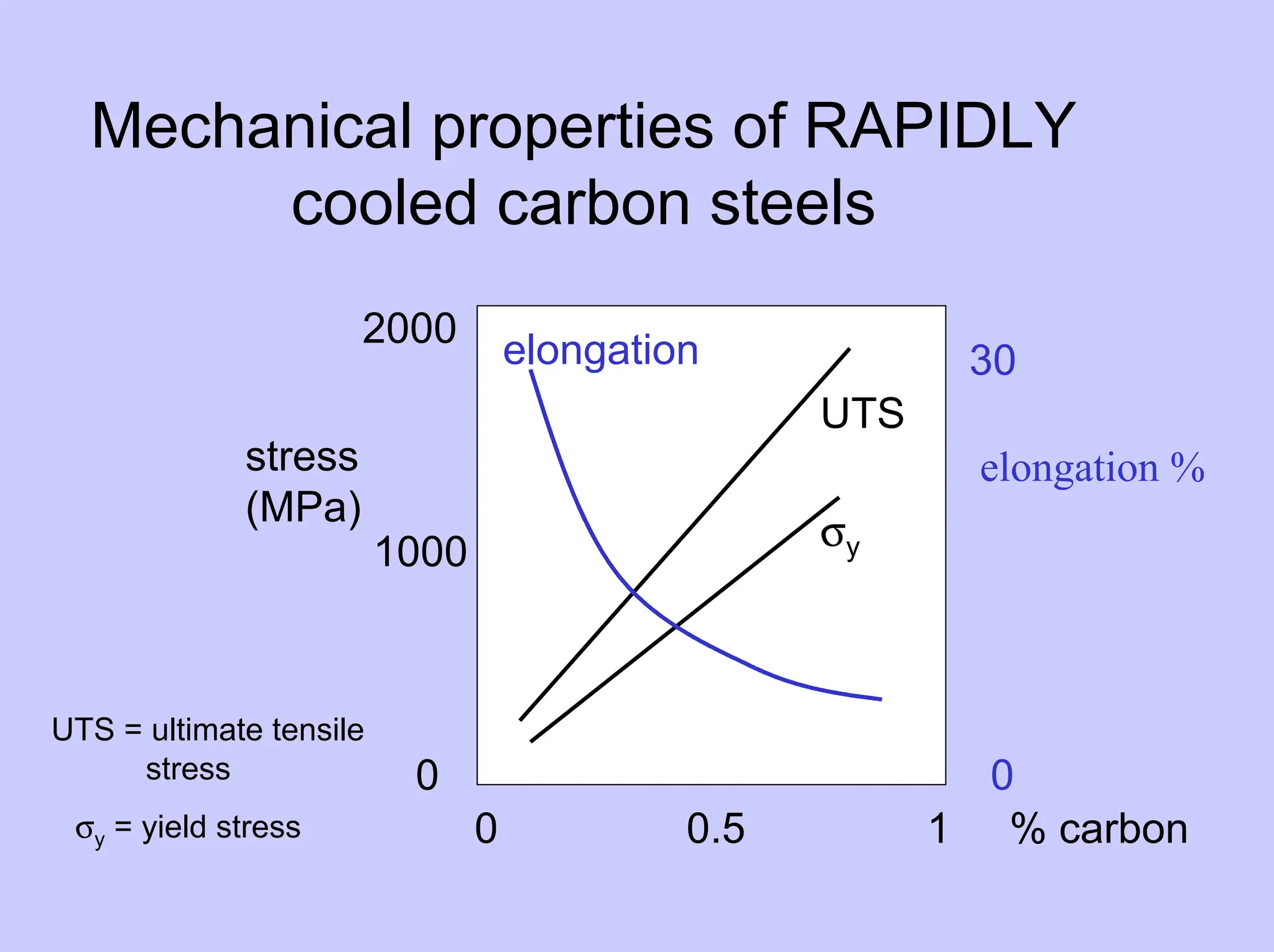
Mechanical properties of RAPIDLY
cooled carbon steels
0 0.5 1 % carbon
stress
(MPa)
elongation %
2000
1000
0 0
30
UTS
σy
elongation
UTS = ultimate tensile
stress
σy = yield stress
Rapidly cooled carbon steels -
martensite
• Fast cooling from γ to room temperature
γ (austenite) → α’ (martensite)
very hard and brittle
Cooling rates required :
• Pure Fe 105 °C/s • Fe-0.8%C 200 °C/s
so α’ difficult to achieve in thick sections
and may → component distortion [Callister chpt 10]
critical
cooling
rates
• Adding Mo, Mn, Cr, Ni, C decreases the
critical cooling rate required for α’ formation
• Steels containing 2-7% of these elements
=low alloy steels. They have high
hardenability i.e. form α’ readily .
• Also these elements increase strength by
solid solution strengthening
• USES: crankshafts, spanners, high tensile
bolts
Martensite...
• But for most uses α’ is too brittle
• So it is tempered by heat treatment at 200-600°C
• α’→ α (ferrite) + Fe3C (as fine particles)
• Fe3C fine particles increase strength by precipitation
hardening
• These steels are known as quench and tempered
steels
Martensite
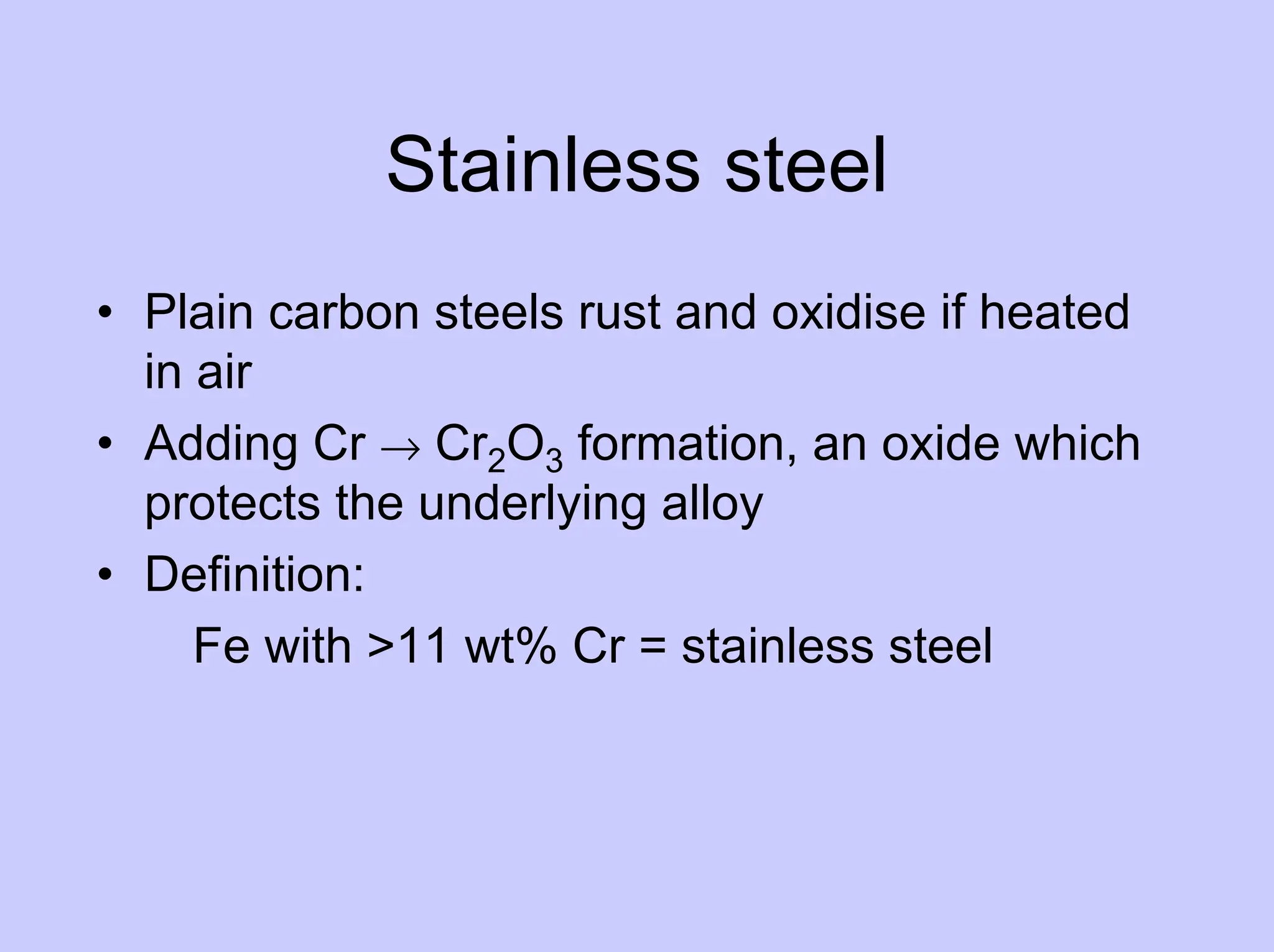
Stainless steel
• Plain carbon steels rust and oxidise if heated
in air
• Adding Cr → Cr2O3 formation, an oxide which
protects the underlying alloy
• Definition:
Fe with >11 wt% Cr = stainless steel
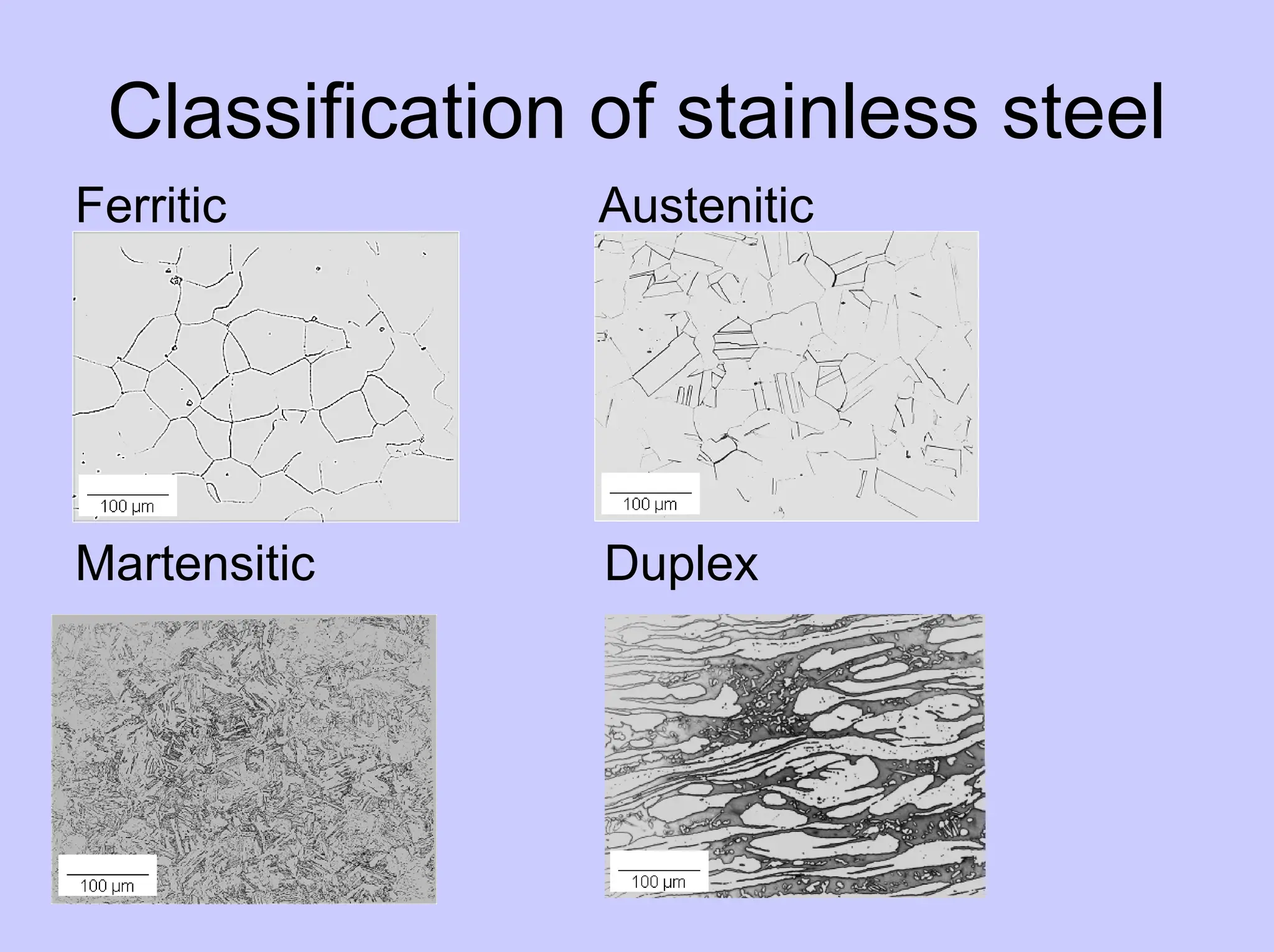
Classification of stainless steel
Ferritic Austenitic
Martensitic Duplex
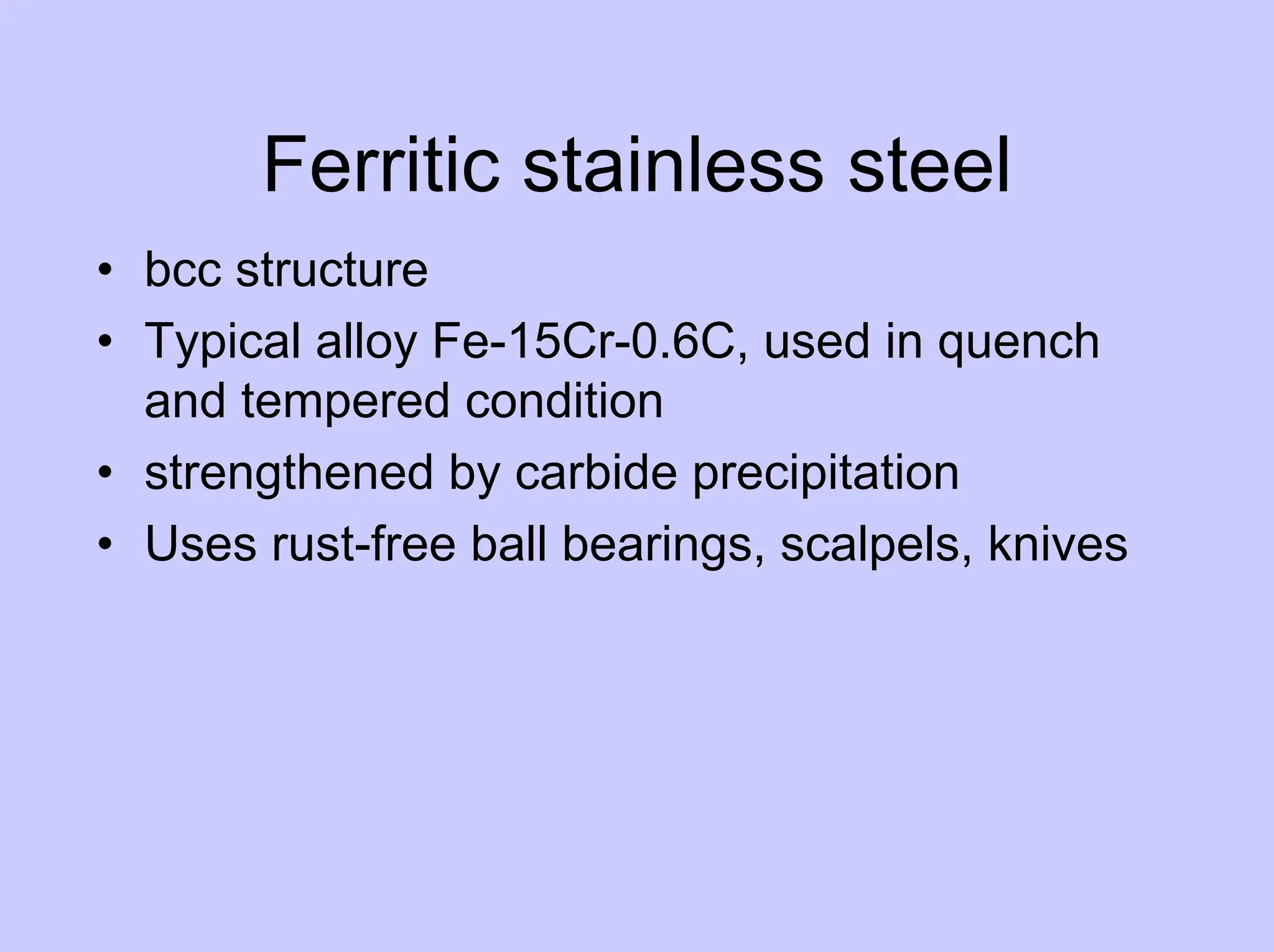
Ferritic stainless steel
• bcc structure
• Typical alloy Fe-15Cr-0.6C, used in quench
and tempered condition
• strengthened by carbide precipitation
• Uses rust-free ball bearings, scalpels, knives
Austenitic stainless steel
• fcc structure (stabilised by adding Ni)
• Typical alloy Fe-18Cr-8Ni-1Mn-0.1C
• Disadvantage work harden rapidly so more
difficult to shape and machine
• Advantages of ALL fcc metals and alloys
– ↑ toughness
– ↑ ductility
– ↑ creep resistance
Cast Iron
• Steel can be cast but tends not to be as it’s
technically difficult (due to high melting
temperature), and high cost
• Definition: Fe with >1.7wt% C =cast iron
• Advantages can be sand cast to intricate
shapes using basic technology
• Disadvantage BRITTLE so can’t be used for
high stress or shock loading
Classification of Cast Iron
• WHITE
– microstructure based on Fe + Fe3C
• GREY
– Silicon (Si) added e.g. Fe-2%Si-C
– Si stabilises the Fe-C system, rather than Fe-Fe3C
– so microstructure based on Fe + C (free graphite)
– the properties of grey cast iron are strongly
dependant on the shape of the graphite flakes:
• flakes
• spheroids - relatively high toughness and ductility; formed by
adding Ce or Mg
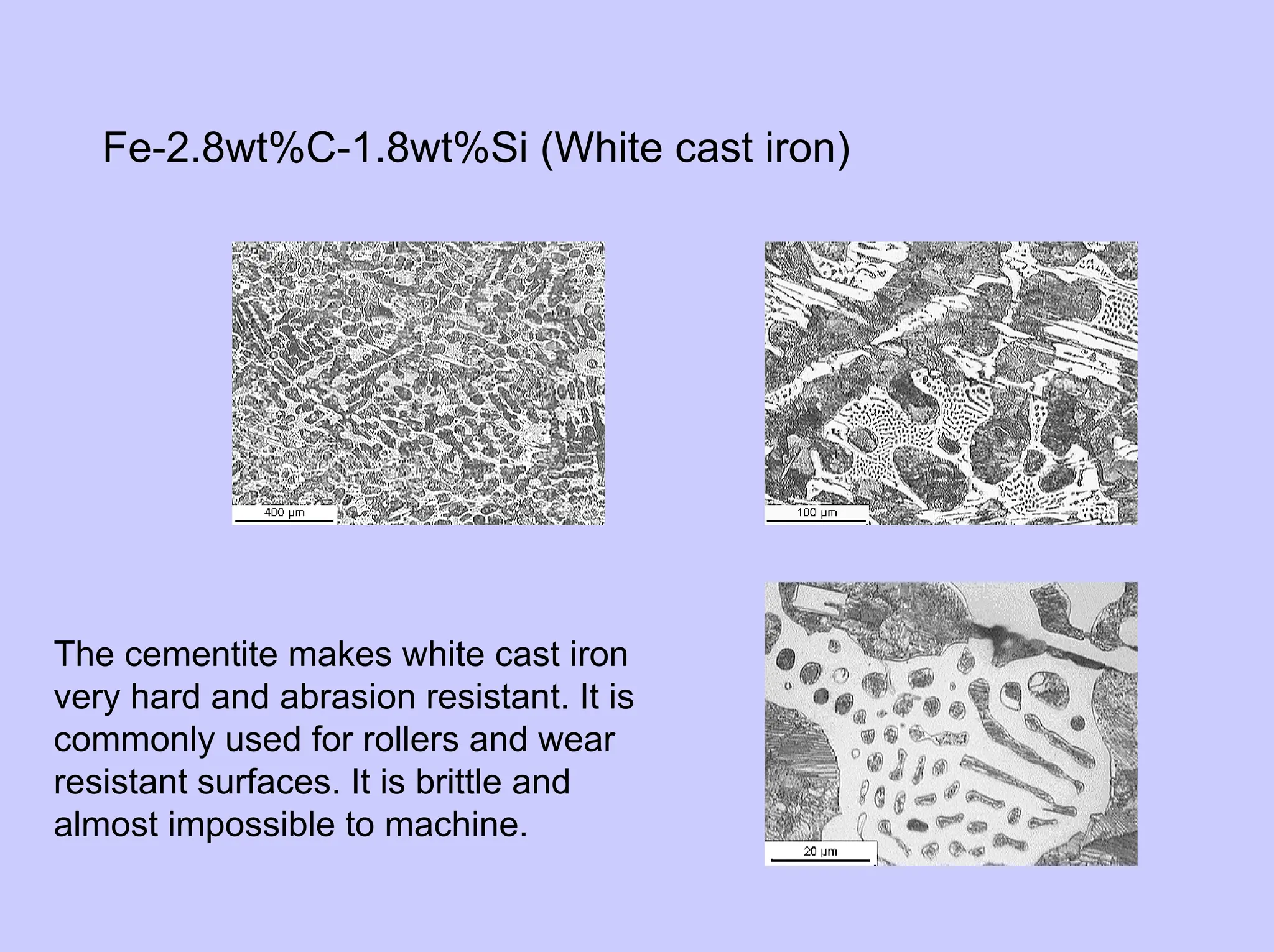
Fe-2.8wt%C-1.8wt%Si (White cast iron)
The cementite makes white cast iron
very hard and abrasion resistant. It is
commonly used for rollers and wear
resistant surfaces. It is brittle and
almost impossible to machine.
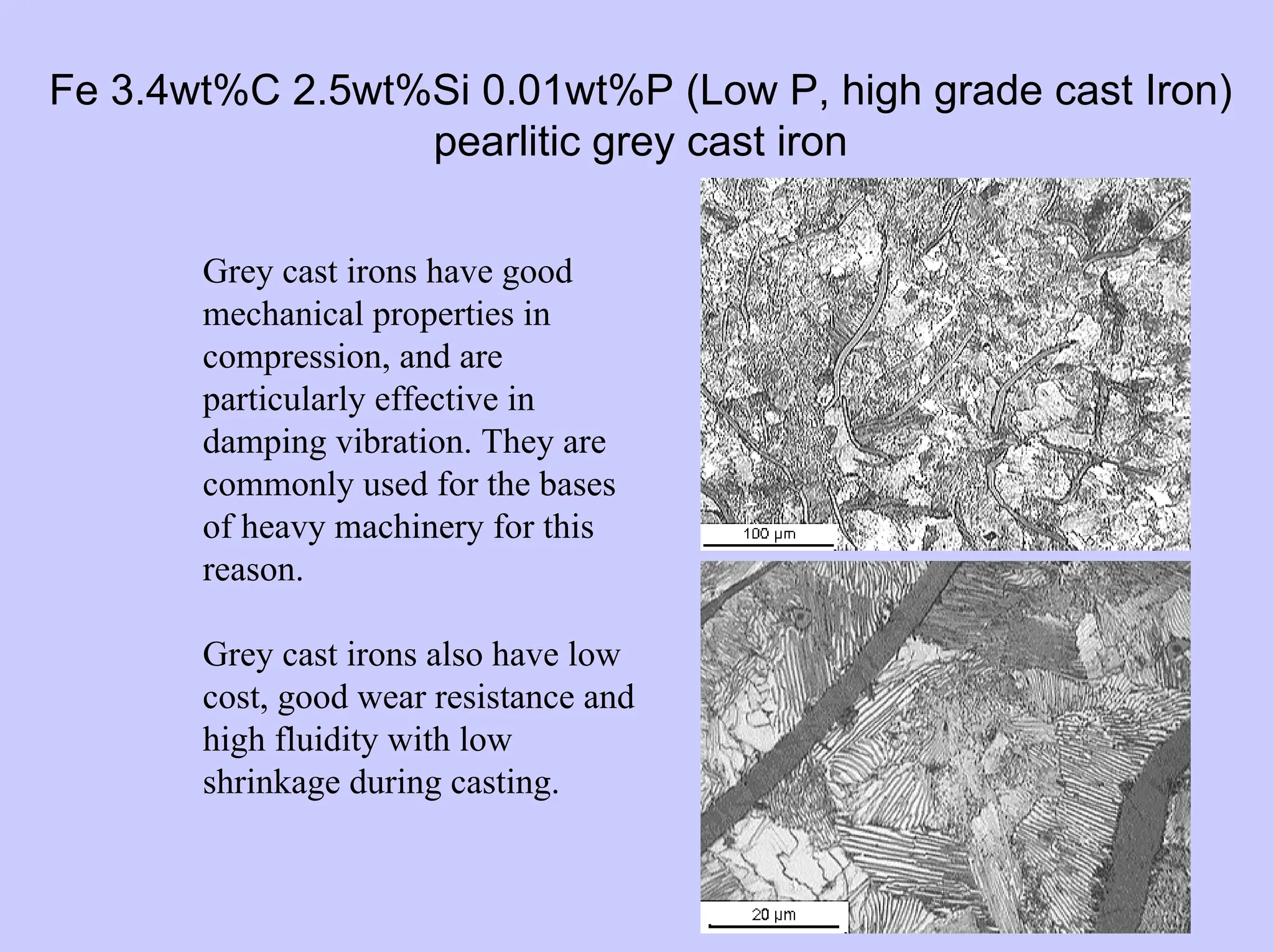
Fe 3.4wt%C 2.5wt%Si 0.01wt%P (Low P, high grade cast Iron)
pearlitic grey cast iron
Grey cast irons have good
mechanical properties in
compression, and are
particularly effective in
damping vibration. They are
commonly used for the bases
of heavy machinery for this
reason.
Grey cast irons also have low
cost, good wear resistance and
high fluidity with low
shrinkage during casting.
Fe 3.4wt%C 2.5wt%Si 0.01wt%P 0.03wt%Mg
pearlitic ductile or nodular iron
.
Removing the graphite flakes
improves the tensile
strength, ductility and
toughness.
Typical applications include
gears, valves and camshafts.

material sciences in civil engineering field

  • 1.
    Materials Science Jane Blackford 4lectures “Metals” E-mail: jane.blackford@ed.ac.uk Room: S141, Sanderson Building
  • 2.
    Outline • Introduction • Strengtheningmechanisms • Classification of metals ferrous (e.g. steel, cast iron) & non ferrous (e.g. Al, Ni) • Applications ↔ properties • Ferrous Metallurgy bcc ↔ fcc; Fe-C phase diagram microstructure ↔ properties effects of %C and heat treatment • Specific types of steels - tool, stainless, cast iron • Non-ferrous metals
  • 3.
    Introduction - metals •Extraction metallurgy - obtaining metals from ores • Physical metallurgy - how to get the metal into the most useful condition of hardness, strength and toughness
  • 4.
    Metals are crystalline •in reality they are not perfect - they contain dislocations dislocation
  • 5.
    A pure metalis very soft and weak • Because dislocations move easily (plastic deformation) • Physical metallurgy aims to restrict movement of dislocations → ↑ strength and hardness [shorthand ⊥ = dislocation]
  • 6.
    Strengthening mechanisms inmetals • Grain boundaries • Solid solution hardening • Work hardening • Precipitation hardening • These mechanisms influence the microstructure which in turn influences the material properties
  • 7.
    Grain boundaries act asbarriers to ⊥ movement ∴ ↓ grain size → ↑strength Hall Petch σy = σo + k (1/√d) σy = yield stress σo and k = material constants d = grain size see Callister 7.8
  • 8.
    Solid solution hardening •lattice strain interactions between impurity atoms and dislocations increase strength • see Callister 7.9
  • 9.
    Work hardening • Workhardening = strain hardening (~ cold work) • plastic deformation → ↑ in ⊥ density ∴ ↑ repulsive ⊥ - ⊥ strain field interactions • strength ↑ with ↑ plastic deformation • example paper clip • see Callister 7.10
  • 10.
    Precipitation hardening • Formationof a uniform distribution of very small particles → ↑ in resistance to ⊥ motion because of lattice strains near particles • important in many alloy systems e.g. tempered martensite, Al alloys • see Callister 11.7, 11.8
  • 11.
    Classification of metalalloys ferrous non- ferrous cast iron steels grey white low alloy high alloy low medium high carbon tool stainless
  • 12.
    Steel • Advantages • Lowcost • high strength • relatively high toughness • weldable • Disadvantages • heavy (high density) • poor corrosion resistance
  • 13.
    Applications see table ofproperties and applications on handout
  • 14.
    Ferrous metallurgy • Definition: Steel = iron with ≤ 1.7 wt % carbon (C) • Iron is allotropic/polymorphic i.e. has different crystal structures in the solid state 912°C 1495 ° C 1538 ° C • bcc ↔ fcc ↔ bcc ↔ liquid • solubility of carbon in bcc (α) = 0.02 wt % and in fcc (γ) = 2.1 wt % • Iron carbon phase diagram (useful for slow cooling and predicting microstructures). • See handout and Callister Chapt 9.
  • 15.
    • bcc =body centre cubic • fcc = face centre cubic
  • 16.
    • Properties ofsteels depend on their microstructure • Now consider how different microstructures can be formed by : 1. Slow cooling from γ to room temperature 2. Fast cooling from γ to room temperature 1. slow cooling: γ (austenite) → α (ferrite) + Fe3C (cementite) α + Fe3C = pearlite As ↑ C → ↑ Fe3C →↑ strength ↑ hardness ↓ ductility
  • 17.
    Mechanical properties ofSLOW cooled carbon steels - relate properties to microstructures - NB can obtain very different properties by fast cooling - see Callister Chapt. 10 0 0.5 1 % carbon stress (MPa) elongation % 1000 500 0 0 30 UTS σy elongation UTS = ultimate tensile stress σy = yield stress
  • 18.
    Iron-carbon phase diagram •see handout including constituents, symbols and description [Callister Chapt. 9]
  • 19.
  • 20.
    0% carbon -pure ferrite 0.4% C ferrite + pearlite 1.4% C ferrite + cementite Microstructures in slow cooled steels
  • 21.
    Three-dimensional analogy to themorphology of pearlite, i.e. the cabbage represents a single crystal of pearlite, and the water in the bucket the single crystal of ferrite. Two-dimensional morphology of pearlite, apparently consisting of alternating layers of cementite and ferrite. from Bhadeshia: http://www.msm.cam.ac.uk/phase-trans/2001/slides.IB/photo.html
  • 22.
    Properties of steelsdepend on their microstructure Now consider how different microstructures can be formed by : 1. Slow cooling from γ to room temperature 2. Fast cooling from γ to room temperature
  • 23.
    Mechanical properties ofRAPIDLY cooled carbon steels 0 0.5 1 % carbon stress (MPa) elongation % 2000 1000 0 0 30 UTS σy elongation UTS = ultimate tensile stress σy = yield stress
  • 24.
    Rapidly cooled carbonsteels - martensite • Fast cooling from γ to room temperature γ (austenite) → α’ (martensite) very hard and brittle Cooling rates required : • Pure Fe 105 °C/s • Fe-0.8%C 200 °C/s so α’ difficult to achieve in thick sections and may → component distortion [Callister chpt 10] critical cooling rates
  • 25.
    • Adding Mo,Mn, Cr, Ni, C decreases the critical cooling rate required for α’ formation • Steels containing 2-7% of these elements =low alloy steels. They have high hardenability i.e. form α’ readily . • Also these elements increase strength by solid solution strengthening • USES: crankshafts, spanners, high tensile bolts Martensite...
  • 26.
    • But formost uses α’ is too brittle • So it is tempered by heat treatment at 200-600°C • α’→ α (ferrite) + Fe3C (as fine particles) • Fe3C fine particles increase strength by precipitation hardening • These steels are known as quench and tempered steels Martensite
  • 27.
    Stainless steel • Plaincarbon steels rust and oxidise if heated in air • Adding Cr → Cr2O3 formation, an oxide which protects the underlying alloy • Definition: Fe with >11 wt% Cr = stainless steel
  • 28.
    Classification of stainlesssteel Ferritic Austenitic Martensitic Duplex
  • 29.
    Ferritic stainless steel •bcc structure • Typical alloy Fe-15Cr-0.6C, used in quench and tempered condition • strengthened by carbide precipitation • Uses rust-free ball bearings, scalpels, knives
  • 30.
    Austenitic stainless steel •fcc structure (stabilised by adding Ni) • Typical alloy Fe-18Cr-8Ni-1Mn-0.1C • Disadvantage work harden rapidly so more difficult to shape and machine • Advantages of ALL fcc metals and alloys – ↑ toughness – ↑ ductility – ↑ creep resistance
  • 31.
    Cast Iron • Steelcan be cast but tends not to be as it’s technically difficult (due to high melting temperature), and high cost • Definition: Fe with >1.7wt% C =cast iron • Advantages can be sand cast to intricate shapes using basic technology • Disadvantage BRITTLE so can’t be used for high stress or shock loading
  • 32.
    Classification of CastIron • WHITE – microstructure based on Fe + Fe3C • GREY – Silicon (Si) added e.g. Fe-2%Si-C – Si stabilises the Fe-C system, rather than Fe-Fe3C – so microstructure based on Fe + C (free graphite) – the properties of grey cast iron are strongly dependant on the shape of the graphite flakes: • flakes • spheroids - relatively high toughness and ductility; formed by adding Ce or Mg
  • 33.
    Fe-2.8wt%C-1.8wt%Si (White castiron) The cementite makes white cast iron very hard and abrasion resistant. It is commonly used for rollers and wear resistant surfaces. It is brittle and almost impossible to machine.
  • 34.
    Fe 3.4wt%C 2.5wt%Si0.01wt%P (Low P, high grade cast Iron) pearlitic grey cast iron Grey cast irons have good mechanical properties in compression, and are particularly effective in damping vibration. They are commonly used for the bases of heavy machinery for this reason. Grey cast irons also have low cost, good wear resistance and high fluidity with low shrinkage during casting.
  • 35.
    Fe 3.4wt%C 2.5wt%Si0.01wt%P 0.03wt%Mg pearlitic ductile or nodular iron . Removing the graphite flakes improves the tensile strength, ductility and toughness. Typical applications include gears, valves and camshafts.