1
Newton's Law
Student Name: Rawa Abdullah Taha
Class: two – Group A
Course Title: Dynamics
Department: Mechanic and Mechatronics
College of Engineering
Salahaddin University - Erbil
Academic Year 2019 – 2020
2
ABSTRACT
between the forces acting on arelationships,Newton’s laws of motion
by English physicist andexpressedof the body, firstmotionbody and the
Newton’s laws of motion relate an.Sir Isaac Newtonmathematician
object’s motion to the forces acting on it.
In the first law, an article will not change its motion unless a force acts
on it. In the second law, the force on an object is equal to its mass times
its acceleration. In the third law, when two objects interact, they apply
forces to each other of equal magnitude and opposite direction.
Newton’s laws of motion are important because they are the basis of
classical mechanics, one of the main branches of physics. Mechanics is
the study of how objects move or do not move when forces act upon
them.
3
TABLE OF CONTENTS
Abstract 2
Table of Contents 3
Introduction 4
Theory 5
Theory 6
Methods 7
8Methods
Conclusion 9
references 10
4
INTRODUCTION
The Newton’s laws first appeared in his masterpiece Philosophiae
Naturalis Principia Mathmaticia (1687), generally known as the Principia.
In 1543 Nicolaus Copernicus suggested that the Sun, rather than Earth,
could be at the centre of the universe. In the intervening years
Galileo, Johannes Kepler, and Descartes placed the foundations of a
new science that would both replace the Aristotelian worldview, inherited
from the ancient Greeks, and describe the workings of a heliocentric
universe. In the Principia Newton created that new science. He developed
his three laws in order to explain why the orbits of the planets are ellipses
reasonably than circles, at which he succeeded, but it turned out that he
explained much more. The series of events from Copernicus to Newton is
known mutually as the Scientific Revolution.
In the 20th century Newton’s laws were replaced by quantum
mechanics and contingency as the most fundamental rules of physics.
Nevertheless, Newton’s laws continue to give an exact account of nature,
except for very small bodies such as electrons or for bodies moving close
to the speed of light. Quantum mechanics and contingency reduce to
Newton’s laws for larger forms or for forms moving more slowly.
A force applied to a body can transformation the magnitude of the
momentum, or its direction, or both. Newton's second law is one of
the most important in all of physics. For a body whose mass m is
constant, it can be written in the form F = ma , where F (force) and a
(acceleration) are both vector amounts.
Samples of Newton's third law of motion are ubiquitous in everyday life.
For example, when you jump, your legs apply a force to the ground, and
the ground relates and equal and opposite reaction force that propels you
into the air. Engineers put on Newton's third law when designing rockets
and other projectile procedures. Through launch, the burning fuel exerts a
downward force, and the reaction force drives the rocket into the air.
5
THEORY
1.They form the most automatically appealing physical theory.
2.They characterize mankind’s first great success at describing diverse
aspects of nature with simple mathematical formulas.
3.These laws really work.
4.They lay the groundwork for later physics improvements.
Newton’s First Law ( 1st
law):
 A body at rest or uniform motion will carry on to be at rest or
uniform motion till and unless a net external force acts on it.
 Real life example is, When a bus rapidly starts, the passengers
standing or sitting in the bus, tend to fall backward.
This is because of Newton’s first law of motion and can be
illuminated as follows:
when the bus unexpectedly starts, the lower part of the body of
the passenger which is in interaction with the bus moves along
with the bus while the upper part of the body inclines to retain
its state of rest due to inertia.
Therefore, the passenger tumbles and falls to backward.
Figure(1)
6
Newton’s Second Law ( 2nd
law):
 The net force practiced by a body is directly proportional to the
rate of change of momentum of the body. It can be written as
assumed below,
F = ma
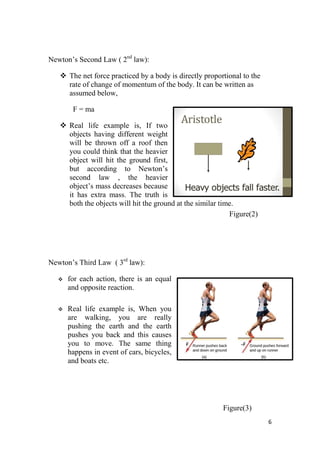
 Real life example is, If two
objects having different weight
will be thrown off a roof then
you could think that the heavier
object will hit the ground first,
but according to Newton’s
second law , the heavier
object’s mass decreases because
it has extra mass. The truth is
both the objects will hit the ground at the similar time.
Figure(2)
Newton’s Third Law ( 3rd
law):
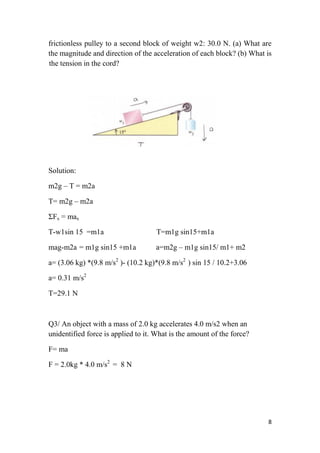
 for each action, there is an equal
and opposite reaction.
 Real life example is, When you
are walking, you are really
pushing the earth and the earth
pushes you back and this causes
you to move. The same thing
happens in event of cars, bicycles,
and boats etc.
Figure(3)
7
METHODS
Q1/ In the figure below, two forces, F1 and F2 pull a 50.0 kg wreck. The
magnitude of F1 is 215 N and it is applied at a 42.0o angle. The
magnitude of F2 is 55.0N. If the crate is accelerating to the right at a rate
of 0.500 m/s', find the quantities of kinetic friction between the crate and
the floor
Figure(13)
Solution:
ΣFy = may ay = 0
mg=0–θsin+F1NΣFy=0 F
sin42m1-=mgNF
FN= (50kg)*(9.8m/s2
)-(215N) sin42
FN = 346N
ΣFx = max F1cos42-FK-F2=max
ax=0.500m/s2
xF2=ma-FNkµ-F1cos42
= 0.231 Nn/ Fxma-F2-= F1 cos 42kµ
Q2/In the figure below, a block of weight wr = 100.0 N on a frictionless
motivated plane of angle 15o'is connected by a cord over a massless,
8
frictionless pulley to a second block of weight w2: 30.0 N. (a) What are
the magnitude and direction of the acceleration of each block? (b) What is
the tension in the cord?
Figure(14)
Solution:
m2g – T = m2a
T= m2g – m2a
ΣFx = max
T-w1sin 15 =m1a T=m1g sin15+m1a
mag-m2a = m1g sin15 +m1a a=m2g – m1g sin15/ m1+ m2
a= (3.06 kg) *(9.8 m/s2
)- (10.2 kg)*(9.8 m/s2
) sin 15 / 10.2+3.06
a= 0.31 m/s2
T=29.1 N
Q3/ An object with a mass of 2.0 kg accelerates 4.0 m/s2 when an
unidentified force is applied to it. What is the amount of the force?
F= ma
F = 2.0kg * 4.0 m/s2
= 8 N
9
CONCLUSION
Throughout my entire report I have been able to point out all the points
and fully discuss Newton's laws as we first briefly outlined Newton's laws
and then elaborated on them and then conversed the problems and
problems of Newton's law as well as how many students there are. The
problems that existed in that idea were outlined in tables and statistics.
The experiment had remedial impact on the common misconceptions of
force-motion relationship as well as students' recognizing Newton's Laws
as theory of motion rather than forces. Though the latter may not
influence problem solving, it may improve general understanding of
mechanics required in further studies of other theories of physics, such as
quantum and relativistic mechanics. Students obtained a chance to grasp
the features of scientific knowledge rarely discussed in physics class: the
theory based nature, modelling, laws, principles, validity area, the status
of "being proved" in science, and the idea of conceptual genesis of
knowledge.
10
REFERENCES
.[1] Newton, I., The Mathematical Principles of Natural Philosophy,
London, 1687
[2] Schilling, G., Atlas of Astronomical Discoveries, Springer Science &
Business Media, 2011
[3] Th. Kuhn (1962). The Structure of Scientific Revolutions. Chicago,
IL: University of Chicago Press
[4] Rozen, A. (2013). Newtonian Mechanics. Rehovot, Israel: Science
Teaching Center
[5] F. W. Sears & M. W. Zemansky (1988). College Physics. Cambridge,
MA: Addison-Wesley.

Newtn's law

  • 1.
    1 Newton's Law Student Name:Rawa Abdullah Taha Class: two – Group A Course Title: Dynamics Department: Mechanic and Mechatronics College of Engineering Salahaddin University - Erbil Academic Year 2019 – 2020
  • 2.
    2 ABSTRACT between the forcesacting on arelationships,Newton’s laws of motion by English physicist andexpressedof the body, firstmotionbody and the Newton’s laws of motion relate an.Sir Isaac Newtonmathematician object’s motion to the forces acting on it. In the first law, an article will not change its motion unless a force acts on it. In the second law, the force on an object is equal to its mass times its acceleration. In the third law, when two objects interact, they apply forces to each other of equal magnitude and opposite direction. Newton’s laws of motion are important because they are the basis of classical mechanics, one of the main branches of physics. Mechanics is the study of how objects move or do not move when forces act upon them.
  • 3.
    3 TABLE OF CONTENTS Abstract2 Table of Contents 3 Introduction 4 Theory 5 Theory 6 Methods 7 8Methods Conclusion 9 references 10
  • 4.
    4 INTRODUCTION The Newton’s lawsfirst appeared in his masterpiece Philosophiae Naturalis Principia Mathmaticia (1687), generally known as the Principia. In 1543 Nicolaus Copernicus suggested that the Sun, rather than Earth, could be at the centre of the universe. In the intervening years Galileo, Johannes Kepler, and Descartes placed the foundations of a new science that would both replace the Aristotelian worldview, inherited from the ancient Greeks, and describe the workings of a heliocentric universe. In the Principia Newton created that new science. He developed his three laws in order to explain why the orbits of the planets are ellipses reasonably than circles, at which he succeeded, but it turned out that he explained much more. The series of events from Copernicus to Newton is known mutually as the Scientific Revolution. In the 20th century Newton’s laws were replaced by quantum mechanics and contingency as the most fundamental rules of physics. Nevertheless, Newton’s laws continue to give an exact account of nature, except for very small bodies such as electrons or for bodies moving close to the speed of light. Quantum mechanics and contingency reduce to Newton’s laws for larger forms or for forms moving more slowly. A force applied to a body can transformation the magnitude of the momentum, or its direction, or both. Newton's second law is one of the most important in all of physics. For a body whose mass m is constant, it can be written in the form F = ma , where F (force) and a (acceleration) are both vector amounts. Samples of Newton's third law of motion are ubiquitous in everyday life. For example, when you jump, your legs apply a force to the ground, and the ground relates and equal and opposite reaction force that propels you into the air. Engineers put on Newton's third law when designing rockets and other projectile procedures. Through launch, the burning fuel exerts a downward force, and the reaction force drives the rocket into the air.
  • 5.
    5 THEORY 1.They form themost automatically appealing physical theory. 2.They characterize mankind’s first great success at describing diverse aspects of nature with simple mathematical formulas. 3.These laws really work. 4.They lay the groundwork for later physics improvements. Newton’s First Law ( 1st law):  A body at rest or uniform motion will carry on to be at rest or uniform motion till and unless a net external force acts on it.  Real life example is, When a bus rapidly starts, the passengers standing or sitting in the bus, tend to fall backward. This is because of Newton’s first law of motion and can be illuminated as follows: when the bus unexpectedly starts, the lower part of the body of the passenger which is in interaction with the bus moves along with the bus while the upper part of the body inclines to retain its state of rest due to inertia. Therefore, the passenger tumbles and falls to backward. Figure(1)
  • 6.
    6 Newton’s Second Law( 2nd law):  The net force practiced by a body is directly proportional to the rate of change of momentum of the body. It can be written as assumed below, F = ma  Real life example is, If two objects having different weight will be thrown off a roof then you could think that the heavier object will hit the ground first, but according to Newton’s second law , the heavier object’s mass decreases because it has extra mass. The truth is both the objects will hit the ground at the similar time. Figure(2) Newton’s Third Law ( 3rd law):  for each action, there is an equal and opposite reaction.  Real life example is, When you are walking, you are really pushing the earth and the earth pushes you back and this causes you to move. The same thing happens in event of cars, bicycles, and boats etc. Figure(3)
  • 7.
    7 METHODS Q1/ In thefigure below, two forces, F1 and F2 pull a 50.0 kg wreck. The magnitude of F1 is 215 N and it is applied at a 42.0o angle. The magnitude of F2 is 55.0N. If the crate is accelerating to the right at a rate of 0.500 m/s', find the quantities of kinetic friction between the crate and the floor Figure(13) Solution: ΣFy = may ay = 0 mg=0–θsin+F1NΣFy=0 F sin42m1-=mgNF FN= (50kg)*(9.8m/s2 )-(215N) sin42 FN = 346N ΣFx = max F1cos42-FK-F2=max ax=0.500m/s2 xF2=ma-FNkµ-F1cos42 = 0.231 Nn/ Fxma-F2-= F1 cos 42kµ Q2/In the figure below, a block of weight wr = 100.0 N on a frictionless motivated plane of angle 15o'is connected by a cord over a massless,
  • 8.
    8 frictionless pulley toa second block of weight w2: 30.0 N. (a) What are the magnitude and direction of the acceleration of each block? (b) What is the tension in the cord? Figure(14) Solution: m2g – T = m2a T= m2g – m2a ΣFx = max T-w1sin 15 =m1a T=m1g sin15+m1a mag-m2a = m1g sin15 +m1a a=m2g – m1g sin15/ m1+ m2 a= (3.06 kg) *(9.8 m/s2 )- (10.2 kg)*(9.8 m/s2 ) sin 15 / 10.2+3.06 a= 0.31 m/s2 T=29.1 N Q3/ An object with a mass of 2.0 kg accelerates 4.0 m/s2 when an unidentified force is applied to it. What is the amount of the force? F= ma F = 2.0kg * 4.0 m/s2 = 8 N
  • 9.
    9 CONCLUSION Throughout my entirereport I have been able to point out all the points and fully discuss Newton's laws as we first briefly outlined Newton's laws and then elaborated on them and then conversed the problems and problems of Newton's law as well as how many students there are. The problems that existed in that idea were outlined in tables and statistics. The experiment had remedial impact on the common misconceptions of force-motion relationship as well as students' recognizing Newton's Laws as theory of motion rather than forces. Though the latter may not influence problem solving, it may improve general understanding of mechanics required in further studies of other theories of physics, such as quantum and relativistic mechanics. Students obtained a chance to grasp the features of scientific knowledge rarely discussed in physics class: the theory based nature, modelling, laws, principles, validity area, the status of "being proved" in science, and the idea of conceptual genesis of knowledge.
  • 10.
    10 REFERENCES .[1] Newton, I.,The Mathematical Principles of Natural Philosophy, London, 1687 [2] Schilling, G., Atlas of Astronomical Discoveries, Springer Science & Business Media, 2011 [3] Th. Kuhn (1962). The Structure of Scientific Revolutions. Chicago, IL: University of Chicago Press [4] Rozen, A. (2013). Newtonian Mechanics. Rehovot, Israel: Science Teaching Center [5] F. W. Sears & M. W. Zemansky (1988). College Physics. Cambridge, MA: Addison-Wesley.