Plastic Instability in Uniaxial
Tension
By
Dr. R. Narayanasamy,
B.E.,M.Tech.,M.Engg.,Ph.D.,(D.Sc.),
Professor,
Department of Production Engineering,
National Institute of Technology,
Tiruchirappalli- 620 015 ,
Tamil Nadu, India.
True Stress vs Engineering Stress
• Engineering Stress(s)=Load(P)/A0
A0 is the initial area of cross section of
tensile sample.
• True Stress(σ) =Load(P)/Ai
Ai is the instantaneous area of cross section
• In the Load-Extension graph, volume constancy
principle can be applied upto the maximum load
point.
Engineering Strain vs True Strain
• Engineering Strain(e)= Change in length(Δl)/𝑙0
l0 is the initial gauge length of tensile sample.
lf is the final or intermediate length of
sample during tensile test.
• Natural (or) True Strain(ϵ) = 𝑙0
𝑙 𝑓 𝑑𝑙
𝑙
• True Strain(ϵ) =ln(lf/l0) = ln((l0 + Δl)/l0) = ln(1+e)
Plastic Instability in Uniaxial Tension
• Load(P) = σ A
where σ is True Stress and A is instantaneous
area of cross section.
• Differentiating on the both sides, we get
dP=dσ A + σdA
• At maximum load, the value of dP = 0 .
• The equation becomes: (dσ/σ) = -(dA/A).
Plastic Instability in Uniaxial Tension
cont..
• For Constant Volume : A l = Constant .
• Differentiating on both sides, we get
dA l +A dl =0
This can be written as:
-(dA/A) = (dl/l) = dϵ
• Therefore, the above equation becomes:
(dσ/σ) = dϵ
This can be written as: (dσ/dϵ) = σ
This is the condition for plastic instability.
True Stress vs True Strain Plot
Plastic Instability in Uniaxial Tension
True Stress vs True Strain
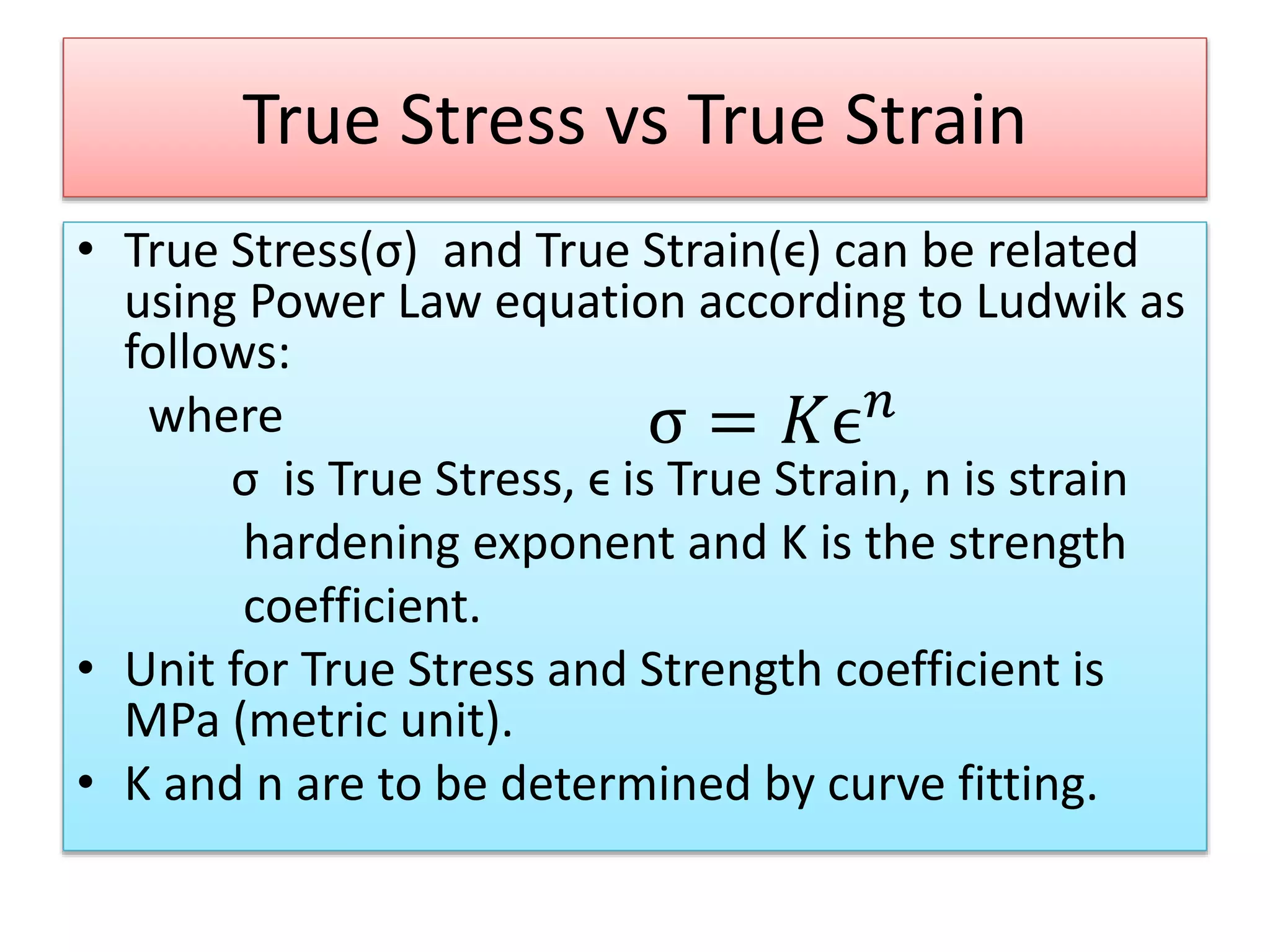
• True Stress(σ) and True Strain(ϵ) can be related
using Power Law equation according to Ludwik as
follows:
where
σ is True Stress, ϵ is True Strain, n is strain
hardening exponent and K is the strength
coefficient.
• Unit for True Stress and Strength coefficient is
MPa (metric unit).
• K and n are to be determined by curve fitting.
σ = 𝐾ϵ 𝑛
Determination of K and n- values
Strain hardening exponent (n) is the ratio of the
physical distance (mm) of “a” by the physical
distance (mm) of “b”.
n – value has no unit.
n – value represents the strain hardening ability
of the material.
n – value varies from 0.1 to 0.5 for conventional
metals.
The effect of Strain hardening
exponent on True stress -True strain
Typical K and n values for various
metals
Plastic Instability in uniaxial tension
We know that:
Differentiating on both sides, we get:
(Or)
This can be written as: (Or)
Plastic Instability in uniaxial tension
cont…
At maximum load, (Or)
Hence, the above expression becomes:
Therefore, n = ε
Where ε is the true uniform strain, which is
denoted by the symbol έ.
Plastic Instability in uniaxial tension
cont…
It is important to note that rate of strain
hardening is not identical with strain
hardening exponent (n)value.
Plastic Instability in uniaxial tension
The rate of strain hardening can be written as
follows:
Plastic Instability in uniaxial tension
Considere’s construction for the determination of the point of maximum load
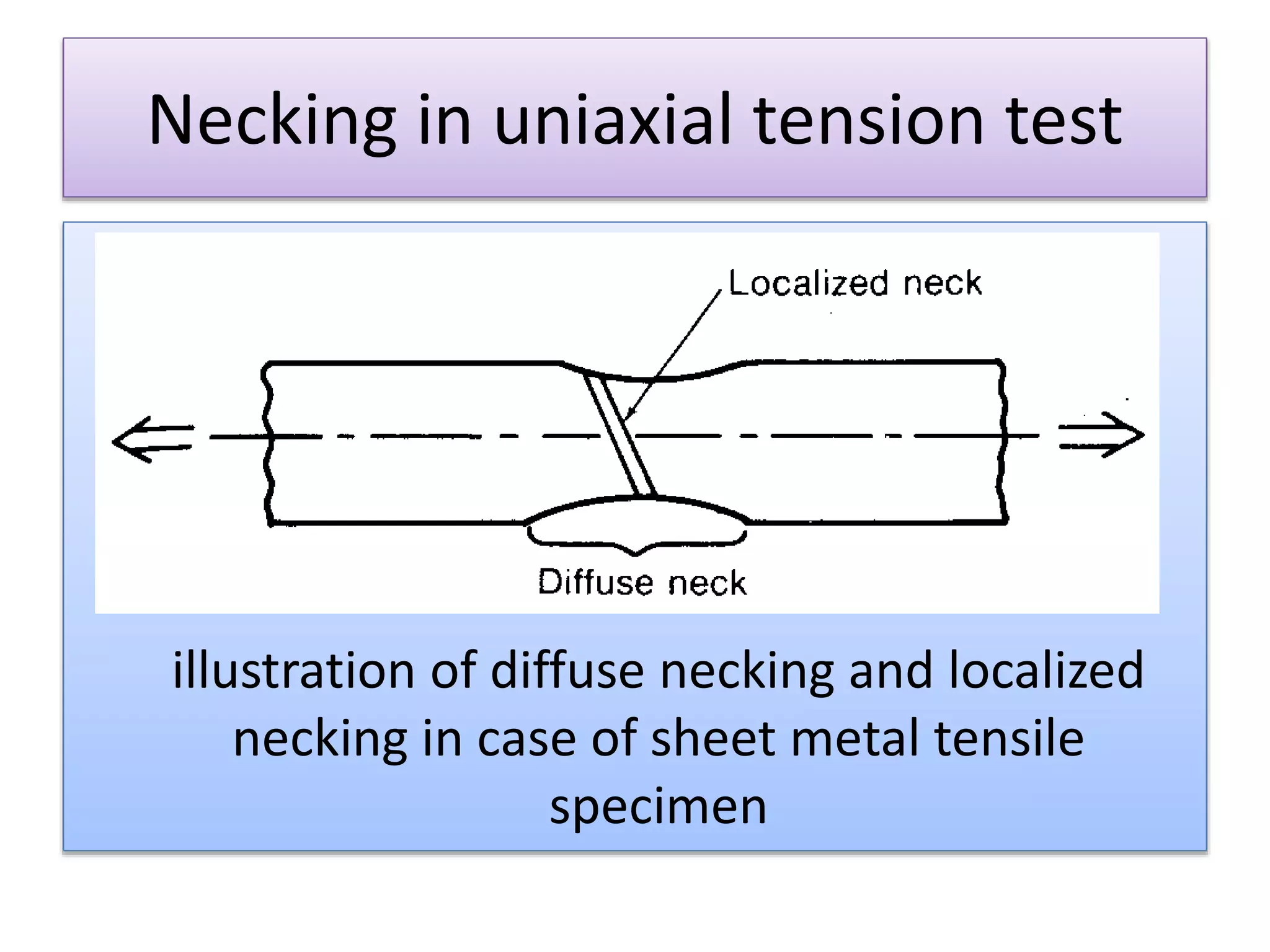
Necking in uniaxial tension test
illustration of diffuse necking and localized
necking in case of sheet metal tensile
specimen
Diffused necking & Localized necking
• Necking in cylindrical specimen is symmetrical around
tensile axis in case of isotropic
• For sheet tensile specimen width is greater than
thickness and two type of tensile instability occurs
• Diffused necking: Its extension is greater than
thickness. It will end in fracture and also it is followed
by second instability (localized necking)
• Localized necking: Neck is narrow width is
approximately equal to thickness inclined at an angle
to the specimen axis.
• Localized necking corresponds to plane-strain
deformation
Diffused necking & Localized necking
cont…
Diffused necking & Localized necking
cont…
Reference
• Mechanical Metallurgy by George E.Dieter,
McGraw – Hill Publication, London,1988.
Thank you

Dr.R.Narayanasamy - Plastic instability in uniaxial tension

  • 1.
    Plastic Instability inUniaxial Tension By Dr. R. Narayanasamy, B.E.,M.Tech.,M.Engg.,Ph.D.,(D.Sc.), Professor, Department of Production Engineering, National Institute of Technology, Tiruchirappalli- 620 015 , Tamil Nadu, India.
  • 2.
    True Stress vsEngineering Stress • Engineering Stress(s)=Load(P)/A0 A0 is the initial area of cross section of tensile sample. • True Stress(σ) =Load(P)/Ai Ai is the instantaneous area of cross section • In the Load-Extension graph, volume constancy principle can be applied upto the maximum load point.
  • 3.
    Engineering Strain vsTrue Strain • Engineering Strain(e)= Change in length(Δl)/𝑙0 l0 is the initial gauge length of tensile sample. lf is the final or intermediate length of sample during tensile test. • Natural (or) True Strain(ϵ) = 𝑙0 𝑙 𝑓 𝑑𝑙 𝑙 • True Strain(ϵ) =ln(lf/l0) = ln((l0 + Δl)/l0) = ln(1+e)
  • 4.
    Plastic Instability inUniaxial Tension • Load(P) = σ A where σ is True Stress and A is instantaneous area of cross section. • Differentiating on the both sides, we get dP=dσ A + σdA • At maximum load, the value of dP = 0 . • The equation becomes: (dσ/σ) = -(dA/A).
  • 5.
    Plastic Instability inUniaxial Tension cont.. • For Constant Volume : A l = Constant . • Differentiating on both sides, we get dA l +A dl =0 This can be written as: -(dA/A) = (dl/l) = dϵ • Therefore, the above equation becomes: (dσ/σ) = dϵ This can be written as: (dσ/dϵ) = σ This is the condition for plastic instability.
  • 6.
    True Stress vsTrue Strain Plot
  • 7.
    Plastic Instability inUniaxial Tension
  • 8.
    True Stress vsTrue Strain • True Stress(σ) and True Strain(ϵ) can be related using Power Law equation according to Ludwik as follows: where σ is True Stress, ϵ is True Strain, n is strain hardening exponent and K is the strength coefficient. • Unit for True Stress and Strength coefficient is MPa (metric unit). • K and n are to be determined by curve fitting. σ = 𝐾ϵ 𝑛
  • 9.
    Determination of Kand n- values
  • 10.
    Determination of Kand n- values Strain hardening exponent (n) is the ratio of the physical distance (mm) of “a” by the physical distance (mm) of “b”. n – value has no unit. n – value represents the strain hardening ability of the material. n – value varies from 0.1 to 0.5 for conventional metals.
  • 11.
    The effect ofStrain hardening exponent on True stress -True strain
  • 12.
    Typical K andn values for various metals
  • 13.
    Plastic Instability inuniaxial tension We know that: Differentiating on both sides, we get: (Or) This can be written as: (Or)
  • 14.
    Plastic Instability inuniaxial tension cont… At maximum load, (Or) Hence, the above expression becomes: Therefore, n = ε Where ε is the true uniform strain, which is denoted by the symbol έ.
  • 15.
    Plastic Instability inuniaxial tension cont… It is important to note that rate of strain hardening is not identical with strain hardening exponent (n)value.
  • 16.
    Plastic Instability inuniaxial tension The rate of strain hardening can be written as follows:
  • 17.
    Plastic Instability inuniaxial tension Considere’s construction for the determination of the point of maximum load
  • 18.
    Necking in uniaxialtension test illustration of diffuse necking and localized necking in case of sheet metal tensile specimen
  • 19.
    Diffused necking &Localized necking • Necking in cylindrical specimen is symmetrical around tensile axis in case of isotropic • For sheet tensile specimen width is greater than thickness and two type of tensile instability occurs • Diffused necking: Its extension is greater than thickness. It will end in fracture and also it is followed by second instability (localized necking) • Localized necking: Neck is narrow width is approximately equal to thickness inclined at an angle to the specimen axis. • Localized necking corresponds to plane-strain deformation
  • 20.
    Diffused necking &Localized necking cont…
  • 21.
    Diffused necking &Localized necking cont…
  • 22.
    Reference • Mechanical Metallurgyby George E.Dieter, McGraw – Hill Publication, London,1988.
  • 23.