1
Gyroscopic Couple & Effect of The
Gyroscopic Couple On The an Aeroplane
Student Name: Mahmood Kahdim Hamad
Class: Third
Group: (A)
Course Title: Theory of Machine
Department: Mechanic and Mechatronics
College Of Engineering
Salahaddin University – Erbil
Academic Year 2020-2021
2
ABSTRACT
A gyroscope (from Ancient Greek γῦρος gûros, "circle" and
σκοπέω skopéō, "to look") is a device used for measuring or
maintaining orientation and angular velocity. It is a spinning wheel or
disc in which the axis of rotation (spin axis) is free to assume any
orientation by itself. When rotating, the orientation of this axis is
unaffected by tilting or rotation of the mounting, according to
the conservation of angular momentum.
Gyroscopes based on other operating principles also exist, such as the
microchip-packaged MEMS gyroscopes found in electronic devices
(sometimes called gyro meters), solid-state ring lasers, fiber optic
gyroscopes, and the extremely sensitive quantum gyroscope.
Applications of gyroscopes include inertial navigation systems, such as in
the Hubble Telescope, or inside the steel hull of a submerged submarine.
Due to their precision, gyroscopes are also used in gyro theodolites to
maintain direction in tunnel mining. Gyroscopes can be used to
construct gyrocompasses, which complement or replace magnetic
compasses (in ships, aircraft and spacecraft, vehicles in general), to assist
in stability (bicycles, motorcycles, and ships) or be used as part of an
inertial guidance system.
3
TABLE OF CONTENTS
ABSTRACT……………………………………………………..2
TABLE OD CONTENT ………………………………………..3
INTRODUCTION………………………………………………4
INTRODUCTION………………………………………………5
INTRODUCTION………………………………………………6
GYROSCOPIC IN AEROPLANE……………………………..7
GYROSCOPIC IN AEROPLANE……………………………..8
GYROSCOPIC IN AEROPLANE……………………………..9
GYROSCOPIC IN AEROPLANE……………………………..10
GYROSCOPIC IN AEROPLANE……………………………..11
GYROSCOPIC IN AEROPLANE……………………………..12
GYROSCOPIC IN AEROPLANE……………………………..13
GYROSCOPIC IN AEROPLANE……………………………..14
REFERENCES…………………………………………………15
4
INTRODUCTION
History: Essentially, a gyroscope is a top combined with a pair
of gimbals. Tops were invented in many different civilizations, including
classical Greece, Rome, and China.Most of these were not utilized as
instruments.
The first known apparatus similar to a gyroscope (the "Whirling
Speculum" or "Serson's Speculum") was invented by John Serson in
1743. It was used as a level, to locate the horizon in foggy or misty
conditions.
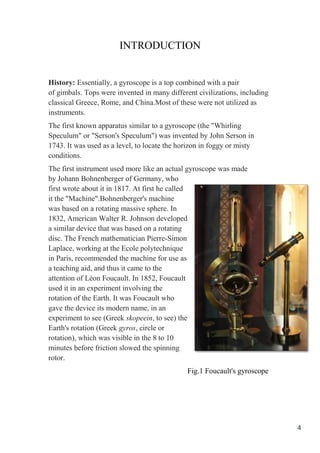
The first instrument used more like an actual gyroscope was made
by Johann Bohnenberger of Germany, who
first wrote about it in 1817. At first he called
it the "Machine".Bohnenberger's machine
was based on a rotating massive sphere. In
1832, American Walter R. Johnson developed
a similar device that was based on a rotating
disc. The French mathematician Pierre-Simon
Laplace, working at the Ecole polytechnique
in Paris, recommended the machine for use as
a teaching aid, and thus it came to the
attention of Léon Foucault. In 1852, Foucault
used it in an experiment involving the
rotation of the Earth. It was Foucault who
gave the device its modern name, in an
experiment to see (Greek skopeein, to see) the
Earth's rotation (Greek gyros, circle or
rotation), which was visible in the 8 to 10
minutes before friction slowed the spinning
rotor.
Fig.1 Foucault's gyroscope
5
In the 1860s, the advent of electric motors made it possible for a
gyroscope to spin indefinitely; this led to the first prototype heading
indicators, and a rather more complicated device, the gyrocompass. The
first functional gyrocompass was patented in 1904 by German
inventor Hermann Anschütz-Kaempfe. American Elmer Sperry followed
with his own design later that year, and other nations soon realized the
military importance of the invention—in an age in which naval prowess
was the most significant measure of military power—and created their
own gyroscope industries. The Sperry Gyroscope Company quickly
expanded to provide aircraft and naval stabilizers as well, and other
gyroscope developers followed suit.
In 1917, the Chandler Company of Indianapolis, created the "Chandler
gyroscope", a toy gyroscope with a pull string and pedestal. Chandler
continued to produce the toy until the company was purchased by
TEDCO inc. in 1982. The chandler toy is still produced by TEDCO
today. In the first several decades of the 20th century, other inventors
attempted (unsuccessfully) to use gyroscopes as the basis for early black
box navigational systems by creating a stable platform from which
accurate acceleration measurements could be performed (in order to
bypass the need for star sightings to calculate position). Similar principles
were later employed in the development of inertial navigation
systems for ballistic missiles.
During World War II, the gyroscope became the prime component for
aircraft and anti-aircraft gun sights. After the war, the race to miniaturize
gyroscopes for guided missiles and weapons navigation systems resulted
in the development and manufacturing of so-called midget
gyroscopes that weighed less than 3 ounces (85 g) and had a diameter of
approximately 1 inch (2.5 cm). Some of these miniaturized gyroscopes
could reach a speed of 24,000 revolutions per minute in less than 10
seconds.
6
This article describes gyroscopes and their effects in various fields of
everyday life. Gyroscopic effect is ability (tendency) of the rotating body
to maintain a steady direction of its axis of rotation. The gyroscopes are
rotating with respect to the axis of symmetry at high speed. Gyroscopic
effect is related to all rotating mechanisms (wheels, gears, shafts, rotors,
bicycles, motorcycles, children’s toys...). In some cases, we want to
enhance the gyroscopic effect (for stabilization, energy accumulation).
Stabilization effect is mainly used for two-wheeled vehicles. It can be
also used on ships and boats, where big wheel is rotating and preventing
the boat to overturn. Gyroscopic effects can help with energy
accumulation.
APPLICATIONS OF GYROSCOPIC EFFECT
Gyroscopic effect is used not only in the logistic but also in the military.
If the bullet is rotating around the longitudinal axis it is more stable and
for example the side wind doesn’t have so big effect on it.
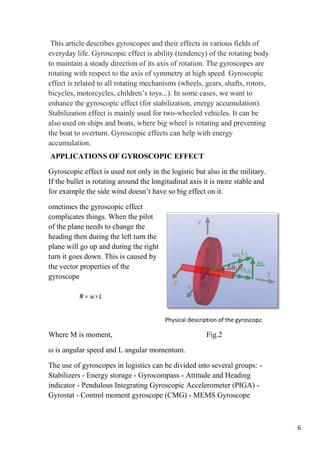
ometimes the gyroscopic effect
complicates things. When the pilot
of the plane needs to change the
heading then during the left turn the
plane will go up and during the right
turn it goes down. This is caused by
the vector properties of the
gyroscope
Physical description of the gyroscope
Where M is moment, Fig.2
ω is angular speed and L angular momentum.
The use of gyroscopes in logistics can be divided into several groups: -
Stabilizers - Energy storage - Gyrocompass - Attitude and Heading
indicator - Pendulous Integrating Gyroscopic Accelerometer (PIGA) -
Gyrostat - Control moment gyroscope (CMG) - MEMS Gyroscope
7
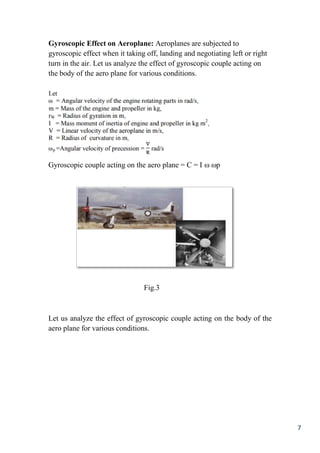
Gyroscopic Effect on Aeroplane: Aeroplanes are subjected to
gyroscopic effect when it taking off, landing and negotiating left or right
turn in the air. Let us analyze the effect of gyroscopic couple acting on
the body of the aero plane for various conditions.
Gyroscopic couple acting on the aero plane = C = I  p
Fig.3
Let us analyze the effect of gyroscopic couple acting on the body of the
aero plane for various conditions.
8
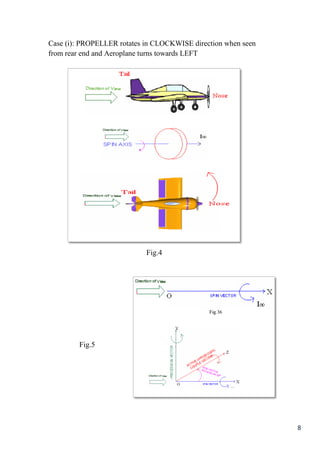
Case (i): PROPELLER rotates in CLOCKWISE direction when seen
from rear end and Aeroplane turns towards LEFT
Fig.4
Fig.5
9
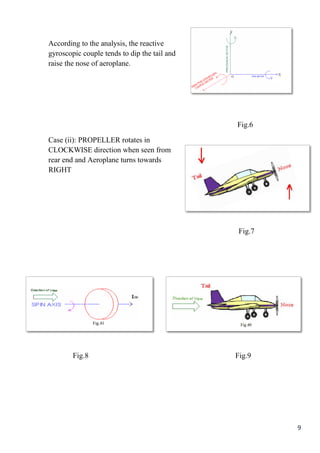
According to the analysis, the reactive
gyroscopic couple tends to dip the tail and
raise the nose of aeroplane.
Fig.6
Case (ii): PROPELLER rotates in
CLOCKWISE direction when seen from
rear end and Aeroplane turns towards
RIGHT
Fig.7
Fig.8 Fig.9
10
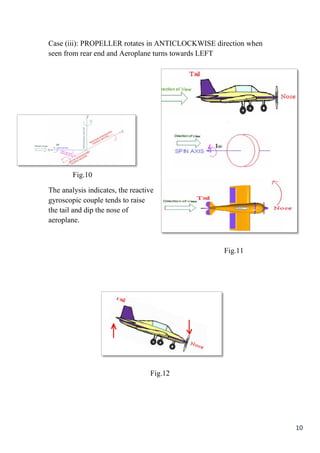
Case (iii): PROPELLER rotates in ANTICLOCKWISE direction when
seen from rear end and Aeroplane turns towards LEFT
Fig.10
The analysis indicates, the reactive
gyroscopic couple tends to raise
the tail and dip the nose of
aeroplane.
Fig.11
Fig.12
11
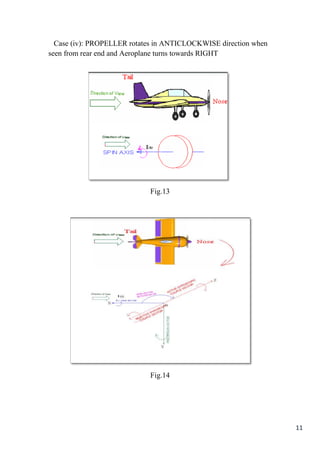
Case (iv): PROPELLER rotates in ANTICLOCKWISE direction when
seen from rear end and Aeroplane turns towards RIGHT
Fig.13
Fig.14
12
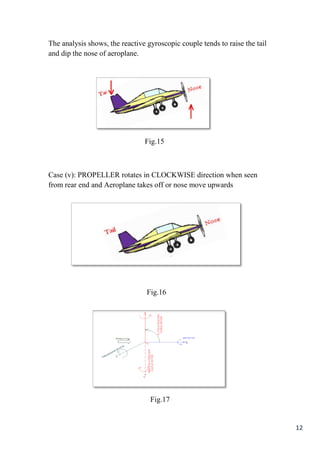
The analysis shows, the reactive gyroscopic couple tends to raise the tail
and dip the nose of aeroplane.
Fig.15
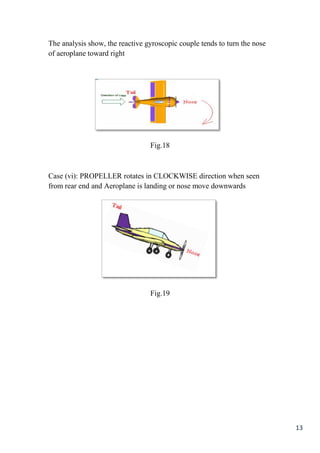
Case (v): PROPELLER rotates in CLOCKWISE direction when seen
from rear end and Aeroplane takes off or nose move upwards
Fig.16
Fig.17
13
The analysis show, the reactive gyroscopic couple tends to turn the nose
of aeroplane toward right
Fig.18
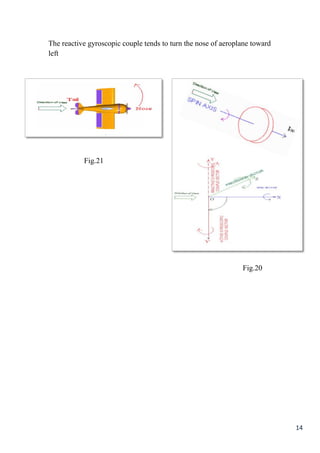
Case (vi): PROPELLER rotates in CLOCKWISE direction when seen
from rear end and Aeroplane is landing or nose move downwards
Fig.19
14
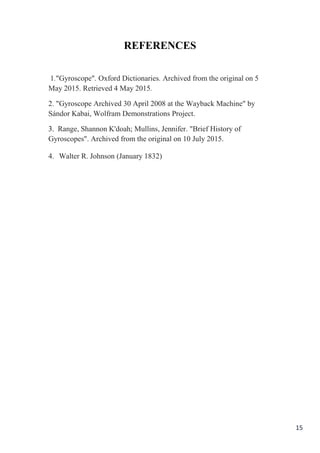
The reactive gyroscopic couple tends to turn the nose of aeroplane toward
left
Fig.21
Fig.20
15
REFERENCES
1."Gyroscope". Oxford Dictionaries. Archived from the original on 5
May 2015. Retrieved 4 May 2015.
2. "Gyroscope Archived 30 April 2008 at the Wayback Machine" by
Sándor Kabai, Wolfram Demonstrations Project.
3. Range, Shannon K'doah; Mullins, Jennifer. "Brief History of
Gyroscopes". Archived from the original on 10 July 2015.
4. Walter R. Johnson (January 1832)

Gyroscopic coupl&amp,aeroplane effect

  • 1.
    1 Gyroscopic Couple &Effect of The Gyroscopic Couple On The an Aeroplane Student Name: Mahmood Kahdim Hamad Class: Third Group: (A) Course Title: Theory of Machine Department: Mechanic and Mechatronics College Of Engineering Salahaddin University – Erbil Academic Year 2020-2021
  • 2.
    2 ABSTRACT A gyroscope (fromAncient Greek γῦρος gûros, "circle" and σκοπέω skopéō, "to look") is a device used for measuring or maintaining orientation and angular velocity. It is a spinning wheel or disc in which the axis of rotation (spin axis) is free to assume any orientation by itself. When rotating, the orientation of this axis is unaffected by tilting or rotation of the mounting, according to the conservation of angular momentum. Gyroscopes based on other operating principles also exist, such as the microchip-packaged MEMS gyroscopes found in electronic devices (sometimes called gyro meters), solid-state ring lasers, fiber optic gyroscopes, and the extremely sensitive quantum gyroscope. Applications of gyroscopes include inertial navigation systems, such as in the Hubble Telescope, or inside the steel hull of a submerged submarine. Due to their precision, gyroscopes are also used in gyro theodolites to maintain direction in tunnel mining. Gyroscopes can be used to construct gyrocompasses, which complement or replace magnetic compasses (in ships, aircraft and spacecraft, vehicles in general), to assist in stability (bicycles, motorcycles, and ships) or be used as part of an inertial guidance system.
  • 3.
    3 TABLE OF CONTENTS ABSTRACT……………………………………………………..2 TABLEOD CONTENT ………………………………………..3 INTRODUCTION………………………………………………4 INTRODUCTION………………………………………………5 INTRODUCTION………………………………………………6 GYROSCOPIC IN AEROPLANE……………………………..7 GYROSCOPIC IN AEROPLANE……………………………..8 GYROSCOPIC IN AEROPLANE……………………………..9 GYROSCOPIC IN AEROPLANE……………………………..10 GYROSCOPIC IN AEROPLANE……………………………..11 GYROSCOPIC IN AEROPLANE……………………………..12 GYROSCOPIC IN AEROPLANE……………………………..13 GYROSCOPIC IN AEROPLANE……………………………..14 REFERENCES…………………………………………………15
  • 4.
    4 INTRODUCTION History: Essentially, agyroscope is a top combined with a pair of gimbals. Tops were invented in many different civilizations, including classical Greece, Rome, and China.Most of these were not utilized as instruments. The first known apparatus similar to a gyroscope (the "Whirling Speculum" or "Serson's Speculum") was invented by John Serson in 1743. It was used as a level, to locate the horizon in foggy or misty conditions. The first instrument used more like an actual gyroscope was made by Johann Bohnenberger of Germany, who first wrote about it in 1817. At first he called it the "Machine".Bohnenberger's machine was based on a rotating massive sphere. In 1832, American Walter R. Johnson developed a similar device that was based on a rotating disc. The French mathematician Pierre-Simon Laplace, working at the Ecole polytechnique in Paris, recommended the machine for use as a teaching aid, and thus it came to the attention of Léon Foucault. In 1852, Foucault used it in an experiment involving the rotation of the Earth. It was Foucault who gave the device its modern name, in an experiment to see (Greek skopeein, to see) the Earth's rotation (Greek gyros, circle or rotation), which was visible in the 8 to 10 minutes before friction slowed the spinning rotor. Fig.1 Foucault's gyroscope
  • 5.
    5 In the 1860s,the advent of electric motors made it possible for a gyroscope to spin indefinitely; this led to the first prototype heading indicators, and a rather more complicated device, the gyrocompass. The first functional gyrocompass was patented in 1904 by German inventor Hermann Anschütz-Kaempfe. American Elmer Sperry followed with his own design later that year, and other nations soon realized the military importance of the invention—in an age in which naval prowess was the most significant measure of military power—and created their own gyroscope industries. The Sperry Gyroscope Company quickly expanded to provide aircraft and naval stabilizers as well, and other gyroscope developers followed suit. In 1917, the Chandler Company of Indianapolis, created the "Chandler gyroscope", a toy gyroscope with a pull string and pedestal. Chandler continued to produce the toy until the company was purchased by TEDCO inc. in 1982. The chandler toy is still produced by TEDCO today. In the first several decades of the 20th century, other inventors attempted (unsuccessfully) to use gyroscopes as the basis for early black box navigational systems by creating a stable platform from which accurate acceleration measurements could be performed (in order to bypass the need for star sightings to calculate position). Similar principles were later employed in the development of inertial navigation systems for ballistic missiles. During World War II, the gyroscope became the prime component for aircraft and anti-aircraft gun sights. After the war, the race to miniaturize gyroscopes for guided missiles and weapons navigation systems resulted in the development and manufacturing of so-called midget gyroscopes that weighed less than 3 ounces (85 g) and had a diameter of approximately 1 inch (2.5 cm). Some of these miniaturized gyroscopes could reach a speed of 24,000 revolutions per minute in less than 10 seconds.
  • 6.
    6 This article describesgyroscopes and their effects in various fields of everyday life. Gyroscopic effect is ability (tendency) of the rotating body to maintain a steady direction of its axis of rotation. The gyroscopes are rotating with respect to the axis of symmetry at high speed. Gyroscopic effect is related to all rotating mechanisms (wheels, gears, shafts, rotors, bicycles, motorcycles, children’s toys...). In some cases, we want to enhance the gyroscopic effect (for stabilization, energy accumulation). Stabilization effect is mainly used for two-wheeled vehicles. It can be also used on ships and boats, where big wheel is rotating and preventing the boat to overturn. Gyroscopic effects can help with energy accumulation. APPLICATIONS OF GYROSCOPIC EFFECT Gyroscopic effect is used not only in the logistic but also in the military. If the bullet is rotating around the longitudinal axis it is more stable and for example the side wind doesn’t have so big effect on it. ometimes the gyroscopic effect complicates things. When the pilot of the plane needs to change the heading then during the left turn the plane will go up and during the right turn it goes down. This is caused by the vector properties of the gyroscope Physical description of the gyroscope Where M is moment, Fig.2 ω is angular speed and L angular momentum. The use of gyroscopes in logistics can be divided into several groups: - Stabilizers - Energy storage - Gyrocompass - Attitude and Heading indicator - Pendulous Integrating Gyroscopic Accelerometer (PIGA) - Gyrostat - Control moment gyroscope (CMG) - MEMS Gyroscope
  • 7.
    7 Gyroscopic Effect onAeroplane: Aeroplanes are subjected to gyroscopic effect when it taking off, landing and negotiating left or right turn in the air. Let us analyze the effect of gyroscopic couple acting on the body of the aero plane for various conditions. Gyroscopic couple acting on the aero plane = C = I  p Fig.3 Let us analyze the effect of gyroscopic couple acting on the body of the aero plane for various conditions.
  • 8.
    8 Case (i): PROPELLERrotates in CLOCKWISE direction when seen from rear end and Aeroplane turns towards LEFT Fig.4 Fig.5
  • 9.
    9 According to theanalysis, the reactive gyroscopic couple tends to dip the tail and raise the nose of aeroplane. Fig.6 Case (ii): PROPELLER rotates in CLOCKWISE direction when seen from rear end and Aeroplane turns towards RIGHT Fig.7 Fig.8 Fig.9
  • 10.
    10 Case (iii): PROPELLERrotates in ANTICLOCKWISE direction when seen from rear end and Aeroplane turns towards LEFT Fig.10 The analysis indicates, the reactive gyroscopic couple tends to raise the tail and dip the nose of aeroplane. Fig.11 Fig.12
  • 11.
    11 Case (iv): PROPELLERrotates in ANTICLOCKWISE direction when seen from rear end and Aeroplane turns towards RIGHT Fig.13 Fig.14
  • 12.
    12 The analysis shows,the reactive gyroscopic couple tends to raise the tail and dip the nose of aeroplane. Fig.15 Case (v): PROPELLER rotates in CLOCKWISE direction when seen from rear end and Aeroplane takes off or nose move upwards Fig.16 Fig.17
  • 13.
    13 The analysis show,the reactive gyroscopic couple tends to turn the nose of aeroplane toward right Fig.18 Case (vi): PROPELLER rotates in CLOCKWISE direction when seen from rear end and Aeroplane is landing or nose move downwards Fig.19
  • 14.
    14 The reactive gyroscopiccouple tends to turn the nose of aeroplane toward left Fig.21 Fig.20
  • 15.
    15 REFERENCES 1."Gyroscope". Oxford Dictionaries.Archived from the original on 5 May 2015. Retrieved 4 May 2015. 2. "Gyroscope Archived 30 April 2008 at the Wayback Machine" by Sándor Kabai, Wolfram Demonstrations Project. 3. Range, Shannon K'doah; Mullins, Jennifer. "Brief History of Gyroscopes". Archived from the original on 10 July 2015. 4. Walter R. Johnson (January 1832)