Chapter 5
Field-Effect Transistors
Chapter Goals
• Describe operation of MOSFETs and JFETs.
• Define MOSFET characteristics in operation regions of cutoff,
triode and saturation.
• Discuss mathematical models for i-v characteristics of MOSFETs
and JFETs.
• Introduce graphical representations for output and transfer
characteristic descriptions of electronic devices.
• Define and contrast characteristics of enhancement-mode and
depletion-mode MOFETs.
• Define symbols to represent MOSFETs in circuit schematics.
• Investigate circuits that bias transistors into different operating
regions.
• MOSFET and JFET DC circuit analysis
• Explore MOSFET modeling in SPICE
Types of Field-Effect Transistors
• MOSFET (Metal-Oxide Semiconductor Field-Effect
Transistor)
– Primary component in high-density VLSI chips such
as memories and microprocessors
• JFET (Junction Field-Effect Transistor)
– Finds application especially in analog and RF circuit
design
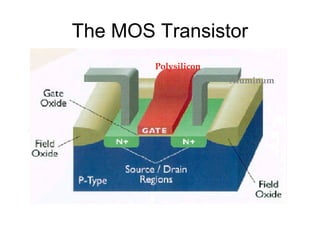
The MOS Transistor
Polysilicon
Aluminum
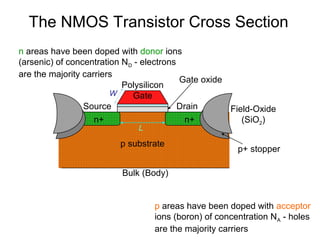
The NMOS Transistor Cross Section
n areas have been doped with donor ions
(arsenic) of concentration ND - electrons
are the majority carriers
p areas have been doped with acceptor
ions (boron) of concentration NA - holes
are the majority carriers
Gate oxide
n+
Source Drain
p substrate
Bulk (Body)
p+ stopper
Field-Oxide
(SiO2)n+
Polysilicon
Gate
L
W
MOS Capacitor Structure
• First electrode - Gate :
Consists of low-resistivity
material such as highly-doped
polycrystalline silicon,
aluminum or tungsten
• Second electrode -
Substrate or Body: n- or p-
type semiconductor
• Dielectric - Silicon dioxide:
stable high-quality electrical
insulator between gate and
substrate.
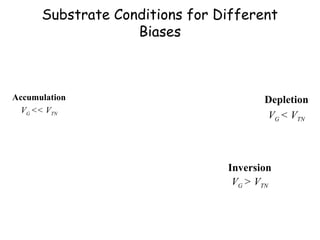
Substrate Conditions for Different
Biases
Accumulation
VG << VTN
Depletion
VG < VTN
Inversion
VG > VTN
Low-frequency C-V Characteristics for MOS Capacitor
on P-type Substrate
• MOS capacitance is non-
linear function of voltage.
• Total capacitance in any
region dictated by the
separation between
capacitor plates.
• Total capacitance modeled
as series combination of
fixed oxide capacitance
and voltage-dependent
depletion layer
capacitance.
NMOS Transistor: Structure
• 4 device terminals:
Gate(G), Drain(D),
Source(S) and Body(B).
• Source and drain regions
form pn junctions with
substrate.
• vSB, vDS and vGS always
positive during normal
operation.
• vSB must always reverse
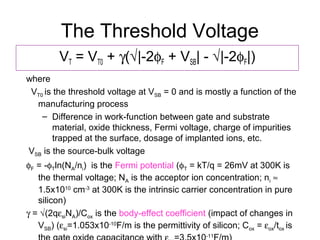
The Threshold Voltage
VT = VT0 + γ(√|-2φF + VSB| - √|-2φF|)
where
VT0 is the threshold voltage at VSB = 0 and is mostly a function of the
manufacturing process
– Difference in work-function between gate and substrate
material, oxide thickness, Fermi voltage, charge of impurities
trapped at the surface, dosage of implanted ions, etc.
VSB is the source-bulk voltage
φF = -φTln(NA/ni) is the Fermi potential (φT = kT/q = 26mV at 300K is
the thermal voltage; NA is the acceptor ion concentration; ni ā‰ˆ
1.5x10¹⁰
cm-3
at 300K is the intrinsic carrier concentration in pure
silicon)
γ = √(2qεsiNA)/Cox is the body-effect coefficient (impact of changes in
VSB) (εsi=1.053x10⁻¹⁰
F/m is the permittivity of silicon; Cox = εox/tox is
-11
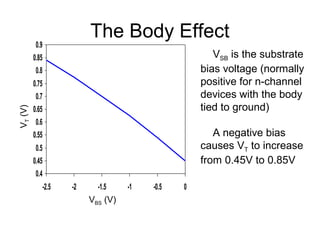
The Body Effect
0.4
0.45
0.5
0.55
0.6
0.65
0.7
0.75
0.8
0.85
0.9
-2.5 -2 -1.5 -1 -0.5 0
VBS (V)
VT(V)
VSB is the substrate
bias voltage (normally
positive for n-channel
devices with the body
tied to ground)
A negative bias
causes VT to increase
from 0.45V to 0.85V
NMOS Transistor: Triode Region Characteristics
• It is to be noted that the VDS measured relative to the source increases from 0 to VDS as we
travel along the channel from source to drain. This is because the voltage between the gate
and points along the channel decreases from VGS at the source end to VGS-VDS.
• When VDS is increased to the value that reduces the voltage between the gate and channel at the
drain end to Vt that is ,
• VGS-VDS=Vt or VDS= VGS-Vt or VDS(sat) ≄ VGS-Vt
Concept of Asymmetric Channel
Transistor in Saturation Mode
S
D
B
G
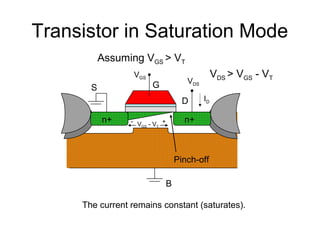
VGS VDS > VGS - VT
ID
VGS - VT
- +n+ n+
Pinch-off
Assuming VGS > VT
VDS
The current remains constant (saturates).
NMOS Transistor: Saturation Region
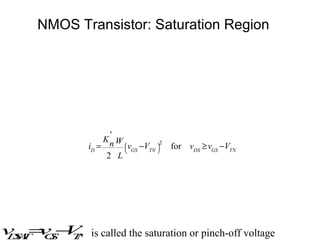
TNGSDSTNGSD
VvvVv
L
WnK
i āˆ’ā‰„āˆ’= 



 for
2
'
2
vDSAT
=vGS
āˆ’VTN is called the saturation or pinch-off voltage
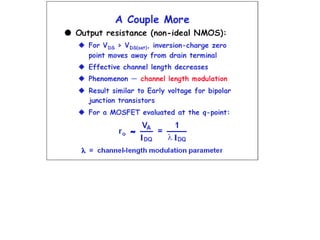
Channel-Length Modulation
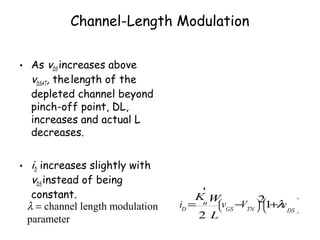
• As vDS increases above
vDSAT, thelength of the
depleted channel beyond
pinch-off point, DL,
increases and actual L
decreases.
• iD increases slightly with
vDS instead of being
constant.
iD
=
Kn
'
2
W
L
vGS
āˆ’VTN


 


2
1+λvDS





λ = channel length modulation
parameter
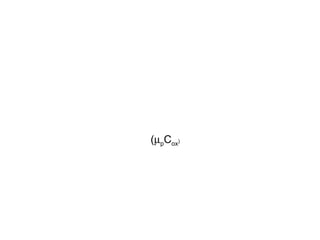
(µpCox)
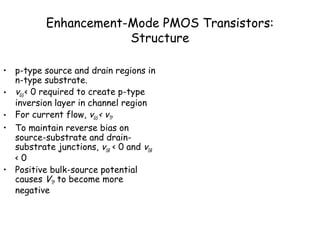
Enhancement-Mode PMOS Transistors:
Structure
• p-type source and drain regions in
n-type substrate.
• vGS < 0 required to create p-type
inversion layer in channel region
• For current flow, vGS < vTP
• To maintain reverse bias on
source-substrate and drain-
substrate junctions, vSB < 0 and vDB
< 0
• Positive bulk-source potential
causes VTP to become more
negative
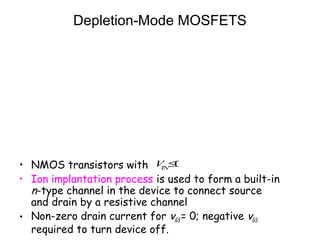
Depletion-Mode MOSFETS
• NMOS transistors with
• Ion implantation process is used to form a built-in
n-type channel in the device to connect source
and drain by a resistive channel
• Non-zero drain current for vGS = 0; negative vGS
required to turn device off.
VTN
≤0
Problem-solving Technique :MOSFET
DC Analysis
• STep1: Requires knowing the bias
condition of the transistor such as
cutoff or saturation or nonsaturation.
• Step2: If the bias condition is not
obvious, one must guess the bias
condition before analyzing the circuit.
• Step3 How can we Guess?
(i) Assume that the transistor is biased in
the saturation region, which implies
that:
VGS>VTN, ID>0, and VDS≄VDS(sat)
If all the above conditions are satisfied,
analyze the circuit using the saturation
current voltage relations.
(ii) If VGS<VTN, then transistor is probably in
cutoff mode.
(iii) If VDS<VDS(sat), the transistor is likely
biased in nonsaturation region, analyze
the circuit using nonsaturation current
voltage relations.
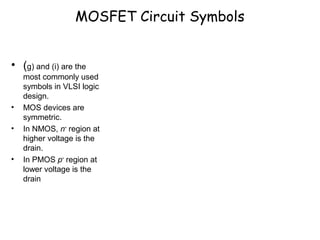
MOSFET Circuit Symbols
• (g) and (i) are the
most commonly used
symbols in VLSI logic
design.
• MOS devices are
symmetric.
• In NMOS, n+
region at
higher voltage is the
drain.
• In PMOS p+
region at
lower voltage is the
drain
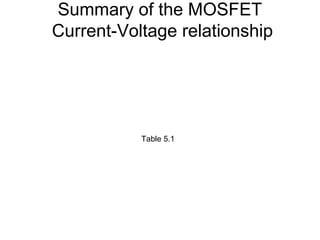
Summary of the MOSFET
Current-Voltage relationship
Table 5.1

Ece 334 lecture 15-mosfet-basics

  • 1.
  • 2.
    Chapter Goals • Describeoperation of MOSFETs and JFETs. • Define MOSFET characteristics in operation regions of cutoff, triode and saturation. • Discuss mathematical models for i-v characteristics of MOSFETs and JFETs. • Introduce graphical representations for output and transfer characteristic descriptions of electronic devices. • Define and contrast characteristics of enhancement-mode and depletion-mode MOFETs. • Define symbols to represent MOSFETs in circuit schematics. • Investigate circuits that bias transistors into different operating regions. • MOSFET and JFET DC circuit analysis • Explore MOSFET modeling in SPICE
  • 4.
    Types of Field-EffectTransistors • MOSFET (Metal-Oxide Semiconductor Field-Effect Transistor) – Primary component in high-density VLSI chips such as memories and microprocessors • JFET (Junction Field-Effect Transistor) – Finds application especially in analog and RF circuit design
  • 5.
  • 6.
    The NMOS TransistorCross Section n areas have been doped with donor ions (arsenic) of concentration ND - electrons are the majority carriers p areas have been doped with acceptor ions (boron) of concentration NA - holes are the majority carriers Gate oxide n+ Source Drain p substrate Bulk (Body) p+ stopper Field-Oxide (SiO2)n+ Polysilicon Gate L W
  • 7.
    MOS Capacitor Structure •First electrode - Gate : Consists of low-resistivity material such as highly-doped polycrystalline silicon, aluminum or tungsten • Second electrode - Substrate or Body: n- or p- type semiconductor • Dielectric - Silicon dioxide: stable high-quality electrical insulator between gate and substrate.
  • 8.
    Substrate Conditions forDifferent Biases Accumulation VG << VTN Depletion VG < VTN Inversion VG > VTN
  • 9.
    Low-frequency C-V Characteristicsfor MOS Capacitor on P-type Substrate • MOS capacitance is non- linear function of voltage. • Total capacitance in any region dictated by the separation between capacitor plates. • Total capacitance modeled as series combination of fixed oxide capacitance and voltage-dependent depletion layer capacitance.
  • 10.
    NMOS Transistor: Structure •4 device terminals: Gate(G), Drain(D), Source(S) and Body(B). • Source and drain regions form pn junctions with substrate. • vSB, vDS and vGS always positive during normal operation. • vSB must always reverse
  • 14.
    The Threshold Voltage VT= VT0 + γ(√|-2φF + VSB| - √|-2φF|) where VT0 is the threshold voltage at VSB = 0 and is mostly a function of the manufacturing process – Difference in work-function between gate and substrate material, oxide thickness, Fermi voltage, charge of impurities trapped at the surface, dosage of implanted ions, etc. VSB is the source-bulk voltage φF = -φTln(NA/ni) is the Fermi potential (φT = kT/q = 26mV at 300K is the thermal voltage; NA is the acceptor ion concentration; ni ā‰ˆ 1.5x1010 cm-3 at 300K is the intrinsic carrier concentration in pure silicon) γ = √(2qεsiNA)/Cox is the body-effect coefficient (impact of changes in VSB) (εsi=1.053x10⁻¹⁰ F/m is the permittivity of silicon; Cox = εox/tox is -11
  • 15.
    The Body Effect 0.4 0.45 0.5 0.55 0.6 0.65 0.7 0.75 0.8 0.85 0.9 -2.5-2 -1.5 -1 -0.5 0 VBS (V) VT(V) VSB is the substrate bias voltage (normally positive for n-channel devices with the body tied to ground) A negative bias causes VT to increase from 0.45V to 0.85V
  • 16.
    NMOS Transistor: TriodeRegion Characteristics
  • 17.
    • It isto be noted that the VDS measured relative to the source increases from 0 to VDS as we travel along the channel from source to drain. This is because the voltage between the gate and points along the channel decreases from VGS at the source end to VGS-VDS. • When VDS is increased to the value that reduces the voltage between the gate and channel at the drain end to Vt that is , • VGS-VDS=Vt or VDS= VGS-Vt or VDS(sat) ≄ VGS-Vt Concept of Asymmetric Channel
  • 18.
    Transistor in SaturationMode S D B G VGS VDS > VGS - VT ID VGS - VT - +n+ n+ Pinch-off Assuming VGS > VT VDS The current remains constant (saturates).
  • 19.
    NMOS Transistor: SaturationRegion TNGSDSTNGSD VvvVv L WnK i āˆ’ā‰„āˆ’=      for 2 ' 2 vDSAT =vGS āˆ’VTN is called the saturation or pinch-off voltage
  • 20.
    Channel-Length Modulation • AsvDS increases above vDSAT, thelength of the depleted channel beyond pinch-off point, DL, increases and actual L decreases. • iD increases slightly with vDS instead of being constant. iD = Kn ' 2 W L vGS āˆ’VTN       2 1+Ī»vDS      λ = channel length modulation parameter
  • 23.
  • 26.
    Enhancement-Mode PMOS Transistors: Structure •p-type source and drain regions in n-type substrate. • vGS < 0 required to create p-type inversion layer in channel region • For current flow, vGS < vTP • To maintain reverse bias on source-substrate and drain- substrate junctions, vSB < 0 and vDB < 0 • Positive bulk-source potential causes VTP to become more negative
  • 30.
    Depletion-Mode MOSFETS • NMOStransistors with • Ion implantation process is used to form a built-in n-type channel in the device to connect source and drain by a resistive channel • Non-zero drain current for vGS = 0; negative vGS required to turn device off. VTN ≤0
  • 33.
    Problem-solving Technique :MOSFET DCAnalysis • STep1: Requires knowing the bias condition of the transistor such as cutoff or saturation or nonsaturation. • Step2: If the bias condition is not obvious, one must guess the bias condition before analyzing the circuit. • Step3 How can we Guess? (i) Assume that the transistor is biased in the saturation region, which implies that: VGS>VTN, ID>0, and VDS≄VDS(sat) If all the above conditions are satisfied, analyze the circuit using the saturation current voltage relations. (ii) If VGS<VTN, then transistor is probably in cutoff mode. (iii) If VDS<VDS(sat), the transistor is likely biased in nonsaturation region, analyze the circuit using nonsaturation current voltage relations.
  • 34.
    MOSFET Circuit Symbols •(g) and (i) are the most commonly used symbols in VLSI logic design. • MOS devices are symmetric. • In NMOS, n+ region at higher voltage is the drain. • In PMOS p+ region at lower voltage is the drain
  • 35.
    Summary of theMOSFET Current-Voltage relationship Table 5.1

Editor's Notes

  • #7Ā &amp;lt;number&amp;gt; Starting at the bottom of the design abstraction chart Gate Oxide – insulator NMOS – since carriers are electrons (n type carriers) M – metal; O – oxide; S – semiconductor Field oxide isolates one device from neighboring devices Base technology for the semester 0.25 micron transistor length L (drawn separation from source to drain) – 0.24 effective 1.0 micron transistor width W for minimum size transistor 2.5V supply voltage VDD 0.43 (-0.4) threshold voltage for NMOS (PMOS) devices so min W/L ratio in max for 250nm technology is 1/.24 View transistor as a switch with an infinite off-resistance and a finite on-resistance
  • #15Ā &amp;lt;number&amp;gt; Value of VGS where strong inversion occurs is VT VSB is the source to bulk (body) or substrate bias (note relationship to body effect) For tox = 5 nm then Cox = 7fF/micron^2 (typical tox less than 10nm (==100 angstroms) in today’s technology) Typical values for NA = 10**15 atoms/cm**3 and ND = 10**16 atoms/cm**3 Observe that the threshold voltage has a positive value for a normal NMOS device and a negative for a normal PMOS device
  • #16Ā &amp;lt;number&amp;gt; Well bias on VT for NMOS (0.25 micron, 2.5V Vdd) |-2phiF| = 0.6V and gamma = 0.4 V**1/2 A negative bias on the well/substrate causes the threshold to increase from 0.45V to 0.85V Can use this trick to help with power consumption – reduces leakage currents (but slows down the gate) VSB always has to be larger than –0.6V in an NMOS device; otherwise the source-body diode becomes forward biased
  • #19Ā &amp;lt;number&amp;gt; As VDS is increased, the assumption that the channel voltage is larger than the threshold all along the channel ceases to hold when VGS – V(x) &amp;lt; VT At this point, the induced charge is zero and the conducting channel disappears or is pinched off. No channel exists in the vicinity of the drain region (VGS - VDS &amp;lt;= VT) The voltage difference over the induced channel remains fixed (at VGS -VT) and the current remains constant (or saturates)