BIOTRANSFORMATION
Dr CHINTAN DOSHI
04-Jan-14 1
Topics to be discussed
Introduction to Biotransformation
The Phases of Drug Metabolism
Enzyme Induction & Inhibition
Enzymes Metabolising Xenobiotics
Sites of Drug Metabolism
Factors affecting Drug metabolism
( Biotransformation )
04-Jan-14 2
Coping with Exposure to Xenobiotics
• Humans come into Contact with foreign chemicals, medicines, or
Xenobiotics (substances foreign to body) Through –
- Intentional exposure,
- Accidental exposure,
- Diet.
• Fortunately, a mechanism to rapidly eliminate them is developed
⇓
• They do not accumulate in & harm the body
04-Jan-14 3
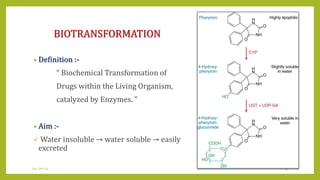
BIOTRANSFORMATION
• Definition :-
“ Biochemical Transformation of
Drugs within the Living Organism,
catalyzed by Enzymes. ”
• Aim :-
 Water insoluble → water soluble → easily
excreted
04-Jan-14 4
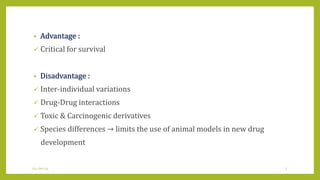
• Advantage :
 Critical for survival
• Disadvantage :
 Inter-individual variations
 Drug-Drug interactions
 Toxic & Carcinogenic derivatives
 Species differences → limits the use of animal models in new drug
development
04-Jan-14 5
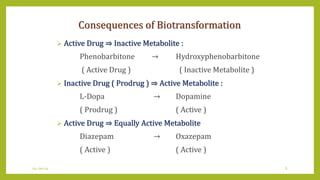
Consequences of Biotransformation
 Active Drug ⇒ Inactive Metabolite :
Phenobarbitone → Hydroxyphenobarbitone
( Active Drug ) ( Inactive Metabolite )
 Inactive Drug ( Prodrug ) ⇒ Active Metabolite :
L-Dopa → Dopamine
( Prodrug ) ( Active )
 Active Drug ⇒ Equally Active Metabolite
Diazepam → Oxazepam
( Active ) ( Active )
04-Jan-14 6
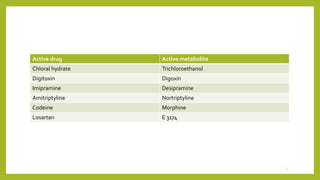
Active drug Active metabolite
Chloral hydrate Trichloroethanol
Digitoxin Digoxin
Imipramine Desipramine
Amitriptyline Nortriptyline
Codeine Morphine
Losartan E 3174
7
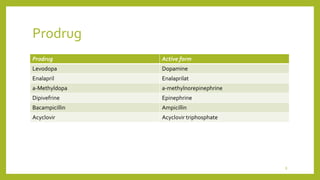
Prodrug
Prodrug Active form
Levodopa Dopamine
Enalapril Enalaprilat
a-Methyldopa a-methylnorepinephrine
Dipivefrine Epinephrine
Bacampicillin Ampicillin
Acyclovir Acyclovir triphosphate
8
First-Pass Metabolism
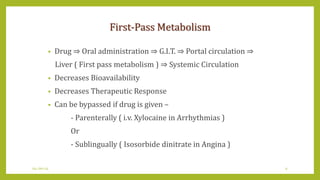
• Drug ⇒ Oral administration ⇒ G.I.T. ⇒ Portal circulation ⇒
Liver ( First pass metabolism ) ⇒ Systemic Circulation
• Decreases Bioavailability
• Decreases Therapeutic Response
• Can be bypassed if drug is given –
- Parenterally ( i.v. Xylocaine in Arrhythmias )
Or
- Sublingually ( Isosorbide dinitrate in Angina )
04-Jan-14 9
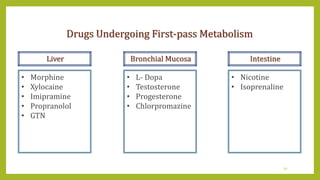
Drugs Undergoing First-pass Metabolism
10
Liver Intestine
Bronchial Mucosa
• Morphine
• Xylocaine
• Imipramine
• Propranolol
• GTN
• L- Dopa
• Testosterone
• Progesterone
• Chlorpromazine
• Nicotine
• Isoprenaline
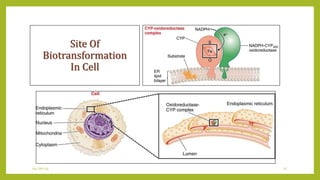
Site Of
Biotransformation
In Cell
04-Jan-14 11
Chemical Pathways Of
Drug Metabolism
04-Jan-14 12
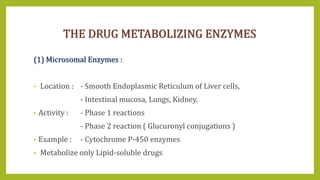
THE DRUG METABOLIZING ENZYMES
(1) Microsomal Enzymes :
• Location : - Smooth Endoplasmic Reticulum of Liver cells,
- Intestinal mucosa, Lungs, Kidney.
• Activity : - Phase 1 reactions
- Phase 2 reaction ( Glucuronyl conjugations )
• Example : - Cytochrome P-450 enzymes
• Metabolize only Lipid-soluble drugs
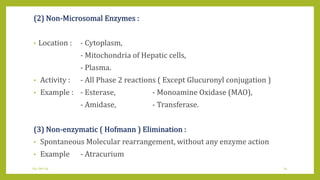
(2) Non-Microsomal Enzymes :
• Location : - Cytoplasm,
- Mitochondria of Hepatic cells,
- Plasma.
• Activity : - All Phase 2 reactions ( Except Glucuronyl conjugation )
• Example : - Esterase, - Monoamine Oxidase (MAO),
- Amidase, - Transferase.
(3) Non-enzymatic ( Hofmann ) Elimination :
• Spontaneous Molecular rearrangement, without any enzyme action
• Example - Atracurium
04-Jan-14 14
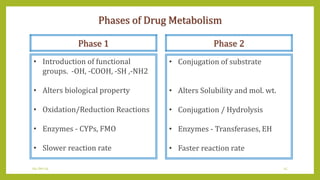
Phases of Drug Metabolism
04-Jan-14 15
Phase 1 Phase 2
• Introduction of functional
groups. -OH, -COOH, -SH ,-NH2
• Alters biological property
• Oxidation/Reduction Reactions
• Enzymes - CYPs, FMO
• Slower reaction rate
• Conjugation of substrate
• Alters Solubility and mol. wt.
• Conjugation / Hydrolysis
• Enzymes - Transferases, EH
• Faster reaction rate
PHASE-1 REACTION
ENZYMES
 CYP ( Cytochrome-P450 )
 FMO ( Flavin-containing Monooxigenases )
 Hydrolytic enzymes
04-Jan-14 16
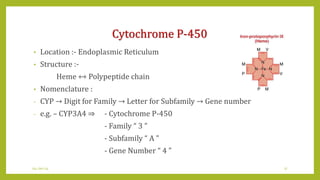
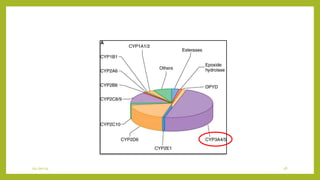
Cytochrome P-450
• Location :- Endoplasmic Reticulum
• Structure :-
Heme ⇿ Polypeptide chain
• Nomenclature :
- CYP → Digit for Family → Letter for Subfamily → Gene number
- e.g. – CYP3A4 ⇒ - Cytochrome P-450
- Family “ 3 ”
- Subfamily “ A ”
- Gene Number “ 4 ”
04-Jan-14 17
04-Jan-14 18
PHASE-1 REACTIONS
 Oxidation
 Reduction
 Hydrolysis
04-Jan-14 19
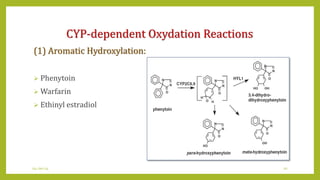
CYP-dependent Oxydation Reactions
(1) Aromatic Hydroxylation:
 Phenytoin
 Warfarin
 Ethinyl estradiol
04-Jan-14 20
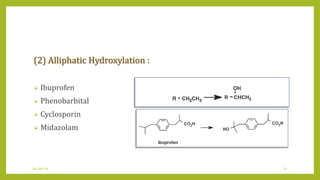
(2) Alliphatic Hydroxylation :
 Ibuprofen
 Phenobarbital
 Cyclosporin
 Midazolam
04-Jan-14 21
04-Jan-14 22
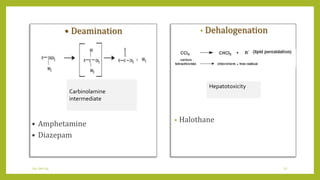
• Deamination
• Amphetamine
• Diazepam
Carbinolamine
intermediate
• Dehalogenation
• Halothane
Hepatotoxicity
04-Jan-14 23
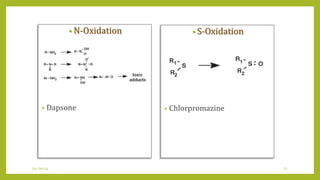
• N-Oxidation
• Dapsone
• S-Oxidation
• Chlorpromazine
Reduction
•CYP-450 work in opposite direction
• Alcohol, Aldehyde
04-Jan-14 24
Hydrolysis
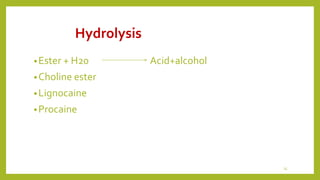
•Ester + H20 Acid+alcohol
•Choline ester
•Lignocaine
•Procaine
25
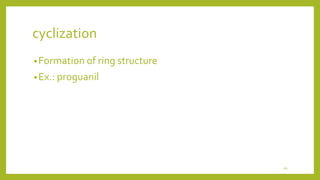
cyclization
•Formation of ring structure
•Ex.: proguanil
26
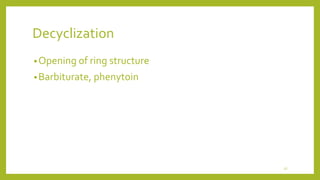
Decyclization
•Opening of ring structure
•Barbiturate, phenytoin
27
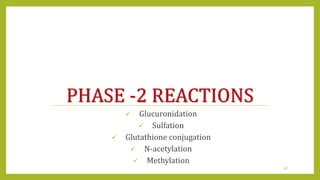
PHASE -2 REACTIONS
 Glucuronidation
 Sulfation
 Glutathione conjugation
 N-acetylation
 Methylation
28
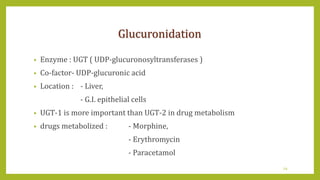
Glucuronidation
• Enzyme : UGT ( UDP-glucuronosyltransferases )
• Co-factor- UDP-glucuronic acid
• Location : - Liver,
- G.I. epithelial cells
• UGT-1 is more important than UGT-2 in drug metabolism
• drugs metabolized : - Morphine,
- Erythromycin
- Paracetamol
29
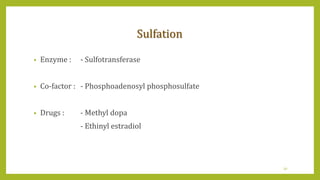
Sulfation
• Enzyme : - Sulfotransferase
• Co-factor : - Phosphoadenosyl phosphosulfate
• Drugs : - Methyl dopa
- Ethinyl estradiol
30
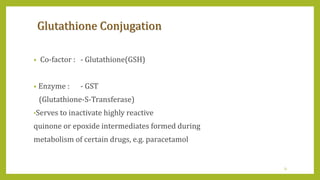
Glutathione Conjugation
• Co-factor : - Glutathione(GSH)
• Enzyme : - GST
(Glutathione-S-Transferase)
•Serves to inactivate highly reactive
quinone or epoxide intermediates formed during
metabolism of certain drugs, e.g. paracetamol
31
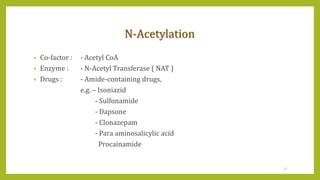
N-Acetylation
• Co-factor : - Acetyl CoA
• Enzyme : - N-Acetyl Transferase ( NAT )
• Drugs : - Amide-containing drugs,
e.g. – Isoniazid
- Sulfonamide
- Dapsone
- Clonazepam
- Para aminosalicylic acid
Procainamide
32
Methylation
• Cofactor : - S-Adenosylmethionine [ SAM ]
• Enzyme : - Methyltransferase ( MT ) (cytosol)
• Highly substrate specific
• Drugs :
- TPMT--- Azathioprine, 6-MT, thioguanine
- COMT --- dopamine, methyl dopa, nor- epinephrine
- HNMT --- Histamine
33
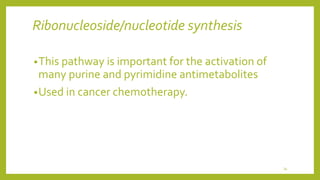
Ribonucleoside/nucleotide synthesis
•This pathway is important for the activation of
many purine and pyrimidine antimetabolites
•Used in cancer chemotherapy.
34
INDUCTION OF
DRUG METABOLISM
35
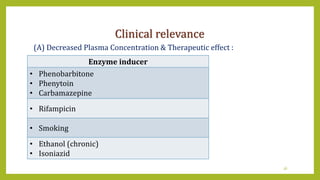
Clinical relevance
(A) Decreased Plasma Concentration & Therapeutic effect :
36
Enzyme inducer
• Phenobarbitone
• Phenytoin
• Carbamazepine
• Rifampicin
• Smoking
• Ethanol (chronic)
• Isoniazid
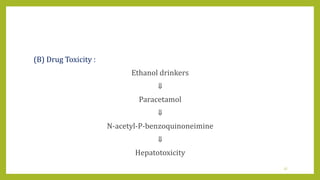
(B) Drug Toxicity :
Ethanol drinkers
⇓
Paracetamol
⇓
N-acetyl-P-benzoquinoneimine
⇓
Hepatotoxicity
37
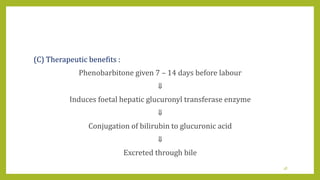
(C) Therapeutic benefits :
Phenobarbitone given 7 – 14 days before labour
⇓
Induces foetal hepatic glucuronyl transferase enzyme
⇓
Conjugation of bilirubin to glucuronic acid
⇓
Excreted through bile
38
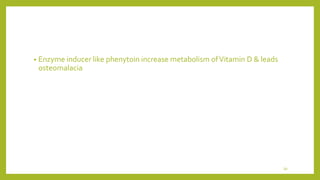
• Enzyme inducer like phenytoin increase metabolism ofVitamin D & leads
osteomalacia
39
ENZYME INHIBITION
40
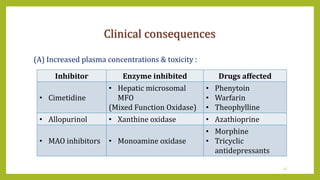
Clinical consequences
(A) Increased plasma concentrations & toxicity :
41
Inhibitor Enzyme inhibited Drugs affected
• Cimetidine
• Hepatic microsomal
MFO
(Mixed Function Oxidase)
• Phenytoin
• Warfarin
• Theophylline
• Allopurinol • Xanthine oxidase • Azathioprine
• MAO inhibitors • Monoamine oxidase
• Morphine
• Tricyclic
antidepressants
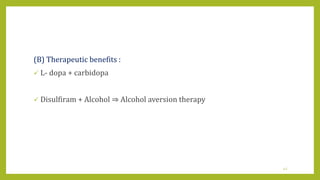
(B) Therapeutic benefits :
 L- dopa + carbidopa
 Disulfiram + Alcohol ⇒ Alcohol aversion therapy
42
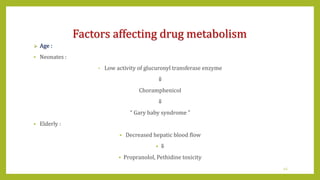
Factors affecting drug metabolism
 Age :
 Neonates :
• Low activity of glucuronyl transferase enzyme
⇓
Choramphenicol
⇓
“ Gary baby syndrome ”
 Elderly :
 Decreased hepatic blood flow
 ⇓
 Propranolol, Pethidine toxicity
43
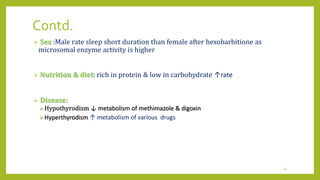
Contd.
 Sex :Male rate sleep short duration than female after hexobarbitione as
microsomal enzyme activity is higher
 Nutrition & diet: rich in protein & low in carbohydrate ↑rate
 Disease:
Hypothyrodism ↓ metabolism of methimazole & digoxin
Hyperthyrodism ↑ metabolism of various drugs
44
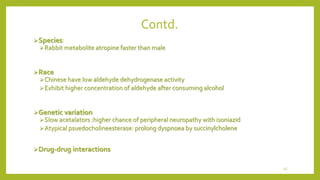
Contd.
Species:
Rabbit metabolite atropine faster than male
Race
Chinese have low aldehyde dehydrogenase activity
Exhibit higher concentration of aldehyde after consuming alcohol
Genetic variation
Slow acetalators :higher chance of peripheral neuropathy with isoniazid
Atypical psuedocholineesterase: prolong dyspnoea by succinylcholene
Drug-drug interactions
45
04-Jan-14 46

Metabolism

  • 1.
  • 2.
    Topics to bediscussed Introduction to Biotransformation The Phases of Drug Metabolism Enzyme Induction & Inhibition Enzymes Metabolising Xenobiotics Sites of Drug Metabolism Factors affecting Drug metabolism ( Biotransformation ) 04-Jan-14 2
  • 3.
    Coping with Exposureto Xenobiotics • Humans come into Contact with foreign chemicals, medicines, or Xenobiotics (substances foreign to body) Through – - Intentional exposure, - Accidental exposure, - Diet. • Fortunately, a mechanism to rapidly eliminate them is developed ⇓ • They do not accumulate in & harm the body 04-Jan-14 3
  • 4.
    BIOTRANSFORMATION • Definition :- “Biochemical Transformation of Drugs within the Living Organism, catalyzed by Enzymes. ” • Aim :-  Water insoluble → water soluble → easily excreted 04-Jan-14 4
  • 5.
    • Advantage : Critical for survival • Disadvantage :  Inter-individual variations  Drug-Drug interactions  Toxic & Carcinogenic derivatives  Species differences → limits the use of animal models in new drug development 04-Jan-14 5
  • 6.
    Consequences of Biotransformation Active Drug ⇒ Inactive Metabolite : Phenobarbitone → Hydroxyphenobarbitone ( Active Drug ) ( Inactive Metabolite )  Inactive Drug ( Prodrug ) ⇒ Active Metabolite : L-Dopa → Dopamine ( Prodrug ) ( Active )  Active Drug ⇒ Equally Active Metabolite Diazepam → Oxazepam ( Active ) ( Active ) 04-Jan-14 6
  • 7.
    Active drug Activemetabolite Chloral hydrate Trichloroethanol Digitoxin Digoxin Imipramine Desipramine Amitriptyline Nortriptyline Codeine Morphine Losartan E 3174 7
  • 8.
    Prodrug Prodrug Active form LevodopaDopamine Enalapril Enalaprilat a-Methyldopa a-methylnorepinephrine Dipivefrine Epinephrine Bacampicillin Ampicillin Acyclovir Acyclovir triphosphate 8
  • 9.
    First-Pass Metabolism • Drug⇒ Oral administration ⇒ G.I.T. ⇒ Portal circulation ⇒ Liver ( First pass metabolism ) ⇒ Systemic Circulation • Decreases Bioavailability • Decreases Therapeutic Response • Can be bypassed if drug is given – - Parenterally ( i.v. Xylocaine in Arrhythmias ) Or - Sublingually ( Isosorbide dinitrate in Angina ) 04-Jan-14 9
  • 10.
    Drugs Undergoing First-passMetabolism 10 Liver Intestine Bronchial Mucosa • Morphine • Xylocaine • Imipramine • Propranolol • GTN • L- Dopa • Testosterone • Progesterone • Chlorpromazine • Nicotine • Isoprenaline
  • 11.
  • 12.
    Chemical Pathways Of DrugMetabolism 04-Jan-14 12
  • 13.
    THE DRUG METABOLIZINGENZYMES (1) Microsomal Enzymes : • Location : - Smooth Endoplasmic Reticulum of Liver cells, - Intestinal mucosa, Lungs, Kidney. • Activity : - Phase 1 reactions - Phase 2 reaction ( Glucuronyl conjugations ) • Example : - Cytochrome P-450 enzymes • Metabolize only Lipid-soluble drugs
  • 14.
    (2) Non-Microsomal Enzymes: • Location : - Cytoplasm, - Mitochondria of Hepatic cells, - Plasma. • Activity : - All Phase 2 reactions ( Except Glucuronyl conjugation ) • Example : - Esterase, - Monoamine Oxidase (MAO), - Amidase, - Transferase. (3) Non-enzymatic ( Hofmann ) Elimination : • Spontaneous Molecular rearrangement, without any enzyme action • Example - Atracurium 04-Jan-14 14
  • 15.
    Phases of DrugMetabolism 04-Jan-14 15 Phase 1 Phase 2 • Introduction of functional groups. -OH, -COOH, -SH ,-NH2 • Alters biological property • Oxidation/Reduction Reactions • Enzymes - CYPs, FMO • Slower reaction rate • Conjugation of substrate • Alters Solubility and mol. wt. • Conjugation / Hydrolysis • Enzymes - Transferases, EH • Faster reaction rate
  • 16.
    PHASE-1 REACTION ENZYMES  CYP( Cytochrome-P450 )  FMO ( Flavin-containing Monooxigenases )  Hydrolytic enzymes 04-Jan-14 16
  • 17.
    Cytochrome P-450 • Location:- Endoplasmic Reticulum • Structure :- Heme ⇿ Polypeptide chain • Nomenclature : - CYP → Digit for Family → Letter for Subfamily → Gene number - e.g. – CYP3A4 ⇒ - Cytochrome P-450 - Family “ 3 ” - Subfamily “ A ” - Gene Number “ 4 ” 04-Jan-14 17
  • 18.
  • 19.
    PHASE-1 REACTIONS  Oxidation Reduction  Hydrolysis 04-Jan-14 19
  • 20.
    CYP-dependent Oxydation Reactions (1)Aromatic Hydroxylation:  Phenytoin  Warfarin  Ethinyl estradiol 04-Jan-14 20
  • 21.
    (2) Alliphatic Hydroxylation:  Ibuprofen  Phenobarbital  Cyclosporin  Midazolam 04-Jan-14 21
  • 22.
    04-Jan-14 22 • Deamination •Amphetamine • Diazepam Carbinolamine intermediate • Dehalogenation • Halothane Hepatotoxicity
  • 23.
    04-Jan-14 23 • N-Oxidation •Dapsone • S-Oxidation • Chlorpromazine
  • 24.
    Reduction •CYP-450 work inopposite direction • Alcohol, Aldehyde 04-Jan-14 24
  • 25.
    Hydrolysis •Ester + H20Acid+alcohol •Choline ester •Lignocaine •Procaine 25
  • 26.
    cyclization •Formation of ringstructure •Ex.: proguanil 26
  • 27.
    Decyclization •Opening of ringstructure •Barbiturate, phenytoin 27
  • 28.
    PHASE -2 REACTIONS Glucuronidation  Sulfation  Glutathione conjugation  N-acetylation  Methylation 28
  • 29.
    Glucuronidation • Enzyme :UGT ( UDP-glucuronosyltransferases ) • Co-factor- UDP-glucuronic acid • Location : - Liver, - G.I. epithelial cells • UGT-1 is more important than UGT-2 in drug metabolism • drugs metabolized : - Morphine, - Erythromycin - Paracetamol 29
  • 30.
    Sulfation • Enzyme :- Sulfotransferase • Co-factor : - Phosphoadenosyl phosphosulfate • Drugs : - Methyl dopa - Ethinyl estradiol 30
  • 31.
    Glutathione Conjugation • Co-factor: - Glutathione(GSH) • Enzyme : - GST (Glutathione-S-Transferase) •Serves to inactivate highly reactive quinone or epoxide intermediates formed during metabolism of certain drugs, e.g. paracetamol 31
  • 32.
    N-Acetylation • Co-factor :- Acetyl CoA • Enzyme : - N-Acetyl Transferase ( NAT ) • Drugs : - Amide-containing drugs, e.g. – Isoniazid - Sulfonamide - Dapsone - Clonazepam - Para aminosalicylic acid Procainamide 32
  • 33.
    Methylation • Cofactor :- S-Adenosylmethionine [ SAM ] • Enzyme : - Methyltransferase ( MT ) (cytosol) • Highly substrate specific • Drugs : - TPMT--- Azathioprine, 6-MT, thioguanine - COMT --- dopamine, methyl dopa, nor- epinephrine - HNMT --- Histamine 33
  • 34.
    Ribonucleoside/nucleotide synthesis •This pathwayis important for the activation of many purine and pyrimidine antimetabolites •Used in cancer chemotherapy. 34
  • 35.
  • 36.
    Clinical relevance (A) DecreasedPlasma Concentration & Therapeutic effect : 36 Enzyme inducer • Phenobarbitone • Phenytoin • Carbamazepine • Rifampicin • Smoking • Ethanol (chronic) • Isoniazid
  • 37.
    (B) Drug Toxicity: Ethanol drinkers ⇓ Paracetamol ⇓ N-acetyl-P-benzoquinoneimine ⇓ Hepatotoxicity 37
  • 38.
    (C) Therapeutic benefits: Phenobarbitone given 7 – 14 days before labour ⇓ Induces foetal hepatic glucuronyl transferase enzyme ⇓ Conjugation of bilirubin to glucuronic acid ⇓ Excreted through bile 38
  • 39.
    • Enzyme inducerlike phenytoin increase metabolism ofVitamin D & leads osteomalacia 39
  • 40.
  • 41.
    Clinical consequences (A) Increasedplasma concentrations & toxicity : 41 Inhibitor Enzyme inhibited Drugs affected • Cimetidine • Hepatic microsomal MFO (Mixed Function Oxidase) • Phenytoin • Warfarin • Theophylline • Allopurinol • Xanthine oxidase • Azathioprine • MAO inhibitors • Monoamine oxidase • Morphine • Tricyclic antidepressants
  • 42.
    (B) Therapeutic benefits:  L- dopa + carbidopa  Disulfiram + Alcohol ⇒ Alcohol aversion therapy 42
  • 43.
    Factors affecting drugmetabolism  Age :  Neonates : • Low activity of glucuronyl transferase enzyme ⇓ Choramphenicol ⇓ “ Gary baby syndrome ”  Elderly :  Decreased hepatic blood flow  ⇓  Propranolol, Pethidine toxicity 43
  • 44.
    Contd.  Sex :Malerate sleep short duration than female after hexobarbitione as microsomal enzyme activity is higher  Nutrition & diet: rich in protein & low in carbohydrate ↑rate  Disease: Hypothyrodism ↓ metabolism of methimazole & digoxin Hyperthyrodism ↑ metabolism of various drugs 44
  • 45.
    Contd. Species: Rabbit metabolite atropinefaster than male Race Chinese have low aldehyde dehydrogenase activity Exhibit higher concentration of aldehyde after consuming alcohol Genetic variation Slow acetalators :higher chance of peripheral neuropathy with isoniazid Atypical psuedocholineesterase: prolong dyspnoea by succinylcholene Drug-drug interactions 45
  • 46.

Editor's Notes

  • #12 This membrane localization is ideally suited for the metabolic function of these enzymes: hydrophobic molecules enter the cell and become embedded in the lipid bilayer where they come into direct contact with the phase 1 enzymes. Once subjected to oxidation, drugs can be conjugated in the membrane by the UGTs or by the cytosolic transferases such as GST and SULT. The metabolites can then be transported out of the cell through the plasma membrane where they are deposited into the bloodstream..,,,,,,,,,,,,,,,,,,,,,,,, CYPs are embedded in the phospholipid bilayer of the endoplasmic reticulum (ER). Most of the enzyme is located on the cytosolic surface of the ER. A second enzyme, NADPH-cytochrome P450 oxidoreductase, transfers electrons to the CYP where it can, in the presence of O2, oxidize xenobiotic substrates, many of which are hydrophobic and dissolved in the ER.
  • #36 Xenobiotics influence drug metabolism,by – activating transcription & - by inducing the expression of genes encoding drug-metabolizing enzymes.or growth of smooth E.R. Thus, a foreign compound can induce its own metabolism