Chemotherapy of helminth
infestation
Dr Chintan Doshi
INTRODUCTION
 Helminth are multicellular worm with digestive, excretory, nervous, and
reproductive system.
 HELMINTHIASIS is a disease in which a part of body is infested with one or more
intestinal parasitic worms such as round worm, tapeworms or fluckers.
 The worms usually infest the intestine but sometimes, they may invade other
organs
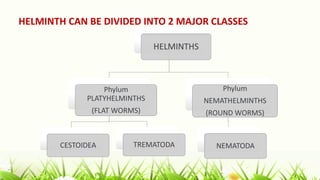
HELMINTH CAN BE DIVIDED INTO 2 MAJOR CLASSES
HELMINTHS
Phylum
PLATYHELMINTHS
(FLAT WORMS)
CESTOIDEA TREMATODA
Phylum
NEMATHELMINTHS
(ROUND WORMS)
NEMATODA
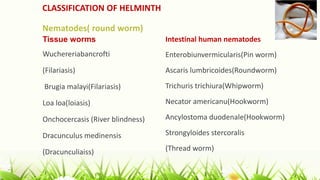
CLASSIFICATION OF HELMINTH
Nematodes( round worm)
Tissue worms
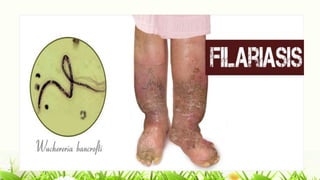
Wuchereriabancrofti
(Filariasis)
Brugia malayi(Filariasis)
Loa loa(loiasis)
Onchocercasis (River blindness)
Dracunculus medinensis
(Dracunculiaiss)
Intestinal human nematodes
Enterobiunvermicularis(Pin worm)
Ascaris lumbricoides(Roundworm)
Trichuris trichiura(Whipworm)
Necator americanu(Hookworm)
Ancylostoma duodenale(Hookworm)
Strongyloides stercoralis
(Thread worm)
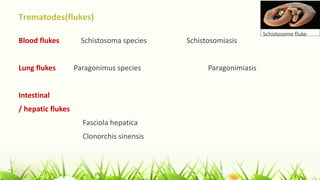
Trematodes(flukes)
Blood flukes Schistosoma species Schistosomiasis
Lung flukes Paragonimus species Paragonimiasis
Intestinal
/ hepatic flukes
Fasciola hepatica
Clonorchis sinensis
Schistosome fluke
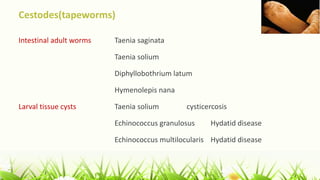
Cestodes(tapeworms)
Intestinal adult worms Taenia saginata
Taenia solium
Diphyllobothrium latum
Hymenolepis nana
Larval tissue cysts Taenia solium cysticercosis
Echinococcus granulosus Hydatid disease
Echinococcus multilocularis Hydatid disease
Antihelminthic drugs
 Benzimidazoles (BZ)
 The discovery by Brown and co-workers that thiabendazole possessed potent
activity against GI nematodes.
 Albendazole
 Mebendazole
 Thiabendazole
 Triclabendazole
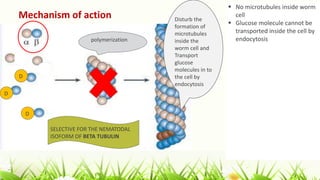
Mechanism of action Disturb the
formation of
microtubules
inside the
worm cell and
Transport
glucose
molecules in to
the cell by
endocytosis
polymerization
D
D
D
 No microtubules inside worm
cell
 Glucose molecule cannot be
transported inside the cell by
endocytosis
SELECTIVE FOR THE NEMATODAL
ISOFORM OF BETA TUBULIN
GENERAL ADVERSE EFFECT
General side effect:
 Abdominal pain
 Diarrhoea
 Dizziness
 Headache
 Insomnia
 Loss of appetite
 Hypersensitivity
 Vomiting
 Granulocytopenia
 Alopecia
 Jaundice
Thiabendazole has
more adverse effect
compare to other BZ
Liver failure and
Stevens-Johnson
syndrome rarely
THERAPEUTIC USES
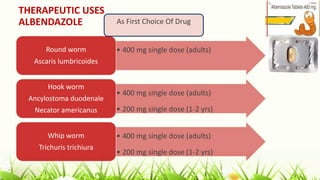
ALBENDAZOLE
• 400 mg single dose (adults)
Round worm
Ascaris lumbricoides
• 400 mg single dose (adults)
• 200 mg single dose (1-2 yrs)
Hook worm
Ancylostoma duodenale
Necator americanus
• 400 mg single dose (adults)
• 200 mg single dose (1-2 yrs)
Whip worm
Trichuris trichiura
As First Choice Of Drug
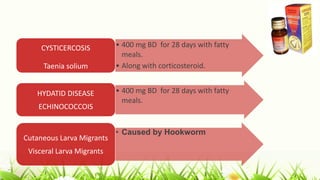
• 400 mg BD for 28 days with fatty
meals.
• Along with corticosteroid.
CYSTICERCOSIS
Taenia solium
• 400 mg BD for 28 days with fatty
meals.
HYDATID DISEASE
ECHINOCOCCOIS
• Caused by Hookworm
Cutaneous Larva Migrants
Visceral Larva Migrants
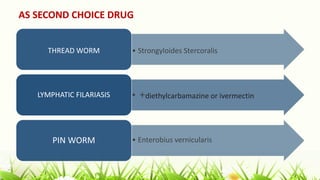
AS SECOND CHOICE DRUG
• Strongyloides Stercoralis
THREAD WORM
• +diethylcarbamazine or ivermectin
LYMPHATIC FILARIASIS
• Enterobius vernicularis
PIN WORM
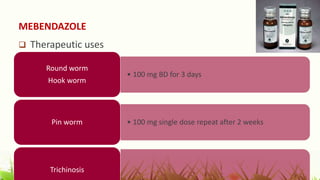
MEBENDAZOLE
 Therapeutic uses
• 100 mg BD for 3 days
Round worm
Hook worm
• 100 mg single dose repeat after 2 weeks
Pin worm
Trichinosis
VISCERAL LARVA MIGRANTS
TAENIA SAGINATA
Hydatid disease
Mebendazole is an alternative drug to metronidazole in guinea worm infection: also
preferred drug for multiple infections
PYRANTEL PAMOATE,OXANTEL PAMOATE
 Introduced in 1969
 PHARMACOKINETICS
 Poor absorbed from GIT(10-15% of an oral dose).
 Active against luminal helminth.
 Excretion : <15% in urine as parent drug metabolites major
portion in feces.
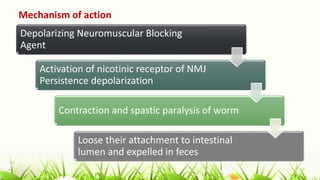
Mechanism of action
Depolarizing Neuromuscular Blocking
Agent
Activation of nicotinic receptor of NMJ
Persistence depolarization
Contraction and spastic paralysis of worm
Loose their attachment to intestinal
lumen and expelled in feces
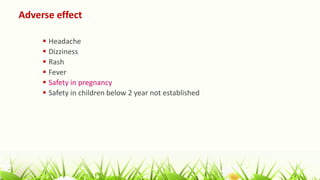
Adverse effect
 Headache
 Dizziness
 Rash
 Fever
 Safety in pregnancy
 Safety in children below 2 year not established
THERAPEUTIC USES
 Ascaris
 Ancylostoma and Enterobius
 Necator and Strongyloides:3 day course suggested
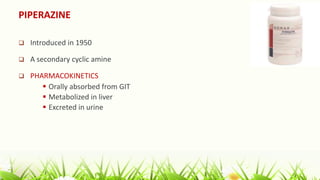
PIPERAZINE
 Introduced in 1950
 A secondary cyclic amine
 PHARMACOKINETICS
 Orally absorbed from GIT
 Metabolized in liver
 Excreted in urine
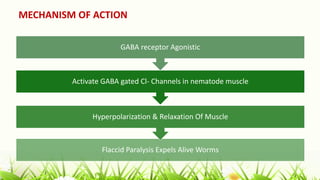
MECHANISM OF ACTION
Flaccid Paralysis Expels Alive Worms
Hyperpolarization & Relaxation Of Muscle
Activate GABA gated Cl- Channels in nematode muscle
GABA receptor Agonistic
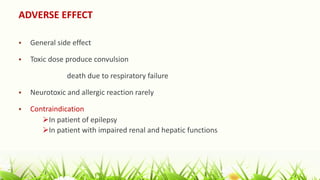
ADVERSE EFFECT
 General side effect
 Toxic dose produce convulsion
death due to respiratory failure
 Neurotoxic and allergic reaction rarely
 Contraindication
In patient of epilepsy
In patient with impaired renal and hepatic functions
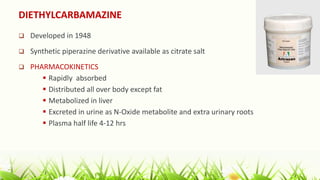
DIETHYLCARBAMAZINE
 Developed in 1948
 Synthetic piperazine derivative available as citrate salt
 PHARMACOKINETICS
 Rapidly absorbed
 Distributed all over body except fat
 Metabolized in liver
 Excreted in urine as N-Oxide metabolite and extra urinary roots
 Plasma half life 4-12 hrs
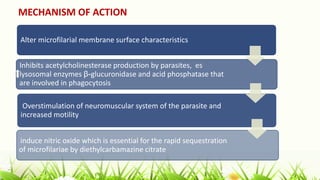
MECHANISM OF ACTION
Alter microfilarial membrane surface characteristics
Overstimulation of neuromuscular system of the parasite and
increased motility
Inhibits acetylcholinesterase production by parasites, es
lysosomal enzymes β-glucuronidase and acid phosphatase that
are involved in phagocytosis
induce nitric oxide which is essential for the rapid sequestration
of microfilariae by diethylcarbamazine citrate
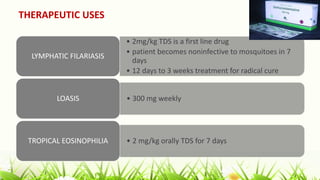
THERAPEUTIC USES
• 2mg/kg TDS is a first line drug
• patient becomes noninfective to mosquitoes in 7
days
• 12 days to 3 weeks treatment for radical cure
LYMPHATIC FILARIASIS
• 300 mg weekly
LOASIS
• 2 mg/kg orally TDS for 7 days
TROPICAL EOSINOPHILIA
ADVERSE EFFECT
 TWO TYPE
 1] Pharmacological dose depended
 Headache
 Malaise
 2] Allergic reaction to dying filarial parasite
 Rash, Pruritus
 Enlargement of lymph nodes,
 Bronchospasm
 Fall in BP
IVERMECTIN
 PHARMACOKINETICS
 Well absorbed
 Widely distributed in the body
 Metabolized in liver by CYP3A4
 Long t1/2 48-60 hrs
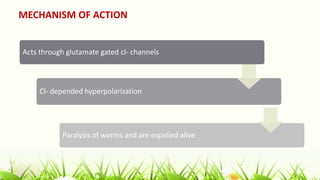
MECHANISM OF ACTION
Acts through glutamate gated cl- channels
Cl- depended hyperpolarization
Paralysis of worms and are expelled alive
Adverse effect
 Pruritus, giddiness, nausea,
 Abdominal Pain, constipation,
 Lethargy and transient ECG Changes
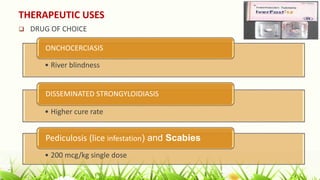
THERAPEUTIC USES
 DRUG OF CHOICE
• River blindness
ONCHOCERCIASIS
• Higher cure rate
DISSEMINATED STRONGYLOIDIASIS
• 200 mcg/kg single dose
Pediculosis (lice infestation) and Scabies
• Single annual dose with 400 mg albendazole for 5-6 yrs
LYMPHATIC FILARIASIS
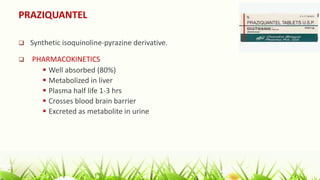
PRAZIQUANTEL
 Synthetic isoquinoline-pyrazine derivative.
 PHARMACOKINETICS
 Well absorbed (80%)
 Metabolized in liver
 Plasma half life 1-3 hrs
 Crosses blood brain barrier
 Excreted as metabolite in urine
MECHANISM OF ACTION
spasms and paralysis of the worms' muscles by a rapid
Ca 2+ influx inside the schistosome by acting on voltage gated
ca++ channels.
ADVERSE EFFECTS
 GENERAL SIDE EFFECTS
 CONTRAINDICATION
 Ocular cysticercosis because of the risk of severs eye damage resulting from
occlusion due to dead parasites.
 PREGNANCY
 CHILDREN BELOW 5 YRS
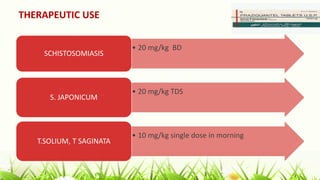
THERAPEUTIC USE
• 20 mg/kg BD
SCHISTOSOMIASIS
• 20 mg/kg TDS
S. JAPONICUM
• 10 mg/kg single dose in morning
T.SOLIUM, T SAGINATA
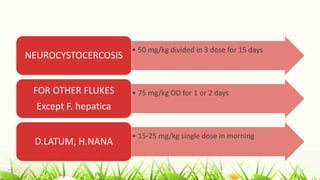
• 50 mg/kg divided in 3 dose for 15 days
NEUROCYSTOCERCOSIS
• 75 mg/kg OD for 1 or 2 days
FOR OTHER FLUKES
Except F. hepatica
• 15-25 mg/kg single dose in morning
D.LATUM, H.NANA
Anti helminth)

Anti helminth)

  • 1.
  • 2.
    INTRODUCTION  Helminth aremulticellular worm with digestive, excretory, nervous, and reproductive system.  HELMINTHIASIS is a disease in which a part of body is infested with one or more intestinal parasitic worms such as round worm, tapeworms or fluckers.  The worms usually infest the intestine but sometimes, they may invade other organs
  • 3.
    HELMINTH CAN BEDIVIDED INTO 2 MAJOR CLASSES HELMINTHS Phylum PLATYHELMINTHS (FLAT WORMS) CESTOIDEA TREMATODA Phylum NEMATHELMINTHS (ROUND WORMS) NEMATODA
  • 4.
    CLASSIFICATION OF HELMINTH Nematodes(round worm) Tissue worms Wuchereriabancrofti (Filariasis) Brugia malayi(Filariasis) Loa loa(loiasis) Onchocercasis (River blindness) Dracunculus medinensis (Dracunculiaiss) Intestinal human nematodes Enterobiunvermicularis(Pin worm) Ascaris lumbricoides(Roundworm) Trichuris trichiura(Whipworm) Necator americanu(Hookworm) Ancylostoma duodenale(Hookworm) Strongyloides stercoralis (Thread worm)
  • 5.
    Trematodes(flukes) Blood flukes Schistosomaspecies Schistosomiasis Lung flukes Paragonimus species Paragonimiasis Intestinal / hepatic flukes Fasciola hepatica Clonorchis sinensis Schistosome fluke
  • 6.
    Cestodes(tapeworms) Intestinal adult wormsTaenia saginata Taenia solium Diphyllobothrium latum Hymenolepis nana Larval tissue cysts Taenia solium cysticercosis Echinococcus granulosus Hydatid disease Echinococcus multilocularis Hydatid disease
  • 7.
    Antihelminthic drugs  Benzimidazoles(BZ)  The discovery by Brown and co-workers that thiabendazole possessed potent activity against GI nematodes.  Albendazole  Mebendazole  Thiabendazole  Triclabendazole
  • 8.
    Mechanism of actionDisturb the formation of microtubules inside the worm cell and Transport glucose molecules in to the cell by endocytosis polymerization D D D  No microtubules inside worm cell  Glucose molecule cannot be transported inside the cell by endocytosis SELECTIVE FOR THE NEMATODAL ISOFORM OF BETA TUBULIN
  • 9.
    GENERAL ADVERSE EFFECT Generalside effect:  Abdominal pain  Diarrhoea  Dizziness  Headache  Insomnia  Loss of appetite  Hypersensitivity  Vomiting  Granulocytopenia  Alopecia  Jaundice Thiabendazole has more adverse effect compare to other BZ Liver failure and Stevens-Johnson syndrome rarely
  • 10.
    THERAPEUTIC USES ALBENDAZOLE • 400mg single dose (adults) Round worm Ascaris lumbricoides • 400 mg single dose (adults) • 200 mg single dose (1-2 yrs) Hook worm Ancylostoma duodenale Necator americanus • 400 mg single dose (adults) • 200 mg single dose (1-2 yrs) Whip worm Trichuris trichiura As First Choice Of Drug
  • 11.
    • 400 mgBD for 28 days with fatty meals. • Along with corticosteroid. CYSTICERCOSIS Taenia solium • 400 mg BD for 28 days with fatty meals. HYDATID DISEASE ECHINOCOCCOIS • Caused by Hookworm Cutaneous Larva Migrants Visceral Larva Migrants
  • 12.
    AS SECOND CHOICEDRUG • Strongyloides Stercoralis THREAD WORM • +diethylcarbamazine or ivermectin LYMPHATIC FILARIASIS • Enterobius vernicularis PIN WORM
  • 13.
    MEBENDAZOLE  Therapeutic uses •100 mg BD for 3 days Round worm Hook worm • 100 mg single dose repeat after 2 weeks Pin worm Trichinosis
  • 14.
    VISCERAL LARVA MIGRANTS TAENIASAGINATA Hydatid disease Mebendazole is an alternative drug to metronidazole in guinea worm infection: also preferred drug for multiple infections
  • 15.
    PYRANTEL PAMOATE,OXANTEL PAMOATE Introduced in 1969  PHARMACOKINETICS  Poor absorbed from GIT(10-15% of an oral dose).  Active against luminal helminth.  Excretion : <15% in urine as parent drug metabolites major portion in feces.
  • 16.
    Mechanism of action DepolarizingNeuromuscular Blocking Agent Activation of nicotinic receptor of NMJ Persistence depolarization Contraction and spastic paralysis of worm Loose their attachment to intestinal lumen and expelled in feces
  • 17.
    Adverse effect  Headache Dizziness  Rash  Fever  Safety in pregnancy  Safety in children below 2 year not established
  • 18.
    THERAPEUTIC USES  Ascaris Ancylostoma and Enterobius  Necator and Strongyloides:3 day course suggested
  • 19.
    PIPERAZINE  Introduced in1950  A secondary cyclic amine  PHARMACOKINETICS  Orally absorbed from GIT  Metabolized in liver  Excreted in urine
  • 20.
    MECHANISM OF ACTION FlaccidParalysis Expels Alive Worms Hyperpolarization & Relaxation Of Muscle Activate GABA gated Cl- Channels in nematode muscle GABA receptor Agonistic
  • 21.
    ADVERSE EFFECT  Generalside effect  Toxic dose produce convulsion death due to respiratory failure  Neurotoxic and allergic reaction rarely  Contraindication In patient of epilepsy In patient with impaired renal and hepatic functions
  • 22.
    DIETHYLCARBAMAZINE  Developed in1948  Synthetic piperazine derivative available as citrate salt  PHARMACOKINETICS  Rapidly absorbed  Distributed all over body except fat  Metabolized in liver  Excreted in urine as N-Oxide metabolite and extra urinary roots  Plasma half life 4-12 hrs
  • 23.
    MECHANISM OF ACTION Altermicrofilarial membrane surface characteristics Overstimulation of neuromuscular system of the parasite and increased motility Inhibits acetylcholinesterase production by parasites, es lysosomal enzymes β-glucuronidase and acid phosphatase that are involved in phagocytosis induce nitric oxide which is essential for the rapid sequestration of microfilariae by diethylcarbamazine citrate
  • 24.
    THERAPEUTIC USES • 2mg/kgTDS is a first line drug • patient becomes noninfective to mosquitoes in 7 days • 12 days to 3 weeks treatment for radical cure LYMPHATIC FILARIASIS • 300 mg weekly LOASIS • 2 mg/kg orally TDS for 7 days TROPICAL EOSINOPHILIA
  • 26.
    ADVERSE EFFECT  TWOTYPE  1] Pharmacological dose depended  Headache  Malaise  2] Allergic reaction to dying filarial parasite  Rash, Pruritus  Enlargement of lymph nodes,  Bronchospasm  Fall in BP
  • 27.
    IVERMECTIN  PHARMACOKINETICS  Wellabsorbed  Widely distributed in the body  Metabolized in liver by CYP3A4  Long t1/2 48-60 hrs
  • 28.
    MECHANISM OF ACTION Actsthrough glutamate gated cl- channels Cl- depended hyperpolarization Paralysis of worms and are expelled alive
  • 29.
    Adverse effect  Pruritus,giddiness, nausea,  Abdominal Pain, constipation,  Lethargy and transient ECG Changes
  • 30.
    THERAPEUTIC USES  DRUGOF CHOICE • River blindness ONCHOCERCIASIS • Higher cure rate DISSEMINATED STRONGYLOIDIASIS • 200 mcg/kg single dose Pediculosis (lice infestation) and Scabies
  • 31.
    • Single annualdose with 400 mg albendazole for 5-6 yrs LYMPHATIC FILARIASIS
  • 32.
    PRAZIQUANTEL  Synthetic isoquinoline-pyrazinederivative.  PHARMACOKINETICS  Well absorbed (80%)  Metabolized in liver  Plasma half life 1-3 hrs  Crosses blood brain barrier  Excreted as metabolite in urine
  • 33.
    MECHANISM OF ACTION spasmsand paralysis of the worms' muscles by a rapid Ca 2+ influx inside the schistosome by acting on voltage gated ca++ channels.
  • 34.
    ADVERSE EFFECTS  GENERALSIDE EFFECTS  CONTRAINDICATION  Ocular cysticercosis because of the risk of severs eye damage resulting from occlusion due to dead parasites.  PREGNANCY  CHILDREN BELOW 5 YRS
  • 35.
    THERAPEUTIC USE • 20mg/kg BD SCHISTOSOMIASIS • 20 mg/kg TDS S. JAPONICUM • 10 mg/kg single dose in morning T.SOLIUM, T SAGINATA
  • 36.
    • 50 mg/kgdivided in 3 dose for 15 days NEUROCYSTOCERCOSIS • 75 mg/kg OD for 1 or 2 days FOR OTHER FLUKES Except F. hepatica • 15-25 mg/kg single dose in morning D.LATUM, H.NANA

Editor's Notes

  • #14 Intestinal capillariasis:  nematode Capillaria philippinensis.
  • #24 Phagocytosis is a process by which a cell can transport substances across the cytoplasmic membrane and into the cytoplasm. Cells that are capable of phagocytosis are collectively known as phagocytes and include neutrophils, eosinophils, and macrophages. Phagocytosis is part of the body's second line of defense, and it is nonspecific. It includes the following steps: Chemotaxis: A cell moves either toward or away from a chemical stimulus. Adherence: The phagocyte attaches to the pathogen, through binding of complementary chemicals on the membranes of the pathogen. Ingestion: After the pseudopodia adhere to the pathogen, the encompassed microbe is internalized as the pseudopodia fuse to form a sac called a phagosome. Digestion: Lysosomes with over 30 digestive enzymes attach to the phagosome and break down the microbe. At the end of this process, the remains of the phagosome are known as the residual body. Elimination: The phagocyte rids itself of undigested material by exocytosis, which is the opposite of ingestio