HIV TREATMENT
GUIDELINES
DR CHINTAN
Introduction
• Treatment of HIV infection and its complications is
complex, prolonged
• Needs expertise, strong motivation and commitment of
the patient, resources and is expensive
• ‘highly active antiretroviral therapy’ (HAART) with
combination of 3 or more drugs whenever indicated
• Monotherapy is contraindicated.
Contd.
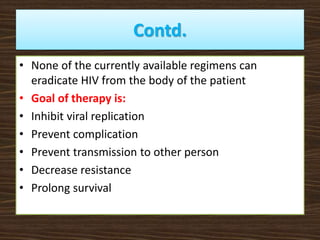
• None of the currently available regimens can
eradicate HIV from the body of the patient
• Goal of therapy is:
• Inhibit viral replication
• Prevent complication
• Prevent transmission to other person
• Decrease resistance
• Prolong survival
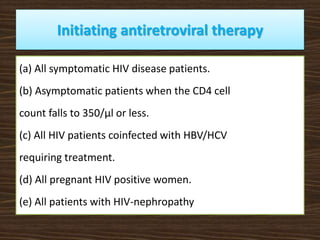
Initiating antiretroviral therapy
(a) All symptomatic HIV disease patients.
(b) Asymptomatic patients when the CD4 cell
count falls to 350/μl or less.
(c) All HIV patients coinfected with HBV/HCV
requiring treatment.
(d) All pregnant HIV positive women.
(e) All patients with HIV-nephropathy
Therapeutic regimens
• All regimens should have 2 NRTI+1NNRTI.
• Include lamivudine in all regimens.
• The other NRTI can be zidovudine or stavudine.
• Choose one NNRTI from nevirapine or efavirenz.
contd
• Choose efavirenz in patients with hepatic dysfunction
and in those concurrently receiving rifampin
• Do not use efavirenz in pregnant women or in those
likely to get pregnant
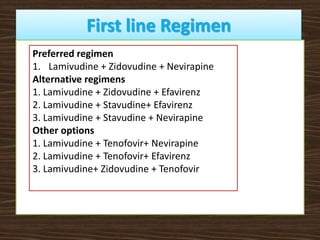
First line Regimen
Preferred regimen
1. Lamivudine + Zidovudine + Nevirapine
Alternative regimens
1. Lamivudine + Zidovudine + Efavirenz
2. Lamivudine + Stavudine+ Efavirenz
3. Lamivudine + Stavudine + Nevirapine
Other options
1. Lamivudine + Tenofovir+ Nevirapine
2. Lamivudine + Tenofovir+ Efavirenz
3. Lamivudine+ Zidovudine + Tenofovir
Contd.
• Stavudine is substituted for zidovudine if patient is
anaemic
• Tenofovir is included when there is toxicity or other
Contraindication to both zidovudine and stavudine
• 3NRTI regimen is only for patients unable to tolerate
both nevirapine and efavirenz.
Contd.
• The PI containing regimens (2 NRTI + PI or NRTI + NNRTI +
PI) are reserved for advanced cases who have failed
earlier regimens.
• Low dose ritonavir boosted PIs are preferred over higher
dose single PI due to lower pill burden and better
tolerability
• If drug toxicity develops, either the entire should be
interrupted or the offending drug should be changed. No
dose reduction should be tried.
Contd.
• Treatment is life-long
• Institution of HAART in patients with latent or
partially treated opportunistic infection may produce
‘immune reconstitution syndrome’
• Pregnancy in women does not contraindicate ART.
• zidovudine, lamivudine, nevirapine, nelfinavir
Contd.
• Durability of the regimens depends mainly on adherence
of the patient to it.
• Compliance is a major determinant of outcome.
• Multiple antiretroviral, Anti-P. jiroveci, antitoxoplasma,
anti-CMV/herpes virus, antitubercular, antifungal or
other drugs may have to be used in a patient
Contd.
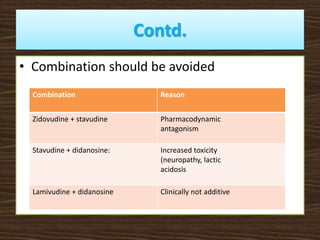
• Combination should be avoided
Combination Reason
Zidovudine + stavudine Pharmacodynamic
antagonism
Stavudine + didanosine: Increased toxicity
(neuropathy, lactic
acidosis
Lamivudine + didanosine Clinically not additive
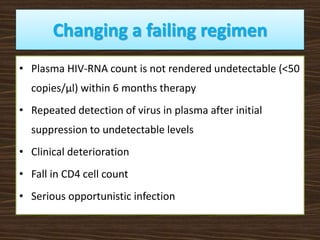
Changing a failing regimen
• Plasma HIV-RNA count is not rendered undetectable (<50
copies/μl) within 6 months therapy
• Repeated detection of virus in plasma after initial
suppression to undetectable levels
• Clinical deterioration
• Fall in CD4 cell count
• Serious opportunistic infection
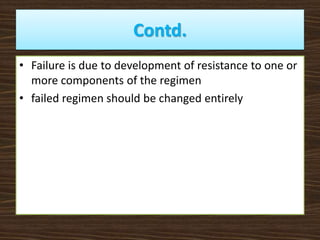
Contd.
• Failure is due to development of resistance to one or
more components of the regimen
• failed regimen should be changed entirely
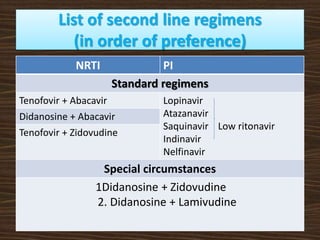
List of second line regimens
(in order of preference)
NRTI PI
Standard regimens
Tenofovir + Abacavir Lopinavir
Atazanavir
Saquinavir Low ritonavir
Indinavir
Nelfinavir
Didanosine + Abacavir
Tenofovir + Zidovudine
Special circumstances
1Didanosine + Zidovudine
2. Didanosine + Lamivudine
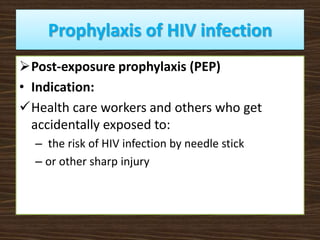
Prophylaxis of HIV infection
Post-exposure prophylaxis (PEP)
• Indication:
Health care workers and others who get
accidentally exposed to:
– the risk of HIV infection by needle stick
– or other sharp injury
Contd.
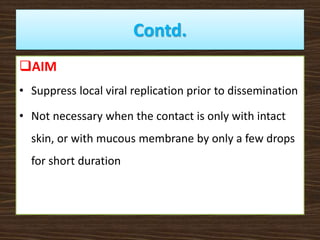
AIM
• Suppress local viral replication prior to dissemination
• Not necessary when the contact is only with intact
skin, or with mucous membrane by only a few drops
for short duration
Contd.
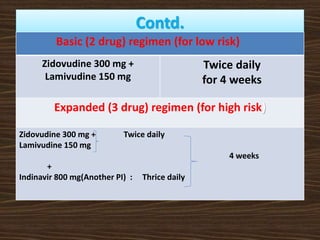
Basic (2 drug) regimen (for low risk)
Zidovudine 300 mg +
Lamivudine 150 mg
Twice daily
for 4 weeks
Expanded (3 drug) regimen (for high risk)
Zidovudine 300 mg + Twice daily
Lamivudine 150 mg
4 weeks
+
Indinavir 800 mg(Another PI) : Thrice daily
Contd.
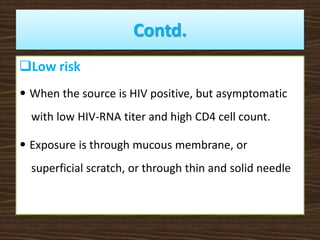
Low risk
• When the source is HIV positive, but asymptomatic
with low HIV-RNA titer and high CD4 cell count.
• Exposure is through mucous membrane, or
superficial scratch, or through thin and solid needle
Contd.
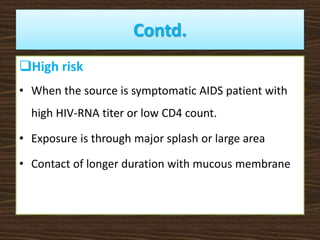
High risk
• When the source is symptomatic AIDS patient with
high HIV-RNA titer or low CD4 count.
• Exposure is through major splash or large area
• Contact of longer duration with mucous membrane
Prophylaxis after sexual exposure
• No data to evaluate the value of prophylaxis after
sexual exposure, the same regimen as for needle
stick may be used.
Perinatal HIV prophylaxis
• The first line NACO regimen for pregnant
women is:
• Zidovudine + Lamivudine + Nevirapine
Contd.
 In HIV-positive women who are not taking ART:
• Zidovudine (300 mg BD) started during 2nd trimester
and continued through delivery to postnatal period
• With treatment of the neonate for 6 weeks
• Has been found to reduce mother-to-child
transmission by 2/3rd.
Contd.
• AZT administered during labour and then to the
infant is also substantially protective.
• Breastfeeding by HIV-positive mother is
contraindicated,
MCQ
• Ganciclovir is preferred over acyclovir in the
following condition:
• (a) Herpes simplex keratitis
• (b) Herpes zoster
• (c) Chickenpox
• (d) Cytomegalovirus retinitis in AIDS patients
• Drug of choice for herpes simplex virus
infection is:
• (a) Acyclovir
• (b) Zidovudine
• (c) Indinavir
• (d) Ribavarin
• Drug of choice for chronic hepatitis –B is
• (a) Lamivudine
• (b) IFN-alpha
• (c) Ribavirin
• (d) Zidovudine
• Drug of choice for swine flu:
a. Acyclovir
b. Oseltamivir
c. Gancyclovir
d. Interferon alfa
• Which of the following is a reverse
transcriptase inhibitor?
• (a) Ritonavir
• (b) Saquanavir
• (c) Amprenavir
• (d) Tenofovir
• Pancreatitis is a common complication of
which one of the following
• (a) Zidovudine
• (b) Didanosine
• (c) Zalcitabine
• (d) Stavudine
• Which one of the following is not an
antiretroviral drug:
• (a) Saquinavir
• (b) Ganciclovir
• (c) Indinavir
• (d) Atazanavir
• Peripheral neuropathy not caused by which
antiretroviral drug?
• (a) Lamivudine
• (b) Didanosine
• (c) Zidovudine
• (d) Zalcitabine
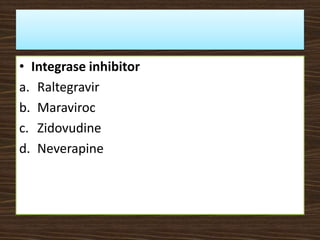
• Integrase inhibitor
a. Raltegravir
b. Maraviroc
c. Zidovudine
d. Neverapine
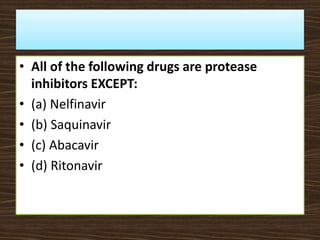
• All of the following drugs are protease
inhibitors EXCEPT:
• (a) Nelfinavir
• (b) Saquinavir
• (c) Abacavir
• (d) Ritonavir
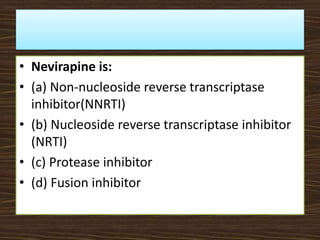
• Nevirapine is:
• (a) Non-nucleoside reverse transcriptase
inhibitor(NNRTI)
• (b) Nucleoside reverse transcriptase inhibitor
(NRTI)
• (c) Protease inhibitor
• (d) Fusion inhibitor
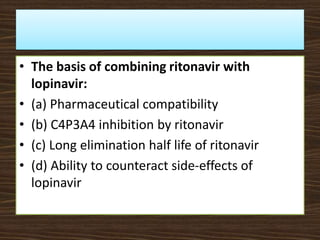
• The basis of combining ritonavir with
lopinavir:
• (a) Pharmaceutical compatibility
• (b) C4P3A4 inhibition by ritonavir
• (c) Long elimination half life of ritonavir
• (d) Ability to counteract side-effects of
lopinavir
• Bone marrow depressive drugs in the
treatment of AIDS patient are:
• (a) Didanosine
• (b) Zalcitabine
• (c) Zidovudine
• (d) Cotrimoxazole
• Select the drug that is active against both HIV
and hepatitis B virus:
• (a) Lamivudine
• (b) Indinavir
• (c) Didanosine
• (d) Efavirenz
06-08-2021

Hiv treatment

  • 1.
  • 2.
    Introduction • Treatment ofHIV infection and its complications is complex, prolonged • Needs expertise, strong motivation and commitment of the patient, resources and is expensive • ‘highly active antiretroviral therapy’ (HAART) with combination of 3 or more drugs whenever indicated • Monotherapy is contraindicated.
  • 3.
    Contd. • None ofthe currently available regimens can eradicate HIV from the body of the patient • Goal of therapy is: • Inhibit viral replication • Prevent complication • Prevent transmission to other person • Decrease resistance • Prolong survival
  • 4.
    Initiating antiretroviral therapy (a)All symptomatic HIV disease patients. (b) Asymptomatic patients when the CD4 cell count falls to 350/μl or less. (c) All HIV patients coinfected with HBV/HCV requiring treatment. (d) All pregnant HIV positive women. (e) All patients with HIV-nephropathy
  • 5.
    Therapeutic regimens • Allregimens should have 2 NRTI+1NNRTI. • Include lamivudine in all regimens. • The other NRTI can be zidovudine or stavudine. • Choose one NNRTI from nevirapine or efavirenz.
  • 6.
    contd • Choose efavirenzin patients with hepatic dysfunction and in those concurrently receiving rifampin • Do not use efavirenz in pregnant women or in those likely to get pregnant
  • 7.
    First line Regimen Preferredregimen 1. Lamivudine + Zidovudine + Nevirapine Alternative regimens 1. Lamivudine + Zidovudine + Efavirenz 2. Lamivudine + Stavudine+ Efavirenz 3. Lamivudine + Stavudine + Nevirapine Other options 1. Lamivudine + Tenofovir+ Nevirapine 2. Lamivudine + Tenofovir+ Efavirenz 3. Lamivudine+ Zidovudine + Tenofovir
  • 8.
    Contd. • Stavudine issubstituted for zidovudine if patient is anaemic • Tenofovir is included when there is toxicity or other Contraindication to both zidovudine and stavudine • 3NRTI regimen is only for patients unable to tolerate both nevirapine and efavirenz.
  • 9.
    Contd. • The PIcontaining regimens (2 NRTI + PI or NRTI + NNRTI + PI) are reserved for advanced cases who have failed earlier regimens. • Low dose ritonavir boosted PIs are preferred over higher dose single PI due to lower pill burden and better tolerability • If drug toxicity develops, either the entire should be interrupted or the offending drug should be changed. No dose reduction should be tried.
  • 10.
    Contd. • Treatment islife-long • Institution of HAART in patients with latent or partially treated opportunistic infection may produce ‘immune reconstitution syndrome’ • Pregnancy in women does not contraindicate ART. • zidovudine, lamivudine, nevirapine, nelfinavir
  • 11.
    Contd. • Durability ofthe regimens depends mainly on adherence of the patient to it. • Compliance is a major determinant of outcome. • Multiple antiretroviral, Anti-P. jiroveci, antitoxoplasma, anti-CMV/herpes virus, antitubercular, antifungal or other drugs may have to be used in a patient
  • 12.
    Contd. • Combination shouldbe avoided Combination Reason Zidovudine + stavudine Pharmacodynamic antagonism Stavudine + didanosine: Increased toxicity (neuropathy, lactic acidosis Lamivudine + didanosine Clinically not additive
  • 13.
    Changing a failingregimen • Plasma HIV-RNA count is not rendered undetectable (<50 copies/μl) within 6 months therapy • Repeated detection of virus in plasma after initial suppression to undetectable levels • Clinical deterioration • Fall in CD4 cell count • Serious opportunistic infection
  • 14.
    Contd. • Failure isdue to development of resistance to one or more components of the regimen • failed regimen should be changed entirely
  • 15.
    List of secondline regimens (in order of preference) NRTI PI Standard regimens Tenofovir + Abacavir Lopinavir Atazanavir Saquinavir Low ritonavir Indinavir Nelfinavir Didanosine + Abacavir Tenofovir + Zidovudine Special circumstances 1Didanosine + Zidovudine 2. Didanosine + Lamivudine
  • 16.
    Prophylaxis of HIVinfection Post-exposure prophylaxis (PEP) • Indication: Health care workers and others who get accidentally exposed to: – the risk of HIV infection by needle stick – or other sharp injury
  • 17.
    Contd. AIM • Suppress localviral replication prior to dissemination • Not necessary when the contact is only with intact skin, or with mucous membrane by only a few drops for short duration
  • 18.
    Contd. Basic (2 drug)regimen (for low risk) Zidovudine 300 mg + Lamivudine 150 mg Twice daily for 4 weeks Expanded (3 drug) regimen (for high risk) Zidovudine 300 mg + Twice daily Lamivudine 150 mg 4 weeks + Indinavir 800 mg(Another PI) : Thrice daily
  • 19.
    Contd. Low risk • Whenthe source is HIV positive, but asymptomatic with low HIV-RNA titer and high CD4 cell count. • Exposure is through mucous membrane, or superficial scratch, or through thin and solid needle
  • 20.
    Contd. High risk • Whenthe source is symptomatic AIDS patient with high HIV-RNA titer or low CD4 count. • Exposure is through major splash or large area • Contact of longer duration with mucous membrane
  • 21.
    Prophylaxis after sexualexposure • No data to evaluate the value of prophylaxis after sexual exposure, the same regimen as for needle stick may be used.
  • 22.
    Perinatal HIV prophylaxis •The first line NACO regimen for pregnant women is: • Zidovudine + Lamivudine + Nevirapine
  • 23.
    Contd.  In HIV-positivewomen who are not taking ART: • Zidovudine (300 mg BD) started during 2nd trimester and continued through delivery to postnatal period • With treatment of the neonate for 6 weeks • Has been found to reduce mother-to-child transmission by 2/3rd.
  • 24.
    Contd. • AZT administeredduring labour and then to the infant is also substantially protective. • Breastfeeding by HIV-positive mother is contraindicated,
  • 25.
    MCQ • Ganciclovir ispreferred over acyclovir in the following condition: • (a) Herpes simplex keratitis • (b) Herpes zoster • (c) Chickenpox • (d) Cytomegalovirus retinitis in AIDS patients
  • 26.
    • Drug ofchoice for herpes simplex virus infection is: • (a) Acyclovir • (b) Zidovudine • (c) Indinavir • (d) Ribavarin
  • 27.
    • Drug ofchoice for chronic hepatitis –B is • (a) Lamivudine • (b) IFN-alpha • (c) Ribavirin • (d) Zidovudine
  • 28.
    • Drug ofchoice for swine flu: a. Acyclovir b. Oseltamivir c. Gancyclovir d. Interferon alfa
  • 29.
    • Which ofthe following is a reverse transcriptase inhibitor? • (a) Ritonavir • (b) Saquanavir • (c) Amprenavir • (d) Tenofovir
  • 30.
    • Pancreatitis isa common complication of which one of the following • (a) Zidovudine • (b) Didanosine • (c) Zalcitabine • (d) Stavudine
  • 31.
    • Which oneof the following is not an antiretroviral drug: • (a) Saquinavir • (b) Ganciclovir • (c) Indinavir • (d) Atazanavir
  • 32.
    • Peripheral neuropathynot caused by which antiretroviral drug? • (a) Lamivudine • (b) Didanosine • (c) Zidovudine • (d) Zalcitabine
  • 33.
    • Integrase inhibitor a.Raltegravir b. Maraviroc c. Zidovudine d. Neverapine
  • 34.
    • All ofthe following drugs are protease inhibitors EXCEPT: • (a) Nelfinavir • (b) Saquinavir • (c) Abacavir • (d) Ritonavir
  • 35.
    • Nevirapine is: •(a) Non-nucleoside reverse transcriptase inhibitor(NNRTI) • (b) Nucleoside reverse transcriptase inhibitor (NRTI) • (c) Protease inhibitor • (d) Fusion inhibitor
  • 36.
    • The basisof combining ritonavir with lopinavir: • (a) Pharmaceutical compatibility • (b) C4P3A4 inhibition by ritonavir • (c) Long elimination half life of ritonavir • (d) Ability to counteract side-effects of lopinavir
  • 37.
    • Bone marrowdepressive drugs in the treatment of AIDS patient are: • (a) Didanosine • (b) Zalcitabine • (c) Zidovudine • (d) Cotrimoxazole
  • 38.
    • Select thedrug that is active against both HIV and hepatitis B virus: • (a) Lamivudine • (b) Indinavir • (c) Didanosine • (d) Efavirenz
  • 39.