DIAGNOSTIC AGENTS
DR. SIDDHARTHA DUTTA
MAMC
NEW DELHI
INTRODUCTION
 Diagnostic agents are chemical or substances
used to detect abnormalities in tissue and
organs or to test on organ function.
 Do not have medicinal & pharmacological
effects
 X-ray film used for radiography
INTRODUCTION
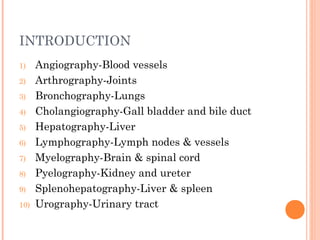
1) Angiography-Blood vessels
2) Arthrography-Joints
3) Bronchography-Lungs
4) Cholangiography-Gall bladder and bile duct
5) Hepatography-Liver
6) Lymphography-Lymph nodes & vessels
7) Myelography-Brain & spinal cord
8) Pyelography-Kidney and ureter
9) Splenohepatography-Liver & spleen
10) Urography-Urinary tract
RADIOPHARMACEUTICALS
(RADIO ISOTOPES)
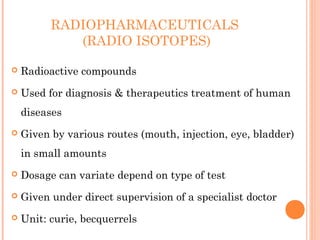
 Radioactive compounds
 Used for diagnosis & therapeutics treatment of human
diseases
 Given by various routes (mouth, injection, eye, bladder)
in small amounts
 Dosage can variate depend on type of test
 Given under direct supervision of a specialist doctor
 Unit: curie, becquerrels
RADIOPHARMACEUTICALS
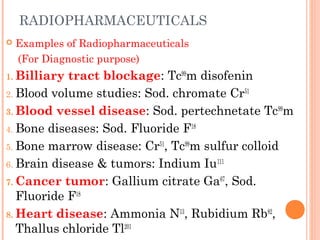
 Examples of Radiopharmaceuticals
(For Diagnostic purpose)
1. Billiary tract blockage: Tc99
m disofenin
2. Blood volume studies: Sod. chromate Cr51
3. Blood vessel disease: Sod. pertechnetate Tc99
m
4. Bone diseases: Sod. Fluoride F18
5. Bone marrow disease: Cr51
, Tc99
m sulfur colloid
6. Brain disease & tumors: Indium Iu111
7. Cancer tumor: Gallium citrate Ga67
, Sod.
Fluoride F18
8. Heart disease: Ammonia N13
, Rubidium Rb82
,
Thallus chloride Tl201
RADIOPHARMACEUTICALS
9. Kidney disease: Iodohippurate sod. I125
, Tc99
m
10. Liver disease: Ammonia N13
, Tc99
m, Albumin
colloid
11. Lung disease: Krypton Kr81
m, Xe133
RADIOLOGICAL CONTRAST MEDIA
(RADIO OPAQUE AGENTS)
 Any substance which when administered to a patient
improves the visualization of an organ or tissue is called
a contrast media.
 Having property of opacifying X-ray radiations
 Either inorganic as well as organic
Classification
RADIOLOGICAL CONTRAST MEDIA
A) Positive contrast media:
 having ability to absorb X-rays (eg. Radio opaques)
Subdivided:
i. Heavy Metals & their salts (Inorganic)
ii. Iodized oils
iii. Iodinated organic compounds (Organic)
a) water soluble contrast media
b) water insoluble contrast media
RADIOLOGICAL CONTRAST MEDIA
B) Negative contrast media:
 Transparent to X-rays
 Renders the structure of a tissue more translucent
 eg. Air, Oxygen, Nitrogen etc.
RADIOLOGICAL CONTRAST MEDIA
 Characteristics:
 Adequate radioopacity which require iodine content
50% or more
 High water solubility (40% and above)
 Low viscosity, no osmotic effect
 Chemical stability
 Minimum toxicity & patient acceptance
 Readily available & low cost
RADIOLOGICAL CONTRAST MEDIA
A) Heavy metals and salts:
High atomic number and radioopaque
eg.
i) Barium Sulphate (BaSO4)
-Low systematic toxicity
-Low water solubility
-Lack of osmotic activity
-Used for examination of GIT
-Used as suspension or thick cream
-Orally or through rectal route
-sod.citrate is added to stabilize preparation
-Sorbitol added to enhance function
RADIOLOGICAL CONTRAST MEDIA
ii) Metallic salt (Tantalum oxide for Bronchography
& esophagography), (calcium tungstate) &
(barium titanate for stomach, small intestine,
esophagus)
iii) Ferrites(Fe2O3):
-about 80% opacity than that of BaSO4
-contain Zn, Cu, Mn, Ni and Mg
-used for Bronchi, stomach & small intestine
studies
RADIOLOGICAL CONTRAST MEDIA
B) Iodized oils:
 Preparation: Iodination of vegetable oils with hydroiodic
acid give iodized oils
 Iodinated fatty acid derivatives(Yellow to amber colored )
 Decompose on exposure to light and air
 Upon administration liberate inorganic iodine in body
which appear in urine
 Used in hepatography, lymphography &
hepatospleenography
RADIOLOGICAL CONTRAST MEDIA
c) Organic Iodine Compound:
 Most widely used
 Tetra iodo phenolphthalein was 1st
agent
 Amount of iodine is important for opacity
Subclassification:
a) Water soluble contrast media
b) Water insoluble contrast media
RADIOLOGICAL CONTRAST MEDIA
a) Water soluble contrast media:
eg. Diatrizoate sodium
Diatrizoate meglumine
Sodium iothalamate
Metrizoic acid
Iodipamide
Ipodate sodium
Iodohippurate sodium
-Mainly used for urography & angiography
-Administered by retrograde method (i.e. By mechanical
means)
-Mild toxicity
RADIOLOGICAL CONTRAST MEDIA
b) Water insoluble contrast media
eg. Iopanoic acid
Propyliodone
Iophendylate
Iocetamic acid
Iodoxamide
-very slightly water soluble
-mainly used for cholecystography, bronchography
and myelography
-patient should not drink or eat before Six hrs.
RADIOLOGICAL CONTRAST MEDIA
a) Water soluble contrast media:
1. Diatrizoate sodium:
 Sodium salt of substituted triiodo benzoic acid
 Iodine content : abt 62%
 Used for angiography & urography
 Also available as meglumine salt
RADIOLOGICAL CONTRAST MEDIA
2. Sodium Iothalamate:
 Structural isomer of diatrizoic acid
 One actamide (CH3CONH-) group replaced by
methyl carbamoyl (-CONHCH3)group
 Available as meglumine salt
 Used in angiography
 Chem. Name: sodium 3-acetamido-2,4,6-triiodo-
5-(methylcarbamoyl)benzoate
DIAGNOSTIC CHEMICALS
a) For kidney function:
 p-amino hippuric acid, Inulin, Phenosulphophthalein
DIAGNOSTIC CHEMICALS
b) For liver function:
 Rose Bengal, Sulphobromophthalein sodium
DIAGNOSTIC CHEMICALS
c) For gastric function:
 Histamine phosphate, Pentagastrin, Xylose
d) For cardiac function:
 Evans blue dye
DIAGNOSTIC CHEMICALS
e) Miscellaneous:
i) Fluorescein sodium
-used for ophthalmological
studies
ii) Congo red
DIAGNOSTIC DRUGS
a) Phentolamine: pheochromocytoma
b) Dexamethasone: Endocrine gland dysfunction
c) Tensilon test: edrophonium
d) Methacholine challenge test
e) L-arginine: growth hormone secretion
THANK YOU

Diagnostic agents

  • 1.
  • 2.
    INTRODUCTION  Diagnostic agentsare chemical or substances used to detect abnormalities in tissue and organs or to test on organ function.  Do not have medicinal & pharmacological effects  X-ray film used for radiography
  • 3.
    INTRODUCTION 1) Angiography-Blood vessels 2)Arthrography-Joints 3) Bronchography-Lungs 4) Cholangiography-Gall bladder and bile duct 5) Hepatography-Liver 6) Lymphography-Lymph nodes & vessels 7) Myelography-Brain & spinal cord 8) Pyelography-Kidney and ureter 9) Splenohepatography-Liver & spleen 10) Urography-Urinary tract
  • 5.
    RADIOPHARMACEUTICALS (RADIO ISOTOPES)  Radioactivecompounds  Used for diagnosis & therapeutics treatment of human diseases  Given by various routes (mouth, injection, eye, bladder) in small amounts  Dosage can variate depend on type of test  Given under direct supervision of a specialist doctor  Unit: curie, becquerrels
  • 6.
    RADIOPHARMACEUTICALS  Examples ofRadiopharmaceuticals (For Diagnostic purpose) 1. Billiary tract blockage: Tc99 m disofenin 2. Blood volume studies: Sod. chromate Cr51 3. Blood vessel disease: Sod. pertechnetate Tc99 m 4. Bone diseases: Sod. Fluoride F18 5. Bone marrow disease: Cr51 , Tc99 m sulfur colloid 6. Brain disease & tumors: Indium Iu111 7. Cancer tumor: Gallium citrate Ga67 , Sod. Fluoride F18 8. Heart disease: Ammonia N13 , Rubidium Rb82 , Thallus chloride Tl201
  • 7.
    RADIOPHARMACEUTICALS 9. Kidney disease:Iodohippurate sod. I125 , Tc99 m 10. Liver disease: Ammonia N13 , Tc99 m, Albumin colloid 11. Lung disease: Krypton Kr81 m, Xe133
  • 8.
    RADIOLOGICAL CONTRAST MEDIA (RADIOOPAQUE AGENTS)  Any substance which when administered to a patient improves the visualization of an organ or tissue is called a contrast media.  Having property of opacifying X-ray radiations  Either inorganic as well as organic Classification
  • 9.
    RADIOLOGICAL CONTRAST MEDIA A)Positive contrast media:  having ability to absorb X-rays (eg. Radio opaques) Subdivided: i. Heavy Metals & their salts (Inorganic) ii. Iodized oils iii. Iodinated organic compounds (Organic) a) water soluble contrast media b) water insoluble contrast media
  • 10.
    RADIOLOGICAL CONTRAST MEDIA B)Negative contrast media:  Transparent to X-rays  Renders the structure of a tissue more translucent  eg. Air, Oxygen, Nitrogen etc.
  • 11.
    RADIOLOGICAL CONTRAST MEDIA Characteristics:  Adequate radioopacity which require iodine content 50% or more  High water solubility (40% and above)  Low viscosity, no osmotic effect  Chemical stability  Minimum toxicity & patient acceptance  Readily available & low cost
  • 12.
    RADIOLOGICAL CONTRAST MEDIA A)Heavy metals and salts: High atomic number and radioopaque eg. i) Barium Sulphate (BaSO4) -Low systematic toxicity -Low water solubility -Lack of osmotic activity -Used for examination of GIT -Used as suspension or thick cream -Orally or through rectal route -sod.citrate is added to stabilize preparation -Sorbitol added to enhance function
  • 13.
    RADIOLOGICAL CONTRAST MEDIA ii)Metallic salt (Tantalum oxide for Bronchography & esophagography), (calcium tungstate) & (barium titanate for stomach, small intestine, esophagus) iii) Ferrites(Fe2O3): -about 80% opacity than that of BaSO4 -contain Zn, Cu, Mn, Ni and Mg -used for Bronchi, stomach & small intestine studies
  • 14.
    RADIOLOGICAL CONTRAST MEDIA B)Iodized oils:  Preparation: Iodination of vegetable oils with hydroiodic acid give iodized oils  Iodinated fatty acid derivatives(Yellow to amber colored )  Decompose on exposure to light and air  Upon administration liberate inorganic iodine in body which appear in urine  Used in hepatography, lymphography & hepatospleenography
  • 15.
    RADIOLOGICAL CONTRAST MEDIA c)Organic Iodine Compound:  Most widely used  Tetra iodo phenolphthalein was 1st agent  Amount of iodine is important for opacity Subclassification: a) Water soluble contrast media b) Water insoluble contrast media
  • 16.
    RADIOLOGICAL CONTRAST MEDIA a)Water soluble contrast media: eg. Diatrizoate sodium Diatrizoate meglumine Sodium iothalamate Metrizoic acid Iodipamide Ipodate sodium Iodohippurate sodium -Mainly used for urography & angiography -Administered by retrograde method (i.e. By mechanical means) -Mild toxicity
  • 17.
    RADIOLOGICAL CONTRAST MEDIA b)Water insoluble contrast media eg. Iopanoic acid Propyliodone Iophendylate Iocetamic acid Iodoxamide -very slightly water soluble -mainly used for cholecystography, bronchography and myelography -patient should not drink or eat before Six hrs.
  • 18.
    RADIOLOGICAL CONTRAST MEDIA a)Water soluble contrast media: 1. Diatrizoate sodium:  Sodium salt of substituted triiodo benzoic acid  Iodine content : abt 62%  Used for angiography & urography  Also available as meglumine salt
  • 19.
    RADIOLOGICAL CONTRAST MEDIA 2.Sodium Iothalamate:  Structural isomer of diatrizoic acid  One actamide (CH3CONH-) group replaced by methyl carbamoyl (-CONHCH3)group  Available as meglumine salt  Used in angiography  Chem. Name: sodium 3-acetamido-2,4,6-triiodo- 5-(methylcarbamoyl)benzoate
  • 20.
    DIAGNOSTIC CHEMICALS a) Forkidney function:  p-amino hippuric acid, Inulin, Phenosulphophthalein
  • 21.
    DIAGNOSTIC CHEMICALS b) Forliver function:  Rose Bengal, Sulphobromophthalein sodium
  • 22.
    DIAGNOSTIC CHEMICALS c) Forgastric function:  Histamine phosphate, Pentagastrin, Xylose d) For cardiac function:  Evans blue dye
  • 23.
    DIAGNOSTIC CHEMICALS e) Miscellaneous: i)Fluorescein sodium -used for ophthalmological studies ii) Congo red
  • 24.
    DIAGNOSTIC DRUGS a) Phentolamine:pheochromocytoma b) Dexamethasone: Endocrine gland dysfunction c) Tensilon test: edrophonium d) Methacholine challenge test e) L-arginine: growth hormone secretion
  • 26.

Editor's Notes

  • #4 Radio opaque Some of used in organ visualization
  • #13 Usually not used for diagnostic purpose Iodine compounds are usually more useful
  • #27 Mannitol: Renal functionhe test starts with a very small dose of methacholine and, depending on your response, the doses will be increased until either you experience 20 percent drop in breathing ability, or you reach a maximum dose with no change in your lung function.