Anthraquinone
Glycosides
1
2
3
4
Sources : Botanical and geographical
Collection
Constituents
Uses
Anthraquinone Glycosides
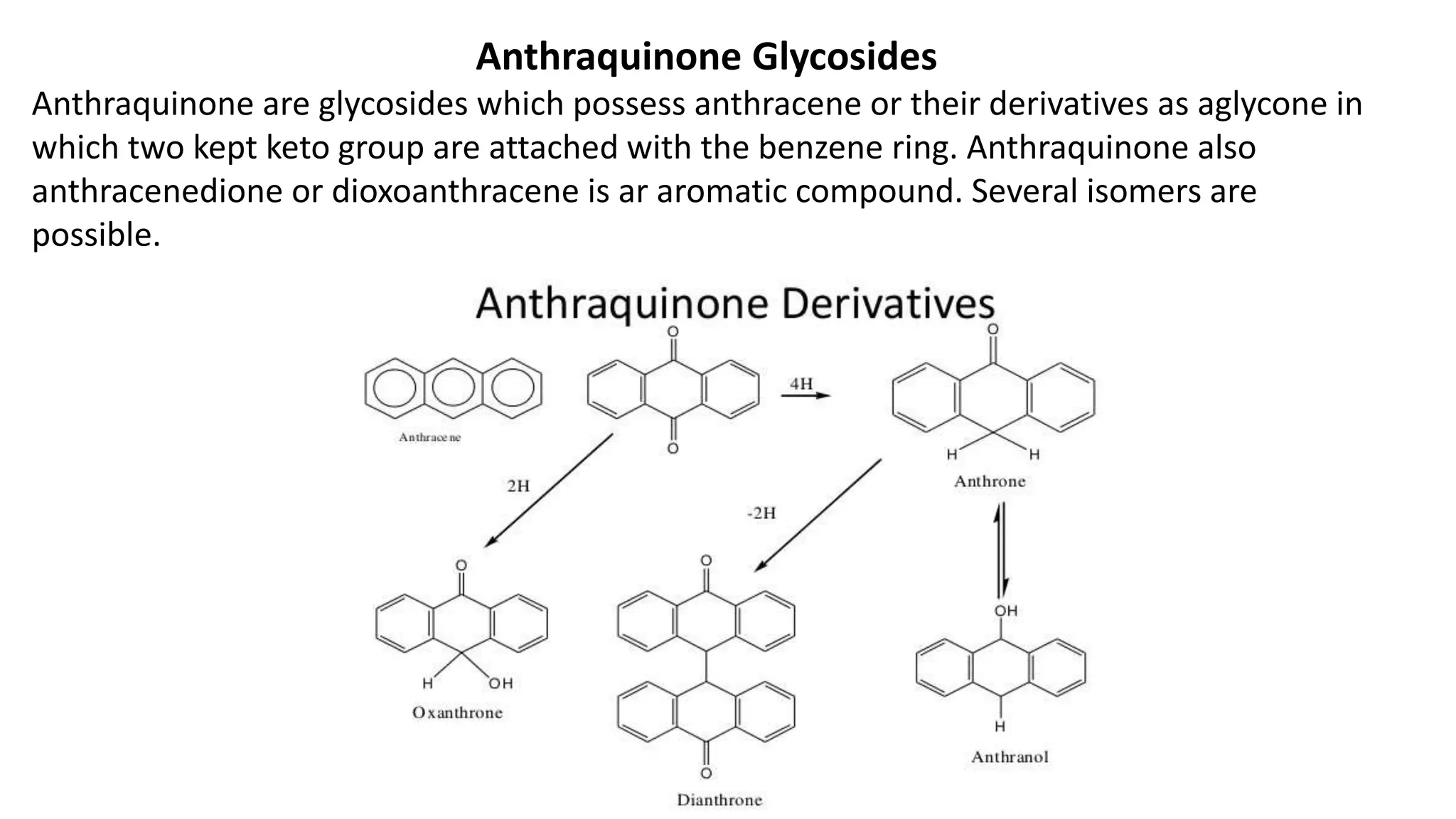
Anthraquinone are glycosides which possess anthracene or their derivatives as aglycone in
which two kept keto group are attached with the benzene ring. Anthraquinone also
anthracenedione or dioxoanthracene is ar aromatic compound. Several isomers are
possible.
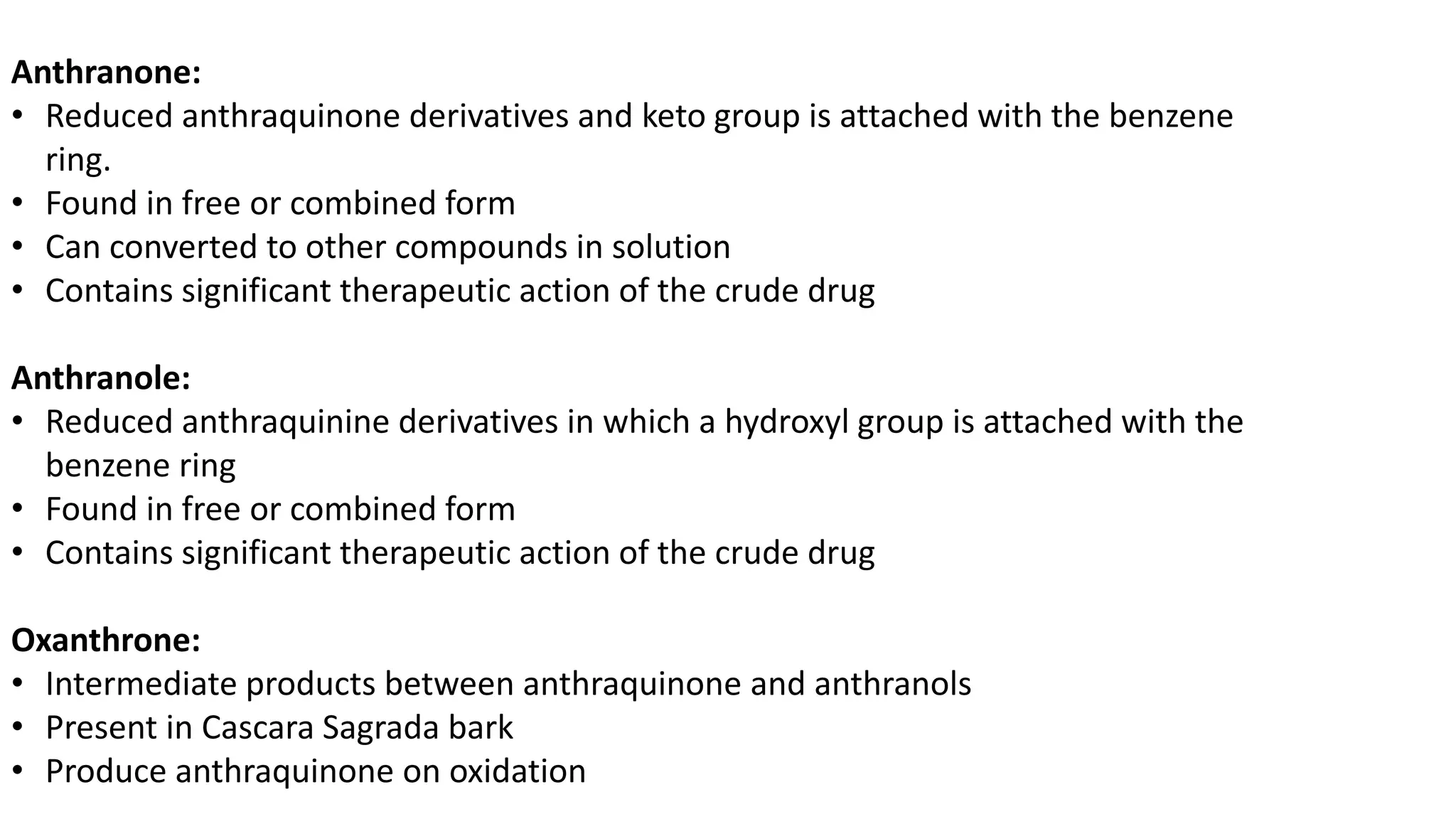
Anthranone:
• Reduced anthraquinone derivatives and keto group is attached with the benzene
ring.
• Found in free or combined form
• Can converted to other compounds in solution
• Contains significant therapeutic action of the crude drug
Anthranole:
• Reduced anthraquinine derivatives in which a hydroxyl group is attached with the
benzene ring
• Found in free or combined form
• Contains significant therapeutic action of the crude drug
Oxanthrone:
• Intermediate products between anthraquinone and anthranols
• Present in Cascara Sagrada bark
• Produce anthraquinone on oxidation
Hydrolysis:
Chemical test of anthraquinone:
• Borntrager’s test
• Modified Borntrager’s test
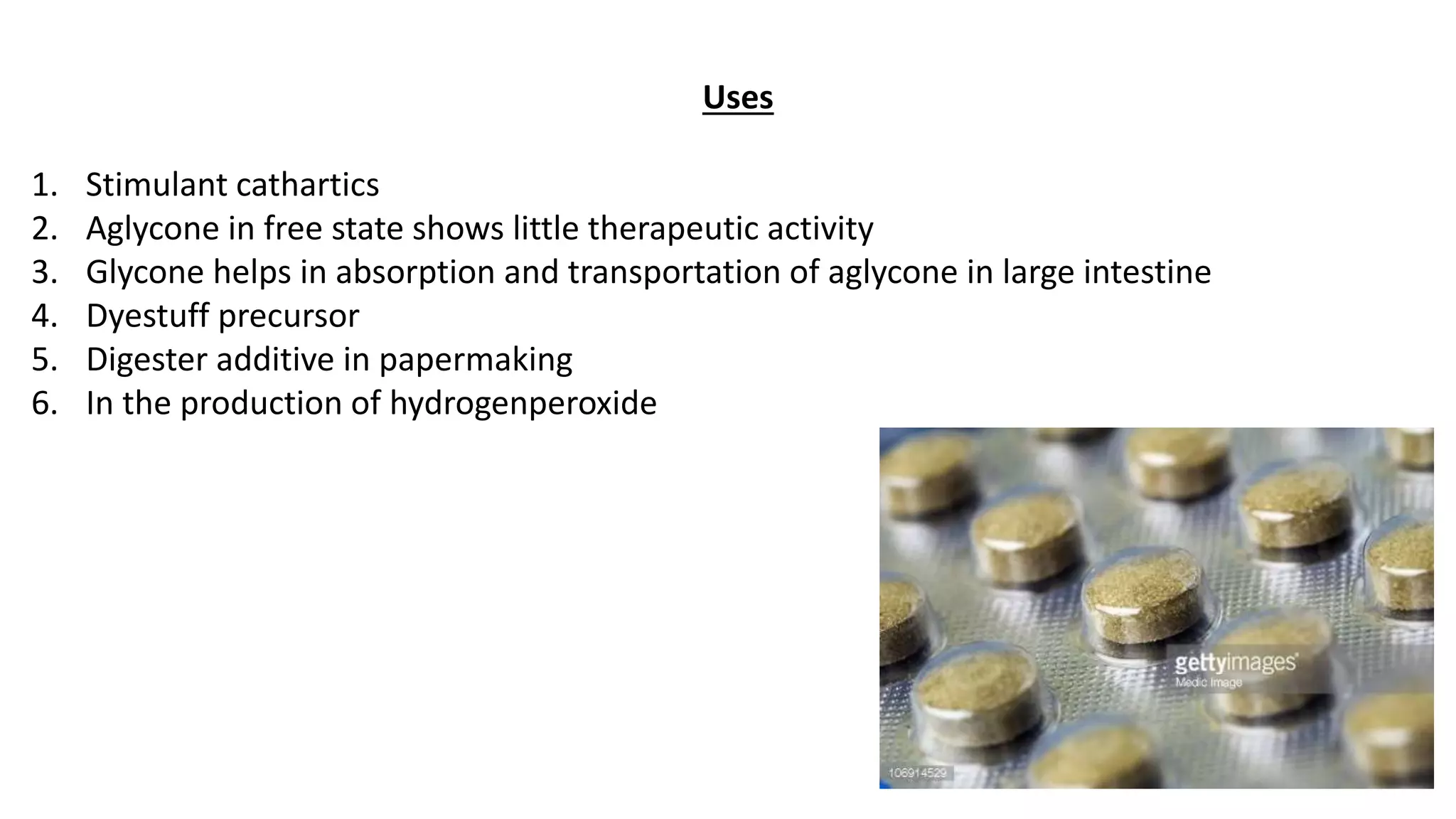
Uses
1. Stimulant cathartics
2. Aglycone in free state shows little therapeutic activity
3. Glycone helps in absorption and transportation of aglycone in large intestine
4. Dyestuff precursor
5. Digester additive in papermaking
6. In the production of hydrogenperoxide
Cascara
Sagrada
Botanical Source: Dried bark of Rhamnus purshianus. (Family- Rhamnaceae)
Geographical sources:
• Native – Pacific coast of North America
• Commercial supplies- Oregon, Washington, Southern British Columbia
Collection:
• Bark is stripped from the tree
• Bark is sun dried
• Broken into small pieces and keep into bags
• Keep for one years before use
Branch of Cascara
Sagrada tree
Bark of cascara
Chemical
Constituent
Glycosides
GlyconeAglycone
Glycosides
O- Glycosides- 10-20% C- Glycosides- 80-90%
(Based on emodin) (Aloin like compounds)
They are both O
and C- Glycosides
Aglycone Unit
Emodin, Iso- emodin, Aloe emodin, Methyl-hydrocotoin, Chrysophanic acid
Emodin
Glycone Unit
Rhamnose and Glucose ratio is 1:1
Uses
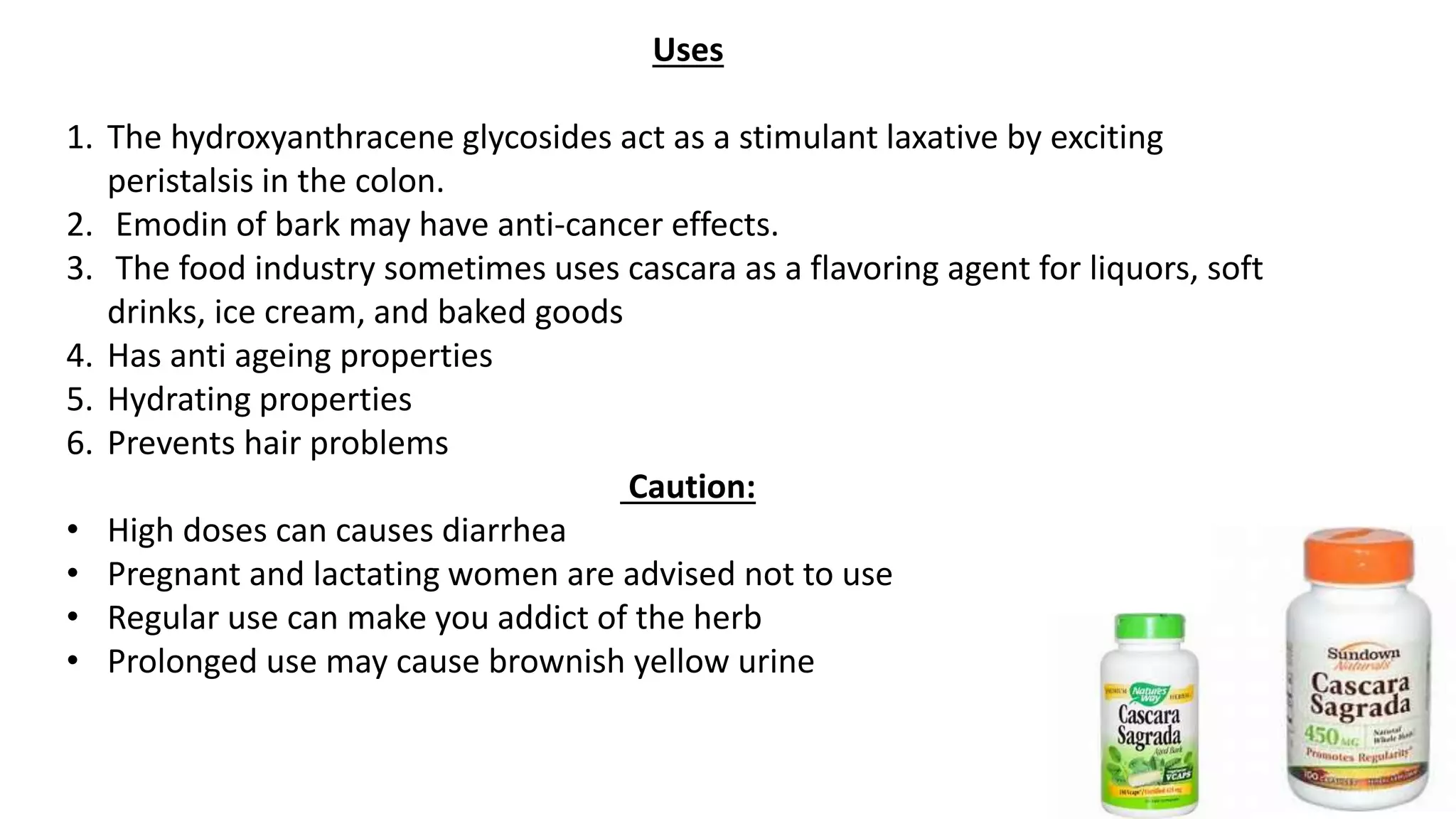
1. The hydroxyanthracene glycosides act as a stimulant laxative by exciting
peristalsis in the colon.
2. Emodin of bark may have anti-cancer effects.
3. The food industry sometimes uses cascara as a flavoring agent for liquors, soft
drinks, ice cream, and baked goods
4. Has anti ageing properties
5. Hydrating properties
6. Prevents hair problems
Caution:
• High doses can causes diarrhea
• Pregnant and lactating women are advised not to use
• Regular use can make you addict of the herb
• Prolonged use may cause brownish yellow urine
Aloe
Botanical Sources: Dried latex of leaves of following plants
• Aloe barbadensis or Aloe vera (Curacao Aloe)
• Alo ferox, Aloe Africana, Aloe spicata (Cape Aloe)
Family- Liliaceae
GEOGRAFICAL SOURCE:
Curacao Aloe: Aloe barbadensis is a native of northern africa
Cape Aloe: Cape Aloe is found in US ,Venezuela,Haiti & South Africa
Collection:
• Leaves are cut in March and april
• Placed cut-end downward in a V-shaped vessel
• Allowed to harden
• Hard , bitter tasted latex is collected then
Chemical constituents:
1. Curacao Aloe
• Isobarbaloin
• Free aloe-emodin
• Free and combine anthranol
• Chrysophanic acid
Anthranol
2. Cape Aloe
• Barbaloin 5-30%
• Socaloin 7.5-10%
• also volatile oil and resinous yellow aloin is present.
Aloin
Uses
1. Aloe perryi,Aloe ferox,aloe babadensis are used as natural flavoring agent in USA.
2. It acts as purgative or laxative mainly unprocessed aloe.Also some drugs are made
up of aloe constituents which acts as colon cleanser.
3. it has healing power so used in the treatment of burns and other skin problems.
4. Used hugely in cosmetic products
5. Also some people use this plants as ornamental or decorative plants because of
their nice color and shape.
6. According to Cancer Research UK, a potentially deadly product called T-UP is made
of concentrated aloe, and promoted as a cancer cure. They say "there is currently no
evidence that aloe products can help to prevent or treat cancer in humans"
Interactions:
1. We cant intake aloe along with Lanoxin drug as it increases the side effects of lanoxin
because aloe is stimulant laxative and decreases the potassium level which aggravates
the side effects of this drug.The latex of aloe decreases some drugs activity.
2.We should avoid aloe while taking antidiabetes drugs because both decreases the
blood sugar level.
3. Taking aloe before surgery can cause increased bleeding as it has anti blood clotting
property.
Rhubarb
Botanical Sources: Dried roots and rhizomes of
• Rheum officinale
• Rheum palmatum
• Rheum emodi (Indian or Himalayan)
• Rheum webbianum (Indian or Himalayan)
Family- Polygonaceae
Geographical sources:
• Native- China for Chinese Rhubarb and India, Pakistan,Nepal for Indian Rhubarb
Rheum officinale
Rheum palmatum
Rheum emodi
Rheum webbianum
Collection:
• Rhizomes are collected in Autumn
• Peeled and perforated, strung on rope
• Dried in sun or artificial heat
Growing Rhubarb in raised beds Growing Rhubarb in Greenhouse
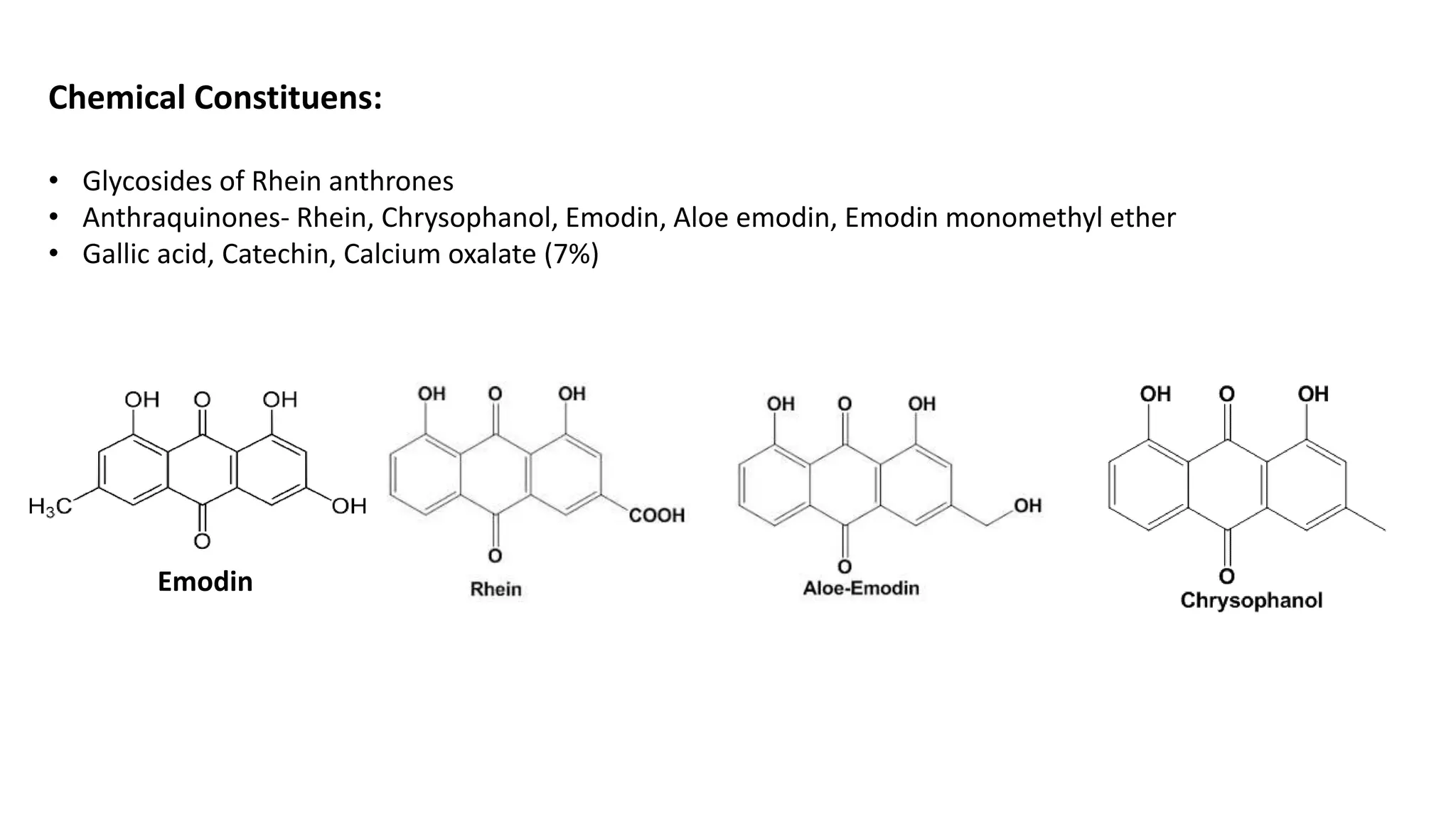
Chemical Constituens:
• Glycosides of Rhein anthrones
• Anthraquinones- Rhein, Chrysophanol, Emodin, Aloe emodin, Emodin monomethyl ether
• Gallic acid, Catechin, Calcium oxalate (7%)
Emodin
Uses
1. Used as cathartic
2. Astringent
3. Mouthwash for oral ulcer
4. Treat burns, wounds
5. Fibers obtained from rhubarb can be used for the manufacture of paper
6. Used for dyeing of hair.
Anything interesting??
• Rhubarb- “a heated argument or dispute”
• The leaves attached to the Rhubarb stalk are poisonous. It repel insects!
• One of its most popular applications….. Pie!
• Fruit??? Or Vegetable???
• Rhubarb enhances the appetite.
• The impact of the rhubarb depends on how it is prepared.
• More recently there have been claims that rhubarb can be useful in treatment of Hepatitis B.
• One of the first medicines to be imported from china to the West
Senna
Botanical Sources: Dried leaflet of
• Cassia acutifolia (Alexandria Senna)
• Cassia angustifolia (Tinnevelly Senna)
Family- Leguminosae
Geographical Sources:
• Cassia acutifolia grows near the Nile Aswan to Kordofan
• Cassia angutifolia grows wild in Somalia, Arabian Peninsula and India
Cultivation:
• Harvested in April and September
• Cut off the tops of the plants about 15 cm above the ground
• Dried in the sun
• Stems and pods are separated from leaflets
• Leaves are graded and baled or packed in bags
Cultivation of Senna
Chemical Constituents:
1. Glycosides- Sennoside A and B whose aglycone is rhein dianthrone.
2.Sennosoids C and D whose aglycone is composed of one molecule of rhein and one
molecule of aloe-emodin.
3. Monomeric glycosides and Free anthraquinones
4. Senna pod contains active glycosides
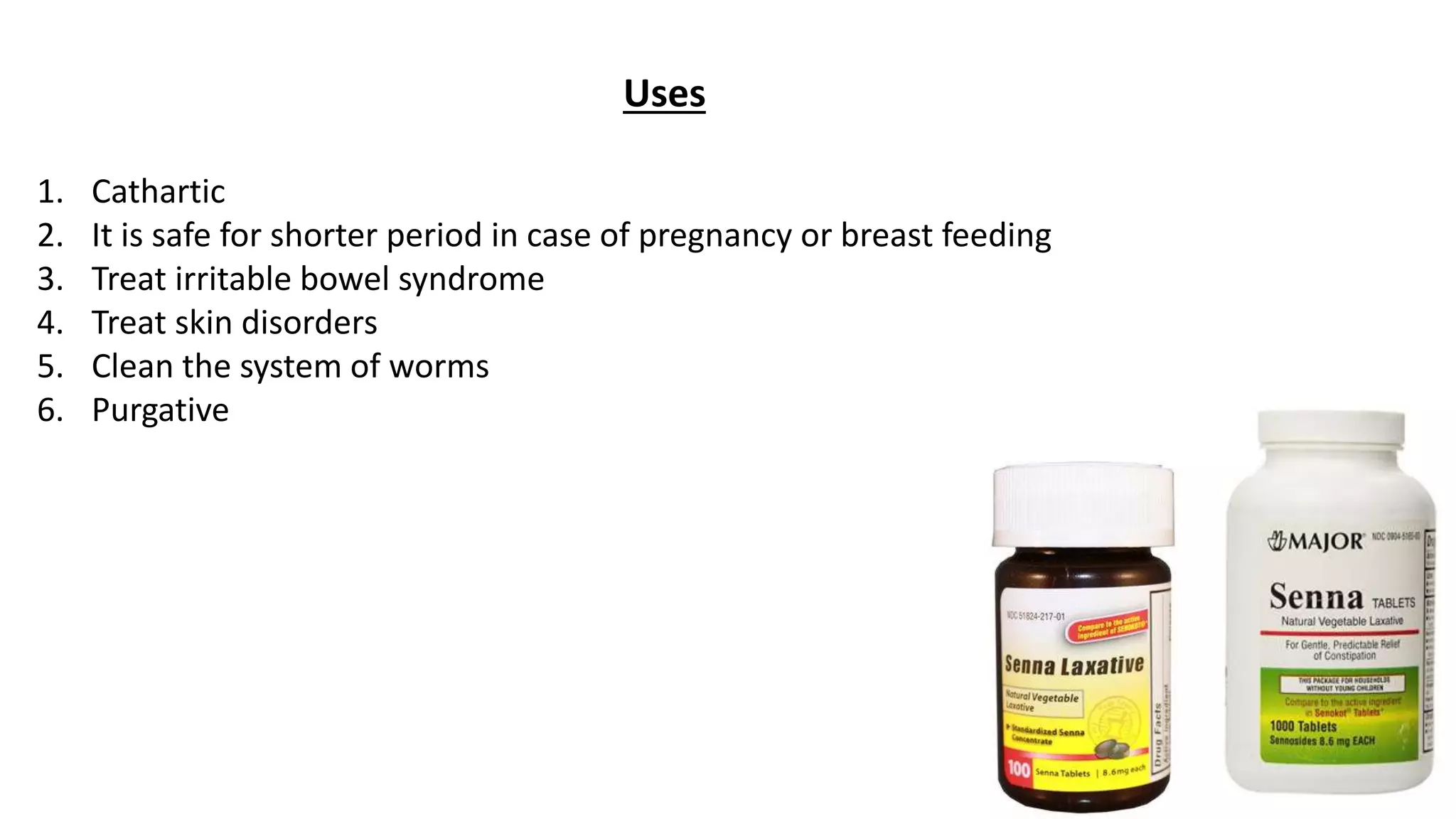
Uses
1. Cathartic
2. It is safe for shorter period in case of pregnancy or breast feeding
3. Treat irritable bowel syndrome
4. Treat skin disorders
5. Clean the system of worms
6. Purgative
Chrysarobin
Botanical Sources: It is a mixture of neutral principles obtained from Goa powder
which is obtained from Lysogenous cavities in the wood of Andira araroba.
Family- Leguminosae.
Geographical sources: Portuguese colon on the Malabar Coast of India.
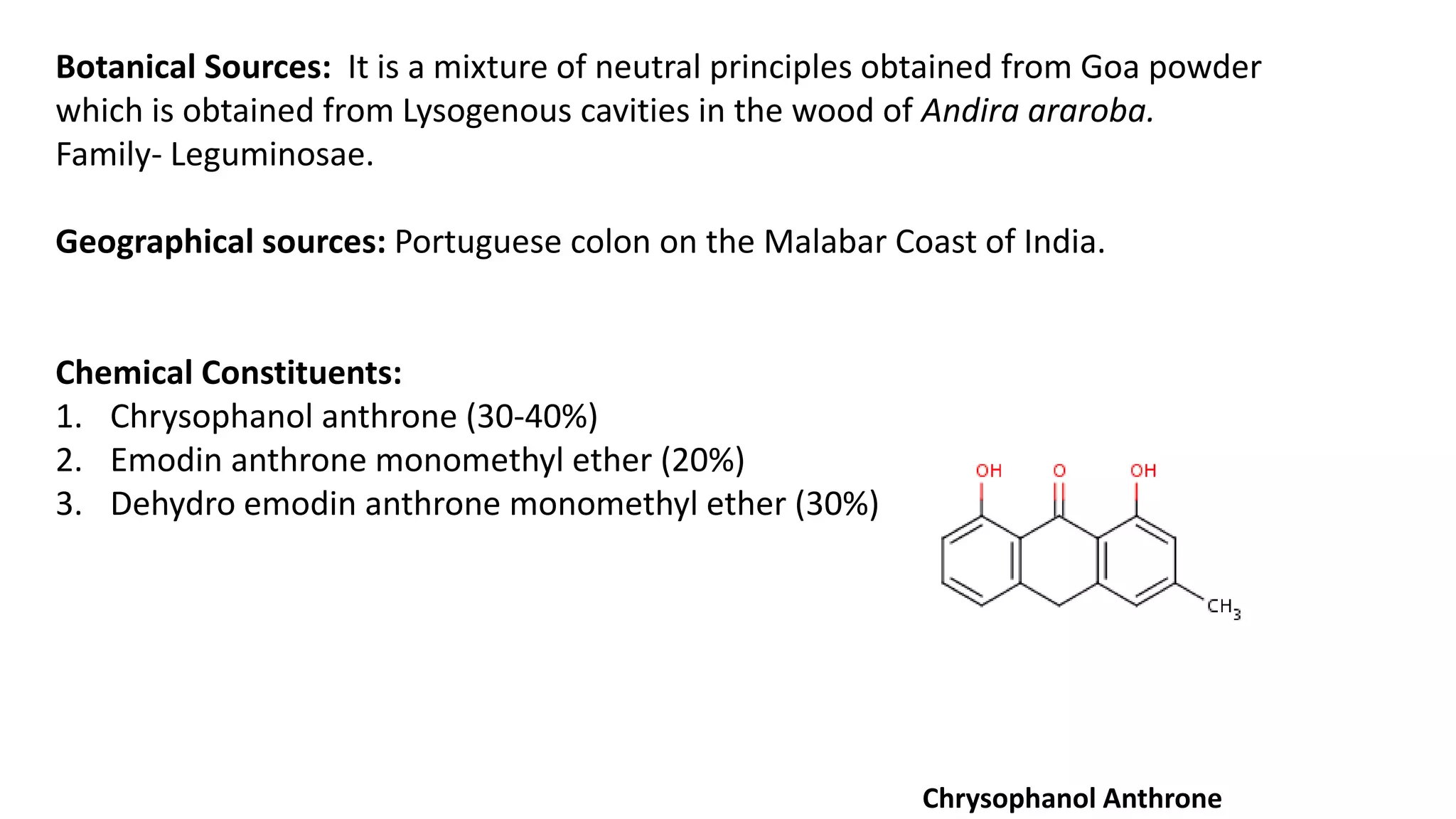
Chemical Constituents:
1. Chrysophanol anthrone (30-40%)
2. Emodin anthrone monomethyl ether (20%)
3. Dehydro emodin anthrone monomethyl ether (30%)
Chrysophanol Anthrone
Properties:
• Commercial product
• Brownish to orange-yellow
• Microcrystalline
• Odorless
• Tasteless powder
• Irritating to mucous membranes
• Causes dangerous inflammation if it enters the eye

Anthraquinone Glycosides

  • 1.
  • 2.
    1 2 3 4 Sources : Botanicaland geographical Collection Constituents Uses
  • 3.
    Anthraquinone Glycosides Anthraquinone areglycosides which possess anthracene or their derivatives as aglycone in which two kept keto group are attached with the benzene ring. Anthraquinone also anthracenedione or dioxoanthracene is ar aromatic compound. Several isomers are possible.
  • 4.
    Anthranone: • Reduced anthraquinonederivatives and keto group is attached with the benzene ring. • Found in free or combined form • Can converted to other compounds in solution • Contains significant therapeutic action of the crude drug Anthranole: • Reduced anthraquinine derivatives in which a hydroxyl group is attached with the benzene ring • Found in free or combined form • Contains significant therapeutic action of the crude drug Oxanthrone: • Intermediate products between anthraquinone and anthranols • Present in Cascara Sagrada bark • Produce anthraquinone on oxidation
  • 5.
    Hydrolysis: Chemical test ofanthraquinone: • Borntrager’s test • Modified Borntrager’s test
  • 6.
    Uses 1. Stimulant cathartics 2.Aglycone in free state shows little therapeutic activity 3. Glycone helps in absorption and transportation of aglycone in large intestine 4. Dyestuff precursor 5. Digester additive in papermaking 6. In the production of hydrogenperoxide
  • 7.
  • 8.
    Botanical Source: Driedbark of Rhamnus purshianus. (Family- Rhamnaceae) Geographical sources: • Native – Pacific coast of North America • Commercial supplies- Oregon, Washington, Southern British Columbia Collection: • Bark is stripped from the tree • Bark is sun dried • Broken into small pieces and keep into bags • Keep for one years before use Branch of Cascara Sagrada tree Bark of cascara
  • 9.
  • 10.
    Glycosides O- Glycosides- 10-20%C- Glycosides- 80-90% (Based on emodin) (Aloin like compounds) They are both O and C- Glycosides
  • 11.
    Aglycone Unit Emodin, Iso-emodin, Aloe emodin, Methyl-hydrocotoin, Chrysophanic acid Emodin Glycone Unit Rhamnose and Glucose ratio is 1:1
  • 12.
    Uses 1. The hydroxyanthraceneglycosides act as a stimulant laxative by exciting peristalsis in the colon. 2. Emodin of bark may have anti-cancer effects. 3. The food industry sometimes uses cascara as a flavoring agent for liquors, soft drinks, ice cream, and baked goods 4. Has anti ageing properties 5. Hydrating properties 6. Prevents hair problems Caution: • High doses can causes diarrhea • Pregnant and lactating women are advised not to use • Regular use can make you addict of the herb • Prolonged use may cause brownish yellow urine
  • 13.
  • 14.
    Botanical Sources: Driedlatex of leaves of following plants • Aloe barbadensis or Aloe vera (Curacao Aloe) • Alo ferox, Aloe Africana, Aloe spicata (Cape Aloe) Family- Liliaceae
  • 15.
    GEOGRAFICAL SOURCE: Curacao Aloe:Aloe barbadensis is a native of northern africa Cape Aloe: Cape Aloe is found in US ,Venezuela,Haiti & South Africa Collection: • Leaves are cut in March and april • Placed cut-end downward in a V-shaped vessel • Allowed to harden • Hard , bitter tasted latex is collected then
  • 16.
    Chemical constituents: 1. CuracaoAloe • Isobarbaloin • Free aloe-emodin • Free and combine anthranol • Chrysophanic acid Anthranol
  • 17.
    2. Cape Aloe •Barbaloin 5-30% • Socaloin 7.5-10% • also volatile oil and resinous yellow aloin is present. Aloin
  • 18.
    Uses 1. Aloe perryi,Aloeferox,aloe babadensis are used as natural flavoring agent in USA. 2. It acts as purgative or laxative mainly unprocessed aloe.Also some drugs are made up of aloe constituents which acts as colon cleanser. 3. it has healing power so used in the treatment of burns and other skin problems. 4. Used hugely in cosmetic products 5. Also some people use this plants as ornamental or decorative plants because of their nice color and shape. 6. According to Cancer Research UK, a potentially deadly product called T-UP is made of concentrated aloe, and promoted as a cancer cure. They say "there is currently no evidence that aloe products can help to prevent or treat cancer in humans"
  • 20.
    Interactions: 1. We cantintake aloe along with Lanoxin drug as it increases the side effects of lanoxin because aloe is stimulant laxative and decreases the potassium level which aggravates the side effects of this drug.The latex of aloe decreases some drugs activity. 2.We should avoid aloe while taking antidiabetes drugs because both decreases the blood sugar level. 3. Taking aloe before surgery can cause increased bleeding as it has anti blood clotting property.
  • 21.
  • 22.
    Botanical Sources: Driedroots and rhizomes of • Rheum officinale • Rheum palmatum • Rheum emodi (Indian or Himalayan) • Rheum webbianum (Indian or Himalayan) Family- Polygonaceae Geographical sources: • Native- China for Chinese Rhubarb and India, Pakistan,Nepal for Indian Rhubarb
  • 23.
  • 24.
    Collection: • Rhizomes arecollected in Autumn • Peeled and perforated, strung on rope • Dried in sun or artificial heat Growing Rhubarb in raised beds Growing Rhubarb in Greenhouse
  • 25.
    Chemical Constituens: • Glycosidesof Rhein anthrones • Anthraquinones- Rhein, Chrysophanol, Emodin, Aloe emodin, Emodin monomethyl ether • Gallic acid, Catechin, Calcium oxalate (7%) Emodin
  • 26.
    Uses 1. Used ascathartic 2. Astringent 3. Mouthwash for oral ulcer 4. Treat burns, wounds 5. Fibers obtained from rhubarb can be used for the manufacture of paper 6. Used for dyeing of hair.
  • 27.
    Anything interesting?? • Rhubarb-“a heated argument or dispute” • The leaves attached to the Rhubarb stalk are poisonous. It repel insects! • One of its most popular applications….. Pie! • Fruit??? Or Vegetable??? • Rhubarb enhances the appetite. • The impact of the rhubarb depends on how it is prepared. • More recently there have been claims that rhubarb can be useful in treatment of Hepatitis B. • One of the first medicines to be imported from china to the West
  • 28.
  • 29.
    Botanical Sources: Driedleaflet of • Cassia acutifolia (Alexandria Senna) • Cassia angustifolia (Tinnevelly Senna) Family- Leguminosae Geographical Sources: • Cassia acutifolia grows near the Nile Aswan to Kordofan • Cassia angutifolia grows wild in Somalia, Arabian Peninsula and India Cultivation: • Harvested in April and September • Cut off the tops of the plants about 15 cm above the ground • Dried in the sun • Stems and pods are separated from leaflets • Leaves are graded and baled or packed in bags Cultivation of Senna
  • 30.
    Chemical Constituents: 1. Glycosides-Sennoside A and B whose aglycone is rhein dianthrone. 2.Sennosoids C and D whose aglycone is composed of one molecule of rhein and one molecule of aloe-emodin. 3. Monomeric glycosides and Free anthraquinones 4. Senna pod contains active glycosides
  • 31.
    Uses 1. Cathartic 2. Itis safe for shorter period in case of pregnancy or breast feeding 3. Treat irritable bowel syndrome 4. Treat skin disorders 5. Clean the system of worms 6. Purgative
  • 32.
  • 33.
    Botanical Sources: Itis a mixture of neutral principles obtained from Goa powder which is obtained from Lysogenous cavities in the wood of Andira araroba. Family- Leguminosae. Geographical sources: Portuguese colon on the Malabar Coast of India. Chemical Constituents: 1. Chrysophanol anthrone (30-40%) 2. Emodin anthrone monomethyl ether (20%) 3. Dehydro emodin anthrone monomethyl ether (30%) Chrysophanol Anthrone
  • 34.
    Properties: • Commercial product •Brownish to orange-yellow • Microcrystalline • Odorless • Tasteless powder • Irritating to mucous membranes • Causes dangerous inflammation if it enters the eye