Approach and management of
Acute mesenteric ischaemia
Dr shambhavi sharma
1st year Resident
PAHS
• On 3rd January 2017, The Mesentery has been declared as a New
Organ and has been published in The Lancet Medical Journal(The
Lancet Gastroenterology & Hepatology) by J Calvin Coffey, a
researcher at the University Hospital Limerick, Ireland
• Gray’s Anatomy has already been updated with the definition.
Acute Mesenteric Ischaemia
• a catastrophic abdominal emergency
• characterized by sudden critical interruption to the intestinal blood flow
• commonly leads to bowel infarction and death
• uncommon but life-threatening disease
• Incidence ~1 in every 1000 hospital admissions
• Mortality remains as high as 60-80%
• Prognosis is poor
• Mark et al Semin Vasc Surg 23:9-20 ,2010
Areas prone to ischemia
• the watershed areas between the major vessels that supply the colon
are at risk for ischemia
• Narrow terminal branches of the SMA supply the splenic flexure,
• narrow terminal branches of the IMA supply the rectosigmoid
junction.
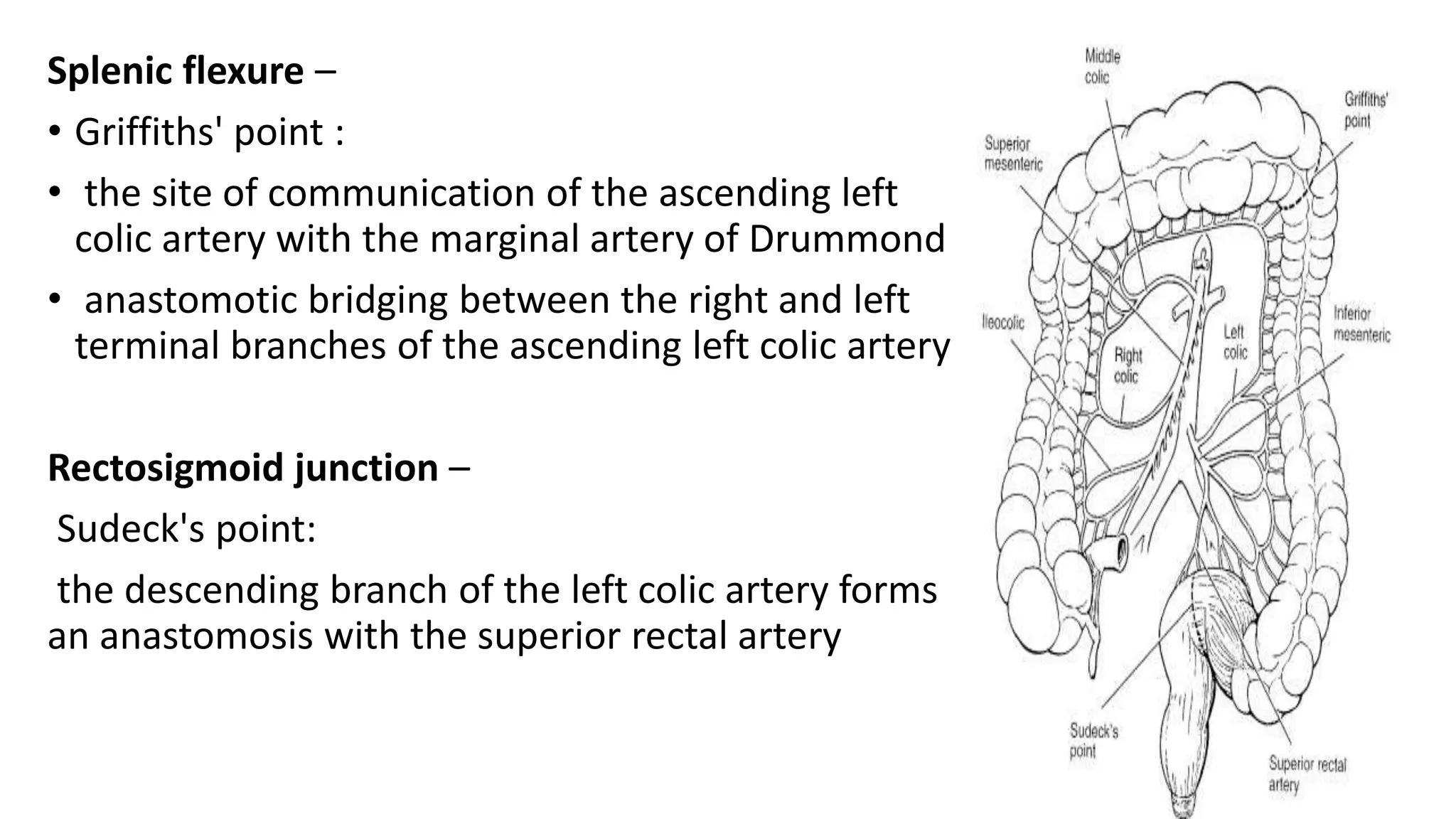
Splenic flexure –
• Griffiths' point :
• the site of communication of the ascending left
colic artery with the marginal artery of Drummond
• anastomotic bridging between the right and left
terminal branches of the ascending left colic artery
Rectosigmoid junction –
Sudeck's point:
the descending branch of the left colic artery forms
an anastomosis with the superior rectal artery
Physiology and mechanism of ischaemia
Normal physiology
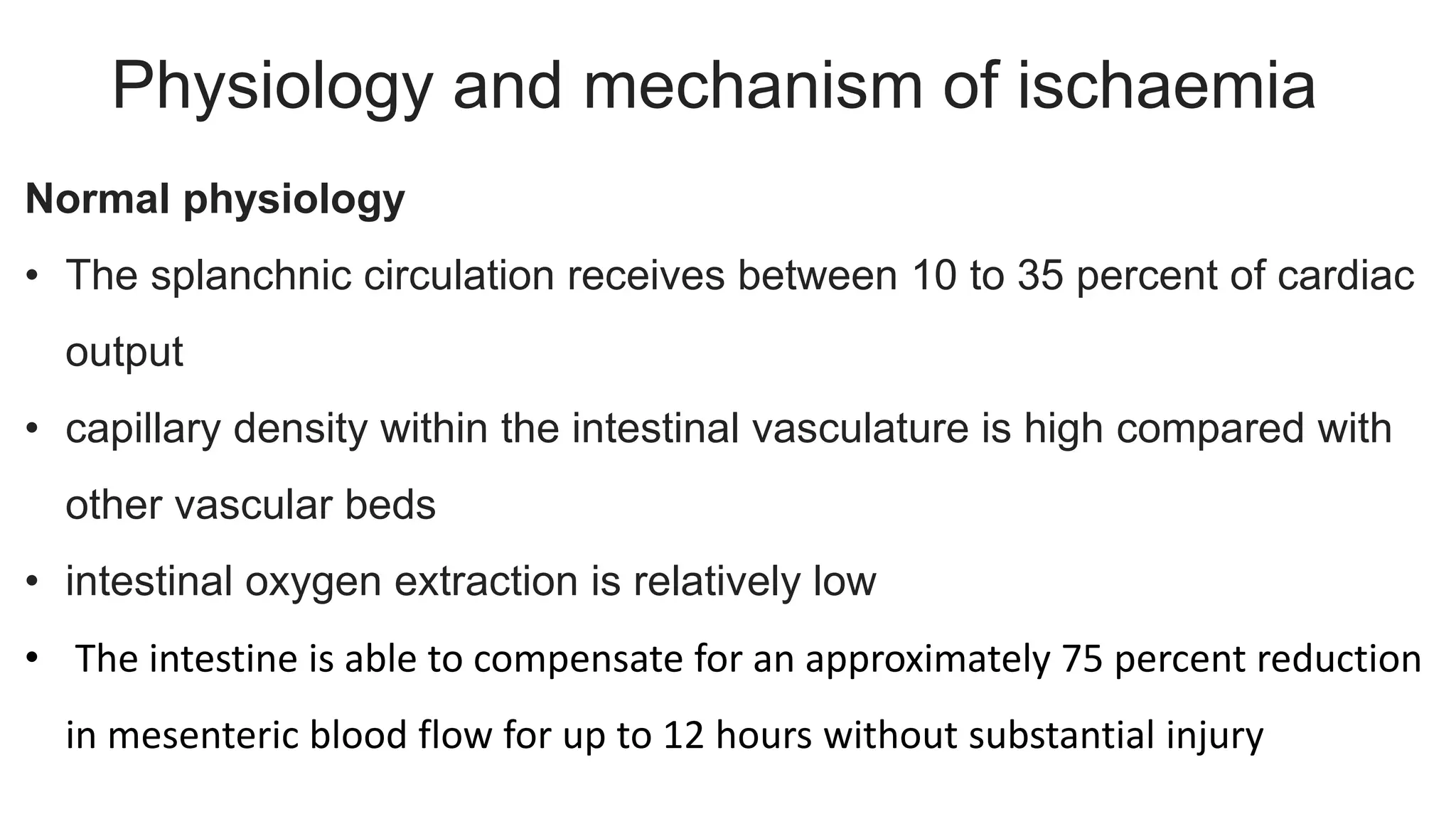
• The splanchnic circulation receives between 10 to 35 percent of cardiac
output
• capillary density within the intestinal vasculature is high compared with
other vascular beds
• intestinal oxygen extraction is relatively low
• The intestine is able to compensate for an approximately 75 percent reduction
in mesenteric blood flow for up to 12 hours without substantial injury
Intrinsic autoregulation of blood flow :
• direct arteriolar smooth muscle relaxation
• a metabolic response to adenosine and other metabolites of mucosal
ischemia
Extrinsic regulation :
• the sympathetic nervous system
• the renin-angiotensin axis
• release of vasopressin from the pituitary gland
Intestinal blood flow must be reduced by at least 50 percent from
the normal fasting level before oxygen delivery to the intestine
Pathophysiology
Ischemia(perfusion pressure < 30mmHg,mean MAP
<45
Mucosal barrier disruption Substantial protein-rich fluid loss
Release of bacteria, toxins, vasoactive substance hypovolemia
SIRS
MODS
Death
Clinical presentation
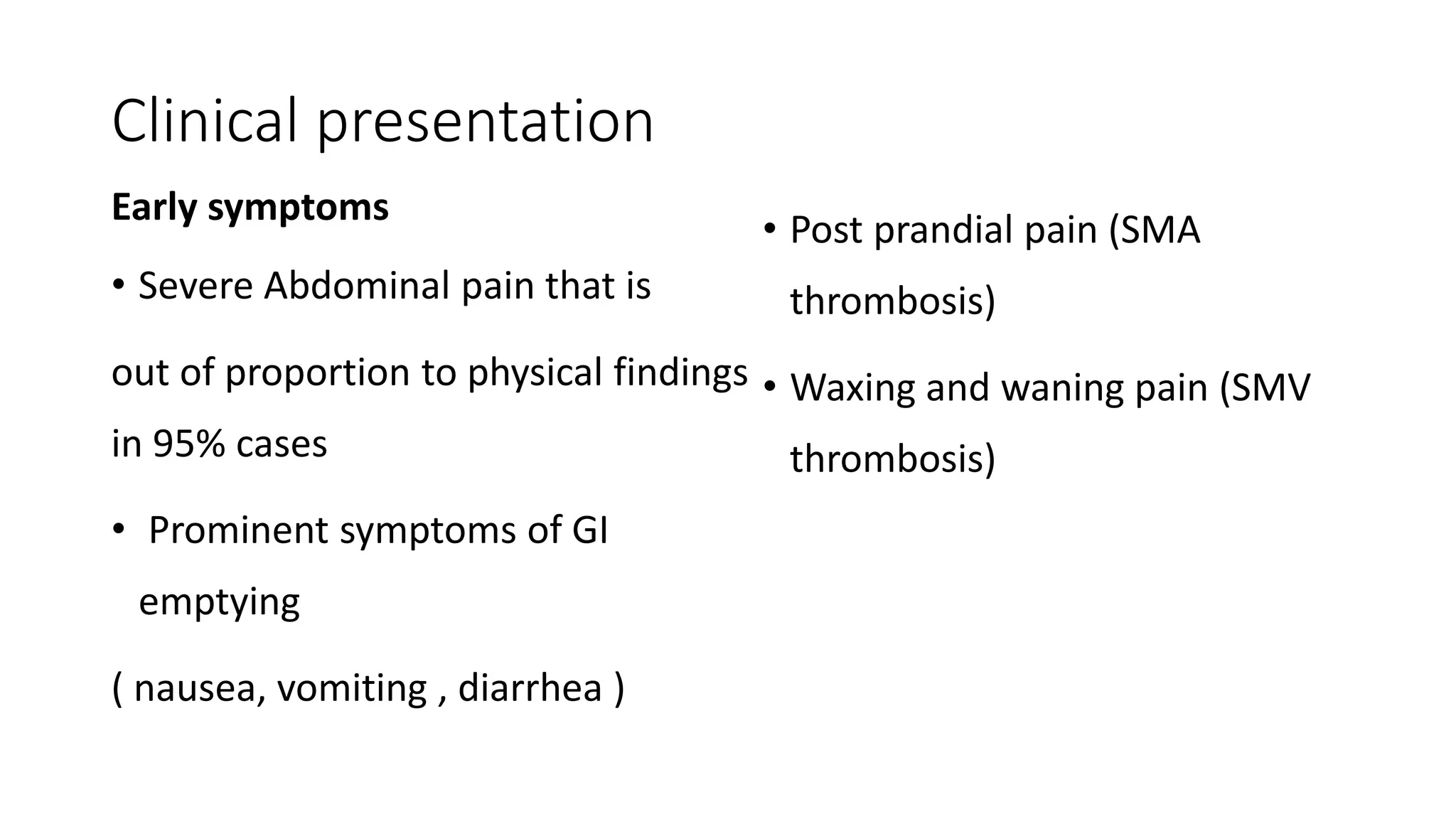
Early symptoms
• Severe Abdominal pain that is
out of proportion to physical findings
in 95% cases
• Prominent symptoms of GI
emptying
( nausea, vomiting , diarrhea )
• Post prandial pain (SMA
thrombosis)
• Waxing and waning pain (SMV
thrombosis)
Late symptoms
• Bloody diarrhea
• Abdominal distension
• Features of Peritonitis-
Fever
 Shock
 Tachycardia
Investigation
Complete blood count
Haemoconcentration
Leukocytosis (Neutrophilic)
ABG analysis
Metabolic acidosis
Lactic acidosis (in more advanced
case)
Other serum markers :
Raised amylase
ALP
X-ray abdomen
Gas in the
small bowel
Dilated bowel loops
Imaging
Bowel wall
edema and
thickening
Gas in portal vein
Doppler study
• Able to identify severe stenosis or total or partial occlusion and
velocity of blood flowing through the vessels
• Unable to detect emboli beyond the proximal main vessel
• Non-obstructive mesenteric ischaemia
partially occluded Artery
Angiography
• Gold Standard
• Non-invasive : CT-Angiography
Magnetic Resonance Angiography
Invasive : Catheter (Conventional Method)
Findings on Angiography: Filling defects
Stenosis or blockage
Risk for mortality
• Older age
• Elevated serum aspartate
aminotransferase
• Increased blood urea nitrogen
• Metabolic acidosis
• Significant co-morbidities and poor
performance status
• Intestinal necrosis
• Increased elapsed time to
laparotomy(24hr)
• When the colon involved
Aliosmanoglu I et al. Int Surg. 2013
Gupta PK et al. Surgery. 2011
• Symptoms >24hr=Mortality increases dramatically
• when <12h= Gut viability 100%
• 56% when 12~24hr
• 18% when >24hr
• Revascularization performed within 12 h from the onset of symptoms.
• Resection of non-viable bowel should be performed without delay
Aliosmanoglu I et al. Int Surg. 2013
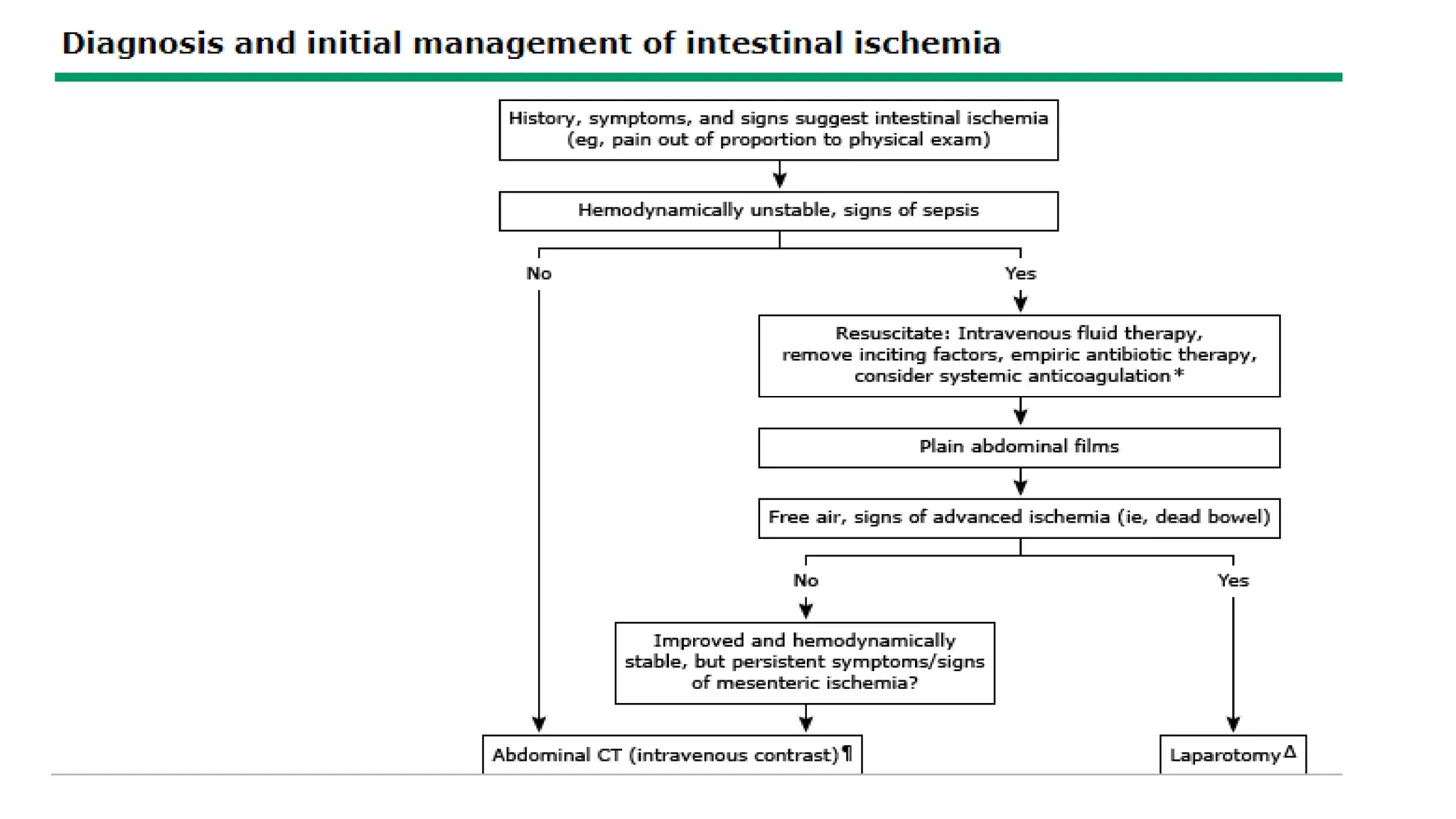
INITIAL MANAGEMENT
• Gastrointestinal decompression
• fluid resuscitation
• hemodynamic monitoring and support
• correction of electrolyte abnormalities
Antibiotics — Broad-spectrum antibiotic therapy
Pain control — parenteral opioids
Anticoagulation
• systemic anticoagulation needed to prevent thrombus formation and
propagation
C/I: actively bleeding, as in ischemic colitis related to nonocclusive ischemia
• For those who require abdominal exploration, anticoagulation is typically
continued after surgery to prevent new thrombus formation
Definitive surgical exploration
• Approach : midline laparotomy
1.Assessment of bowel viability
2. Determination of underlying cause
3. Mesenteric revascularization
4. Resection of necrotic bowel
5. Second look laparotomy
Assessment of bowel viability
1. Clinical Judgment
• pink serosa
• visible peristalsis
• positive pulsations
• bleeding from cut edges
• 2. Doppler USG - hand-held Doppler(Detects anti-mesenteric
blood flow)
• 3. Fluorescein -Injection of IV Sodium fluorescein(1gm) and
inspection under Wood’s lamp (Viable bowel has smooth,
uniform fluorescence)
Mesenteric Revascularization
• Embolism : Balloon catheter embolectomy ± Vein patch angioplasty
• Thrombosis : Thrombectomy
Bypass grafting
Reimplantation of SMA
Resection and anastomosis
Second look surgery
• Planned second look techniques are required after restoration of SMA flow,
with or without resection of ischemic bowel following resuscitation in intensive
care unit
• Given frequent uncertainty with regard to bowel viability, the stapled off bowel
ends should be left in discontinuity and re-inspected after a period of
continued ICU resuscitation to restore physiological balance.
• Often, bowel which is borderline ischemic at the initial exploration will improve
after restoration of blood supply and physiologic stabilization
• re-exploration should be accomplished within 48 h
• decisions regarding anastomosis, stoma, or additional resection can
be made with plans for sequential abdominal closure.
• Thank you
• Acute mesenteric ischemia: guidelines of the World Society of
Emergency Surgery 2017
• Sabiston text book of surgery
• Uptodate

Acute and chronic mesenteric ischaemia(1).pptx

  • 1.
    Approach and managementof Acute mesenteric ischaemia Dr shambhavi sharma 1st year Resident PAHS
  • 2.
    • On 3rdJanuary 2017, The Mesentery has been declared as a New Organ and has been published in The Lancet Medical Journal(The Lancet Gastroenterology & Hepatology) by J Calvin Coffey, a researcher at the University Hospital Limerick, Ireland • Gray’s Anatomy has already been updated with the definition.
  • 4.
    Acute Mesenteric Ischaemia •a catastrophic abdominal emergency • characterized by sudden critical interruption to the intestinal blood flow • commonly leads to bowel infarction and death • uncommon but life-threatening disease • Incidence ~1 in every 1000 hospital admissions • Mortality remains as high as 60-80% • Prognosis is poor • Mark et al Semin Vasc Surg 23:9-20 ,2010
  • 6.
    Areas prone toischemia • the watershed areas between the major vessels that supply the colon are at risk for ischemia • Narrow terminal branches of the SMA supply the splenic flexure, • narrow terminal branches of the IMA supply the rectosigmoid junction.
  • 7.
    Splenic flexure – •Griffiths' point : • the site of communication of the ascending left colic artery with the marginal artery of Drummond • anastomotic bridging between the right and left terminal branches of the ascending left colic artery Rectosigmoid junction – Sudeck's point: the descending branch of the left colic artery forms an anastomosis with the superior rectal artery
  • 10.
    Physiology and mechanismof ischaemia Normal physiology • The splanchnic circulation receives between 10 to 35 percent of cardiac output • capillary density within the intestinal vasculature is high compared with other vascular beds • intestinal oxygen extraction is relatively low • The intestine is able to compensate for an approximately 75 percent reduction in mesenteric blood flow for up to 12 hours without substantial injury
  • 11.
    Intrinsic autoregulation ofblood flow : • direct arteriolar smooth muscle relaxation • a metabolic response to adenosine and other metabolites of mucosal ischemia Extrinsic regulation : • the sympathetic nervous system • the renin-angiotensin axis • release of vasopressin from the pituitary gland Intestinal blood flow must be reduced by at least 50 percent from the normal fasting level before oxygen delivery to the intestine
  • 12.
    Pathophysiology Ischemia(perfusion pressure <30mmHg,mean MAP <45 Mucosal barrier disruption Substantial protein-rich fluid loss Release of bacteria, toxins, vasoactive substance hypovolemia SIRS MODS Death
  • 13.
    Clinical presentation Early symptoms •Severe Abdominal pain that is out of proportion to physical findings in 95% cases • Prominent symptoms of GI emptying ( nausea, vomiting , diarrhea ) • Post prandial pain (SMA thrombosis) • Waxing and waning pain (SMV thrombosis)
  • 14.
    Late symptoms • Bloodydiarrhea • Abdominal distension • Features of Peritonitis- Fever  Shock  Tachycardia
  • 17.
    Investigation Complete blood count Haemoconcentration Leukocytosis(Neutrophilic) ABG analysis Metabolic acidosis Lactic acidosis (in more advanced case) Other serum markers : Raised amylase ALP
  • 18.
    X-ray abdomen Gas inthe small bowel Dilated bowel loops
  • 19.
  • 20.
    Doppler study • Ableto identify severe stenosis or total or partial occlusion and velocity of blood flowing through the vessels • Unable to detect emboli beyond the proximal main vessel • Non-obstructive mesenteric ischaemia partially occluded Artery
  • 24.
    Angiography • Gold Standard •Non-invasive : CT-Angiography Magnetic Resonance Angiography Invasive : Catheter (Conventional Method) Findings on Angiography: Filling defects Stenosis or blockage
  • 26.
    Risk for mortality •Older age • Elevated serum aspartate aminotransferase • Increased blood urea nitrogen • Metabolic acidosis • Significant co-morbidities and poor performance status • Intestinal necrosis • Increased elapsed time to laparotomy(24hr) • When the colon involved Aliosmanoglu I et al. Int Surg. 2013 Gupta PK et al. Surgery. 2011
  • 27.
    • Symptoms >24hr=Mortalityincreases dramatically • when <12h= Gut viability 100% • 56% when 12~24hr • 18% when >24hr • Revascularization performed within 12 h from the onset of symptoms. • Resection of non-viable bowel should be performed without delay Aliosmanoglu I et al. Int Surg. 2013
  • 28.
    INITIAL MANAGEMENT • Gastrointestinaldecompression • fluid resuscitation • hemodynamic monitoring and support • correction of electrolyte abnormalities Antibiotics — Broad-spectrum antibiotic therapy Pain control — parenteral opioids
  • 29.
    Anticoagulation • systemic anticoagulationneeded to prevent thrombus formation and propagation C/I: actively bleeding, as in ischemic colitis related to nonocclusive ischemia • For those who require abdominal exploration, anticoagulation is typically continued after surgery to prevent new thrombus formation
  • 30.
    Definitive surgical exploration •Approach : midline laparotomy 1.Assessment of bowel viability 2. Determination of underlying cause 3. Mesenteric revascularization 4. Resection of necrotic bowel 5. Second look laparotomy
  • 31.
    Assessment of bowelviability 1. Clinical Judgment • pink serosa • visible peristalsis • positive pulsations • bleeding from cut edges • 2. Doppler USG - hand-held Doppler(Detects anti-mesenteric blood flow) • 3. Fluorescein -Injection of IV Sodium fluorescein(1gm) and inspection under Wood’s lamp (Viable bowel has smooth, uniform fluorescence)
  • 34.
    Mesenteric Revascularization • Embolism: Balloon catheter embolectomy ± Vein patch angioplasty • Thrombosis : Thrombectomy Bypass grafting Reimplantation of SMA
  • 35.
  • 36.
    Second look surgery •Planned second look techniques are required after restoration of SMA flow, with or without resection of ischemic bowel following resuscitation in intensive care unit • Given frequent uncertainty with regard to bowel viability, the stapled off bowel ends should be left in discontinuity and re-inspected after a period of continued ICU resuscitation to restore physiological balance. • Often, bowel which is borderline ischemic at the initial exploration will improve after restoration of blood supply and physiologic stabilization
  • 37.
    • re-exploration shouldbe accomplished within 48 h • decisions regarding anastomosis, stoma, or additional resection can be made with plans for sequential abdominal closure.
  • 38.
  • 39.
    • Acute mesentericischemia: guidelines of the World Society of Emergency Surgery 2017 • Sabiston text book of surgery • Uptodate

Editor's Notes

  • #7 Griffiths' point is defined as the site of communication of the ascending left colic artery with the marginal artery of Drummond, and anastomotic bridging between the right and left terminal branches of the ascending left colic artery at the splenic flexure of the colon It is a critical area of weakness of the blood supply of the splenic flexure that is prone to ischemia.