MENTALLY
CHALLENGED
KSHIRABDHI TANAYA
MSC TUTOR
SNC,SOA(DTU)
BBSR
INTRODUCTION:-
•Handicapped or Challenged is defined as a disadvantage
for a given individual resulting from an impairment or a
disability ,that limits and prevents the fulfilment of a role
which is normal for that individual .
•A mental challenge is any disease or condition affecting
the brain that influences the way a person thinks, feels,
behaves and/or relates to others and to his or her
surroundings.
Mentally handicap children include Mental retardation.
MENTAL RETARDATION:-
Definition-
Mental retardation is defined as
significantly sub average
general intellectual functioning,
resulting in associated with
concurrent impairment in
adaptive behavior ,which
manifests during the
developmental
period.(American Association
on Mental Deficiency).
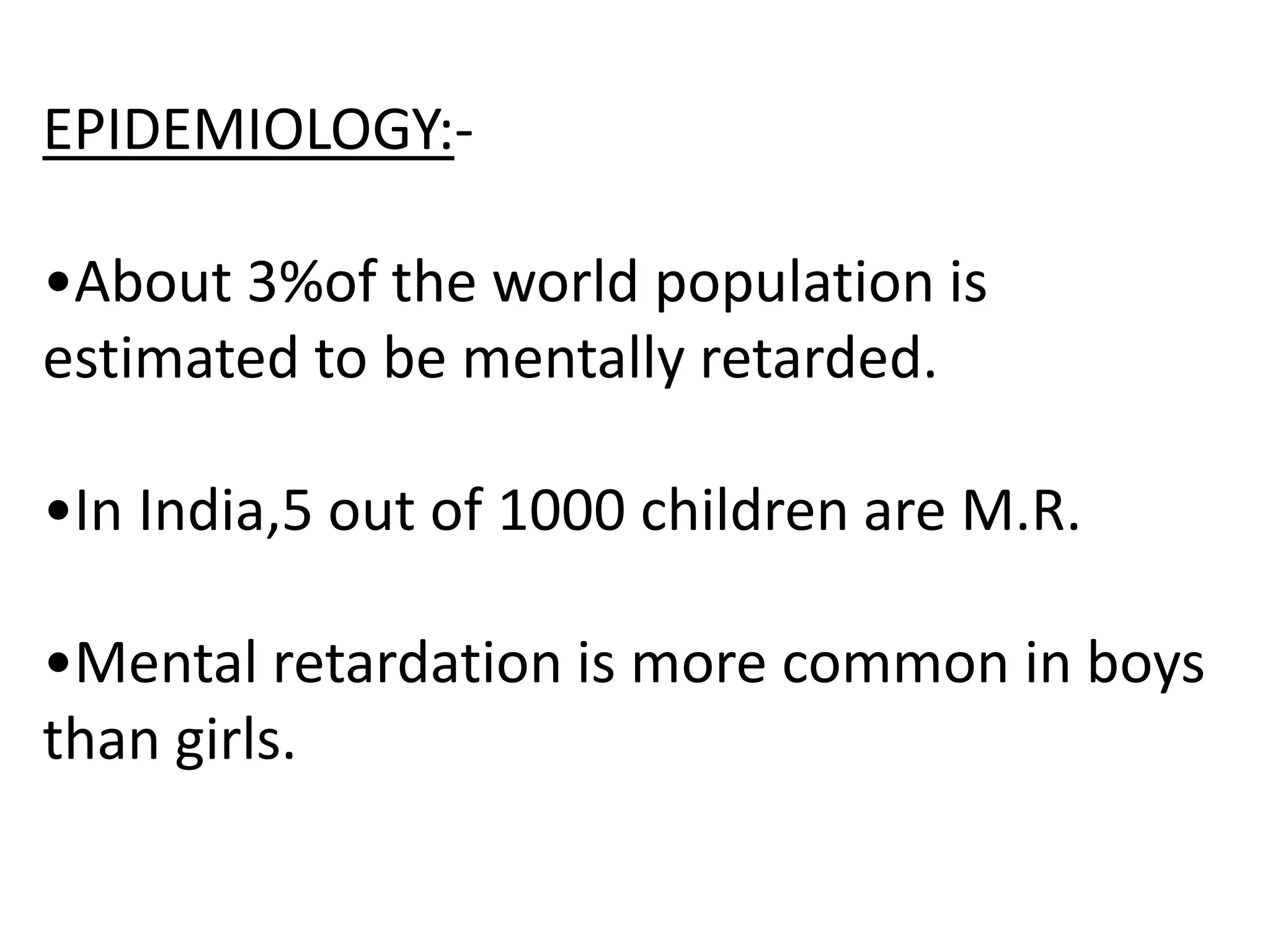
EPIDEMIOLOGY:-
•About 3%of the world population is
estimated to be mentally retarded.
•In India,5 out of 1000 children are M.R.
•Mental retardation is more common in boys
than girls.
ETIOLOGY:-
1-Genetic Factors:-
Chromosomal abnormalities
•Down’s syndrome
•Fragile X syndrome(abnormally X Chromosome
damage due to folic acid deficiency)
•Trisomy X syndrome(presence of extra X
chromosome)
•Turner’s syndrome (female born with only 1X
chromosome)
Metabolic disorders:-
•Phenylketonuria(Increases level of amino acid
phenylalanine)
•Wilson’s disease (inherited disorder cause copper
poisoning)
•Galactosemia(undigested sugar(galactose) build
up in the blood)
Cranial malformation:-
•Hydrocephaly
•Microcephaly
Gross diseases of brain:-
•Epilepsy
•Neurofibromatosis(form of tumours in brain,spinal cord
& nerves)
2 - Prenatal factors
INFECTIONS:-
•Rubella
•Cytomegalovirus
•Syphilis
•Toxoplasmosis
•Herpes simplex
Endocrine disorders:-
•Hypothyroidism
•Hypoparathyroidism
•Diabetes mellitus
Physical damage & disorders:-
•Injury
•Hypoxia
•Radiation
•Hypertension
•Anaemia
•Emphysema
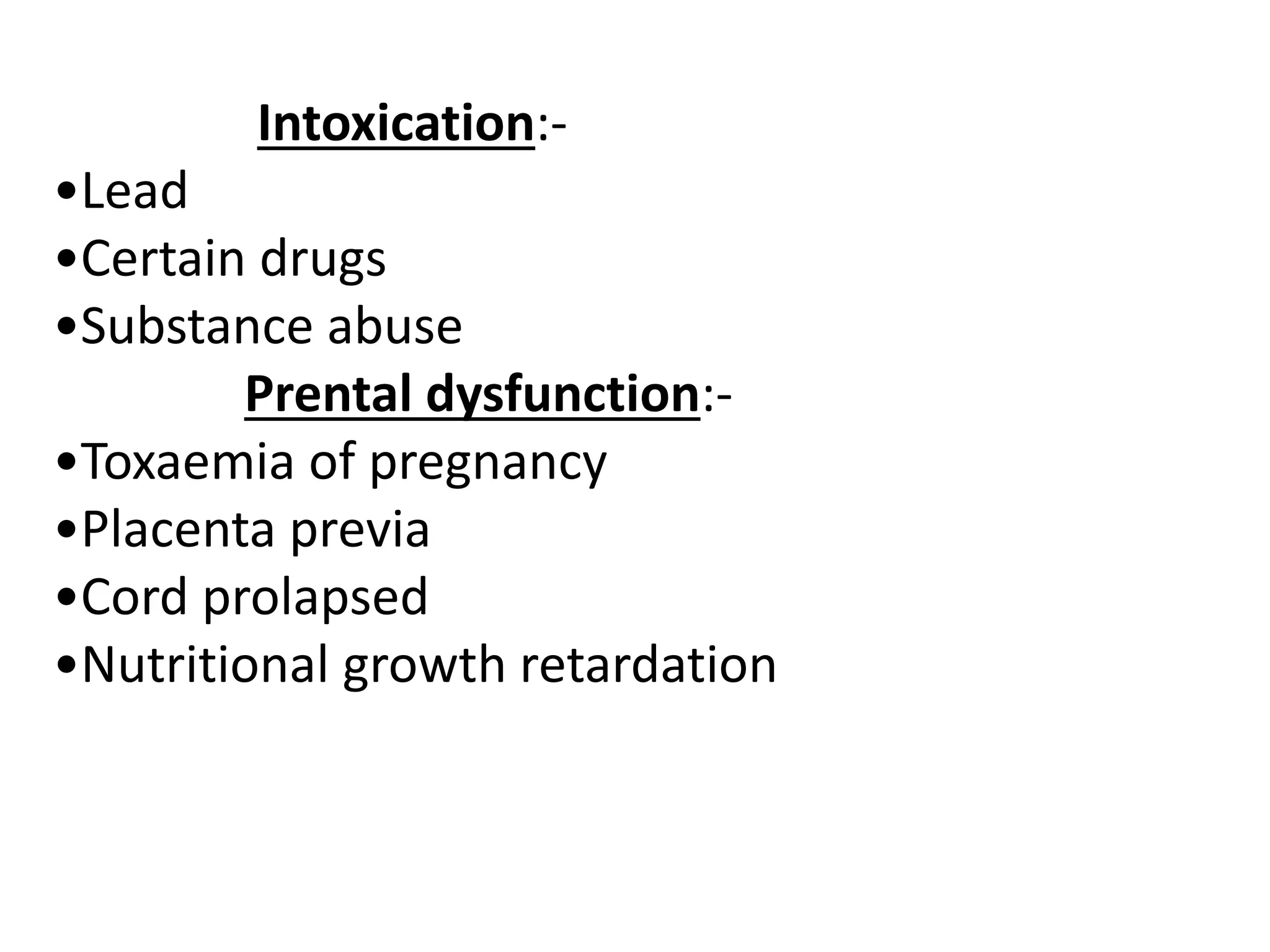
Intoxication:-
•Lead
•Certain drugs
•Substance abuse
Prental dysfunction:-
•Toxaemia of pregnancy
•Placenta previa
•Cord prolapsed
•Nutritional growth retardation
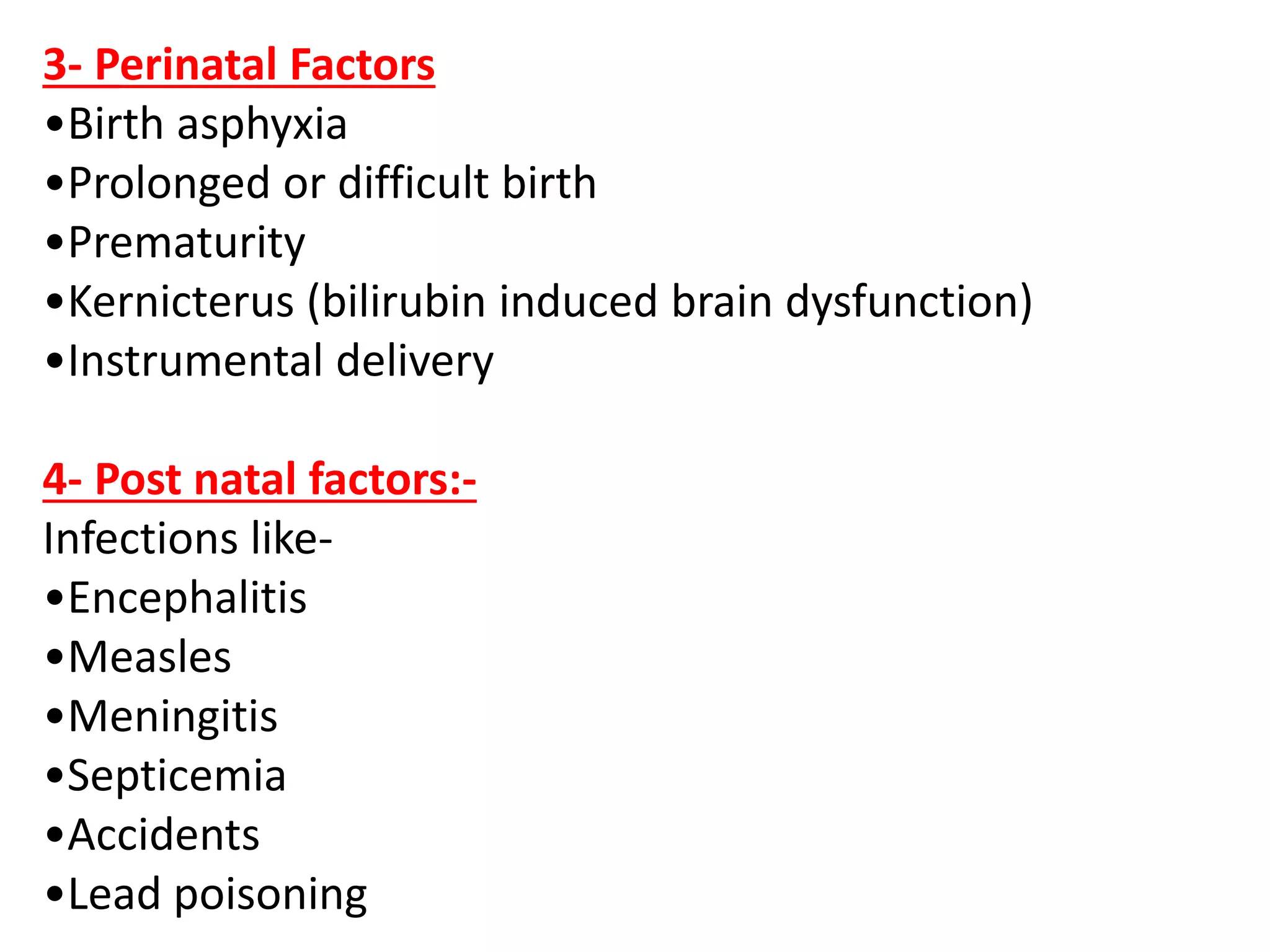
3- Perinatal Factors
•Birth asphyxia
•Prolonged or difficult birth
•Prematurity
•Kernicterus (bilirubin induced brain dysfunction)
•Instrumental delivery
4- Post natal factors:-
Infections like-
•Encephalitis
•Measles
•Meningitis
•Septicemia
•Accidents
•Lead poisoning
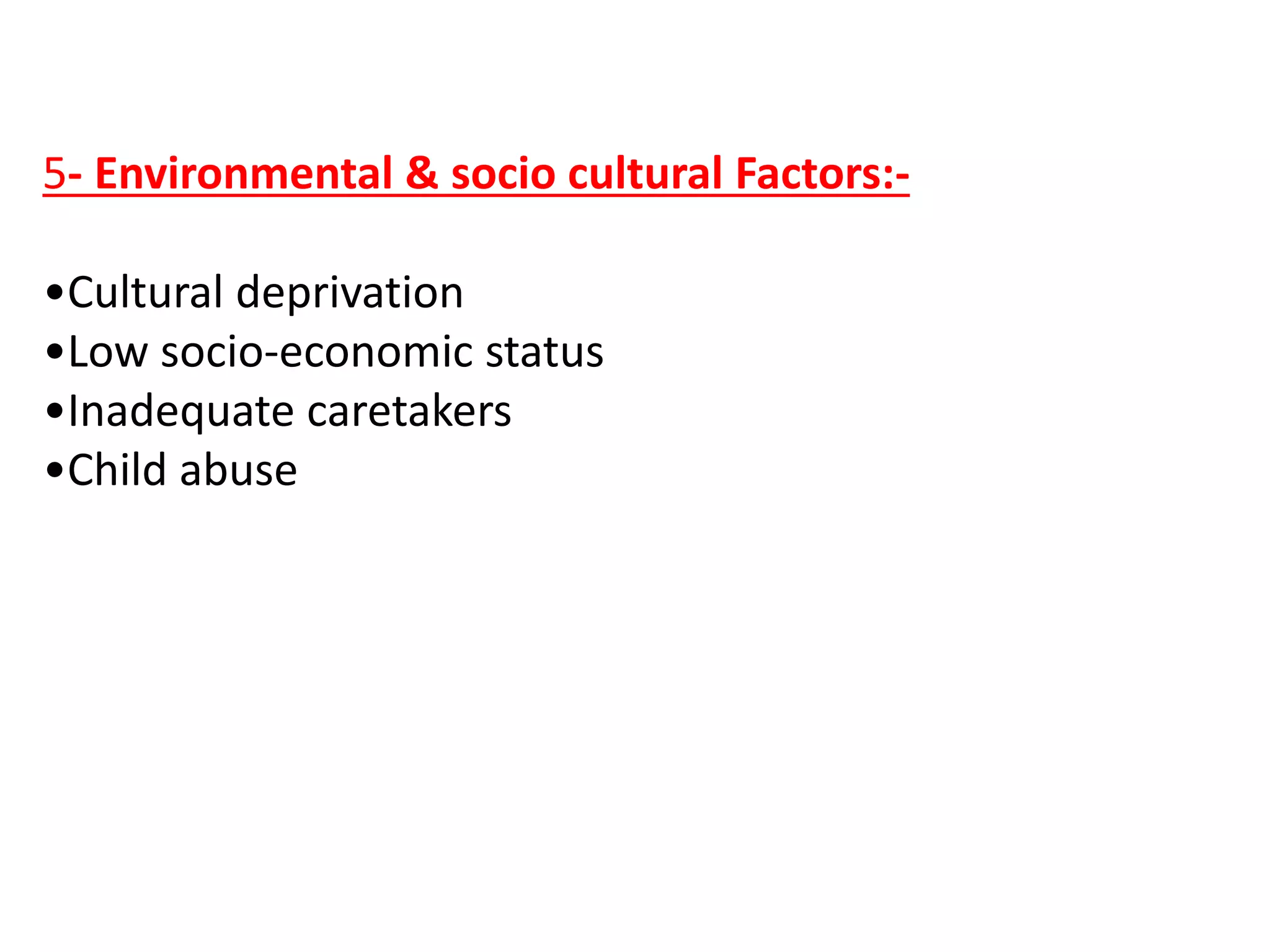
5- Environmental & socio cultural Factors:-
•Cultural deprivation
•Low socio-economic status
•Inadequate caretakers
•Child abuse
RISK FACTORS:-
•Low socio economic status
•LBW
•Advanced maternal age
•Extreme malnutrition
•Parental deprivation
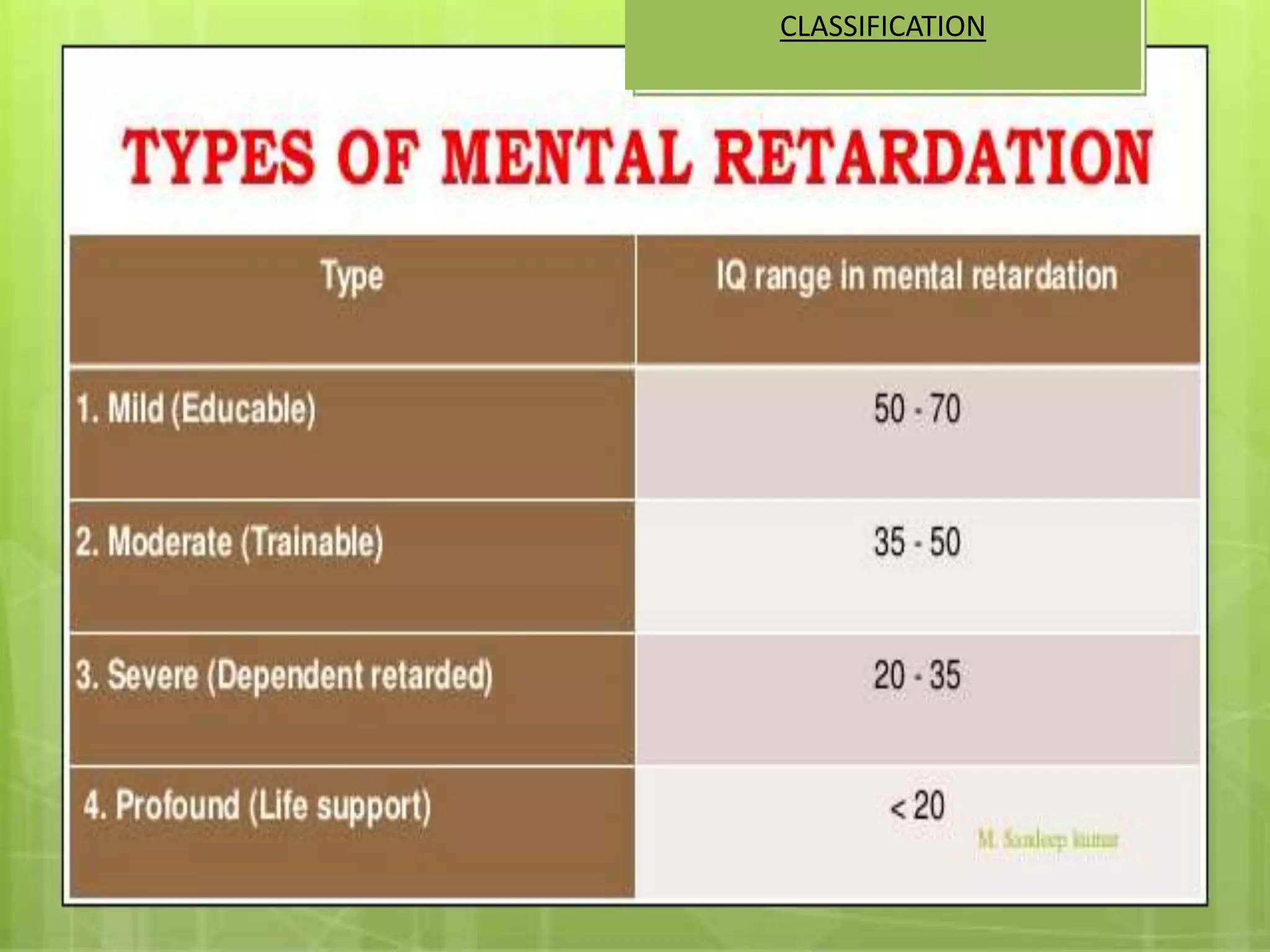
Classification:-
Classification of mental retardation based on intelligence
quotient.
Types of mental retardation ------
CLASSIFICATION
MILD RETARDATION(IQ 50-70) :-
•85-95% of total mental retardation cases belong to mild
mental retardation.
•They have deficient intellectual skills, studies up to 6-8th
standard, problem in reading and writing, difficulty in
academic school work, walking, talking, toilet training,
language abilities & development of domestic skill, social &
emotional adjustment like a normal person.
•They are designated as EDUCABLE.
•Can learn motor skills better than verbal skill &
writing ,emotionally they are stable ,over active,
temper tantrum is common, they can be trained in
special school.
•In adult life most of them lead independent life in
normal surroundings.
•They can perform a job under supervision&manage
money with proper guidance.
MODERATE RETARDATION(IQ 35-50):-
•10% of mental retardation cases belong to moderate
mental retardation.
•They can able to attain up to 2nd class standards in
academic skills.
•They are considered as TRAINABLE.
•They can learn maximum up to self care activities&
communication skills develop much slowly.
•They can support themselves ,able to perform
semiskilled or unskilled work under supervision.
•They can handle a small amount of pocket money as well
as how to make change.
SEVERE RETARDATION (IQ 20-35):-
•7% of total mental retardation cases, belong to severe
mental retardation.
•Slow motor development in preschool years,
trainable for normal living activities,allow them to do
daily living activities under supervision.
•able to communicate in simple way,engaged in
limited activities,delayed speech & communication
skills.
•They need much supervision & considered as
CUSTODIAL.
•They can use money & supervised while shopping.
PROFOUND RETARDATION(IQ <20):-
•1-2% of mental retardation cases are profound type.
•Considerable organic pathology ,associated conditions ;
blindness ,deafness,seizure are common,delayed mile
stones,motor impairment,totally dependent ,cannot do
anything on their own.
•Death may occur due to variety of problems.
•The child depend upon others for money management.
Clinical manifestations:-
•Significant limitations in intellectual
functioning.
•Significant limitations in adaptive functioning.
•Failure to achieve developmental milestones
•Deficiencies in cognitive functioning such as
inability to follow commands
•Reduced ability to learn or to meet academic
demands.
•Expressive language problems.
•Psychomotor skill deficits.
•Difficulty in performing self-care
activities.
•Neurologic impairment.
•Low self esteem
•Depression
•Lack of curiosity
•Seizure
•Poor memory &concentration
•Short attention span &distractibility
Diagnostic evaluation:-
•History collection from family members.
•Physical examination
•Neurological assessment
•Assessment of mile stones .
•Hormonal studies
•EEG
•MRI,CT scan
•Urine & blood examination
Psychological tests
TREATMENT MODALITIES:-
•Behaviour management
•Environmental supervision
•Monitoring the child’s developmental
needs & problems.
•Programs that maximize
speech,language,cognitive,psychomotor,soci
al,self care&occupational skills.
•Family therapy to help parents develop
coping skills.
PREVENTIVE MANAGEMENT:-
•Genetic counselling to prevent genetic
&chromosomal abnormalities.
•Prevention & mgt of LBW
•Good obstetrical care is important.
•Essential neonatal care to be provided.
•Routine physical & neurological assessment
should be done for all neonates.
•Early detection & treatment of disorders.
•Rehabilitation in vocational ,physical & social
areas according to the level of handicap.
Prevention:-
Primary prevention
i-preconception:-
•Genetic counselling to the parents.
•Immunization for maternal rubella.
•Blood tests for marriage to detect venereal
disease.
•Adequate maternal nutrition.
•Family planning for appropriate spacing.
ii-During gestation:-
•Prenatal care by adequate nutrition,fetal
monitoring& protection from disease.
•Avoidance of teratogenic substances like
consumption of alcohol,exposure to
radiation.
•Analysis of fetus for possible genetic
disorders by amniocentesis,fetal
biopsy,fetoscopy.
iii-At delivery:-
•Delivery conducted by expert doctors &
staff,especially in case of high risk pregnancy.
•Apgar scoring done at 1& 5mins after the birth
of the child.
•Close monitoring of mother & child.
iv-childhood:-
•Proper nutrition throughout the developmental
period & particularly at first 6 months after birth.
•Avoidance of hazards in the child’s environment
to avoid brain injury causes such as lead
poisoning, accidents.
Secondary prevention:-
•Early detection & treatment of preventable
disorders.eg-
phenylketonuria,hypothyroidism.
•Early recognition of presence of mental
retardation.
•Psychiatric treatment for emotional &
behavioural difficulties.
Tertiary prevention:
It includes rehabilitation in vocational ,physical &social
areas according to the level of handicap.
•The mildly retarded children require boarding schools or
residential care.
•In severely retarded case of children some require special
services throughout their lives .
•Divide each training activity into small steps &
demonstrate.
•Give the mentally retarded person repeated training in
each activity.
•Give the training regularly & systematically .
•Start the training with what the child already knows &
then proceed to the skill that needs to be trained.
•Reward his effort even if the child attains near
success
•Reduce the reward gradually as he masters a skill.
•Use the training materials which are appropriate
,attractive & locally available.
•There is no age limit for training a mentally
retarded person.
•Assess the child periodically once in four or six
months.
•A mentally retarded child learns very slowly. so
tell the parents not to be dejected at the slow
progress, nor feel threatened by the child’s failure.
Family therapy:-
Stage 1:-
•Impart information regarding condition of mentally retarded child.
•Avoid giving misleading information or building false hopes in the
parents.
Stage 2:-
•Help the parents develop right attitude towards their mentally
retarded child.(to prevent over protection ,rejection,pushing the
child too hard)
•Handle guilty feelings in parents.
Stage 3:-
•Create awareness in parents regarding their role in training the
child.
•The parents should be made to realize that training a mentally
retarded child does not need complex skills & with repeated training
in simple steps,the child can learn.
•Parents should taught about behaviour
modification techniques to decrease or eliminate
problematic behaviour,increase adaptive behaviour
& develop new skills. These techniques include
positive reinforcement,shaping,modelling etc.
•Parents should be demonstrated how their
training has helped their child to acquire new
skills.That make them more involvement in care at
home.
•The child can also be cared in day care centres
,half way homes .
NURSING MANAGEMENT:-
1. Delayed Growth and Development r / t abnormalities in cognitive
function.
Goal: Growth and development goes according to stages.
Interventions :-
•Assess the factors causing developmental disorders of children.
•Identification and use of educational resources to facilitate optimal
child development.
•Provide stimulation activities, according to age.
•Monitor the patterns of growth (height, weight, head
circumference and refer to a dietitian to obtain nutritional
intervention)
2. Impaired Verbal Communication r / t delayed language
skills of expression and reception.
Goal: Communication fulfilled in accordance stages of
child development.
Interventions:
•Improve communication verbal and tactile stimulation.
•Give repetitive and simple instructions.
•Give enough time to communicate.
•Encourage continuous communication with the outside
world, for example: newspapers, television, radio,
calendar, clock.
3. Risk for Injury r / t aggressive behavior /
uncontrolled motor coordination.
Goal: Indicates changes in behavior, lifestyle to
reduce risk factors and to protect themselves from
injury.
Intervention:
•Provide a safe and comfortable position.
•Difficult child behavior management.
•Limit excessive activity.
•Ambulate with assistance; give special bathroom.
4. Impaired social interaction r / t trouble speaking / social
adaptation difficulties
Goal: Minimize disruption of social interaction.
Intervention:
•Help children identify personal strengths.
•Give knowledge to people nearby, about mental
retardation.
•Encourage children to participate in activities with friends
and other family.
•Encourage the children to maintain contact with friends.
•Give positive reinforcement on the results achieved by
children.
5. Family processes, Interrupted r / t have children mental
retardation.
Goal: Family show an understanding of the child's illness
and its treatment
Intervention:
•Assess understanding family about the child's illness and
treatment plan.
•Emphasize and explain other health team, about the
child's condition, procedures and therapies are
recommended.
•Use every opportunity to improve understanding of the
disease and its treatment family
•Repeat as often as possible information.
6. Self-care deficit r / t the physical and mental
incompetence / lack of maturity development.
Goal: Perform self-care, appropriate age and
developmental level of the child.
Intervention:
•Identification of the need for personal hygiene and
provide assistance as needed.
•Identification of difficulties in self-care, such as
lack of physical movement, cognitive decline.
•Encourage children to do their own maintenance.
Mental retard ppt

Mental retard ppt

  • 1.
  • 2.
    INTRODUCTION:- •Handicapped or Challengedis defined as a disadvantage for a given individual resulting from an impairment or a disability ,that limits and prevents the fulfilment of a role which is normal for that individual . •A mental challenge is any disease or condition affecting the brain that influences the way a person thinks, feels, behaves and/or relates to others and to his or her surroundings. Mentally handicap children include Mental retardation.
  • 3.
    MENTAL RETARDATION:- Definition- Mental retardationis defined as significantly sub average general intellectual functioning, resulting in associated with concurrent impairment in adaptive behavior ,which manifests during the developmental period.(American Association on Mental Deficiency).
  • 4.
    EPIDEMIOLOGY:- •About 3%of theworld population is estimated to be mentally retarded. •In India,5 out of 1000 children are M.R. •Mental retardation is more common in boys than girls.
  • 5.
    ETIOLOGY:- 1-Genetic Factors:- Chromosomal abnormalities •Down’ssyndrome •Fragile X syndrome(abnormally X Chromosome damage due to folic acid deficiency) •Trisomy X syndrome(presence of extra X chromosome) •Turner’s syndrome (female born with only 1X chromosome)
  • 6.
    Metabolic disorders:- •Phenylketonuria(Increases levelof amino acid phenylalanine) •Wilson’s disease (inherited disorder cause copper poisoning) •Galactosemia(undigested sugar(galactose) build up in the blood) Cranial malformation:- •Hydrocephaly •Microcephaly
  • 7.
    Gross diseases ofbrain:- •Epilepsy •Neurofibromatosis(form of tumours in brain,spinal cord & nerves) 2 - Prenatal factors INFECTIONS:- •Rubella •Cytomegalovirus •Syphilis •Toxoplasmosis •Herpes simplex
  • 8.
    Endocrine disorders:- •Hypothyroidism •Hypoparathyroidism •Diabetes mellitus Physicaldamage & disorders:- •Injury •Hypoxia •Radiation •Hypertension •Anaemia •Emphysema
  • 9.
    Intoxication:- •Lead •Certain drugs •Substance abuse Prentaldysfunction:- •Toxaemia of pregnancy •Placenta previa •Cord prolapsed •Nutritional growth retardation
  • 10.
    3- Perinatal Factors •Birthasphyxia •Prolonged or difficult birth •Prematurity •Kernicterus (bilirubin induced brain dysfunction) •Instrumental delivery 4- Post natal factors:- Infections like- •Encephalitis •Measles •Meningitis •Septicemia •Accidents •Lead poisoning
  • 11.
    5- Environmental &socio cultural Factors:- •Cultural deprivation •Low socio-economic status •Inadequate caretakers •Child abuse
  • 12.
    RISK FACTORS:- •Low socioeconomic status •LBW •Advanced maternal age •Extreme malnutrition •Parental deprivation
  • 13.
    Classification:- Classification of mentalretardation based on intelligence quotient. Types of mental retardation ------
  • 14.
  • 15.
    MILD RETARDATION(IQ 50-70):- •85-95% of total mental retardation cases belong to mild mental retardation. •They have deficient intellectual skills, studies up to 6-8th standard, problem in reading and writing, difficulty in academic school work, walking, talking, toilet training, language abilities & development of domestic skill, social & emotional adjustment like a normal person. •They are designated as EDUCABLE.
  • 16.
    •Can learn motorskills better than verbal skill & writing ,emotionally they are stable ,over active, temper tantrum is common, they can be trained in special school. •In adult life most of them lead independent life in normal surroundings. •They can perform a job under supervision&manage money with proper guidance.
  • 17.
    MODERATE RETARDATION(IQ 35-50):- •10%of mental retardation cases belong to moderate mental retardation. •They can able to attain up to 2nd class standards in academic skills. •They are considered as TRAINABLE. •They can learn maximum up to self care activities& communication skills develop much slowly. •They can support themselves ,able to perform semiskilled or unskilled work under supervision. •They can handle a small amount of pocket money as well as how to make change.
  • 18.
    SEVERE RETARDATION (IQ20-35):- •7% of total mental retardation cases, belong to severe mental retardation. •Slow motor development in preschool years, trainable for normal living activities,allow them to do daily living activities under supervision. •able to communicate in simple way,engaged in limited activities,delayed speech & communication skills. •They need much supervision & considered as CUSTODIAL. •They can use money & supervised while shopping.
  • 19.
    PROFOUND RETARDATION(IQ <20):- •1-2%of mental retardation cases are profound type. •Considerable organic pathology ,associated conditions ; blindness ,deafness,seizure are common,delayed mile stones,motor impairment,totally dependent ,cannot do anything on their own. •Death may occur due to variety of problems. •The child depend upon others for money management.
  • 20.
    Clinical manifestations:- •Significant limitationsin intellectual functioning. •Significant limitations in adaptive functioning. •Failure to achieve developmental milestones •Deficiencies in cognitive functioning such as inability to follow commands •Reduced ability to learn or to meet academic demands. •Expressive language problems.
  • 21.
    •Psychomotor skill deficits. •Difficultyin performing self-care activities. •Neurologic impairment. •Low self esteem •Depression •Lack of curiosity •Seizure •Poor memory &concentration •Short attention span &distractibility
  • 22.
    Diagnostic evaluation:- •History collectionfrom family members. •Physical examination •Neurological assessment •Assessment of mile stones . •Hormonal studies •EEG •MRI,CT scan •Urine & blood examination Psychological tests
  • 23.
    TREATMENT MODALITIES:- •Behaviour management •Environmentalsupervision •Monitoring the child’s developmental needs & problems. •Programs that maximize speech,language,cognitive,psychomotor,soci al,self care&occupational skills. •Family therapy to help parents develop coping skills.
  • 24.
    PREVENTIVE MANAGEMENT:- •Genetic counsellingto prevent genetic &chromosomal abnormalities. •Prevention & mgt of LBW •Good obstetrical care is important. •Essential neonatal care to be provided. •Routine physical & neurological assessment should be done for all neonates. •Early detection & treatment of disorders. •Rehabilitation in vocational ,physical & social areas according to the level of handicap.
  • 25.
    Prevention:- Primary prevention i-preconception:- •Genetic counsellingto the parents. •Immunization for maternal rubella. •Blood tests for marriage to detect venereal disease. •Adequate maternal nutrition. •Family planning for appropriate spacing.

  • 26.
    ii-During gestation:- •Prenatal careby adequate nutrition,fetal monitoring& protection from disease. •Avoidance of teratogenic substances like consumption of alcohol,exposure to radiation. •Analysis of fetus for possible genetic disorders by amniocentesis,fetal biopsy,fetoscopy.
  • 27.
    iii-At delivery:- •Delivery conductedby expert doctors & staff,especially in case of high risk pregnancy. •Apgar scoring done at 1& 5mins after the birth of the child. •Close monitoring of mother & child. iv-childhood:- •Proper nutrition throughout the developmental period & particularly at first 6 months after birth. •Avoidance of hazards in the child’s environment to avoid brain injury causes such as lead poisoning, accidents.
  • 28.
    Secondary prevention:- •Early detection& treatment of preventable disorders.eg- phenylketonuria,hypothyroidism. •Early recognition of presence of mental retardation. •Psychiatric treatment for emotional & behavioural difficulties.
  • 29.
    Tertiary prevention: It includesrehabilitation in vocational ,physical &social areas according to the level of handicap. •The mildly retarded children require boarding schools or residential care. •In severely retarded case of children some require special services throughout their lives . •Divide each training activity into small steps & demonstrate. •Give the mentally retarded person repeated training in each activity. •Give the training regularly & systematically . •Start the training with what the child already knows & then proceed to the skill that needs to be trained.
  • 30.
    •Reward his efforteven if the child attains near success •Reduce the reward gradually as he masters a skill. •Use the training materials which are appropriate ,attractive & locally available. •There is no age limit for training a mentally retarded person. •Assess the child periodically once in four or six months. •A mentally retarded child learns very slowly. so tell the parents not to be dejected at the slow progress, nor feel threatened by the child’s failure.
  • 31.
    Family therapy:- Stage 1:- •Impartinformation regarding condition of mentally retarded child. •Avoid giving misleading information or building false hopes in the parents. Stage 2:- •Help the parents develop right attitude towards their mentally retarded child.(to prevent over protection ,rejection,pushing the child too hard) •Handle guilty feelings in parents. Stage 3:- •Create awareness in parents regarding their role in training the child. •The parents should be made to realize that training a mentally retarded child does not need complex skills & with repeated training in simple steps,the child can learn.
  • 32.
    •Parents should taughtabout behaviour modification techniques to decrease or eliminate problematic behaviour,increase adaptive behaviour & develop new skills. These techniques include positive reinforcement,shaping,modelling etc. •Parents should be demonstrated how their training has helped their child to acquire new skills.That make them more involvement in care at home. •The child can also be cared in day care centres ,half way homes .
  • 33.
    NURSING MANAGEMENT:- 1. DelayedGrowth and Development r / t abnormalities in cognitive function. Goal: Growth and development goes according to stages. Interventions :- •Assess the factors causing developmental disorders of children. •Identification and use of educational resources to facilitate optimal child development. •Provide stimulation activities, according to age. •Monitor the patterns of growth (height, weight, head circumference and refer to a dietitian to obtain nutritional intervention)
  • 34.
    2. Impaired VerbalCommunication r / t delayed language skills of expression and reception. Goal: Communication fulfilled in accordance stages of child development. Interventions: •Improve communication verbal and tactile stimulation. •Give repetitive and simple instructions. •Give enough time to communicate. •Encourage continuous communication with the outside world, for example: newspapers, television, radio, calendar, clock.
  • 35.
    3. Risk forInjury r / t aggressive behavior / uncontrolled motor coordination. Goal: Indicates changes in behavior, lifestyle to reduce risk factors and to protect themselves from injury. Intervention: •Provide a safe and comfortable position. •Difficult child behavior management. •Limit excessive activity. •Ambulate with assistance; give special bathroom.
  • 36.
    4. Impaired socialinteraction r / t trouble speaking / social adaptation difficulties Goal: Minimize disruption of social interaction. Intervention: •Help children identify personal strengths. •Give knowledge to people nearby, about mental retardation. •Encourage children to participate in activities with friends and other family. •Encourage the children to maintain contact with friends. •Give positive reinforcement on the results achieved by children.
  • 37.
    5. Family processes,Interrupted r / t have children mental retardation. Goal: Family show an understanding of the child's illness and its treatment Intervention: •Assess understanding family about the child's illness and treatment plan. •Emphasize and explain other health team, about the child's condition, procedures and therapies are recommended. •Use every opportunity to improve understanding of the disease and its treatment family •Repeat as often as possible information.
  • 38.
    6. Self-care deficitr / t the physical and mental incompetence / lack of maturity development. Goal: Perform self-care, appropriate age and developmental level of the child. Intervention: •Identification of the need for personal hygiene and provide assistance as needed. •Identification of difficulties in self-care, such as lack of physical movement, cognitive decline. •Encourage children to do their own maintenance.