Autism
MR. VIHANG TAYDE
INTRODUCTION:
• WHO, American psychological Association
classification ‘Autism’ as a developmental
disability that results from central nervous
system disorder.
• The word ‘Autism’ is derived from Greek
word ‘autos’ means ‘self’.
• Autism is a developmental disorder that is
characterized by impaired development in
communication, social interaction, and
behavior.
• In other words, the symptoms and
characteristic of autism can present in a wide
variety of combinations, from mild to severe.
• Children are marked by delay in their social
interaction, communication, symbolic or
imaginative play, exhibits lack of interest in
other people.
INCIDENCE:
• Autism is a rare disorder, long term illness
with a poor prognosis
• Generally, the onset occurs before the age of 2
½ years.
• In some cases, the onset may occur later in
childhood. And such cases are called as
childhood onset autism.
DEFINITION:
• Quantitative impairment in social interaction,
communication, restricted, repetitive and
stereotyped patterns of behavior, interests and
activities, delays in abnormal functioning
• A developmental disorder characterized by
total lack of responsiveness to people gross
language developmental deficits or distortions,
bizarre response to environmental aspects.
PREDISPOSING FACTORS
• History of perinatal complication- maternal
bleeding
• Anoxia during pregnancy and delivery
• Drug abuse in pregnancy
• Maternal rubella infection, congenital rubella
• Encephalitis
• Meningitis
• Tuberous sclerosis
• Familial interpersonal factors
CAUSES:
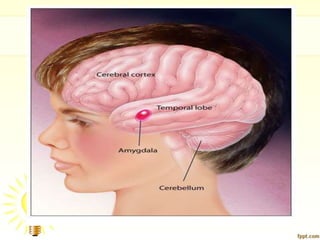
• Abnormalities in the brain functioning,
E.g. Defects in temporal lobe of brain,
limbic system.
Psychosocial factors
– Parental rejection,
– Deviated personality,
– Broken families stress,
– Defective communication pattern,
– Sibling conflicts.
• Autism is not caused by an unhappy home
environment, both parents working, mental
stress during the pregnancy, poor handling by
the mother and also some emotional trauma or
other psychological factors.
CLINICAL MANIFESTATION:
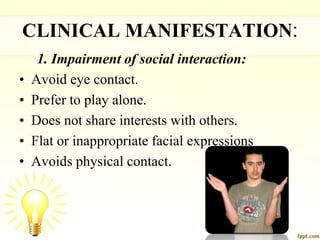
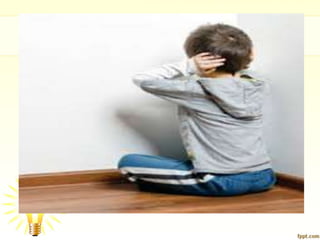
1. Impairment of social interaction:
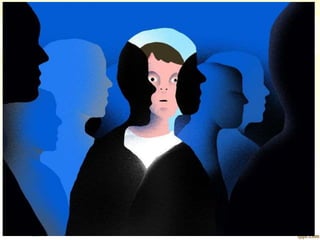
• Avoid eye contact.
• Prefer to play alone.
• Does not share interests with others.
• Flat or inappropriate facial expressions
• Avoids physical contact.
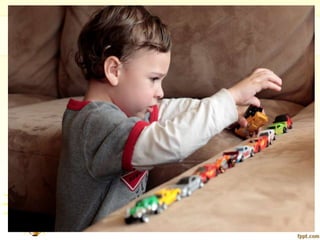
2.Impairment in behavior:
• Plays with toys the same way every time.
• Likes parts of objects.
• Gets upset by minor changes.
• Has an obsessive interest.
• Dislike being kisses or touch.
• Failure to develop empathy.
3.Impairment in communication
• Gives unrelated answer to a question.
• Does not understand jokes or teasing.
• Delayed speech and language skills.
• Repeated words or phrases over and over.
4.Other symptoms
• Hyperactivity.
• Short attention span
• Lack of fear or more fear than expected.
• Causing self-injury.
• Aggression.
EXAMINATION AND TESTS:
1. Medical history: During the medical history
interview, a doctor asks general questions about
a child's development, such as whether a child
shows parents things by pointing to objects.
• Young children with autism often point to
items they want, but do not point to show
parents an item and then check to see if parents
are looking at the item being pointed out.
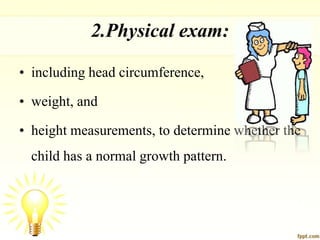
2.Physical exam:
• including head circumference,
• weight, and
• height measurements, to determine whether the
child has a normal growth pattern.
• 3. Screening test for autism (such as the
Checklist for Autism in Toddlers [CHAT] or
the Autism Screening Questionnaire).
Modified Checklist of Autism in
Toddlers:
• Valid for toddlers 16-30 months
• List of questions
• Answers determine need for referral to a
developmental specialist
– Developmental pediatrician
– Neurologist
– Psychiatrist
• Scoring: child requires follow up if
– Answered “No” to 2 or more critical questions
or Answered “No” to 3 questions
TREATMENT
• Medicines are often used to treat behavior or
emotional that people with autism may have,
including: Aggression, Anxiety, Attention
Problems, Hyperactivity, Irritability, Mood
Swings, Sleep difficulty....etc. but mostly used
drug are lithium.
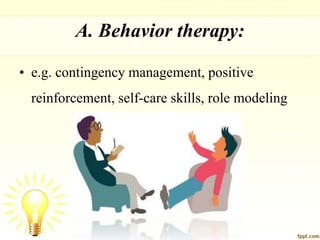
A. Behavior therapy:
• e.g. contingency management, positive
reinforcement, self-care skills, role modeling
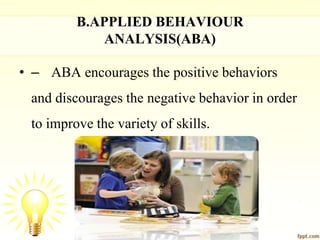
B.APPLIED BEHAVIOUR
ANALYSIS(ABA)
• – ABA encourages the positive behaviors
and discourages the negative behavior in order
to improve the variety of skills.
• – For example; a teacher might ask a child
to put his toys away. If the child puts his toys
away, the teacher will praise the child.
• If the child does not put his toys away, the
teacher might guide the child’s hand or
withhold a reward until the child puts the toys
away.
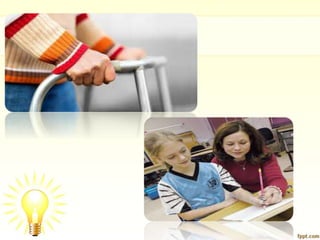
C. OCCUPATIONAL THEARPY:
• Occupational therapy teaches skills that help
the person live as independently as possible.
• Skills might include dressing, eating, bathing,
and relating to people.
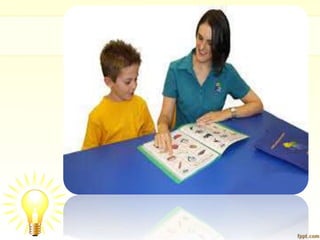
D. SPEECH THERAPY:
• – It helps to improve the person’s
communication skills.
• – Some peoples are able to learn verbal
communication.
E. PSYCHOTHERAPY:
• – Psychotherapy is not effective in treatment
of autism.
• – However, parental counseling and
supportive therapy are useful is allaying
parental anxiety and guilt, and ensuring
their active involvement of the therapy.
NURSING MANAGEMENT:
1.Impair social interaction related to self-concept
disturbance as evidence by lack of eye contact
and failure to development friendship.
• GOAL: patient will initiate social interaction
with another individual by discharge.
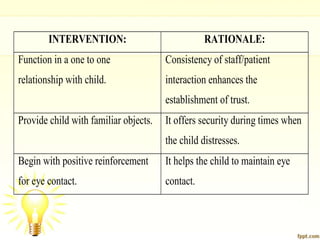
INTERVENTION: RATIONALE:
Function in a one to one
relationship with child.
Consistency of staff/patient
interaction enhances the
establishment of trust.
Provide child with familiar objects. It offers security during times when
the child distresses.
Begin with positive reinforcement
for eye contact.
It helps the child to maintain eye
contact.
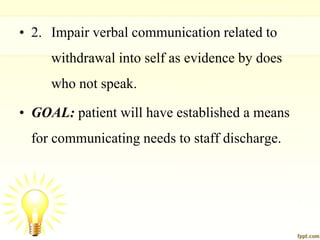
• 2. Impair verbal communication related to
withdrawal into self as evidence by does
who not speak.
• GOAL: patient will have established a means
for communicating needs to staff discharge.
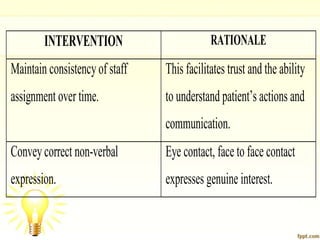
INTERVENTION RATIONALE
Maintain consistencyof staff
assignment over time.
This facilitates trust and the ability
to understand patient’s actions and
communication.
Conveycorrect non-verbal
expression.
Eye contact, face to face contact
expresses genuine interest.
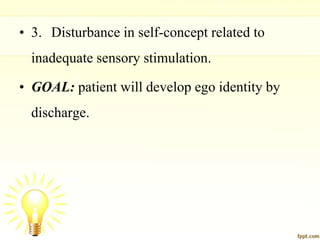
• 3. Disturbance in self-concept related to
inadequate sensory stimulation.
• GOAL: patient will develop ego identity by
discharge.
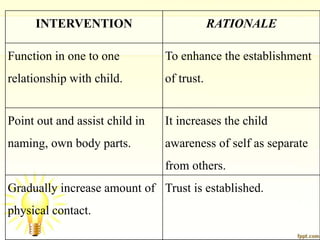
INTERVENTION RATIONALE
Function in one to one
relationship with child.
To enhance the establishment
of trust.
Point out and assist child in
naming, own body parts.
It increases the child
awareness of self as separate
from others.
Gradually increase amount of
physical contact.
Trust is established.
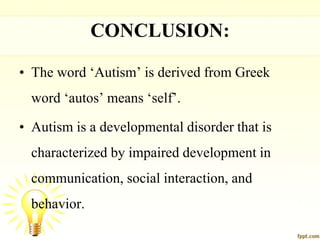
CONCLUSION:
• The word ‘Autism’ is derived from Greek
word ‘autos’ means ‘self’.
• Autism is a developmental disorder that is
characterized by impaired development in
communication, social interaction, and
behavior.
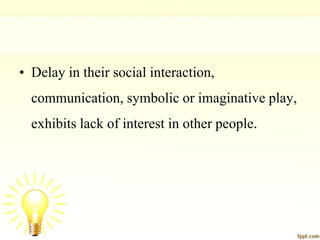
• Delay in their social interaction,
communication, symbolic or imaginative play,
exhibits lack of interest in other people.
ASSIGNMENTS:
• Define autism.
• Enlist the causes of autism
BIBLIOGRAPHY:
• 1. R. Sreevani, A guide to Mental Health &
Psychiatric Nursing, JAYPEE BROTHERS,
3rd Edition 2010; page No – 230-234.
• 2. Anbu.T; Text book of Psychiatric Nursing;
EMMESS., 1st Edition 2010; Page No- 164-
167.
• 3. R.K.Gupta, New Approach To Mental
Health Nursing, 2011 Edition.
Thank
you……

Autism. MSc MENTAL HEALTH NURSING

  • 2.
  • 3.
    INTRODUCTION: • WHO, Americanpsychological Association classification ‘Autism’ as a developmental disability that results from central nervous system disorder.
  • 4.
    • The word‘Autism’ is derived from Greek word ‘autos’ means ‘self’. • Autism is a developmental disorder that is characterized by impaired development in communication, social interaction, and behavior.
  • 5.
    • In otherwords, the symptoms and characteristic of autism can present in a wide variety of combinations, from mild to severe. • Children are marked by delay in their social interaction, communication, symbolic or imaginative play, exhibits lack of interest in other people.
  • 6.
    INCIDENCE: • Autism isa rare disorder, long term illness with a poor prognosis • Generally, the onset occurs before the age of 2 ½ years. • In some cases, the onset may occur later in childhood. And such cases are called as childhood onset autism.
  • 7.
    DEFINITION: • Quantitative impairmentin social interaction, communication, restricted, repetitive and stereotyped patterns of behavior, interests and activities, delays in abnormal functioning
  • 8.
    • A developmentaldisorder characterized by total lack of responsiveness to people gross language developmental deficits or distortions, bizarre response to environmental aspects.
  • 9.
    PREDISPOSING FACTORS • Historyof perinatal complication- maternal bleeding • Anoxia during pregnancy and delivery • Drug abuse in pregnancy
  • 10.
    • Maternal rubellainfection, congenital rubella • Encephalitis • Meningitis • Tuberous sclerosis • Familial interpersonal factors
  • 11.
    CAUSES: • Abnormalities inthe brain functioning, E.g. Defects in temporal lobe of brain, limbic system.
  • 13.
    Psychosocial factors – Parentalrejection, – Deviated personality, – Broken families stress, – Defective communication pattern, – Sibling conflicts.
  • 14.
    • Autism isnot caused by an unhappy home environment, both parents working, mental stress during the pregnancy, poor handling by the mother and also some emotional trauma or other psychological factors.
  • 15.
    CLINICAL MANIFESTATION: 1. Impairmentof social interaction: • Avoid eye contact. • Prefer to play alone. • Does not share interests with others. • Flat or inappropriate facial expressions • Avoids physical contact.
  • 17.
    2.Impairment in behavior: •Plays with toys the same way every time. • Likes parts of objects. • Gets upset by minor changes. • Has an obsessive interest. • Dislike being kisses or touch. • Failure to develop empathy.
  • 19.
    3.Impairment in communication •Gives unrelated answer to a question. • Does not understand jokes or teasing. • Delayed speech and language skills. • Repeated words or phrases over and over.
  • 21.
    4.Other symptoms • Hyperactivity. •Short attention span • Lack of fear or more fear than expected. • Causing self-injury. • Aggression.
  • 22.
    EXAMINATION AND TESTS: 1.Medical history: During the medical history interview, a doctor asks general questions about a child's development, such as whether a child shows parents things by pointing to objects.
  • 23.
    • Young childrenwith autism often point to items they want, but do not point to show parents an item and then check to see if parents are looking at the item being pointed out.
  • 24.
    2.Physical exam: • includinghead circumference, • weight, and • height measurements, to determine whether the child has a normal growth pattern.
  • 25.
    • 3. Screeningtest for autism (such as the Checklist for Autism in Toddlers [CHAT] or the Autism Screening Questionnaire).
  • 26.
    Modified Checklist ofAutism in Toddlers:
  • 27.
    • Valid fortoddlers 16-30 months • List of questions • Answers determine need for referral to a developmental specialist – Developmental pediatrician – Neurologist – Psychiatrist • Scoring: child requires follow up if – Answered “No” to 2 or more critical questions or Answered “No” to 3 questions
  • 28.
    TREATMENT • Medicines areoften used to treat behavior or emotional that people with autism may have, including: Aggression, Anxiety, Attention Problems, Hyperactivity, Irritability, Mood Swings, Sleep difficulty....etc. but mostly used drug are lithium.
  • 29.
    A. Behavior therapy: •e.g. contingency management, positive reinforcement, self-care skills, role modeling
  • 30.
    B.APPLIED BEHAVIOUR ANALYSIS(ABA) • –ABA encourages the positive behaviors and discourages the negative behavior in order to improve the variety of skills.
  • 31.
    • – Forexample; a teacher might ask a child to put his toys away. If the child puts his toys away, the teacher will praise the child. • If the child does not put his toys away, the teacher might guide the child’s hand or withhold a reward until the child puts the toys away.
  • 32.
    C. OCCUPATIONAL THEARPY: •Occupational therapy teaches skills that help the person live as independently as possible. • Skills might include dressing, eating, bathing, and relating to people.
  • 34.
    D. SPEECH THERAPY: •– It helps to improve the person’s communication skills. • – Some peoples are able to learn verbal communication.
  • 36.
    E. PSYCHOTHERAPY: • –Psychotherapy is not effective in treatment of autism. • – However, parental counseling and supportive therapy are useful is allaying parental anxiety and guilt, and ensuring their active involvement of the therapy.
  • 38.
    NURSING MANAGEMENT: 1.Impair socialinteraction related to self-concept disturbance as evidence by lack of eye contact and failure to development friendship. • GOAL: patient will initiate social interaction with another individual by discharge.
  • 39.
    INTERVENTION: RATIONALE: Function ina one to one relationship with child. Consistency of staff/patient interaction enhances the establishment of trust. Provide child with familiar objects. It offers security during times when the child distresses. Begin with positive reinforcement for eye contact. It helps the child to maintain eye contact.
  • 40.
    • 2. Impairverbal communication related to withdrawal into self as evidence by does who not speak. • GOAL: patient will have established a means for communicating needs to staff discharge.
  • 41.
    INTERVENTION RATIONALE Maintain consistencyofstaff assignment over time. This facilitates trust and the ability to understand patient’s actions and communication. Conveycorrect non-verbal expression. Eye contact, face to face contact expresses genuine interest.
  • 42.
    • 3. Disturbancein self-concept related to inadequate sensory stimulation. • GOAL: patient will develop ego identity by discharge.
  • 43.
    INTERVENTION RATIONALE Function inone to one relationship with child. To enhance the establishment of trust. Point out and assist child in naming, own body parts. It increases the child awareness of self as separate from others. Gradually increase amount of physical contact. Trust is established.
  • 44.
    CONCLUSION: • The word‘Autism’ is derived from Greek word ‘autos’ means ‘self’. • Autism is a developmental disorder that is characterized by impaired development in communication, social interaction, and behavior.
  • 45.
    • Delay intheir social interaction, communication, symbolic or imaginative play, exhibits lack of interest in other people.
  • 46.
    ASSIGNMENTS: • Define autism. •Enlist the causes of autism
  • 47.
    BIBLIOGRAPHY: • 1. R.Sreevani, A guide to Mental Health & Psychiatric Nursing, JAYPEE BROTHERS, 3rd Edition 2010; page No – 230-234. • 2. Anbu.T; Text book of Psychiatric Nursing; EMMESS., 1st Edition 2010; Page No- 164- 167.
  • 48.
    • 3. R.K.Gupta,New Approach To Mental Health Nursing, 2011 Edition.
  • 49.