
Oncoplastic breast
surgery
Objectives
• Indication
• Patient selection
• Overview of different techniques of oncoplastic surgery
Introduction
• Represents any surgery that aims to maintain quality of life
and acceptable breast appearance whilst at the same time
being uncompromizing on oncological effectiveness
• Includes
1. Use of breast reduction techniques
2. Use of volume replacement techniques
3. Use of various techniques to allow en block closure of breast
defects
Curr Breast Cancer Rep. 2016; 8; 112-117
Multidisciplinary approach
• Oncological surgeon
• Reconstructive surgeon
• Radiologists
• Pathologists
• Radiation therapist
• Medical oncologists
Concerns
1. Need for skin resection
2. Adjuvant radiation therapy
3. Patient size
4. Esthetic desires
5. Activity level
Patient selection
• BCS
• Unilateral mastectomy
• Bilateral mastectomy
• Congenital deformity
• Relative C/I
1. Extreme age
2. Severe CVS disease or other co- morbidity
3. Extreme obesity
4. Advanced breast cancer
Oncoplastic breast surgery
Breast Conservation Surgery
• Initially scoop and run approach (no effort made to obliterate
the internal cavity)
• Adverse cosmetic outcome when > 80 gm of breast tissue is
removed
• Unsatisfactory results due to
• Volumetric deformity
1. Retraction deformity when seroma resorbs
2. Skin- pectoral muscle adherence deformity
Oncoplastic reconstruction
in BCS
• 200- 1000gm can be removed without significant
cosmetic outcome.
• Allows major resection 20% to 50% of breast volume
without causing deformity
• Hence broadens the application of BCS
• Techniques
1. Volume reduction
a. Obliterate the dead space of lumpectomy
b. Counteract the contractile forces after radiation therapy
2. Immediate flap reconstruction
Timing for oncoplastic surgery
Immediate
1. 75%
2. Same day,
3. Preserving maximum amount
of breast skin for use in
reconstruction,
4. Combining the recovery
period for both
5. Avoiding a period of time
without a breast mound
6. Skin flaps more pliable
7. Stage I and II cancer
Delayed
1. 25%
2. Months /years later
3. In patient who require
postmastectomy radiation
therapy
4. In certain
chemotherapeutic agents
Advantages
Immediate
• One operative setting
(overall cost)
• Psychological benefit
• Preserves normal breast
landmarks ( inframammary
folds)
Delayed
• Assurance of clear margin
before definite reconstruction
• Minimize the effect of poorly
perfused mastectomy skin
flaps on the quality of
reconstruction
• Allows completion of all
adjuvant treatment
Kronowitz and colleagues showed that immediate repair of partial mastectomy defects
with local tissues results in fewer complications (23% vs. 67%) and better aesthetic
outcomes (57% vs. 33%) compared to delayed reconstruction
Disadvantages
Immediate
• Prolonged operative time
• Necrosis of mastectomy skin
flaps can adversely affect
the esthetic result of the
reconstruction
• The need of post-operative
RT can adversely affect the
reconstruction
Delayed
• Need for subsequent
surgery
• Limited reconstructive
options following
radiotherapy
• Lesser esthetic quality
compared to immediate
reconstruction
Preoperative planning
• History
• Prior breast surgery history including indwelling breast
implants from previous augmentation
• Physical examination
• Preoperative tissue biopsy using percutaneous core-cut biopsy
rather than excisional biopsy (scar)
• Preoperative breast imaging to establish full extent of disease
• Preoperative marking of skin landmarks with patient in upright
sitting position
• Identification of
1. Inframammary crease
2. Anterior axillary fold at the pectoralis major muscle
3. Posterior axillary fold at the latissimus dorsi muscle
4. Sternal border of breast
5. Periareolar circle
Consider
1. Size
2. Shape
3. Position in chest wall
4. Location of inframammary fold
5. Height, size and colour of nipple-areolar complex
6. Amount of breast ptosis
Oncoplastic surgical techniques in BCS
1. Parallelogram lumpectomy
2. Lateral segmentectomy
3. Batwing lumpectomy
4. Central lumpectomy
5. Reduction mastopexy lumpectomy
6. Donut mastopexy lumpectomy
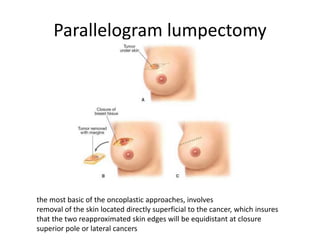
Parallelogram lumpectomy
the most basic of the oncoplastic approaches, involves
removal of the skin located directly superficial to the cancer, which insures
that the two reapproximated skin edges will be equidistant at closure
superior pole or lateral cancers
Lateral segmentectomy
lesions located within the lateral breast at the 3 o’clock (left) and 9 o’clock (right) positions
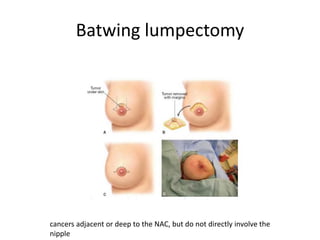
Batwing lumpectomy
cancers adjacent or deep to the NAC, but do not directly involve the
nipple
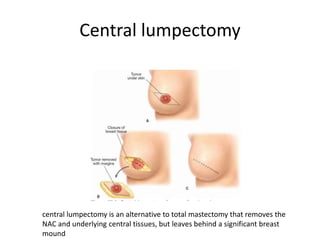
Central lumpectomy
central lumpectomy is an alternative to total mastectomy that removes the
NAC and underlying central tissues, but leaves behind a significant breast
mound
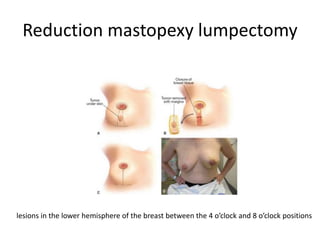
Reduction mastopexy lumpectomy
lesions in the lower hemisphere of the breast between the 4 o’clock and 8 o’clock positions
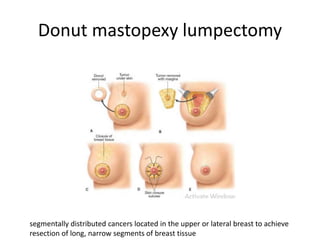
Donut mastopexy lumpectomy
segmentally distributed cancers located in the upper or lateral breast to achieve
resection of long, narrow segments of breast tissue
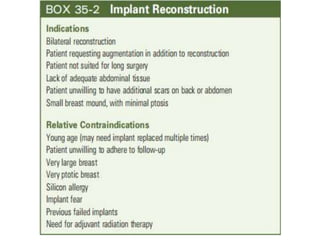
Implant based reconstruction
• Patients with reasonable amount of good-quality
skin after mastectomy
• Enough to cover an implant completely and
provide a natural shape
• Advantage
– Relatively quick
– Minimal morbidity
– Best used for bilateral reconstruction
• Disadvantage
– Difficult to mimic the natural ptosis and contour of the
contralateral breast .
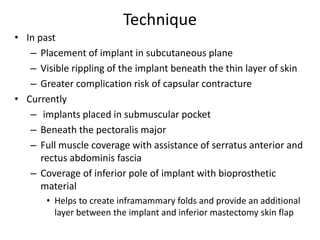
Technique
• In past
– Placement of implant in subcutaneous plane
– Visible rippling of the implant beneath the thin layer of skin
– Greater complication risk of capsular contracture
• Currently
– implants placed in submuscular pocket
– Beneath the pectoralis major
– Full muscle coverage with assistance of serratus anterior and
rectus abdominis fascia
– Coverage of inferior pole of implant with bioprosthetic
material
• Helps to create inframammary folds and provide an additional
layer between the implant and inferior mastectomy skin flap
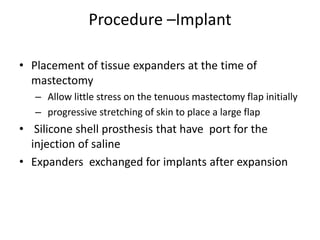
Procedure –Implant
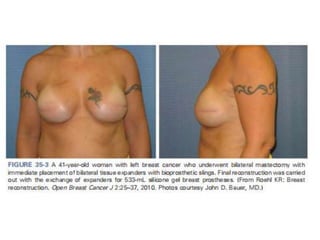
• Placement of tissue expanders at the time of
mastectomy
– Allow little stress on the tenuous mastectomy flap initially
– progressive stretching of skin to place a large flap
• Silicone shell prosthesis that have port for the
injection of saline
• Expanders exchanged for implants after expansion
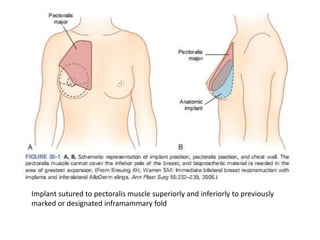
Implant sutured to pectoralis muscle superiorly and inferiorly to previously
marked or designated inframammary fold
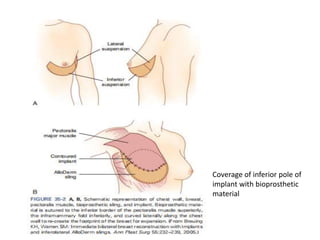
Coverage of inferior pole of
implant with bioprosthetic
material
Adverse reaction
• Tends to change because of gravity
• The body’s response to foreign objects ( capsule formation)
• Ageing of the implant itself
Latisimmus dorsi flap
• Myocutaneous flap based on the thoracodorsal
artery pedicle
• Latisimmus dorsi
– Broad flat muscle
– Span back from the tip of the scapula superiorly to the
spine medially and the iliac crest inferiorly
Advantage
1. Proximity to breast and
reliable circulation
2. Workhorse for reconstruction
of U/L defect in thin women
with minimal donor site
3. Smaller breasted women
4. salvage for any failed breast
resonstruction
5. Also used for reconstruction
of lateral partial mastectomy
defects
Disadvantage
1. Possible large scar on
back
2. Donor site complication
Technique-LD flap
1. Single staged fashion or staged procedure
2. latissimus serves as a sling inferiorly, attached to superior
pectoral muscle to provide full muscle coverage of the
implant
3. Taken with overlying skin for nipple areola reconstruction
4. Skin paddle is centered over the muscle and attempts are
made to hide the donor site scar within the bra line
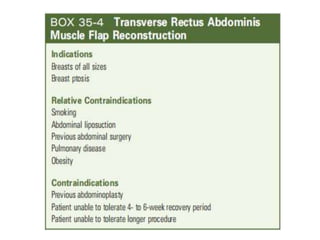
Transverse abdominis myocutaneous
(TRAM) flap
• Pedicled flap
• Based on superior and inferior epigastric artery
• Gold standard in breast reconstruction
– Lower abdominal tissue are similar in consistency to breast
tissue
– Orients the donor scar into more acceptable
abdominoplasty location
– Better arc of rotation
• free TRAM flaps
– the skin and fat of lower abdomen are connected via the deep
inferior epigastric artery and vein to the blood supply in the
axilla (thoracodorsal vessels originally)
– more recently with internal mammary vessels
– less partial flap and fat necrosis then pedicled flaps
– avoid the epigastric bulge of the muscle that occurs in pedicled
flaps
Procedure
The small vessels connecting the
superior and inferior systems, known as
choke vessels are dilated to increase
perfusion when the deep system is
ligated
Advantages
1. Replaces like with like
tissue
2. Provides an acceptable
donor scar
3. Improvement of abdominal
contour
Limitations
1. High metabolic demand
tissue necrosis
• Partial flap loss- 7.1%
• Total flap loss- 1.4%
• Fat necrosis- 12% in smoker
and 3 % in non smoker
Limitations –contd.
2. Longer recovery period after surgery increase
abddominal discomfort and risk for abdominal weakness or
hernia fomation or both
3. limited by previous abdominal operations and scars
4. Obese, smoker or with medical co- morbidity age greater risk
for these complications
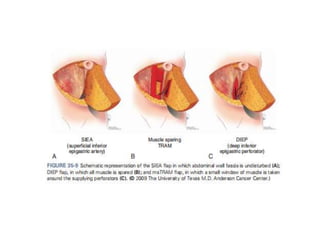
Refinement of TRAM
To preserve abdominal wall strength
1. (Ms) TRAM
– only the muscle surrounding the perforating vessels is taken
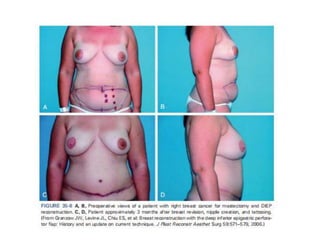
2. Deep inferior epigastric artery perforator (DIEP) flap –
– no muscle is taken
– the perforating vessels are dissected out in a chain
– based on perforators travelling through the rectus abdominis
muscle and sheath to supply skin and fat
3. Superficial inferior epigastric artey ( SIEA) flap-
– Provide a pedicle that doesnot penetrate the rectus muscle at
all
– No abdominal wall morbidity
– Shorter recovery time
Choice of flap
• SIEA flap:
– reasonable caliber > 1.5 mm
– Favourable for small breast reconstruction
– Disadvantage : Difficulty because artery is small and some
discrepency between SIEA and internal mammary artery
• msTRAM :
– When vessels are small or their orientation is
unfavourable
– Flap perfusion better
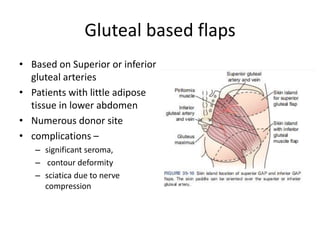
Gluteal based flaps
• Based on Superior or inferior
gluteal arteries
• Patients with little adipose
tissue in lower abdomen
• Numerous donor site
• complications –
– significant seroma,
– contour deformity
– sciatica due to nerve
compression
Inner thigh based flaps
• Women without abdominal or gluteal tissue to use as a donor site
• Women who donot want donor scar on the buttock
• Transverse upper gracilis (TUG) flap
• based on the ascending branch of the medial circumflex femoral
artery and includes the gracilis muscle and the overlying horizon
tal paddle of skin or fat.
• Advantages
– reasonable amount of tissue can be obtained
– to reconstruct small to moderate-sized breasts in the immediate
– Setting
• Disadvantage:
– Because TUG flaps are slightly smaller than their abdominal or gluteal
counterparts with regard to skin,
– less useful for delayed reconstruction
Nipple areolar reconstruction
Timing of nipple creation
• After creation of breast mound or completion of adjuvant
therapy
• After months (usually 3 months) settling of reconstruction -
allows for symmetrical positioning of the created nipple
• Period of time after radiation – breast reconstruction
undergoes some amount of contraction
Technique
• Created via myriad local flap techniques – using skin of the
reconstructed breast mound
• Areolar reconstruction usually after 4-6 weeks of creation of
nipple by:
1. Full thickness skin graft- usually from groin(for darker
pigmentation)
2. Medical tattoo pigments ( matched to contralateral side)
• Nipple tattoo tends to fade over time and needs touchup
Drawbacks
• Little projection
• Insensate
• Less than the esthetic normal
Hence surgical oncologist and plastic surgeon attempts to
preserve the areola or entire nipple areolar complex
Combination reconstruction
• Use of autologous tissue in conjunction of an implant
• There is need of additional tissue after mastectomy to
1. To create a sizable breast and a natural breast drape
2. To prevent the development of ptosis
3. To counter radiation induced skin changes
• Uses myocutaneous LD flap
Management of contralateral breast
• Symmetry ( with /without clothing)
• Revision of breast mound reconstruction to improve shape
• surgeries on the native contralateral breast
• Difficult for large or ptotic breast
• Augmentation mammaplasty, mastopexy ( lifting) and
reduction mammaplasty
Survillence after oncoplastic surgery
• Easier to monitor for local recurrence ( as recurrence is often
within the skin)
• Routine mammography unnecessary
• USG and MRI are most commonly used technique
• Recurrence is usually managed with surgical excision,
adjuvant chemotherapy or radiation therapy
• Only in case of multifocal recurrence or involvement of flap
pedicle itself reconstruction is removed in its entirety.
Conclusion
• Vital component in the treatment of breast cancer
• Lessens psychological and physical burden
• Immediate reconstruction is preferred as it has not been
shown to increase oncological risk or delay adjuvant therapy
• Immediate reconstruction is cost effective, better esthetic
outcome and results in less depression
• Decision of type according to advantages and disadvantages
of each procedure
References
• Sabiston text book of surgery,20th edition
• Fishers’ mastery of surgery 7th edition
• Thank you

Final oncoplastic breast surgery

  • 1.
  • 2.
    Objectives • Indication • Patientselection • Overview of different techniques of oncoplastic surgery
  • 3.
    Introduction • Represents anysurgery that aims to maintain quality of life and acceptable breast appearance whilst at the same time being uncompromizing on oncological effectiveness • Includes 1. Use of breast reduction techniques 2. Use of volume replacement techniques 3. Use of various techniques to allow en block closure of breast defects Curr Breast Cancer Rep. 2016; 8; 112-117
  • 4.
    Multidisciplinary approach • Oncologicalsurgeon • Reconstructive surgeon • Radiologists • Pathologists • Radiation therapist • Medical oncologists
  • 5.
    Concerns 1. Need forskin resection 2. Adjuvant radiation therapy 3. Patient size 4. Esthetic desires 5. Activity level
  • 6.
    Patient selection • BCS •Unilateral mastectomy • Bilateral mastectomy • Congenital deformity • Relative C/I 1. Extreme age 2. Severe CVS disease or other co- morbidity 3. Extreme obesity 4. Advanced breast cancer
  • 7.
    Oncoplastic breast surgery BreastConservation Surgery • Initially scoop and run approach (no effort made to obliterate the internal cavity) • Adverse cosmetic outcome when > 80 gm of breast tissue is removed • Unsatisfactory results due to • Volumetric deformity 1. Retraction deformity when seroma resorbs 2. Skin- pectoral muscle adherence deformity
  • 8.
    Oncoplastic reconstruction in BCS •200- 1000gm can be removed without significant cosmetic outcome. • Allows major resection 20% to 50% of breast volume without causing deformity • Hence broadens the application of BCS • Techniques 1. Volume reduction a. Obliterate the dead space of lumpectomy b. Counteract the contractile forces after radiation therapy 2. Immediate flap reconstruction
  • 9.
    Timing for oncoplasticsurgery Immediate 1. 75% 2. Same day, 3. Preserving maximum amount of breast skin for use in reconstruction, 4. Combining the recovery period for both 5. Avoiding a period of time without a breast mound 6. Skin flaps more pliable 7. Stage I and II cancer Delayed 1. 25% 2. Months /years later 3. In patient who require postmastectomy radiation therapy 4. In certain chemotherapeutic agents
  • 10.
    Advantages Immediate • One operativesetting (overall cost) • Psychological benefit • Preserves normal breast landmarks ( inframammary folds) Delayed • Assurance of clear margin before definite reconstruction • Minimize the effect of poorly perfused mastectomy skin flaps on the quality of reconstruction • Allows completion of all adjuvant treatment Kronowitz and colleagues showed that immediate repair of partial mastectomy defects with local tissues results in fewer complications (23% vs. 67%) and better aesthetic outcomes (57% vs. 33%) compared to delayed reconstruction
  • 11.
    Disadvantages Immediate • Prolonged operativetime • Necrosis of mastectomy skin flaps can adversely affect the esthetic result of the reconstruction • The need of post-operative RT can adversely affect the reconstruction Delayed • Need for subsequent surgery • Limited reconstructive options following radiotherapy • Lesser esthetic quality compared to immediate reconstruction
  • 12.
    Preoperative planning • History •Prior breast surgery history including indwelling breast implants from previous augmentation • Physical examination • Preoperative tissue biopsy using percutaneous core-cut biopsy rather than excisional biopsy (scar) • Preoperative breast imaging to establish full extent of disease
  • 13.
    • Preoperative markingof skin landmarks with patient in upright sitting position • Identification of 1. Inframammary crease 2. Anterior axillary fold at the pectoralis major muscle 3. Posterior axillary fold at the latissimus dorsi muscle 4. Sternal border of breast 5. Periareolar circle
  • 14.
    Consider 1. Size 2. Shape 3.Position in chest wall 4. Location of inframammary fold 5. Height, size and colour of nipple-areolar complex 6. Amount of breast ptosis
  • 15.
    Oncoplastic surgical techniquesin BCS 1. Parallelogram lumpectomy 2. Lateral segmentectomy 3. Batwing lumpectomy 4. Central lumpectomy 5. Reduction mastopexy lumpectomy 6. Donut mastopexy lumpectomy
  • 16.
    Parallelogram lumpectomy the mostbasic of the oncoplastic approaches, involves removal of the skin located directly superficial to the cancer, which insures that the two reapproximated skin edges will be equidistant at closure superior pole or lateral cancers
  • 17.
    Lateral segmentectomy lesions locatedwithin the lateral breast at the 3 o’clock (left) and 9 o’clock (right) positions
  • 18.
    Batwing lumpectomy cancers adjacentor deep to the NAC, but do not directly involve the nipple
  • 19.
    Central lumpectomy central lumpectomyis an alternative to total mastectomy that removes the NAC and underlying central tissues, but leaves behind a significant breast mound
  • 20.
    Reduction mastopexy lumpectomy lesionsin the lower hemisphere of the breast between the 4 o’clock and 8 o’clock positions
  • 21.
    Donut mastopexy lumpectomy segmentallydistributed cancers located in the upper or lateral breast to achieve resection of long, narrow segments of breast tissue
  • 23.
    Implant based reconstruction •Patients with reasonable amount of good-quality skin after mastectomy • Enough to cover an implant completely and provide a natural shape • Advantage – Relatively quick – Minimal morbidity – Best used for bilateral reconstruction • Disadvantage – Difficult to mimic the natural ptosis and contour of the contralateral breast .
  • 25.
    Technique • In past –Placement of implant in subcutaneous plane – Visible rippling of the implant beneath the thin layer of skin – Greater complication risk of capsular contracture • Currently – implants placed in submuscular pocket – Beneath the pectoralis major – Full muscle coverage with assistance of serratus anterior and rectus abdominis fascia – Coverage of inferior pole of implant with bioprosthetic material • Helps to create inframammary folds and provide an additional layer between the implant and inferior mastectomy skin flap
  • 26.
    Procedure –Implant • Placementof tissue expanders at the time of mastectomy – Allow little stress on the tenuous mastectomy flap initially – progressive stretching of skin to place a large flap • Silicone shell prosthesis that have port for the injection of saline • Expanders exchanged for implants after expansion
  • 27.
    Implant sutured topectoralis muscle superiorly and inferiorly to previously marked or designated inframammary fold
  • 28.
    Coverage of inferiorpole of implant with bioprosthetic material
  • 30.
    Adverse reaction • Tendsto change because of gravity • The body’s response to foreign objects ( capsule formation) • Ageing of the implant itself
  • 31.
    Latisimmus dorsi flap •Myocutaneous flap based on the thoracodorsal artery pedicle • Latisimmus dorsi – Broad flat muscle – Span back from the tip of the scapula superiorly to the spine medially and the iliac crest inferiorly
  • 33.
    Advantage 1. Proximity tobreast and reliable circulation 2. Workhorse for reconstruction of U/L defect in thin women with minimal donor site 3. Smaller breasted women 4. salvage for any failed breast resonstruction 5. Also used for reconstruction of lateral partial mastectomy defects Disadvantage 1. Possible large scar on back 2. Donor site complication
  • 34.
    Technique-LD flap 1. Singlestaged fashion or staged procedure 2. latissimus serves as a sling inferiorly, attached to superior pectoral muscle to provide full muscle coverage of the implant 3. Taken with overlying skin for nipple areola reconstruction 4. Skin paddle is centered over the muscle and attempts are made to hide the donor site scar within the bra line
  • 36.
    Transverse abdominis myocutaneous (TRAM)flap • Pedicled flap • Based on superior and inferior epigastric artery • Gold standard in breast reconstruction – Lower abdominal tissue are similar in consistency to breast tissue – Orients the donor scar into more acceptable abdominoplasty location – Better arc of rotation
  • 37.
    • free TRAMflaps – the skin and fat of lower abdomen are connected via the deep inferior epigastric artery and vein to the blood supply in the axilla (thoracodorsal vessels originally) – more recently with internal mammary vessels – less partial flap and fat necrosis then pedicled flaps – avoid the epigastric bulge of the muscle that occurs in pedicled flaps
  • 39.
    Procedure The small vesselsconnecting the superior and inferior systems, known as choke vessels are dilated to increase perfusion when the deep system is ligated
  • 40.
    Advantages 1. Replaces likewith like tissue 2. Provides an acceptable donor scar 3. Improvement of abdominal contour Limitations 1. High metabolic demand tissue necrosis • Partial flap loss- 7.1% • Total flap loss- 1.4% • Fat necrosis- 12% in smoker and 3 % in non smoker
  • 41.
    Limitations –contd. 2. Longerrecovery period after surgery increase abddominal discomfort and risk for abdominal weakness or hernia fomation or both 3. limited by previous abdominal operations and scars 4. Obese, smoker or with medical co- morbidity age greater risk for these complications
  • 42.
    Refinement of TRAM Topreserve abdominal wall strength 1. (Ms) TRAM – only the muscle surrounding the perforating vessels is taken 2. Deep inferior epigastric artery perforator (DIEP) flap – – no muscle is taken – the perforating vessels are dissected out in a chain – based on perforators travelling through the rectus abdominis muscle and sheath to supply skin and fat 3. Superficial inferior epigastric artey ( SIEA) flap- – Provide a pedicle that doesnot penetrate the rectus muscle at all – No abdominal wall morbidity – Shorter recovery time
  • 43.
    Choice of flap •SIEA flap: – reasonable caliber > 1.5 mm – Favourable for small breast reconstruction – Disadvantage : Difficulty because artery is small and some discrepency between SIEA and internal mammary artery • msTRAM : – When vessels are small or their orientation is unfavourable – Flap perfusion better
  • 46.
    Gluteal based flaps •Based on Superior or inferior gluteal arteries • Patients with little adipose tissue in lower abdomen • Numerous donor site • complications – – significant seroma, – contour deformity – sciatica due to nerve compression
  • 48.
    Inner thigh basedflaps • Women without abdominal or gluteal tissue to use as a donor site • Women who donot want donor scar on the buttock • Transverse upper gracilis (TUG) flap • based on the ascending branch of the medial circumflex femoral artery and includes the gracilis muscle and the overlying horizon tal paddle of skin or fat. • Advantages – reasonable amount of tissue can be obtained – to reconstruct small to moderate-sized breasts in the immediate – Setting • Disadvantage: – Because TUG flaps are slightly smaller than their abdominal or gluteal counterparts with regard to skin, – less useful for delayed reconstruction
  • 49.
  • 50.
    Timing of nipplecreation • After creation of breast mound or completion of adjuvant therapy • After months (usually 3 months) settling of reconstruction - allows for symmetrical positioning of the created nipple • Period of time after radiation – breast reconstruction undergoes some amount of contraction
  • 51.
    Technique • Created viamyriad local flap techniques – using skin of the reconstructed breast mound • Areolar reconstruction usually after 4-6 weeks of creation of nipple by: 1. Full thickness skin graft- usually from groin(for darker pigmentation) 2. Medical tattoo pigments ( matched to contralateral side) • Nipple tattoo tends to fade over time and needs touchup
  • 52.
    Drawbacks • Little projection •Insensate • Less than the esthetic normal Hence surgical oncologist and plastic surgeon attempts to preserve the areola or entire nipple areolar complex
  • 53.
    Combination reconstruction • Useof autologous tissue in conjunction of an implant • There is need of additional tissue after mastectomy to 1. To create a sizable breast and a natural breast drape 2. To prevent the development of ptosis 3. To counter radiation induced skin changes • Uses myocutaneous LD flap
  • 54.
    Management of contralateralbreast • Symmetry ( with /without clothing) • Revision of breast mound reconstruction to improve shape • surgeries on the native contralateral breast • Difficult for large or ptotic breast • Augmentation mammaplasty, mastopexy ( lifting) and reduction mammaplasty
  • 55.
    Survillence after oncoplasticsurgery • Easier to monitor for local recurrence ( as recurrence is often within the skin) • Routine mammography unnecessary • USG and MRI are most commonly used technique • Recurrence is usually managed with surgical excision, adjuvant chemotherapy or radiation therapy • Only in case of multifocal recurrence or involvement of flap pedicle itself reconstruction is removed in its entirety.
  • 56.
    Conclusion • Vital componentin the treatment of breast cancer • Lessens psychological and physical burden • Immediate reconstruction is preferred as it has not been shown to increase oncological risk or delay adjuvant therapy • Immediate reconstruction is cost effective, better esthetic outcome and results in less depression • Decision of type according to advantages and disadvantages of each procedure
  • 57.
    References • Sabiston textbook of surgery,20th edition • Fishers’ mastery of surgery 7th edition
  • 58.

Editor's Notes

  • #37 TRAM flap with horizontal lower abdominal skin paddle