Submitted by:                     Submitted to:
Rimando, Maria Clarita Tondy A.   Ms. Shalimaar Dimaandal
BSN3-d2                           Clinical Instructor
   Meningitis is the infection and inflammation
    of the meninges (covering of the brain and
    spinal cord: duramater, arachnoid and
    piamater) and the cerebrospinal fluid.
   Causative agents
     Neisseria meningitides
      ▪ Incubation period: 2-10 days
     Haemophilus influenzae
      ▪ Incubation period: 1-4 days
     Enteroviruses
      ▪ Incubation period: 3 to 7 days
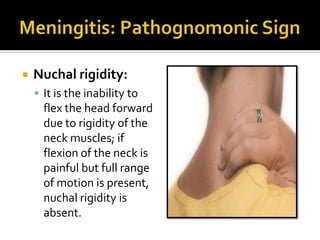
   Nuchal rigidity:
     It is the inability to
      flex the head forward
      due to rigidity of the
      neck muscles; if
      flexion of the neck is
      painful but full range
      of motion is present,
      nuchal rigidity is
      absent.
   Kernig's sign:
     It is positive when the
     leg is bent at the hip
     and knee at 90
     degree angles, and
     subsequent extension
     in the knee is painful
     (leading to
     resistance).
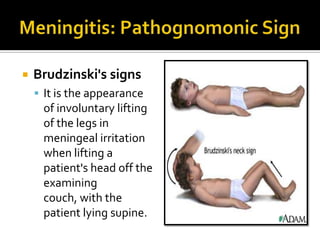
   Brudzinski's signs
     It is the appearance
     of involuntary lifting
     of the legs in
     meningeal irritation
     when lifting a
     patient's head off the
     examining
     couch, with the
     patient lying supine.
   Antibiotics:
     Ampicillin, Third-generation Cephalosporin such
      as Ceftriaxone or Ampicillin and an
      Aminoglycoside.
     Other drugs include Digitalis glycoside such as
      Digoxin (to control arrythmias), Mannitol (to
      decrease cerebral edema) or a Sedative (to
      reduce restlessness) and Aspirin or
      Acetaminophen (to relieve headache and fever).
   Rifampacin and Ciprobay
   Anti-fungal, Antibiotic, Mannitol
   Corticosteroid (Dexamethasone/Solucortef)
   Anti-convulsant (Phenytoin) (to reduce
    restlessness)
   A person can pass the infection to others for
    as long as the bacteria are present in
    discharges from the nose and mouth. A
    person is no longer infectious within 24 to 48
    hours after starting antibiotic treatment.
   Encourage personal hygiene especially the practice of hand
    washing. Keep hands clean and wash hands properly. Wash
    hands when they are dirtied by respiratory secretions e.g. after
    sneezing. Cover nose and mouth while sneezing or coughing
    and dispose of nasal and mouth discharge properly.
   Do not share eating and drinking utensils and wash them
    before use by others.
   Avoid going to overcrowded places.
   For Neisseria meningitidis meningitis, household contacts and
    others who have had close personal contact with infected
    persons are recommended to receive a preventive antibiotic
    which kills bacteria living in nose and throat secretions.
   For contacts of Haemophilus influenzae meningitis, antibiotics
    may also be recommended
   Effective vaccines against Haemophilus influenzae type b, and
    some types of Neisseria meningitidis are available.
   Haemophilus Influenzae type B
     Haemophilus influenzae type b (Hib) is a bacterium
      that can infect the outer lining of the brain causing
      meningitis. Hib disease occurs most often at three
      months to three years of age, peaking at six to seven
      months of age. The disease is uncommon after age
      five years.
      ▪ Children should get Hib vaccine at:
        ▪   2 months of age
        ▪   6 months of age
        ▪   4 months of age
        ▪   12-15 months of age
   Vaccines against four strains of N.
    meningitidis
   Meningococcal Conjugated vaccine are
    given to adolescents entering high school and
    to college freshmen living in dormitories.
   Assess neurologic status.
   Monitor vital signs especially temperature frequently or continuously.
   Pulse oximeter and arterial blood gas (ABG) are use to quickly identify
    the respiratory support for increasing ICP
   Institute other cooling measures such as TSB.
   Monitor I & O closely.
   Encourage adequate fluid intake.
   Darken the room if photophobia is present.
   Assist with position to comfort neck stiffness and turn patient slowly and
    carefully with head and neck in alignment.
   Elevate the head of the bed to decrease intracranial pressure and reduce
    pain.
   Administer vaccines against H. influenza type B for children; N.
    meningitides for patients at high risk; and S. pneumonia for patients with
    chronic illnesses and the elderly.
   Inform patients about the importance of vaccination.
   Vancomycin Hydrochloride in combination
    with one of the Cephalosporins is
    administered IV.
   Dexamethasone (Decadron)
   Dehydration and shock are treated with fluid
    volume expanders.
   Phenytoin (Dilantin)- treatment for seizures
    if occurs.
   Lumbar Puncture (Increase Protein and
    WBC, Low Sugar level)
     A lumbar puncture takes samples of the fluid around
      the spine and brain, known as cerebral spinal fluid
      (CSF). A culture of the spinal fluid is done to check for
      organisms known to cause illness.
   Blood Culture
     A blood culture is a test on a sample of blood to check
      for bacteria in the bloodstream; it may be done if a
      doctor suspects a blood infection. A blood culture
      may be helpful in determining the specific bacteria
      causing an infection and selecting the appropriate
      antibiotic to treat it.
   Imaging (X-rays and CT scans)
     X-rays and computerized tomography (CT) scans
     of the head, chest or sinuses may reveal swelling
     or inflammation. These tests can also help your
     doctor look for infection in other areas of the body
     that may be associated with meningitis.
   Both viral meningitis and bacterial meningitis
    can be transmitted through direct contact
    with nose and throat secretions of infected
    person (Droplet).
   Healthy persons, who have no signs of
    illness, can carry these bacteria in their nose
    or throat (Upper respiratory tract infection).
   Viral meningitis can also be transmitted
    through fecal-oral route.
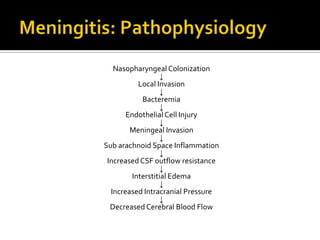
Nasopharyngeal Colonization
                   ↓
           Local Invasion
                   ↓
            Bacteremia
                   ↓
       Endothelial Cell Injury
                   ↓
        Meningeal Invasion
                   ↓
Sub arachnoid Space Inflammation
                   ↓
 Increased CSF outflow resistance
                   ↓
         Interstitial Edema
                   ↓
  Increased Intracranial Pressure
                   ↓
  Decreased Cerebral Blood Flow
   Encephalitis is irritation and swelling
    (inflammation) of the brain
    parenchyma, most often due to infections.
   Encephalitis with meningitis is known
    as meningoencephalitis.
   Causative agents
     Specifically to rural areas are Arboviruses or
      Arthropod-borne Viruses (viruses carried by
      arthropods, such as mosquitoes and tick), while in
      urban areas it is most frequently caused by
      Enteroviruses (Coxsackievirus, Poliovirus and
      Echovirus)
     Enteroviruses Incubation Period is most oftenly
      3-5 days
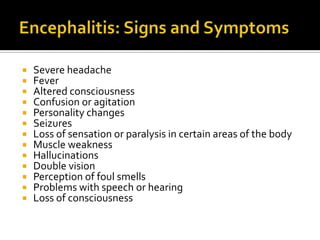
   Severe headache
   Fever
   Altered consciousness
   Confusion or agitation
   Personality changes
   Seizures
   Loss of sensation or paralysis in certain areas of the body
   Muscle weakness
   Hallucinations
   Double vision
   Perception of foul smells
   Problems with speech or hearing
   Loss of consciousness
   Antiviral medications, such as Acyclovir (Zovirax) and
    Foscarnet (Foscavir) -- to treat herpes encephalitis or
    other severe viral infections (however, no specific
    antiviral drugs are available to fight encephalitis)
   Antibiotics -- if the infection is caused by certain
    bacteria
   Anti-seizure medications (such as Phenytoin) -- to
    prevent seizures
   Steroids (such as Dexamethasone) -- to reduce brain
    swelling (in rare cases)
   Sedatives -- to treat irritability or restlessness
   Acetaminophen -- for fever and headache
   The period of communicability varies by etiologic
    agent, and some of them are not transmitted from
    person to person (e.g., histoplasmosis and
    toxoplasmosis). Enteroviruses may be shed in feces
    for several days to many weeks after symptoms
    have resolved. Enteroviruses may also be shed in
    respiratory secretions, usually for no longer than
    one week following symptoms.
   Dress to protect yourself. Wear long-sleeved
    shirts and long pants if you're outside when
    mosquitoes are most active and when you're in a
    wooded area with tall grasses and shrubs where
    ticks are more common.
   Apply mosquito repellent. To repel mosquitoes.
   Keep mosquitoes out of your home. Repair
    holes in screens on doors and windows.
   Monitoring pupils and vital signs frequently for increased
    intracranial pressure(ICP; irregular pupils, widening pulse
    pressure, tachycardia, irregular breathing hyperthermia).
   Monitor neurologic status closely. Watch for subtle
    changes, such as behavior or personality changes,
    weakness, or cranial nerve involvement
   Maintain adequate fluid intake to prevent dehydration,
    but avoid fluid overload, which may increase cerebral
    edema.
   Maintain adequate nutrition. Give small, frequent meals,
    or supplement meals with nasogastric tube or parenteral
    feedings.
   To prevent constipation and minimize the risk of
    increased ICP resulting from straining at stool, provide a
    mild laxative or stool softener.
   Carefully positioned the patient to prevent joint stiffness
    and neck pain, and turn the patient often.
   Provide thorough mouth care.
   Maintain a quiet environment. Darkening the room may
    decrease headache.
   If the patient has seizures, take precautions to protect
    him from injury.
   Measure and record intake and output.
   If the patient becomes delirious or confused, try to
    reorient him often.
   Teach the patient and his family about the disease and its
    effects.
   Teach eradication of the source of infection: Use
    insecticide or insect repellent and placement of screens
    to doors and windows.
   Antiviral agent Acyclovir given I.V. for 10 days
    to 3 weeks for herpes simplex virus.
   Blood cultures and foscarnet I.V. for CMV
    encephalitis.
   Anticonvulsants to treat
    seizures, corticosteroids to reduce cerebral
    edema, and sedatives and analgesics as
    supportive therapy.
 Spinal fluid analysis
  ▪ By doing a lumbar puncture (also called a spinal
    tap), your doctor can check the spinal fluid for an
    increase in white blood cells and protein.
   Electroencephalography (EEG)
     This can identify abnormal brain waves by monitoring
      electrical activity in the brain through the skull.
      Among its many functions, EEG is used to help
      diagnose certain seizure disorders, brain damage
      from head injuries, specific viral infections such as
      herpes virus, and inflammation of the brain and/or
      spinal cord.
   Blood tests.
     These tests can show what type of virus is causing
      encephalitis.
   Computer-assisted
    imaging (Computed
    tomography: CT
    SCAN and Magnetic
    resonance imaging:
    MRI)
     This can reveal signs
      of brain
      inflammation, internal
      bleeding or
      hemorrhage, or other
      brain abnormalities.
   Breathing in respiratory droplets from an
    infected person
   Skin contact
   Mosquito, tick, and other insect bites
   Tick of Horses
   Migratory Birds
   Contaminated food or drink
ARTHROPOD-BORNE VIRUS
                    Mosquito bite
                          ↓
        Inadequate Host Immune Response
                          ↓
                       Viremia
                          ↓
                 Cerebral Capillaries
                          ↓
              Central Nervous System
                          ↓
Cortical Gray Matter, The Brain Stem and Thalamus
                          ↓
                Meningual Exudates
                          ↓
              Irritating The Meninges
                          ↓
          Increasing Intracranial Pressure
FUNGAL ENCEPHALITIS
            Fungal Spores (enter body through inhalation)
                                  ↓
                          Infect the Lungs
                                  ↓
             Vague Respiratory Symptoms or Pneumonitis
                                  ↓
                            Bloodstream
                                  ↓
                             Fungemia
                                  ↓
                      Central Nervous System
                                  ↓
                            Encephalitis
                                  ↓
Fever, Malaise, Headache, Meningeal signs and change in Cranial Nerve
                              Dysfunction

Meningitis and Encephalitis

  • 1.
    Submitted by: Submitted to: Rimando, Maria Clarita Tondy A. Ms. Shalimaar Dimaandal BSN3-d2 Clinical Instructor
  • 3.
    Meningitis is the infection and inflammation of the meninges (covering of the brain and spinal cord: duramater, arachnoid and piamater) and the cerebrospinal fluid.
  • 5.
    Causative agents  Neisseria meningitides ▪ Incubation period: 2-10 days  Haemophilus influenzae ▪ Incubation period: 1-4 days  Enteroviruses ▪ Incubation period: 3 to 7 days
  • 6.
    Nuchal rigidity:  It is the inability to flex the head forward due to rigidity of the neck muscles; if flexion of the neck is painful but full range of motion is present, nuchal rigidity is absent.
  • 7.
    Kernig's sign:  It is positive when the leg is bent at the hip and knee at 90 degree angles, and subsequent extension in the knee is painful (leading to resistance).
  • 8.
    Brudzinski's signs  It is the appearance of involuntary lifting of the legs in meningeal irritation when lifting a patient's head off the examining couch, with the patient lying supine.
  • 9.
    Antibiotics:  Ampicillin, Third-generation Cephalosporin such as Ceftriaxone or Ampicillin and an Aminoglycoside.  Other drugs include Digitalis glycoside such as Digoxin (to control arrythmias), Mannitol (to decrease cerebral edema) or a Sedative (to reduce restlessness) and Aspirin or Acetaminophen (to relieve headache and fever).
  • 10.
    Rifampacin and Ciprobay  Anti-fungal, Antibiotic, Mannitol  Corticosteroid (Dexamethasone/Solucortef)  Anti-convulsant (Phenytoin) (to reduce restlessness)
  • 11.
    A person can pass the infection to others for as long as the bacteria are present in discharges from the nose and mouth. A person is no longer infectious within 24 to 48 hours after starting antibiotic treatment.
  • 12.
    Encourage personal hygiene especially the practice of hand washing. Keep hands clean and wash hands properly. Wash hands when they are dirtied by respiratory secretions e.g. after sneezing. Cover nose and mouth while sneezing or coughing and dispose of nasal and mouth discharge properly.  Do not share eating and drinking utensils and wash them before use by others.  Avoid going to overcrowded places.  For Neisseria meningitidis meningitis, household contacts and others who have had close personal contact with infected persons are recommended to receive a preventive antibiotic which kills bacteria living in nose and throat secretions.  For contacts of Haemophilus influenzae meningitis, antibiotics may also be recommended  Effective vaccines against Haemophilus influenzae type b, and some types of Neisseria meningitidis are available.
  • 13.
    Haemophilus Influenzae type B  Haemophilus influenzae type b (Hib) is a bacterium that can infect the outer lining of the brain causing meningitis. Hib disease occurs most often at three months to three years of age, peaking at six to seven months of age. The disease is uncommon after age five years. ▪ Children should get Hib vaccine at: ▪ 2 months of age ▪ 6 months of age ▪ 4 months of age ▪ 12-15 months of age
  • 14.
    Vaccines against four strains of N. meningitidis  Meningococcal Conjugated vaccine are given to adolescents entering high school and to college freshmen living in dormitories.
  • 15.
    Assess neurologic status.  Monitor vital signs especially temperature frequently or continuously.  Pulse oximeter and arterial blood gas (ABG) are use to quickly identify the respiratory support for increasing ICP  Institute other cooling measures such as TSB.  Monitor I & O closely.  Encourage adequate fluid intake.  Darken the room if photophobia is present.  Assist with position to comfort neck stiffness and turn patient slowly and carefully with head and neck in alignment.  Elevate the head of the bed to decrease intracranial pressure and reduce pain.  Administer vaccines against H. influenza type B for children; N. meningitides for patients at high risk; and S. pneumonia for patients with chronic illnesses and the elderly.  Inform patients about the importance of vaccination.
  • 16.
    Vancomycin Hydrochloride in combination with one of the Cephalosporins is administered IV.  Dexamethasone (Decadron)  Dehydration and shock are treated with fluid volume expanders.  Phenytoin (Dilantin)- treatment for seizures if occurs.
  • 17.
    Lumbar Puncture (Increase Protein and WBC, Low Sugar level)  A lumbar puncture takes samples of the fluid around the spine and brain, known as cerebral spinal fluid (CSF). A culture of the spinal fluid is done to check for organisms known to cause illness.  Blood Culture  A blood culture is a test on a sample of blood to check for bacteria in the bloodstream; it may be done if a doctor suspects a blood infection. A blood culture may be helpful in determining the specific bacteria causing an infection and selecting the appropriate antibiotic to treat it.
  • 18.
    Imaging (X-rays and CT scans)  X-rays and computerized tomography (CT) scans of the head, chest or sinuses may reveal swelling or inflammation. These tests can also help your doctor look for infection in other areas of the body that may be associated with meningitis.
  • 19.
    Both viral meningitis and bacterial meningitis can be transmitted through direct contact with nose and throat secretions of infected person (Droplet).  Healthy persons, who have no signs of illness, can carry these bacteria in their nose or throat (Upper respiratory tract infection).  Viral meningitis can also be transmitted through fecal-oral route.
  • 20.
    Nasopharyngeal Colonization ↓ Local Invasion ↓ Bacteremia ↓ Endothelial Cell Injury ↓ Meningeal Invasion ↓ Sub arachnoid Space Inflammation ↓ Increased CSF outflow resistance ↓ Interstitial Edema ↓ Increased Intracranial Pressure ↓ Decreased Cerebral Blood Flow
  • 22.
    Encephalitis is irritation and swelling (inflammation) of the brain parenchyma, most often due to infections.  Encephalitis with meningitis is known as meningoencephalitis.
  • 23.
    Causative agents  Specifically to rural areas are Arboviruses or Arthropod-borne Viruses (viruses carried by arthropods, such as mosquitoes and tick), while in urban areas it is most frequently caused by Enteroviruses (Coxsackievirus, Poliovirus and Echovirus)  Enteroviruses Incubation Period is most oftenly 3-5 days
  • 24.
    Severe headache  Fever  Altered consciousness  Confusion or agitation  Personality changes  Seizures  Loss of sensation or paralysis in certain areas of the body  Muscle weakness  Hallucinations  Double vision  Perception of foul smells  Problems with speech or hearing  Loss of consciousness
  • 25.
    Antiviral medications, such as Acyclovir (Zovirax) and Foscarnet (Foscavir) -- to treat herpes encephalitis or other severe viral infections (however, no specific antiviral drugs are available to fight encephalitis)  Antibiotics -- if the infection is caused by certain bacteria  Anti-seizure medications (such as Phenytoin) -- to prevent seizures  Steroids (such as Dexamethasone) -- to reduce brain swelling (in rare cases)  Sedatives -- to treat irritability or restlessness  Acetaminophen -- for fever and headache
  • 26.
    The period of communicability varies by etiologic agent, and some of them are not transmitted from person to person (e.g., histoplasmosis and toxoplasmosis). Enteroviruses may be shed in feces for several days to many weeks after symptoms have resolved. Enteroviruses may also be shed in respiratory secretions, usually for no longer than one week following symptoms.
  • 27.
    Dress to protect yourself. Wear long-sleeved shirts and long pants if you're outside when mosquitoes are most active and when you're in a wooded area with tall grasses and shrubs where ticks are more common.  Apply mosquito repellent. To repel mosquitoes.  Keep mosquitoes out of your home. Repair holes in screens on doors and windows.
  • 28.
    Monitoring pupils and vital signs frequently for increased intracranial pressure(ICP; irregular pupils, widening pulse pressure, tachycardia, irregular breathing hyperthermia).  Monitor neurologic status closely. Watch for subtle changes, such as behavior or personality changes, weakness, or cranial nerve involvement  Maintain adequate fluid intake to prevent dehydration, but avoid fluid overload, which may increase cerebral edema.  Maintain adequate nutrition. Give small, frequent meals, or supplement meals with nasogastric tube or parenteral feedings.  To prevent constipation and minimize the risk of increased ICP resulting from straining at stool, provide a mild laxative or stool softener.
  • 29.
    Carefully positioned the patient to prevent joint stiffness and neck pain, and turn the patient often.  Provide thorough mouth care.  Maintain a quiet environment. Darkening the room may decrease headache.  If the patient has seizures, take precautions to protect him from injury.  Measure and record intake and output.  If the patient becomes delirious or confused, try to reorient him often.  Teach the patient and his family about the disease and its effects.  Teach eradication of the source of infection: Use insecticide or insect repellent and placement of screens to doors and windows.
  • 30.
    Antiviral agent Acyclovir given I.V. for 10 days to 3 weeks for herpes simplex virus.  Blood cultures and foscarnet I.V. for CMV encephalitis.  Anticonvulsants to treat seizures, corticosteroids to reduce cerebral edema, and sedatives and analgesics as supportive therapy.
  • 31.
     Spinal fluidanalysis ▪ By doing a lumbar puncture (also called a spinal tap), your doctor can check the spinal fluid for an increase in white blood cells and protein.
  • 32.
    Electroencephalography (EEG)  This can identify abnormal brain waves by monitoring electrical activity in the brain through the skull. Among its many functions, EEG is used to help diagnose certain seizure disorders, brain damage from head injuries, specific viral infections such as herpes virus, and inflammation of the brain and/or spinal cord.  Blood tests.  These tests can show what type of virus is causing encephalitis.
  • 33.
    Computer-assisted imaging (Computed tomography: CT SCAN and Magnetic resonance imaging: MRI)  This can reveal signs of brain inflammation, internal bleeding or hemorrhage, or other brain abnormalities.
  • 34.
    Breathing in respiratory droplets from an infected person  Skin contact  Mosquito, tick, and other insect bites  Tick of Horses  Migratory Birds  Contaminated food or drink
  • 36.
    ARTHROPOD-BORNE VIRUS Mosquito bite ↓ Inadequate Host Immune Response ↓ Viremia ↓ Cerebral Capillaries ↓ Central Nervous System ↓ Cortical Gray Matter, The Brain Stem and Thalamus ↓ Meningual Exudates ↓ Irritating The Meninges ↓ Increasing Intracranial Pressure
  • 37.
    FUNGAL ENCEPHALITIS Fungal Spores (enter body through inhalation) ↓ Infect the Lungs ↓ Vague Respiratory Symptoms or Pneumonitis ↓ Bloodstream ↓ Fungemia ↓ Central Nervous System ↓ Encephalitis ↓ Fever, Malaise, Headache, Meningeal signs and change in Cranial Nerve Dysfunction