DR. DHRUVI MISTRY
(MPT IN NEUROLOGICAL SCIENCES)
Include:
• Introduction
• Definition
• Cause
• Pathophysiology
• Types
• Investigations
• Treatment
• The brain and spinal cord are enclosed in
three protective membranes called
‘meninges’.
• From outward to inward: dura mater
arachnoid mater
pia mater
• Arachnoid mater and pia mater together
are termed leptomeninges.
• Subarachnoid space : space exist between
arachnoid mater and pia mater that contain
cerebro-spinal fluid.
Definition
• Meningitis is the inflammation of the
meninges caused by infectious agents .
• The inflammation is usually caused by
infection of the fluid surrounding the
brain and spinal cord.
• Meningitis can be life-threatening
because of the inflammation’s proximity
to the brain and spinal cord, therefore it is
classified as a medical emergency.
• Meningitis may also be non-infectious in
origin. E.g. in malignancy & toxic drugs
• Micro organism can reach meninges by:
-- blood stream
-- skull fracture
--midle ear infection
--sinus
Causes:
infectious Non infectious
Bacterial Malignant
Viral Vasculitis
Protozoal Sarcoidosis
Mycobacterial SLE
Fungal RA
Spirochaetal
ricketssial
PATHOPHYSIOLOGY
Causative organism enters the blood stream
cross blood barriers
inflammation in meninges
inflammation of subarachnoid space
CSF cloudiness ↑ ICP ↑ CSF cell count
Types
Bacterial viral parasitic fungal non
infectious
Bacterial meningitis
• It is potentially life threatening form of
disease that can cause a serious
complications such as brain damage,
hearing loss and ultimately death.
• Inflammation of leptomeninges and fluid
in subarachnoid space occur.
• Most commonly transmitted by blood
stream.
• It is always cerebrospinal as the
subarachnoid space is continuous around
brain and spinal cord.
• Causes: N. meningitidis
H. influenza
S. pneumoniae
E .coli
Group B Strepto.
Clinical features
• Infection : fever, rigors
• ↑ ICP : headache, nausea, vomiting,
hypertension, bradycardia
• Meningeal irritation : neck stiffness
photophobia
seizures
Clinical menifestation :
• Kernig’s sign : severe stiffness of
hamstrings causes an inability to
straighten the leg when hip is flexed 90˚.
• Brudzinski’s sign: passive flexion of the
neck causes involuntary flexion of the
knee and hip.
• Carnial nerve palsies : 3rd , 4th, 6th & 7th
• Nystagmus, aphasia, ataxia, peripheral
nerve palsy.
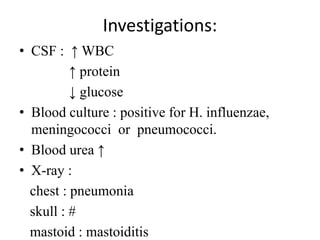
Investigations:
• CSF : ↑ WBC
↑ protein
↓ glucose
• Blood culture : positive for H. influenzae,
meningococci or pneumococci.
• Blood urea ↑
• X-ray :
chest : pneumonia
skull : #
mastoid : mastoiditis
• CT scan : cerebritis, vascular occlusion,
encephalomalacia, hydrocephalus, brain
abscess.
Medical treatment
• Neonates : ampicillin (100-150 mg/d) +
cefotaxime (50mg /kg)
• Older infant : ceftriaxone + vancomycin
• Elderly : ampicillin + ceftriaxone
• Older adult : vancomycin ( 1gm q8h)+
ceftriaxone (100mg/kg/day)
VIRAL (ASEPTIC ) MENINGITIS
• It does not typically cause notable
paranchymal involvement of brain and
spinal cord.
• It has a more benign clinical course.
• Cause : herpes simplex virus
- E-B virus
- cytomegalovirus
- mumps virus
- varicella zoster virus
- rabies virus
• Transmitted by droplet infection, close
personal contact or faeco-oral contact.
• Viral meningitis is sually self limited.
• Clinical features:
fever
headache
vomiting
meningeal irrritation
arthralgia
myalgia
sore throat
weakness
lethargy
Tuberculous meningitis
• It is caused by mycobacterium
tuburculum.
• Blood- borne spread certainly occurs.
• Aetiology :
age : 6months to 3 years
sex : equal incidence
primary infection : lung or
mediastinal gland
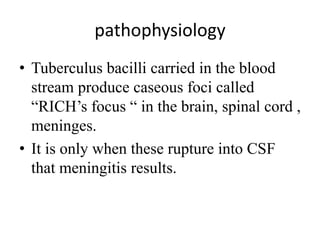
pathophysiology
• Tuberculus bacilli carried in the blood
stream produce caseous foci called
“RICH’s focus “ in the brain, spinal cord ,
meninges.
• It is only when these rupture into CSF
that meningitis results.
Clinical features
• 1) prodromal stage of sensory irritability:
high fever
drowsiness
anorexia
headache
restlessness
constipation
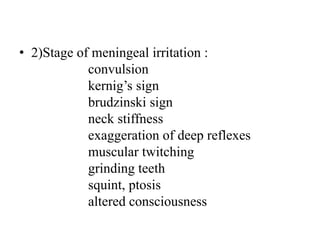
• 2)Stage of meningeal irritation :
convulsion
kernig’s sign
brudzinski sign
neck stiffness
exaggeration of deep reflexes
muscular twitching
grinding teeth
squint, ptosis
altered consciousness
• 3) terminal stage of coma :
- irritability replaced by coma
- rapid loss of weight
-tachycardia, irregular pulse
- irregular respiration ,chyne stoke
breathing
- tremors of limb , choreic movement
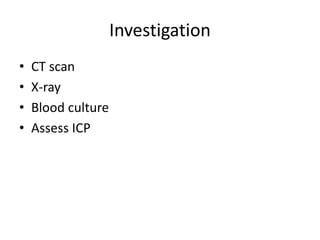
Investigation
• CT scan
• X-ray
• Blood culture
• Assess ICP
Treatment
• Antituberculin drugs RNTCP regimes
drugs Daily mg /kg Int15ermitten
t thrice
weekly mg/kg
Adverse
effect
Isoniazid 5 12-17 hepatotoxicity
polyneuritis
Rifampicin 10 15 hepatotoxicity
Red coloured
body
Pyrazinamide 25 35 hepatotoxicity
Streptomycin 15 15 Vestibular
damage
ethambutol 15 30 Retrobulbar
neuritis
Fungal meningitis
• Cause : cryptococcus
candida
blastomyces
aspergillus
• It is not spread from person to person.
• It can develop after a fungus spread through
blood stream from somewhere else in the
body to the brain or spinal cord.
• It may also get after taking medications that
weaken immune system.
Parasitic meningitis
• Cause is often assumed when there is a
predominance of eosinophils in tne CSF.
• Common parasites : schistosoma
amoeba
plasmodium
toxoplasma
Non -infectious meningitis
• Spread of cancer to the meninges and certain
drugs like NSAIDS , antibiotics
• Several inflammatory conditions like
sarcoidosis, SLE
CSF comparison
cause appearance Polymorpho
nuclear cells
lymphocyte protein Glucose
Bacterial
meningitis
Yellowish,
turbid
Markedly
increased
Slightly
increased or
normal
Markedly
increased
Decreased
Viral
meningitis
Clear fluid Slightly
increased or
normal
Markedly
increased
Slightly
increased or
normal
Normal
Tuberculous
meningitis
Yellowish
and viscous
Slightly
increased or
normal
Markedly
increased
increased Decreased
Fungal
meningitis
Yellowish
and viscous
Slightly
increased or
normal
Markedly
increased
Slightly
increased or
normal
Normal or
decreased
Physiotherapy treatment
Aims
• Chest care
• Normalization of tone
• Facilitation of ambulation
• Improve ROM
• Prevent DVT
• Improve functional activities
• Prevent bed sores
• Chest care : breathing exercise
chest expansion exercise
coughing ,huffing
positioning
chest clearance technique
• Normalization of tone: icing
slow passive movt
- electrical stimulation to
antagonist
- PNF technique like slow reversal
- sustained stretching
• Facilitation of ambulation :
- orthosis
- wheelchair
- training in parallel bar
• Atxia : frenkel’s exercise
balance exercise
• Cranial nerve palsy :
electrical stimulation
eye exercise
facial muscles exercise
• To prevent DVT : ankle pump exercise
• To prevent bed sores : move patient every 2
hours and positioning.
• Sensory integration
Reference
• 1. Golwalla’s MEDICINE for students;
A.golwalla, S.golwalla; 25th edition
• 2.MEDICINE prep manual for undergraduates;
K.Mathew , P,Aggarwal; 5th edition
• 3. Textbook of CLINICAL
NEUROANATOMY; Vishram Singh; 2nd
edition
• 4. Umphred’s neurological rehabilitation;
U.darcy; 6th edition
Meningitis
Meningitis

Meningitis

  • 1.
    DR. DHRUVI MISTRY (MPTIN NEUROLOGICAL SCIENCES)
  • 2.
    Include: • Introduction • Definition •Cause • Pathophysiology • Types • Investigations • Treatment
  • 3.
    • The brainand spinal cord are enclosed in three protective membranes called ‘meninges’. • From outward to inward: dura mater arachnoid mater pia mater • Arachnoid mater and pia mater together are termed leptomeninges.
  • 4.
    • Subarachnoid space: space exist between arachnoid mater and pia mater that contain cerebro-spinal fluid.
  • 6.
    Definition • Meningitis isthe inflammation of the meninges caused by infectious agents . • The inflammation is usually caused by infection of the fluid surrounding the brain and spinal cord. • Meningitis can be life-threatening because of the inflammation’s proximity to the brain and spinal cord, therefore it is classified as a medical emergency.
  • 8.
    • Meningitis mayalso be non-infectious in origin. E.g. in malignancy & toxic drugs • Micro organism can reach meninges by: -- blood stream -- skull fracture --midle ear infection --sinus
  • 9.
    Causes: infectious Non infectious BacterialMalignant Viral Vasculitis Protozoal Sarcoidosis Mycobacterial SLE Fungal RA Spirochaetal ricketssial
  • 10.
    PATHOPHYSIOLOGY Causative organism entersthe blood stream cross blood barriers inflammation in meninges inflammation of subarachnoid space CSF cloudiness ↑ ICP ↑ CSF cell count
  • 11.
    Types Bacterial viral parasiticfungal non infectious
  • 12.
    Bacterial meningitis • Itis potentially life threatening form of disease that can cause a serious complications such as brain damage, hearing loss and ultimately death. • Inflammation of leptomeninges and fluid in subarachnoid space occur. • Most commonly transmitted by blood stream.
  • 13.
    • It isalways cerebrospinal as the subarachnoid space is continuous around brain and spinal cord. • Causes: N. meningitidis H. influenza S. pneumoniae E .coli Group B Strepto.
  • 14.
    Clinical features • Infection: fever, rigors • ↑ ICP : headache, nausea, vomiting, hypertension, bradycardia • Meningeal irritation : neck stiffness photophobia seizures
  • 15.
    Clinical menifestation : •Kernig’s sign : severe stiffness of hamstrings causes an inability to straighten the leg when hip is flexed 90˚. • Brudzinski’s sign: passive flexion of the neck causes involuntary flexion of the knee and hip. • Carnial nerve palsies : 3rd , 4th, 6th & 7th • Nystagmus, aphasia, ataxia, peripheral nerve palsy.
  • 17.
    Investigations: • CSF :↑ WBC ↑ protein ↓ glucose • Blood culture : positive for H. influenzae, meningococci or pneumococci. • Blood urea ↑ • X-ray : chest : pneumonia skull : # mastoid : mastoiditis
  • 18.
    • CT scan: cerebritis, vascular occlusion, encephalomalacia, hydrocephalus, brain abscess.
  • 19.
    Medical treatment • Neonates: ampicillin (100-150 mg/d) + cefotaxime (50mg /kg) • Older infant : ceftriaxone + vancomycin • Elderly : ampicillin + ceftriaxone • Older adult : vancomycin ( 1gm q8h)+ ceftriaxone (100mg/kg/day)
  • 20.
    VIRAL (ASEPTIC )MENINGITIS • It does not typically cause notable paranchymal involvement of brain and spinal cord. • It has a more benign clinical course. • Cause : herpes simplex virus - E-B virus - cytomegalovirus
  • 21.
    - mumps virus -varicella zoster virus - rabies virus • Transmitted by droplet infection, close personal contact or faeco-oral contact. • Viral meningitis is sually self limited.
  • 22.
    • Clinical features: fever headache vomiting meningealirrritation arthralgia myalgia sore throat weakness lethargy
  • 23.
    Tuberculous meningitis • Itis caused by mycobacterium tuburculum. • Blood- borne spread certainly occurs. • Aetiology : age : 6months to 3 years sex : equal incidence primary infection : lung or mediastinal gland
  • 24.
    pathophysiology • Tuberculus bacillicarried in the blood stream produce caseous foci called “RICH’s focus “ in the brain, spinal cord , meninges. • It is only when these rupture into CSF that meningitis results.
  • 25.
    Clinical features • 1)prodromal stage of sensory irritability: high fever drowsiness anorexia headache restlessness constipation
  • 26.
    • 2)Stage ofmeningeal irritation : convulsion kernig’s sign brudzinski sign neck stiffness exaggeration of deep reflexes muscular twitching grinding teeth squint, ptosis altered consciousness
  • 27.
    • 3) terminalstage of coma : - irritability replaced by coma - rapid loss of weight -tachycardia, irregular pulse - irregular respiration ,chyne stoke breathing - tremors of limb , choreic movement
  • 28.
    Investigation • CT scan •X-ray • Blood culture • Assess ICP
  • 29.
    Treatment • Antituberculin drugsRNTCP regimes drugs Daily mg /kg Int15ermitten t thrice weekly mg/kg Adverse effect Isoniazid 5 12-17 hepatotoxicity polyneuritis Rifampicin 10 15 hepatotoxicity Red coloured body Pyrazinamide 25 35 hepatotoxicity Streptomycin 15 15 Vestibular damage ethambutol 15 30 Retrobulbar neuritis
  • 30.
    Fungal meningitis • Cause: cryptococcus candida blastomyces aspergillus • It is not spread from person to person. • It can develop after a fungus spread through blood stream from somewhere else in the body to the brain or spinal cord. • It may also get after taking medications that weaken immune system.
  • 31.
    Parasitic meningitis • Causeis often assumed when there is a predominance of eosinophils in tne CSF. • Common parasites : schistosoma amoeba plasmodium toxoplasma
  • 32.
    Non -infectious meningitis •Spread of cancer to the meninges and certain drugs like NSAIDS , antibiotics • Several inflammatory conditions like sarcoidosis, SLE
  • 33.
    CSF comparison cause appearancePolymorpho nuclear cells lymphocyte protein Glucose Bacterial meningitis Yellowish, turbid Markedly increased Slightly increased or normal Markedly increased Decreased Viral meningitis Clear fluid Slightly increased or normal Markedly increased Slightly increased or normal Normal Tuberculous meningitis Yellowish and viscous Slightly increased or normal Markedly increased increased Decreased Fungal meningitis Yellowish and viscous Slightly increased or normal Markedly increased Slightly increased or normal Normal or decreased
  • 34.
    Physiotherapy treatment Aims • Chestcare • Normalization of tone • Facilitation of ambulation • Improve ROM • Prevent DVT • Improve functional activities • Prevent bed sores
  • 35.
    • Chest care: breathing exercise chest expansion exercise coughing ,huffing positioning chest clearance technique • Normalization of tone: icing slow passive movt
  • 36.
    - electrical stimulationto antagonist - PNF technique like slow reversal - sustained stretching • Facilitation of ambulation : - orthosis - wheelchair - training in parallel bar
  • 37.
    • Atxia :frenkel’s exercise balance exercise • Cranial nerve palsy : electrical stimulation eye exercise facial muscles exercise • To prevent DVT : ankle pump exercise • To prevent bed sores : move patient every 2 hours and positioning. • Sensory integration
  • 38.
    Reference • 1. Golwalla’sMEDICINE for students; A.golwalla, S.golwalla; 25th edition • 2.MEDICINE prep manual for undergraduates; K.Mathew , P,Aggarwal; 5th edition • 3. Textbook of CLINICAL NEUROANATOMY; Vishram Singh; 2nd edition • 4. Umphred’s neurological rehabilitation; U.darcy; 6th edition