MENINGITIS Case Presentation Aquino, Sheila Mae B. Austria, Tiffany M. Cabigao, Marc Andrew
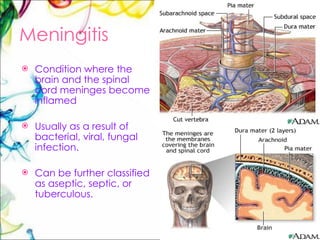
Meningitis Condition where the brain and the spinal cord meninges become inflamed Usually as a result of bacterial, viral, fungal infection. Can be further classified as aseptic, septic, or tuberculous.
The CNS consists of the brain, the spinal cord and the surrounding membranes or meninges that protect the delicate tissues from normal trauma. These tissues are also protected by the skull, the vertebral column, and the cerebrospinal fluid (CSF), the fluid in the subarachnoid space which serves as a cushion.
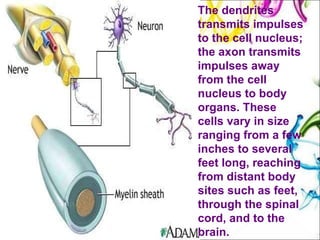
The dendrites transmits impulses to the cell nucleus; the axon transmits impulses away from the cell nucleus to body organs. These cells vary in size ranging from a few inches to several feet long, reaching from distant body sites such as feet, through the spinal cord, and to the brain.
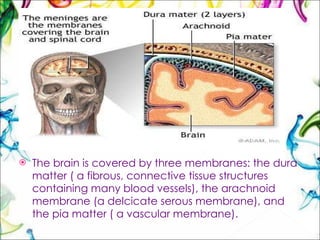
The brain is covered by three membranes: the dura matter ( a fibrous, connective tissue structures containing many blood vessels), the arachnoid membrane (a delcicate serous membrane), and the pia matter ( a vascular membrane).
 
Etiology Bacterial meningitis  is caused by bacteria and is rare, but is usually serious and can be life-threatening if it's not treated right away. Common agents are:  Group B streptococcus  Escherichia coli  Listeria monocytogenes  S treptococcus pneumoniae  (pneumococcus)   Neisseria meningitidis  (meningococcus)   Haemophilus influenza type b (Hib) Aseptic/Viral meningitis is caused by viruses. Common agents are:  Coxsackievirus  Poliovirus  Hepatitis A  Herpesvirus
Epidemiology Bacterial meningitis occurs in about 3 people per 100,000 annually in western world.  Population-wide studies have shown that viral meningitis is more common, at 10.9 per 100,000, and occurs more often in the summer. In Sub-saharan Africa, large epidemics of meningococcal meningitis occur in the dry season, leading to it being labeled the "meningitis belt"; annual rates of 500 cases per 100,000 are encountered in this area, which is poorly served by Health Care.  Meningococcal disease occurs in epidemics in areas where many people live together for the first time, such as army barracks during mobilization, college campuses.
Transmission Meningitis is spread by direct contact with a carrier’s secretions, especially by respiratory droplets. People may be carrier’s only, without having he actual disease.
High-risk groups 1. Anyone who lives in close contact with many people. 2. Anyone who has frequent upper respiratory infections. 3. Anyone who has had trauma or an invasive procedure involving the brain, spinal cord, or sinuses.
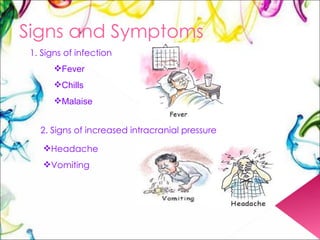
Signs and Symptoms 1. Signs of infection Fever Chills Malaise 2. Signs of increased intracranial pressure Headache Vomiting
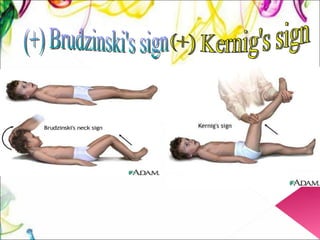
3. Signs of meningeal irritation Nuchal rigidity (stiff neck) Opisthotonos  (backward arching of the body in muscle spasms) Photophobia (sensitivity to light) Diplopia (double vision) Delirium, stupor, coma: indicates a decreasing level of consciousness, an agitated state followed by a progressive decrease in consciousness, and ultimately a lack of any response.
(+) Brudzinski's sign (+) Kernig's sign
4. Children may exhibit any of the signs and symptoms listed above, as well as these signs: Bulging fontanelle Twitching, seizures, and coma
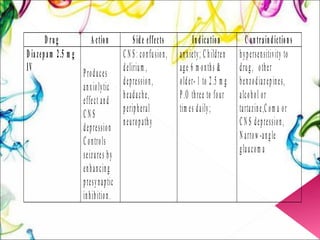
Treatment Bed rest I.V. fluid administration Oxygen therapy Medications  Anticonvulsant (prevent seizures ): Phenytoin (Dilantin), Phenobarbital (Barbita, Luminal, Solfoton) Analgesic or antipyretic (to treat fever and muscle aches ): acetaminophen (Tylenol or Panadol), nonsteroidal anti-inflammatory drugs(NSAIDs) Aspirin ibuprofen, ketoprofen, and naproxen ( reduce pressure within the brain): Dexamethasone (corticosteroid medicine), Mannitol (Osmitrol) Antibiotics  - depend on the isolated microorganism
Prevention Haemophilus vaccine (HiB vaccine) (MMR) vaccine (measles, mumps, and rubella ) meningococcal vaccine (MCV4) pneumococcal conjugate vaccine Good personal hygiene  Avoiding people who have meningitis.
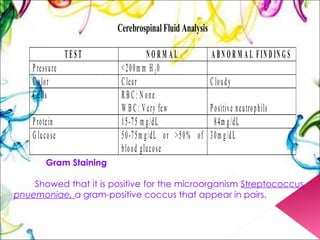
Lab and Diagnostic Exams Meningitis is diagnosed by analysis of the spinal fluid. Spinal fluid is obtained by a procedure called the  lumbar puncture or spinal tap  in which a needle is introduced into the space between vertebraeL-3 and L-4, because the spinal cord ends at L-2. Spinal fluis is withdrawn from the subarachnoid space.
A  CBC  will indicate acute infection. Bacterial antigen testing may also be done. A  Gram’s stain  will determine the presence of bacteria. A full culture should be done with sensitivity.  Radiograph y   skull and spine x-rays used to identify sinus infections, fracture, or osteomyellitis; chest x-rays may be used to identify respiratory infections, abscesses, lesions, or granulomas. CT scan   will usually be normal in uncomplicated cases of meningitis, but can show diffuse enhancement in some types or show hydrocephalus. Electroencephalogram   may be performed to show slow wave activity.
Pathophysiology Enters the bloodstream &  Crosses the blood-brain barrier BACTERIA Invasion of the nasopharynx Proliferates the CSF Inflammation of the subarachnoid & pia mater Increased ICP
Theoretical Framework Wellness or Disease Pure or Fresh Water Pure Water Light Efficient Drainage Cleanliness Nightingale’s Environmental Theory Florence Nightingale defined nursing as “the act of utilizing the environment of the patient to assist him in his recovery”. Based on her theory the five environmental factors: pure or fresh air, pure water, efficient drainage, cleanliness and light affect client’s illness or health. Any deficiencies in these five factors produced lack of health or illness.
CASE STUDY
Biographic Data Patient: C.A.M (Second Child) Sex: Male Age: 9 months  Address: Sitio Taguisan Bagong Nayon, Antipolo City  Weight 8.6kg Birth Day: October 24, 2008 Mother: Marites A. Magbanua Age: 33years old Occupation: Housewife Birth Date: February 14 1976  Father: Henry V. Magbanua (Security Guard) Age: 36 years old Occupation: Security Guard Birth Date: August 16, 1973 Religion: Catholic
Socio-Economic History Place and nature of dwelling: Own House,  area is slighty crowded but with good ventilation. Source of Water: Nawasa, Mineral Type of lightning: Electricity, Florescent Number of persons living in the house: 4 Member of the Family who work: 1 (Father) Financial Status: 5,000.00/month
Admission Confined Date: June 23, 2009   Time: 11:20am Verbalized by the Mother: Fever, Convulsion Behavior: Irritable Medication Given By the Mother: Paracetamol June 19 2009, Patient was febrile that lasted for four days; by June 23, 2009 @ 10pm patient was confined due to Convulsion at NCH.
Physical Examination General Appearance and Condition: Asleep, not in Distress Temperature: 38.3   C Pulse Rate: 128bpm Weight: 8.6kgs Height: 69cm Head Circumference: 94cm Chest Circumference: 46cm Abdominal circumference: 45cm Blood Pressure: 100/60 mmHg HEENT: slightly pinkish, palpebral conjuctiva Thorax and Spine: No deformity in Lungs Skin: Warm and flushed
Nervous System Cerebrum: awake Cerebellum: No nystagmus 2-3mm ERTC when awake, pinpoint when asleep CN III,IV,VI- (+) bicomeal reflex CN  VII- no facial assemtry CN  IX- (+) gag reflex CN  XI- midline tongue Motor: cannot move all Sensory: withdrawal and pain  Meningeal Signs: Nuchal ridigity (+) Kernig’s Sign (+) Brudzinski’s sign (+)
Past & Present illness Otitis Media @ 6months Fever for 4 days PTA Cough & cold Diarrhea
Immunization
Developmental Milestones
Nutritional-Metabolic Pattern Soft Diet: Bottle Feed: 4ounce Breast Feed  Rice Porridge Biscuit Water
Systems Review A review of all health problems of body systems: General: Fever EENT: Eye redness, ear discharge Skin: Warm and flushed Respiratory: Cough & cold GIT: diarrhea GUT: dysuria
Lab and Diagnostic Exams CT Scan   No lesion intact Ventricles normal Midline structure undisplaced Sella/pineal gland/posterior fossa unremarkable Anterior fontanelle infused IMPRESSION: Meningitis with subdural empyema as described
Gram Staining  Showed that it is positive for the microorganism  Streptococcus  pnuemoniae,  a gram-positive coccus that appear in pairs.
Pharmacologic Intervention Ch
 
Me Pen
Nursing Diagnosis  Hyperthermia related to positive bacterial infection as manifested by flushed and warm to touch skin.  Acute pain related to meningeal irritation with spasm of extensor muscles (neck, shoulders and back) as manifested by positive kernig’s and brudzinski’s sign.  Risk for ineffective cerebral tissue perfusion related to increased intracranial pressure.  Risk for infection related to presence of infective organisms  Risk for injury related to presence of infection  Altered thermoregulation related to compression of hypothalamus  Altered family processes related to having a child with a serious illness
Nursing Management  Monitor vital signs constantly. Determine oxygenation from arterial blood gas values and pulse oximetry.  Give oxygen to maintain arterial partial pressure of oxygen.  Reduce high fever to decrease load on heart and brain from oxygen demands.  Rapid intravenous fluid replacement may be prescribed, but take care not to overhydrate patient because of risk of cerebral edema.  Assess clinical status continuously; evaluate skin and oral hygiene; promote comfort; and protect patient during seizures.  Implement infection control precautions and respiratory isolation until 24 hours after start of antibiotic therapy  Inform family about patient’s condition
Nursing Care Plan CUES NURSING DIAGNOSIS GOAL NURSING INTERVENTION EVALUATION SUBJECTIVE: “ Mataas pa din ang lagnat nya hanggang ngayon” as verbalized by the patient’s mother. OBJECTIVE: -flushed skin -skin warm to touch -38.2 ºC -PR 109 -RR 34 -BP 90/60 Hyperthermia related to positive bacterial infection as manifested by flushed and warm to touch skin Short term: Within 1 hour of nursing intervention, the patient’s elevated temperature of 38.2 o C will lessen to 37.4 o C. Long term: Within 3 consecutive days of nursing intervention, the patient’s body temperature will return to its normal range. Establish rapport to mother to gain trust and cooperation Promote surface cooling by means of undressing ( heat loss by radiation and conduction) Demonstrate on ways on how to do proper Tepid Sponge Bath using wet and dry cloth Provide nutritious diet to meet increased metabolic demands Administer antipyretics as ordered . After 1 hour of nursing intervention, the goal is partially achieved as manifested by temperature of  37.7 o C.
CUES NURSING DIAGNOSIS GOAL NURSING INTERVENTION EVALUATION Subjective: “ Umiiyak yan kapag nagagalaw yung batok niya tska nung may ginawa si doctor sa kanya”  Objective: - facial grimace - irritable - ( + ) Brudzinski’s sign - ( + ) Kernig’s sign Acute pain related to meningeal irritation with spasm of extensor muscles (neck, shoulders and back) as manifested by positive kernig’s and brudzinski’s sign. Within 2 hours of nursing intervention, the patient’s pain from 8 will reduce to 4 using the facial pain rating scale. Use pain rating scale appropriate to it’s age. Assess for neurologic status and vital signs. Position on the side with head gently supported in extension. Promote rest by keeping stimulation in the room to a minimum. Institute respiratory isolation. Monitor and record carefully intake and output. Administer mediation as ordered. After 2 hours of nursing intervention, there is no sign of facial grimace and irritability from the patient.
CUES NURSING DIAGNOSIS GOAL NURSING INTERVENTION EVALUATION Objective: - lethargic - change in motor responses - changes in papillary reaction Risk for ineffective cerebral tissue perfusion related to increased intracranial pressure Within an hour of nursing intervention, the nurse will be able to educate the patient’s mother about the causes and symptoms of ineffective cerebral tissue perfusion Educate patient’s mother about the causes of ineffective cerebral tissue perfusion. Observe carefully for signs of increased intracranial pressure such as; lethargy, shrill cry, hyperactive reflexes, decreased pulse and respiratory rate, increased blood pressure and temperature Carefully monitor the rate of all IV infusions to prevent overhydration Check for the urine’s specific gravity to detect oversecretion or undersecretion of ADH due to pituitary pressure Measure head circumference and weight Monitor vital signs After an hour of nursing intervention, the patient’s mother is educated about the causes and symptoms of ineffective cerebral tissue perfusion.
Discharge Planning Medicines: -take your (antibiotics) medications as prescribed by physician. -do not quit taking your (antibiotics) meds until your physician say so Wellness: -eat a variety of healthy foods such as fruits and vegetables -drink more liquid like water, juices and milk -avoid stress by providing calm and clean environment, stress causes slow healing. Health teaching: -teach patient’s mother how to perform oral care and it’s benefits Check-up: -teach patient’s mother to have a regular check-up in the health center or in the nearest hospital.

meningitis

  • 1.
    MENINGITIS Case PresentationAquino, Sheila Mae B. Austria, Tiffany M. Cabigao, Marc Andrew
  • 2.
    Meningitis Condition wherethe brain and the spinal cord meninges become inflamed Usually as a result of bacterial, viral, fungal infection. Can be further classified as aseptic, septic, or tuberculous.
  • 3.
    The CNS consistsof the brain, the spinal cord and the surrounding membranes or meninges that protect the delicate tissues from normal trauma. These tissues are also protected by the skull, the vertebral column, and the cerebrospinal fluid (CSF), the fluid in the subarachnoid space which serves as a cushion.
  • 4.
    The dendrites transmitsimpulses to the cell nucleus; the axon transmits impulses away from the cell nucleus to body organs. These cells vary in size ranging from a few inches to several feet long, reaching from distant body sites such as feet, through the spinal cord, and to the brain.
  • 5.
    The brain iscovered by three membranes: the dura matter ( a fibrous, connective tissue structures containing many blood vessels), the arachnoid membrane (a delcicate serous membrane), and the pia matter ( a vascular membrane).
  • 6.
  • 7.
    Etiology Bacterial meningitis is caused by bacteria and is rare, but is usually serious and can be life-threatening if it's not treated right away. Common agents are:  Group B streptococcus  Escherichia coli  Listeria monocytogenes  S treptococcus pneumoniae (pneumococcus)  Neisseria meningitidis (meningococcus)  Haemophilus influenza type b (Hib) Aseptic/Viral meningitis is caused by viruses. Common agents are:  Coxsackievirus  Poliovirus  Hepatitis A  Herpesvirus
  • 8.
    Epidemiology Bacterial meningitisoccurs in about 3 people per 100,000 annually in western world. Population-wide studies have shown that viral meningitis is more common, at 10.9 per 100,000, and occurs more often in the summer. In Sub-saharan Africa, large epidemics of meningococcal meningitis occur in the dry season, leading to it being labeled the "meningitis belt"; annual rates of 500 cases per 100,000 are encountered in this area, which is poorly served by Health Care. Meningococcal disease occurs in epidemics in areas where many people live together for the first time, such as army barracks during mobilization, college campuses.
  • 9.
    Transmission Meningitis isspread by direct contact with a carrier’s secretions, especially by respiratory droplets. People may be carrier’s only, without having he actual disease.
  • 10.
    High-risk groups 1.Anyone who lives in close contact with many people. 2. Anyone who has frequent upper respiratory infections. 3. Anyone who has had trauma or an invasive procedure involving the brain, spinal cord, or sinuses.
  • 11.
    Signs and Symptoms1. Signs of infection Fever Chills Malaise 2. Signs of increased intracranial pressure Headache Vomiting
  • 12.
    3. Signs ofmeningeal irritation Nuchal rigidity (stiff neck) Opisthotonos (backward arching of the body in muscle spasms) Photophobia (sensitivity to light) Diplopia (double vision) Delirium, stupor, coma: indicates a decreasing level of consciousness, an agitated state followed by a progressive decrease in consciousness, and ultimately a lack of any response.
  • 13.
    (+) Brudzinski's sign(+) Kernig's sign
  • 14.
    4. Children mayexhibit any of the signs and symptoms listed above, as well as these signs: Bulging fontanelle Twitching, seizures, and coma
  • 15.
    Treatment Bed restI.V. fluid administration Oxygen therapy Medications Anticonvulsant (prevent seizures ): Phenytoin (Dilantin), Phenobarbital (Barbita, Luminal, Solfoton) Analgesic or antipyretic (to treat fever and muscle aches ): acetaminophen (Tylenol or Panadol), nonsteroidal anti-inflammatory drugs(NSAIDs) Aspirin ibuprofen, ketoprofen, and naproxen ( reduce pressure within the brain): Dexamethasone (corticosteroid medicine), Mannitol (Osmitrol) Antibiotics - depend on the isolated microorganism
  • 16.
    Prevention Haemophilus vaccine(HiB vaccine) (MMR) vaccine (measles, mumps, and rubella ) meningococcal vaccine (MCV4) pneumococcal conjugate vaccine Good personal hygiene Avoiding people who have meningitis.
  • 17.
    Lab and DiagnosticExams Meningitis is diagnosed by analysis of the spinal fluid. Spinal fluid is obtained by a procedure called the lumbar puncture or spinal tap in which a needle is introduced into the space between vertebraeL-3 and L-4, because the spinal cord ends at L-2. Spinal fluis is withdrawn from the subarachnoid space.
  • 18.
    A CBC will indicate acute infection. Bacterial antigen testing may also be done. A Gram’s stain will determine the presence of bacteria. A full culture should be done with sensitivity. Radiograph y skull and spine x-rays used to identify sinus infections, fracture, or osteomyellitis; chest x-rays may be used to identify respiratory infections, abscesses, lesions, or granulomas. CT scan will usually be normal in uncomplicated cases of meningitis, but can show diffuse enhancement in some types or show hydrocephalus. Electroencephalogram may be performed to show slow wave activity.
  • 19.
    Pathophysiology Enters thebloodstream & Crosses the blood-brain barrier BACTERIA Invasion of the nasopharynx Proliferates the CSF Inflammation of the subarachnoid & pia mater Increased ICP
  • 20.
    Theoretical Framework Wellnessor Disease Pure or Fresh Water Pure Water Light Efficient Drainage Cleanliness Nightingale’s Environmental Theory Florence Nightingale defined nursing as “the act of utilizing the environment of the patient to assist him in his recovery”. Based on her theory the five environmental factors: pure or fresh air, pure water, efficient drainage, cleanliness and light affect client’s illness or health. Any deficiencies in these five factors produced lack of health or illness.
  • 21.
  • 22.
    Biographic Data Patient:C.A.M (Second Child) Sex: Male Age: 9 months Address: Sitio Taguisan Bagong Nayon, Antipolo City Weight 8.6kg Birth Day: October 24, 2008 Mother: Marites A. Magbanua Age: 33years old Occupation: Housewife Birth Date: February 14 1976 Father: Henry V. Magbanua (Security Guard) Age: 36 years old Occupation: Security Guard Birth Date: August 16, 1973 Religion: Catholic
  • 23.
    Socio-Economic History Placeand nature of dwelling: Own House, area is slighty crowded but with good ventilation. Source of Water: Nawasa, Mineral Type of lightning: Electricity, Florescent Number of persons living in the house: 4 Member of the Family who work: 1 (Father) Financial Status: 5,000.00/month
  • 24.
    Admission Confined Date:June 23, 2009 Time: 11:20am Verbalized by the Mother: Fever, Convulsion Behavior: Irritable Medication Given By the Mother: Paracetamol June 19 2009, Patient was febrile that lasted for four days; by June 23, 2009 @ 10pm patient was confined due to Convulsion at NCH.
  • 25.
    Physical Examination GeneralAppearance and Condition: Asleep, not in Distress Temperature: 38.3  C Pulse Rate: 128bpm Weight: 8.6kgs Height: 69cm Head Circumference: 94cm Chest Circumference: 46cm Abdominal circumference: 45cm Blood Pressure: 100/60 mmHg HEENT: slightly pinkish, palpebral conjuctiva Thorax and Spine: No deformity in Lungs Skin: Warm and flushed
  • 26.
    Nervous System Cerebrum:awake Cerebellum: No nystagmus 2-3mm ERTC when awake, pinpoint when asleep CN III,IV,VI- (+) bicomeal reflex CN VII- no facial assemtry CN IX- (+) gag reflex CN XI- midline tongue Motor: cannot move all Sensory: withdrawal and pain Meningeal Signs: Nuchal ridigity (+) Kernig’s Sign (+) Brudzinski’s sign (+)
  • 27.
    Past & Presentillness Otitis Media @ 6months Fever for 4 days PTA Cough & cold Diarrhea
  • 28.
  • 29.
  • 30.
    Nutritional-Metabolic Pattern SoftDiet: Bottle Feed: 4ounce Breast Feed Rice Porridge Biscuit Water
  • 31.
    Systems Review Areview of all health problems of body systems: General: Fever EENT: Eye redness, ear discharge Skin: Warm and flushed Respiratory: Cough & cold GIT: diarrhea GUT: dysuria
  • 32.
    Lab and DiagnosticExams CT Scan No lesion intact Ventricles normal Midline structure undisplaced Sella/pineal gland/posterior fossa unremarkable Anterior fontanelle infused IMPRESSION: Meningitis with subdural empyema as described
  • 33.
    Gram Staining Showed that it is positive for the microorganism Streptococcus pnuemoniae, a gram-positive coccus that appear in pairs.
  • 34.
  • 35.
  • 36.
  • 37.
    Nursing Diagnosis Hyperthermia related to positive bacterial infection as manifested by flushed and warm to touch skin.  Acute pain related to meningeal irritation with spasm of extensor muscles (neck, shoulders and back) as manifested by positive kernig’s and brudzinski’s sign.  Risk for ineffective cerebral tissue perfusion related to increased intracranial pressure.  Risk for infection related to presence of infective organisms  Risk for injury related to presence of infection  Altered thermoregulation related to compression of hypothalamus  Altered family processes related to having a child with a serious illness
  • 38.
    Nursing Management Monitor vital signs constantly. Determine oxygenation from arterial blood gas values and pulse oximetry.  Give oxygen to maintain arterial partial pressure of oxygen.  Reduce high fever to decrease load on heart and brain from oxygen demands.  Rapid intravenous fluid replacement may be prescribed, but take care not to overhydrate patient because of risk of cerebral edema.  Assess clinical status continuously; evaluate skin and oral hygiene; promote comfort; and protect patient during seizures.  Implement infection control precautions and respiratory isolation until 24 hours after start of antibiotic therapy  Inform family about patient’s condition
  • 39.
    Nursing Care PlanCUES NURSING DIAGNOSIS GOAL NURSING INTERVENTION EVALUATION SUBJECTIVE: “ Mataas pa din ang lagnat nya hanggang ngayon” as verbalized by the patient’s mother. OBJECTIVE: -flushed skin -skin warm to touch -38.2 ºC -PR 109 -RR 34 -BP 90/60 Hyperthermia related to positive bacterial infection as manifested by flushed and warm to touch skin Short term: Within 1 hour of nursing intervention, the patient’s elevated temperature of 38.2 o C will lessen to 37.4 o C. Long term: Within 3 consecutive days of nursing intervention, the patient’s body temperature will return to its normal range. Establish rapport to mother to gain trust and cooperation Promote surface cooling by means of undressing ( heat loss by radiation and conduction) Demonstrate on ways on how to do proper Tepid Sponge Bath using wet and dry cloth Provide nutritious diet to meet increased metabolic demands Administer antipyretics as ordered . After 1 hour of nursing intervention, the goal is partially achieved as manifested by temperature of 37.7 o C.
  • 40.
    CUES NURSING DIAGNOSISGOAL NURSING INTERVENTION EVALUATION Subjective: “ Umiiyak yan kapag nagagalaw yung batok niya tska nung may ginawa si doctor sa kanya” Objective: - facial grimace - irritable - ( + ) Brudzinski’s sign - ( + ) Kernig’s sign Acute pain related to meningeal irritation with spasm of extensor muscles (neck, shoulders and back) as manifested by positive kernig’s and brudzinski’s sign. Within 2 hours of nursing intervention, the patient’s pain from 8 will reduce to 4 using the facial pain rating scale. Use pain rating scale appropriate to it’s age. Assess for neurologic status and vital signs. Position on the side with head gently supported in extension. Promote rest by keeping stimulation in the room to a minimum. Institute respiratory isolation. Monitor and record carefully intake and output. Administer mediation as ordered. After 2 hours of nursing intervention, there is no sign of facial grimace and irritability from the patient.
  • 41.
    CUES NURSING DIAGNOSISGOAL NURSING INTERVENTION EVALUATION Objective: - lethargic - change in motor responses - changes in papillary reaction Risk for ineffective cerebral tissue perfusion related to increased intracranial pressure Within an hour of nursing intervention, the nurse will be able to educate the patient’s mother about the causes and symptoms of ineffective cerebral tissue perfusion Educate patient’s mother about the causes of ineffective cerebral tissue perfusion. Observe carefully for signs of increased intracranial pressure such as; lethargy, shrill cry, hyperactive reflexes, decreased pulse and respiratory rate, increased blood pressure and temperature Carefully monitor the rate of all IV infusions to prevent overhydration Check for the urine’s specific gravity to detect oversecretion or undersecretion of ADH due to pituitary pressure Measure head circumference and weight Monitor vital signs After an hour of nursing intervention, the patient’s mother is educated about the causes and symptoms of ineffective cerebral tissue perfusion.
  • 42.
    Discharge Planning Medicines:-take your (antibiotics) medications as prescribed by physician. -do not quit taking your (antibiotics) meds until your physician say so Wellness: -eat a variety of healthy foods such as fruits and vegetables -drink more liquid like water, juices and milk -avoid stress by providing calm and clean environment, stress causes slow healing. Health teaching: -teach patient’s mother how to perform oral care and it’s benefits Check-up: -teach patient’s mother to have a regular check-up in the health center or in the nearest hospital.