Genetics and Heredity
Inheritance
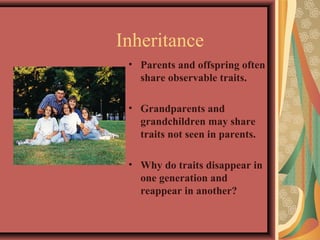
• Parents and offspring often
share observable traits.
• Grandparents and
grandchildren may share
traits not seen in parents.
• Why do traits disappear in
one generation and
reappear in another?
Background
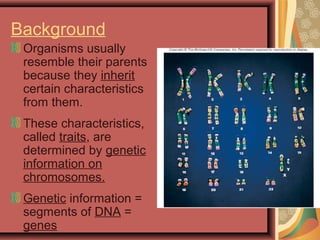
Organisms usually
resemble their parents
because they inherit
certain characteristics
from them.
These characteristics,
called traits, are
determined by genetic
information on
chromosomes.
Genetic information =
segments of DNA =
genes
Definitions
Genetics = the branch of biology that
studies heredity
Heredity = the passing on of
characteristics from parents to
offspring
***from the Latin word hered-,
meaning “heir.”
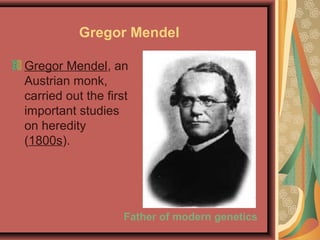
Gregor Mendel
Father of modern genetics
Gregor Mendel, an
Austrian monk,
carried out the first
important studies
on heredity
(1800s).
History
Mendel was the first person to
succeed in predicting how traits would
be transferred from one generation to
the next.
Earlier observers looked at many
traits at once-- Mendel focused on
one at a time
Mendel Combined:
• Plant breeding
• Statistics
• Careful record keeping
Mendel’s findings of transmission of traits are
now considered the Laws of Inheritance.
Mendel’s Experiments
Mendel studied the pea plant Pisum
sativum
- easy to cultivate and a short life cycle
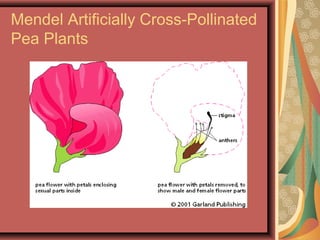
- easy to control pollination
- keep unwanted pollen out
- cross-fertilize artificially
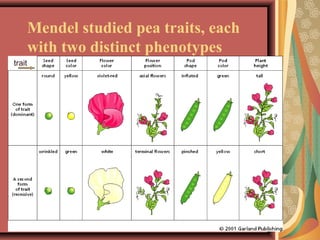
-had discontinuous characteristics
-Ex: flower color, seed texture
-knew of at least 34 such traits
Mendel Artificially Cross-Pollinated
Pea Plants
Mendel studied pea traits, each
with two distinct phenotypes
trait
TERMINOLOGY
PHENOTYPE - appearance
("pheno-"=visible, as in
"phenomenon")
GENOTYPE - genetic make-up, not
always visible, but detectable by
performing crosses
ALLELES - variants of a gene.
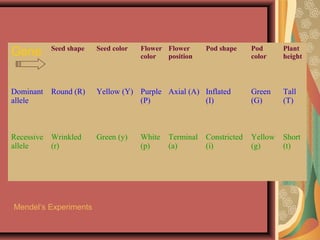
Gene Seed shape Seed color Flower
color
Flower
position
Pod shape Pod
color
Plant
height
Dominant
allele
Round (R) Yellow (Y) Purple
(P)
Axial (A) Inflated
(I)
Green
(G)
Tall
(T)
Recessive
allele
Wrinkled
(r)
Green (y) White
(p)
Terminal
(a)
Constricted
(i)
Yellow
(g)
Short
(t)
Mendel‘s Experiments
Three important written conventions
for writing genotypes:
The same letter is used for different
alleles of the same gene.
Uppercase letters are used for
dominant alleles and lowercase
letters are used for recessive
alleles.
The letter for the dominant allele is
always written first.
TERMINOLOGY
HOMOZYGOUS - having two alleles
that are alike
HETEROZYGOUS - having two
unlike alleles
DOMINANT - showing a phenotypic
effect in heterozygous form
RECESSIVE - showing a phenotypic
effect only when homozygous
Mendel’s Laws of Inheritance
"LAW OF SEGREGATION" - dominant and
recessive alleles of heterozygote separate
from one another during meiosis
"LAW OF INDEPENDENT ASSORTMENT"
for 2 genes at a time: genes at different
locations are chosen (sampled)
independently of one another during gamete
formation.
“LAW OF DOMINANCE” – recessive alleles
will always be masked by dominant alleles

Mendelian genetics

  • 1.
  • 2.
    Inheritance • Parents andoffspring often share observable traits. • Grandparents and grandchildren may share traits not seen in parents. • Why do traits disappear in one generation and reappear in another?
  • 3.
    Background Organisms usually resemble theirparents because they inherit certain characteristics from them. These characteristics, called traits, are determined by genetic information on chromosomes. Genetic information = segments of DNA = genes
  • 4.
    Definitions Genetics = thebranch of biology that studies heredity Heredity = the passing on of characteristics from parents to offspring ***from the Latin word hered-, meaning “heir.”
  • 5.
    Gregor Mendel Father ofmodern genetics Gregor Mendel, an Austrian monk, carried out the first important studies on heredity (1800s).
  • 6.
    History Mendel was thefirst person to succeed in predicting how traits would be transferred from one generation to the next. Earlier observers looked at many traits at once-- Mendel focused on one at a time
  • 7.
    Mendel Combined: • Plantbreeding • Statistics • Careful record keeping Mendel’s findings of transmission of traits are now considered the Laws of Inheritance. Mendel’s Experiments
  • 8.
    Mendel studied thepea plant Pisum sativum - easy to cultivate and a short life cycle - easy to control pollination - keep unwanted pollen out - cross-fertilize artificially -had discontinuous characteristics -Ex: flower color, seed texture -knew of at least 34 such traits
  • 9.
  • 10.
    Mendel studied peatraits, each with two distinct phenotypes trait
  • 11.
    TERMINOLOGY PHENOTYPE - appearance ("pheno-"=visible,as in "phenomenon") GENOTYPE - genetic make-up, not always visible, but detectable by performing crosses ALLELES - variants of a gene.
  • 12.
    Gene Seed shapeSeed color Flower color Flower position Pod shape Pod color Plant height Dominant allele Round (R) Yellow (Y) Purple (P) Axial (A) Inflated (I) Green (G) Tall (T) Recessive allele Wrinkled (r) Green (y) White (p) Terminal (a) Constricted (i) Yellow (g) Short (t) Mendel‘s Experiments
  • 13.
    Three important writtenconventions for writing genotypes: The same letter is used for different alleles of the same gene. Uppercase letters are used for dominant alleles and lowercase letters are used for recessive alleles. The letter for the dominant allele is always written first.
  • 14.
    TERMINOLOGY HOMOZYGOUS - havingtwo alleles that are alike HETEROZYGOUS - having two unlike alleles DOMINANT - showing a phenotypic effect in heterozygous form RECESSIVE - showing a phenotypic effect only when homozygous
  • 15.
    Mendel’s Laws ofInheritance "LAW OF SEGREGATION" - dominant and recessive alleles of heterozygote separate from one another during meiosis "LAW OF INDEPENDENT ASSORTMENT" for 2 genes at a time: genes at different locations are chosen (sampled) independently of one another during gamete formation. “LAW OF DOMINANCE” – recessive alleles will always be masked by dominant alleles

Editor's Notes

  • #4 Characteristic = a heritable feature (ex. Flower color) Trait = a genetically determined variant of a characteristic (ex. Yellow flower color)
  • #9 True-breeding = pure for a trait, always produce offspring with that trait when they self-pollinate.
  • #10 Pollination = occurs when pollen grains produced in the male parts of a flower (anther) are transferred to the female parts of the flower (stigma) Self-pollination = occurs when pollen is transferred from the anthers of a flower to the stigma of either that flower or another flower on the same plant. Cross-pollination = occurs between flowers of two (different) plants. *Pea plants normally reproduce through self-pollination.
  • #11 A Mendelian trait is one that is controlled by a single locus in an inheritance pattern. Mendel explained inheritance in terms of discrete factors—genes—that are passed along from generation to generation according to the rules of probability. Peas have seven pairs of chromosomes and each trait studied by Mendel is on a different chromosome.
  • #16 Mendel's laws are valid for all sexually reproducing organisms, including garden peas and human beings. However, Mendel's laws stop short of explaining some patterns of genetic inheritance. For most sexually reproducing organisms, cases where Mendel's laws can strictly account for the patterns of inheritance are relatively rare. Often, the inheritance patterns are more complex.