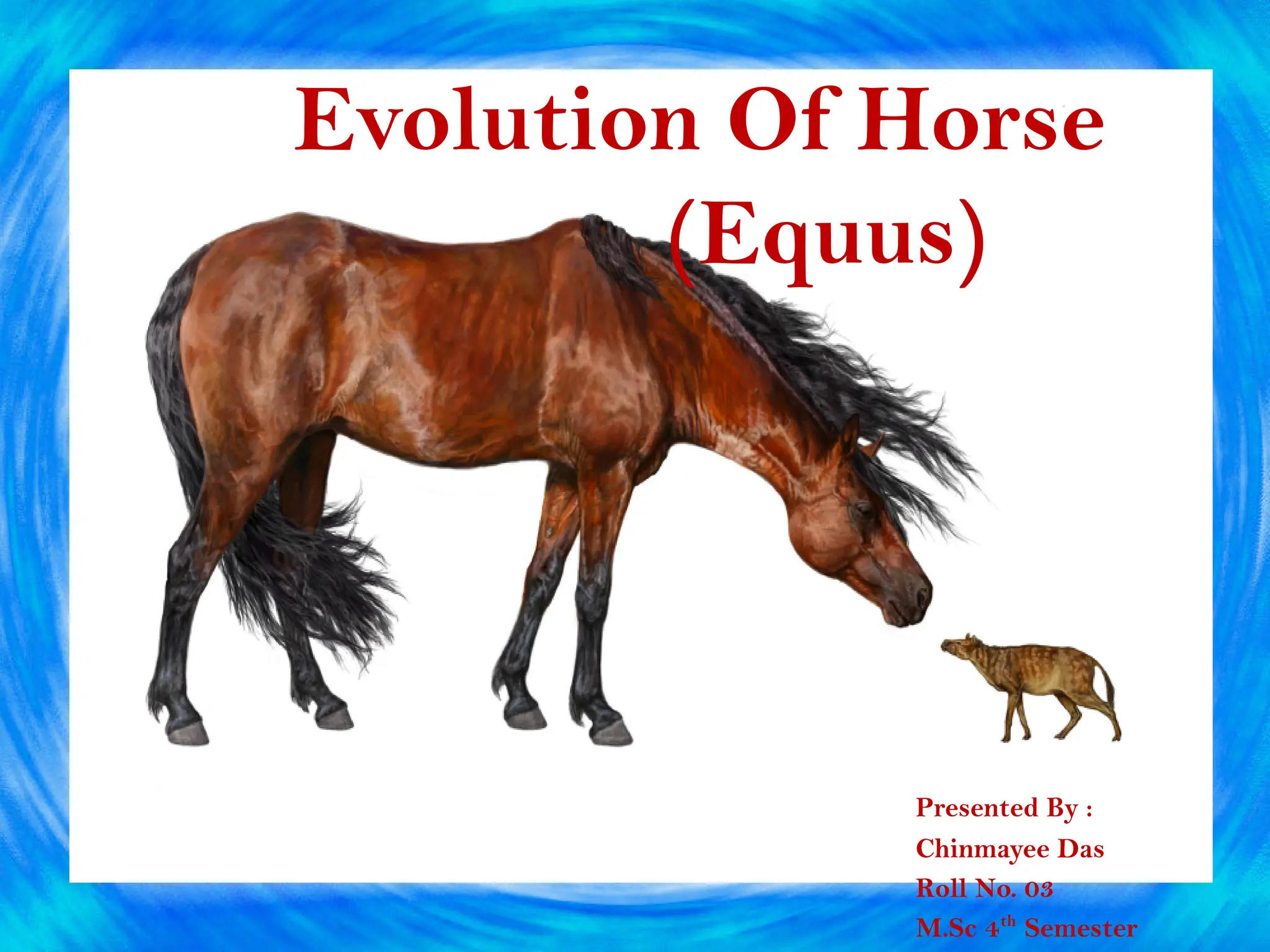
Evolution Of Horse
(Equus)
Presented By :
Chinmayee Das
Roll No. 03
M.Sc 4th
Semester
▪ Of all the evolutionary histories, the origin & evolutionary history of horse is
widely known because the fossil records of the horses are remarkably
complete and well understood.
▪ The evolutionary history of horse is a classical example of Orthogenesis or
straight course of evolution.
▪ Further, it offers the finest example of progressive evolution through natural
selection.
▪ This is because of the pattern of evolution of horse found is remarkably simple
showing a single line of adaptation instead of showing diversification through
multiple radiation along different lines & it also exhibits progressive change of
characters in some predetermined directions.
▪ This evolutionary course of Equidae is often viewed as a typical example of
macroevolution.
INTRODUCTION
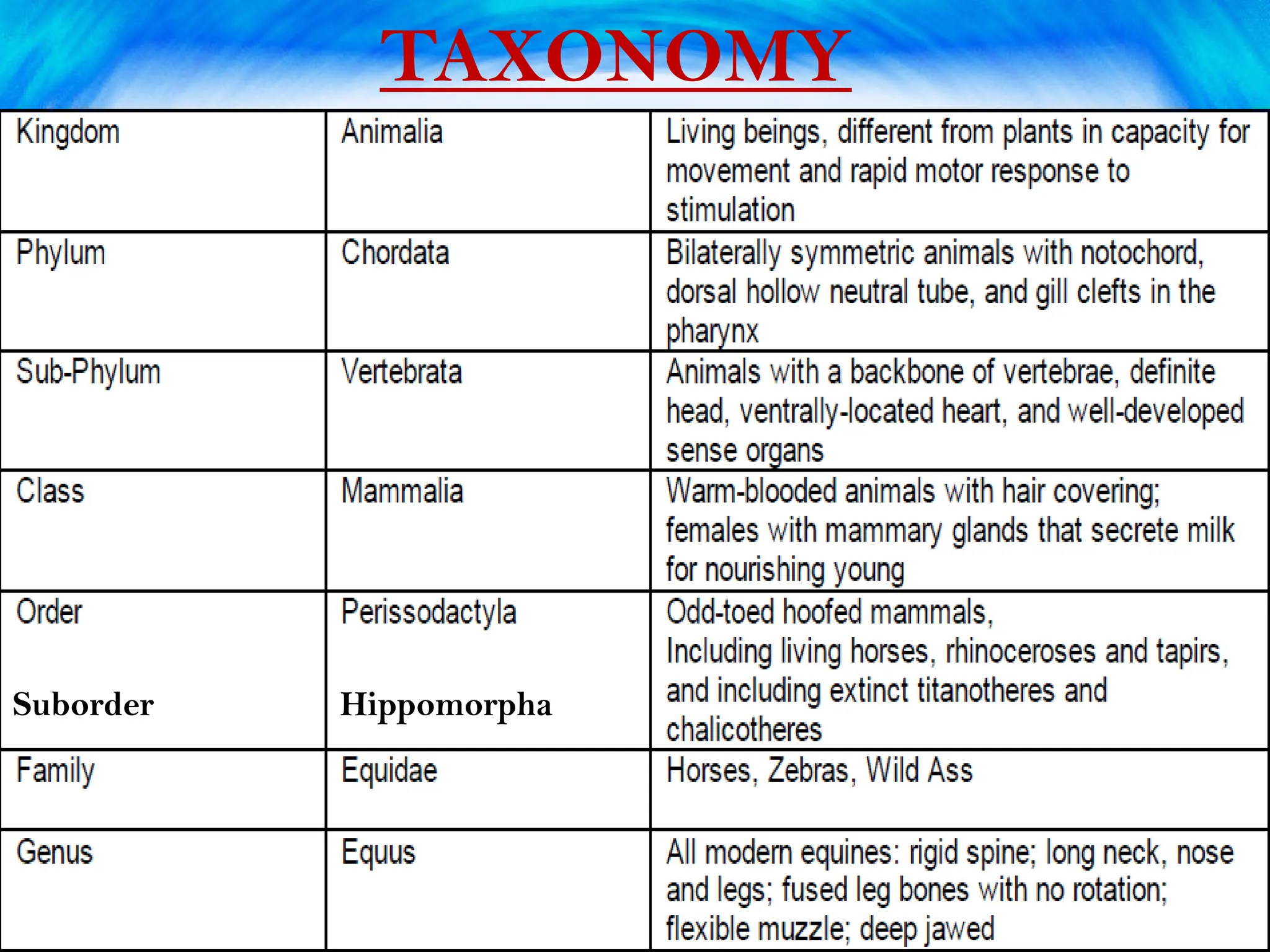
TAXONOMY
Suborder Hippomorpha
EVOLUTIONARY
TRENDS
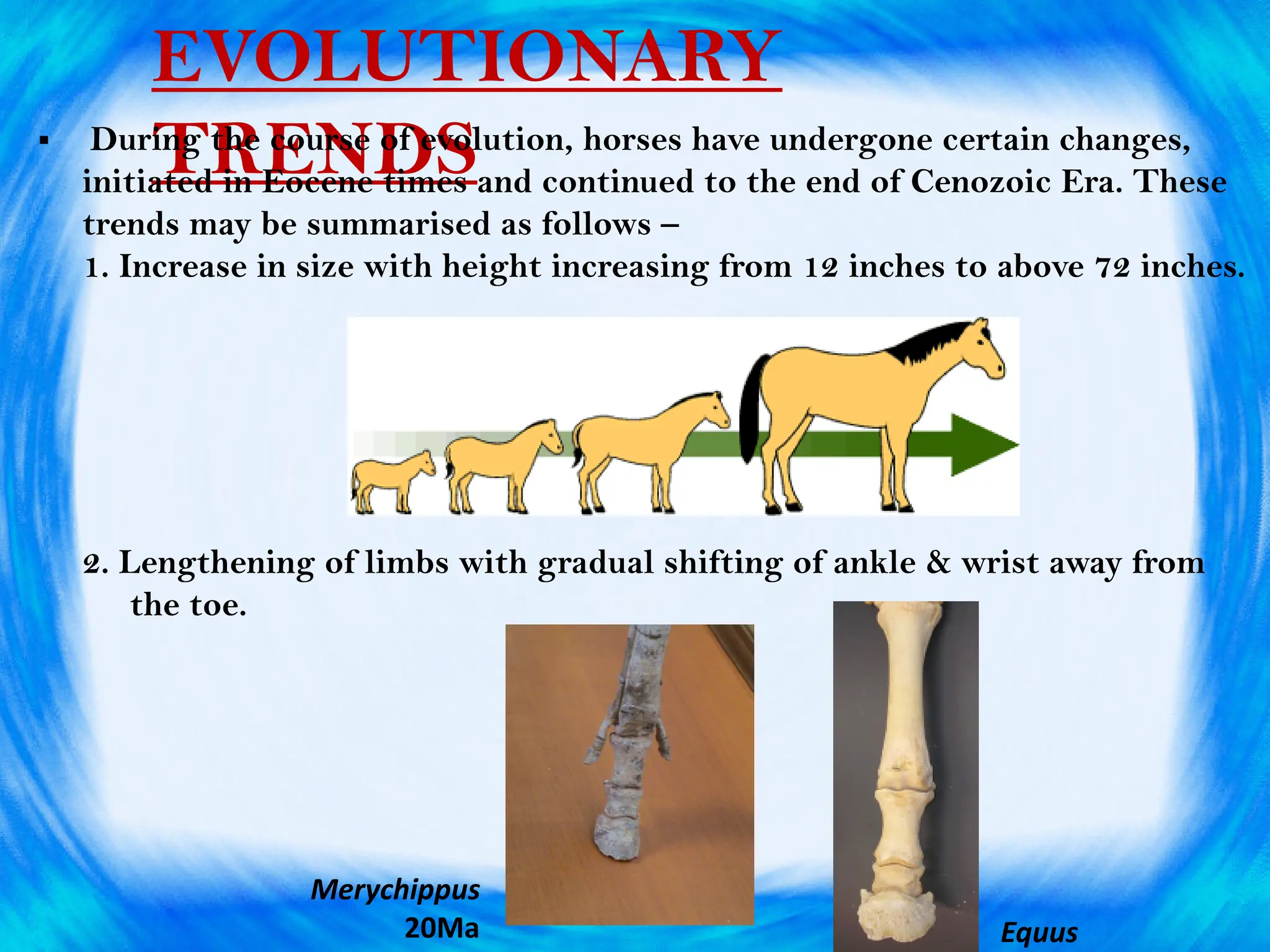
▪ During the course of evolution, horses have undergone certain changes,
initiated in Eocene times and continued to the end of Cenozoic Era. These
trends may be summarised as follows –
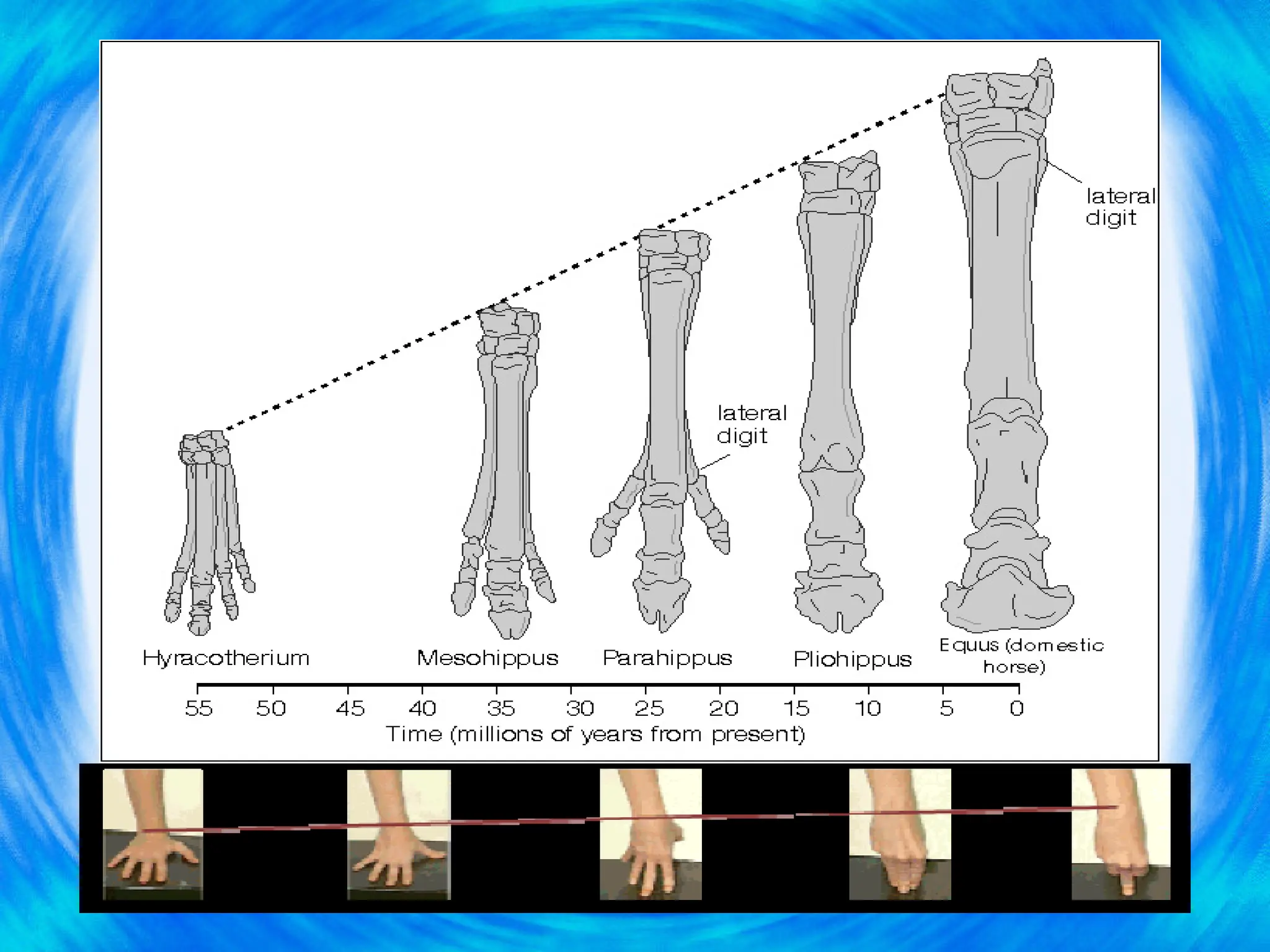
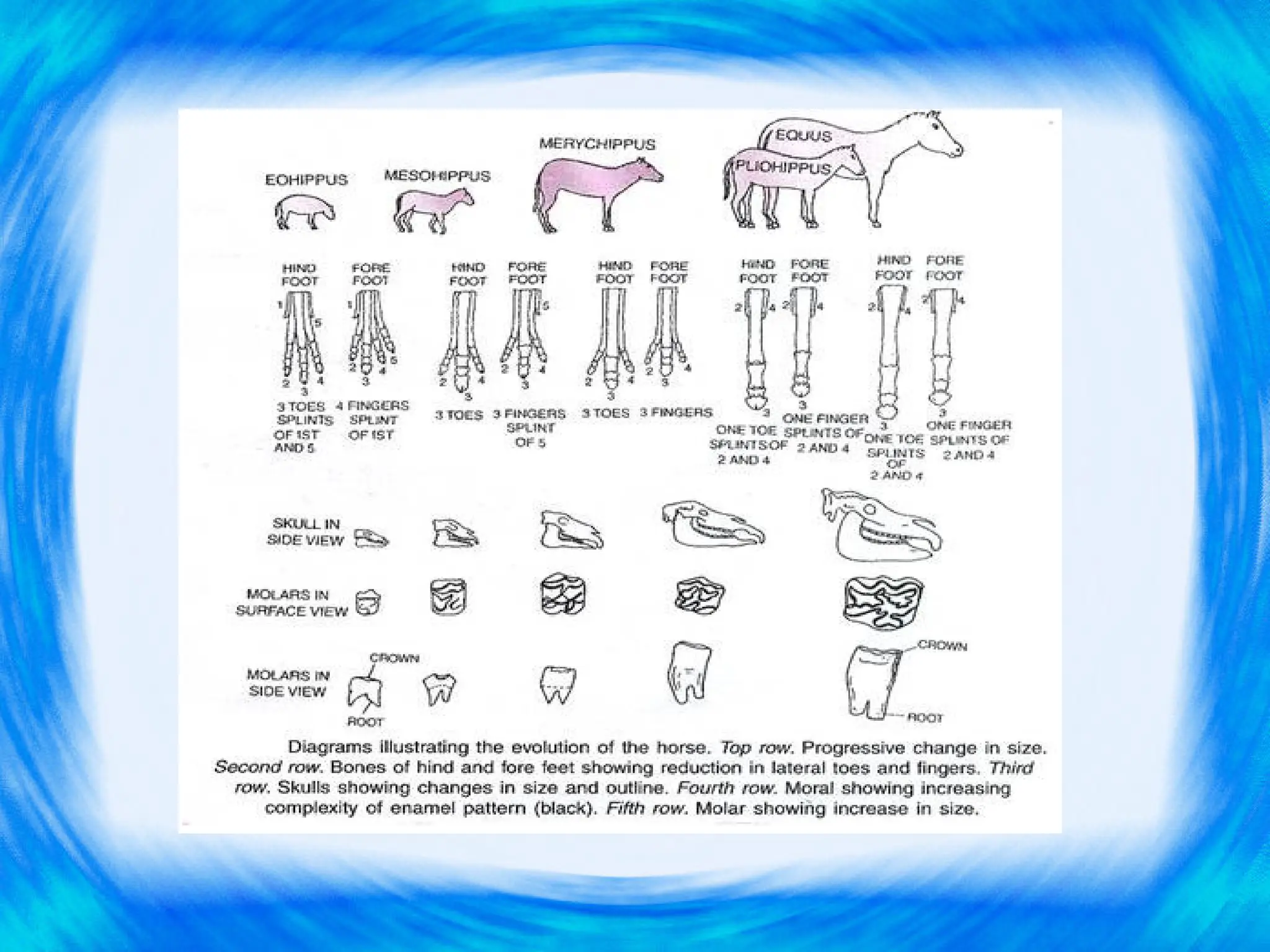
1. Increase in size with height increasing from 12 inches to above 72 inches.
2. Lengthening of limbs with gradual shifting of ankle & wrist away from
the toe.
Merychippus
20Ma Equus
3. Lengthening of neck & straightening & stiffening of
back producing a stream-lined body.
4. Reduction of ulna & fibula with a consequent limitation
of the range of movement.
5. Lengthening of the portion of head or face in front of
eyes forming a muzzle.
6. Perfection of the hoof.
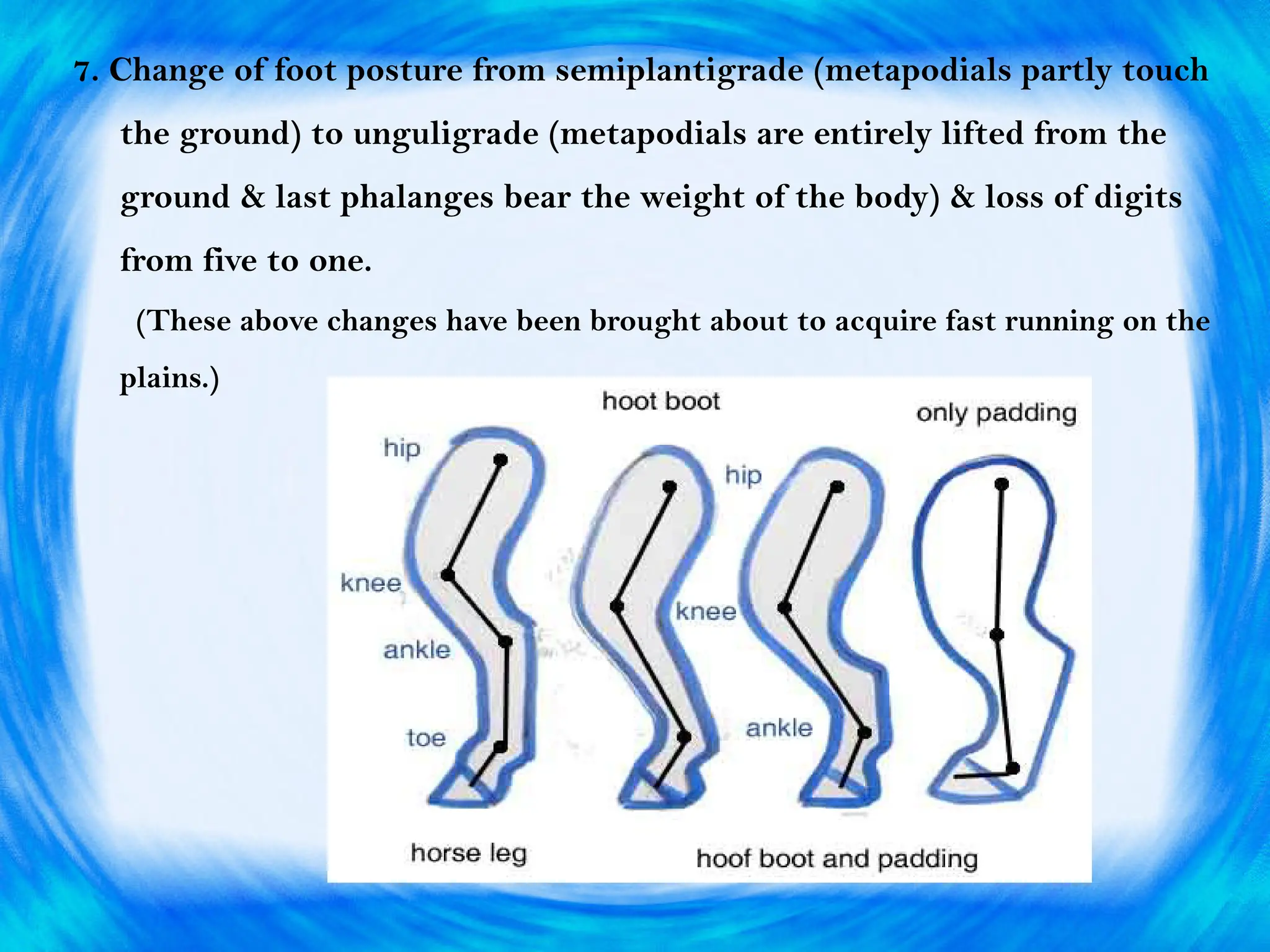
7. Change of foot posture from semiplantigrade (metapodials partly touch
the ground) to unguligrade (metapodials are entirely lifted from the
ground & last phalanges bear the weight of the body) & loss of digits
from five to one.
(These above changes have been brought about to acquire fast running on the
plains.)
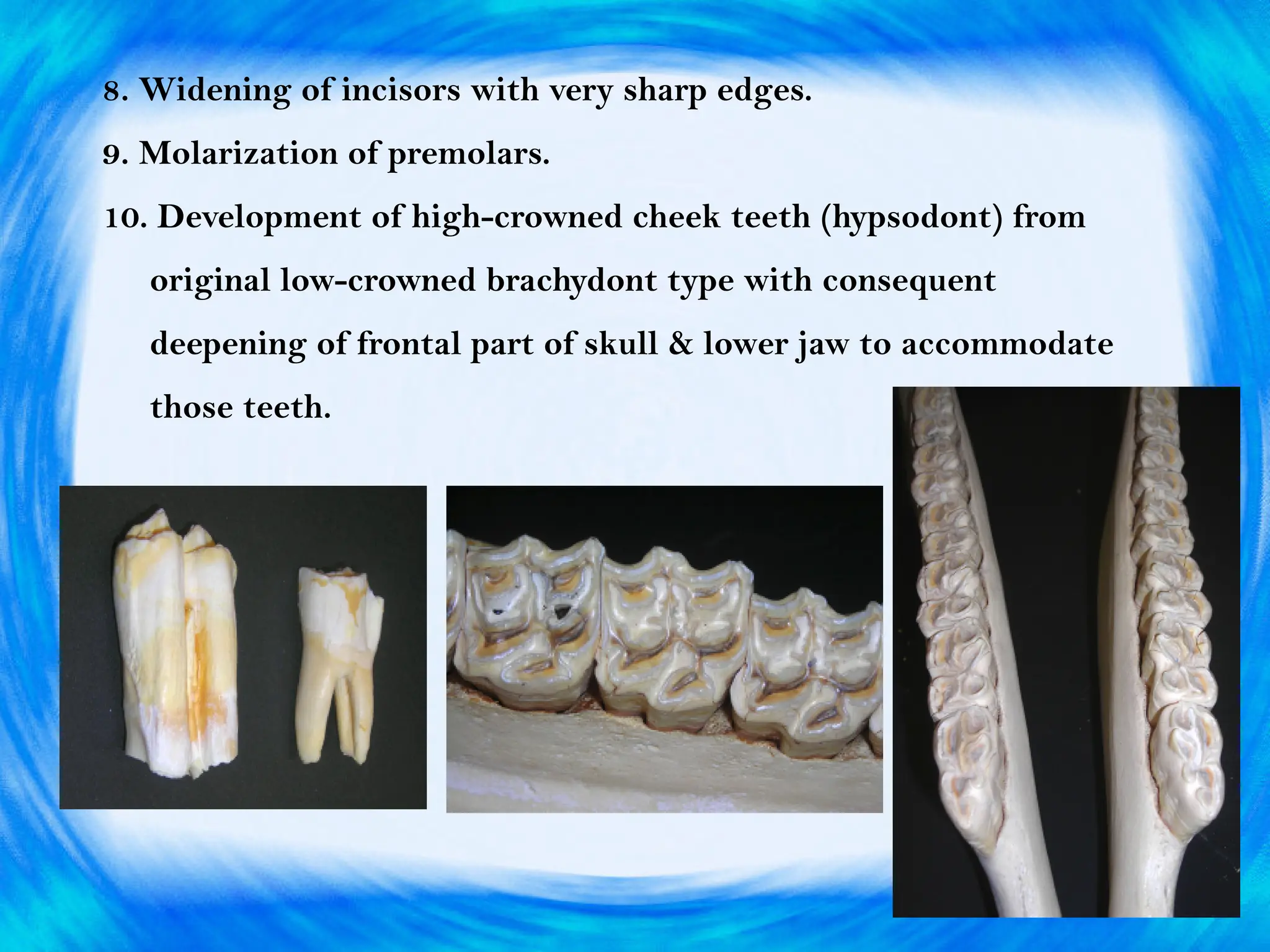
8. Widening of incisors with very sharp edges.
9. Molarization of premolars.
10. Development of high-crowned cheek teeth (hypsodont) from
original low-crowned brachydont type with consequent
deepening of frontal part of skull & lower jaw to accommodate
those teeth.
11. Elongation & complexity of teeth with an increase in the height of
the crown of the teeth.
12. Gradual increase of size and complexity of the brain.
▪ These changes are in response to their change in food-habit from
browsing to grazing type. The change of food habit has been
attributed to a great environmental change at Late Oligocene in
North America causing retreat of humid forests and spread of
grasslands.
From…….. rich rainforest which covered most of the Earth in
which the horses ancestors browsed on leaves and hid from
predators.
To ……. open savannah grassland where the modern horses
grazed grass and had to run from predators.
▪ These changes were observed in North America, which was the main
theatre of the evolution of horses.
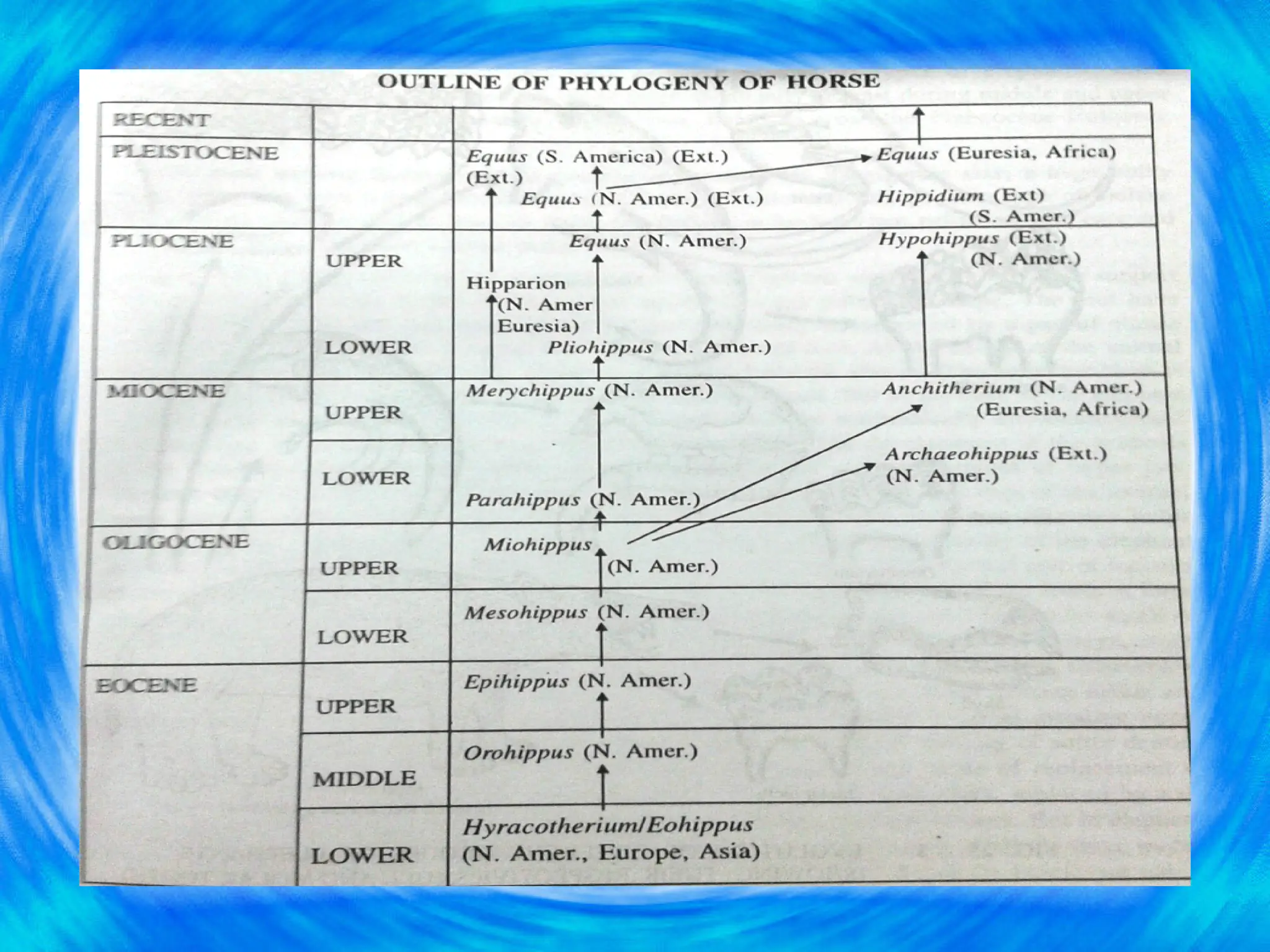
PHYLOGENY OF HORSES
• Horses of Eocene :
▪ Eocene was a time of warm & moist climate with a luxuriant
vegetation of both evergreen & deciduous trees, grassy plains and
numerous lakes. During this period the following horses were known :
1. Genus Eohippus (Hyracotherium)
2. Genus Orohippus
3. Genus Epihippus
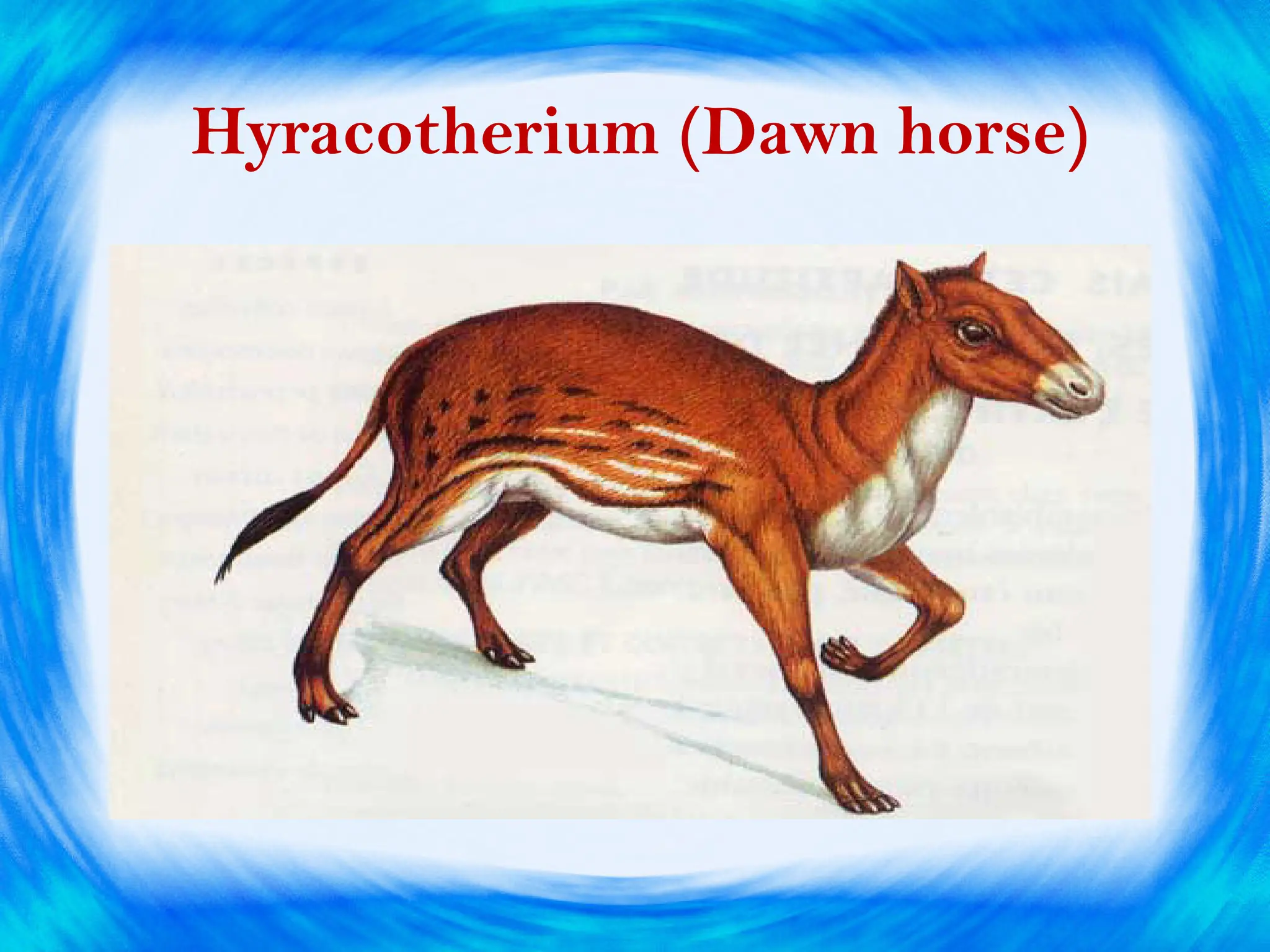
• Earliest fossil remains of horse in
equine evolution and is called the
‘Dawn horse’.
• Eohippus of North America &
Hyracotherium of Europe were
closely related to each other.
• About 30 cms high with arched &
flexible back.
• Head & neck were short.
• Limbs were digitigrade.
• Ulna & fibula bones were separate
from radius & tibia.
• Teeth were low crowned.
Hyracotherium (Dawn horse)
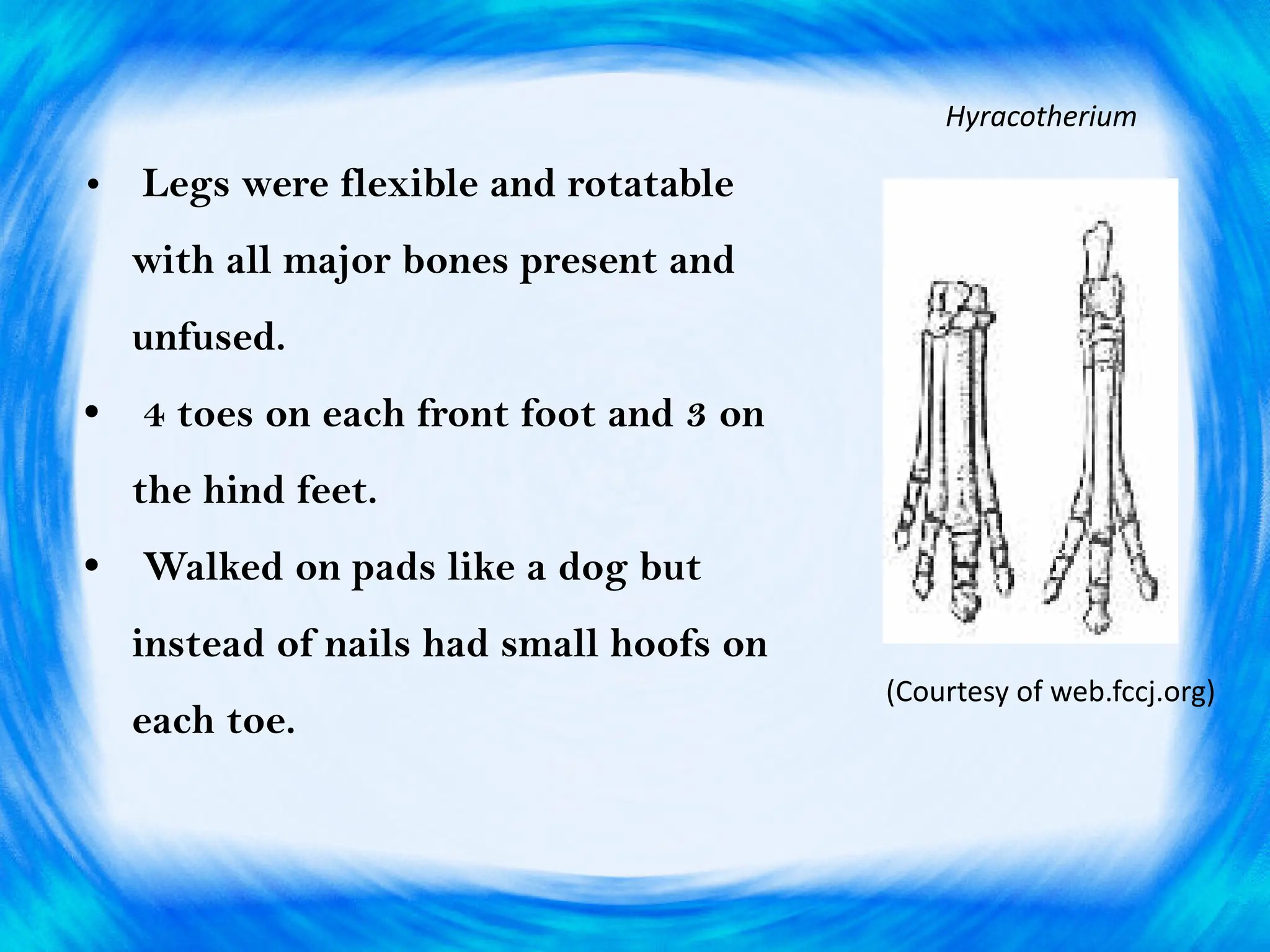
• Legs were flexible and rotatable
with all major bones present and
unfused.
• 4 toes on each front foot and 3 on
the hind feet.
• Walked on pads like a dog but
instead of nails had small hoofs on
each toe.
Hyracotherium
(Courtesy of web.fccj.org)
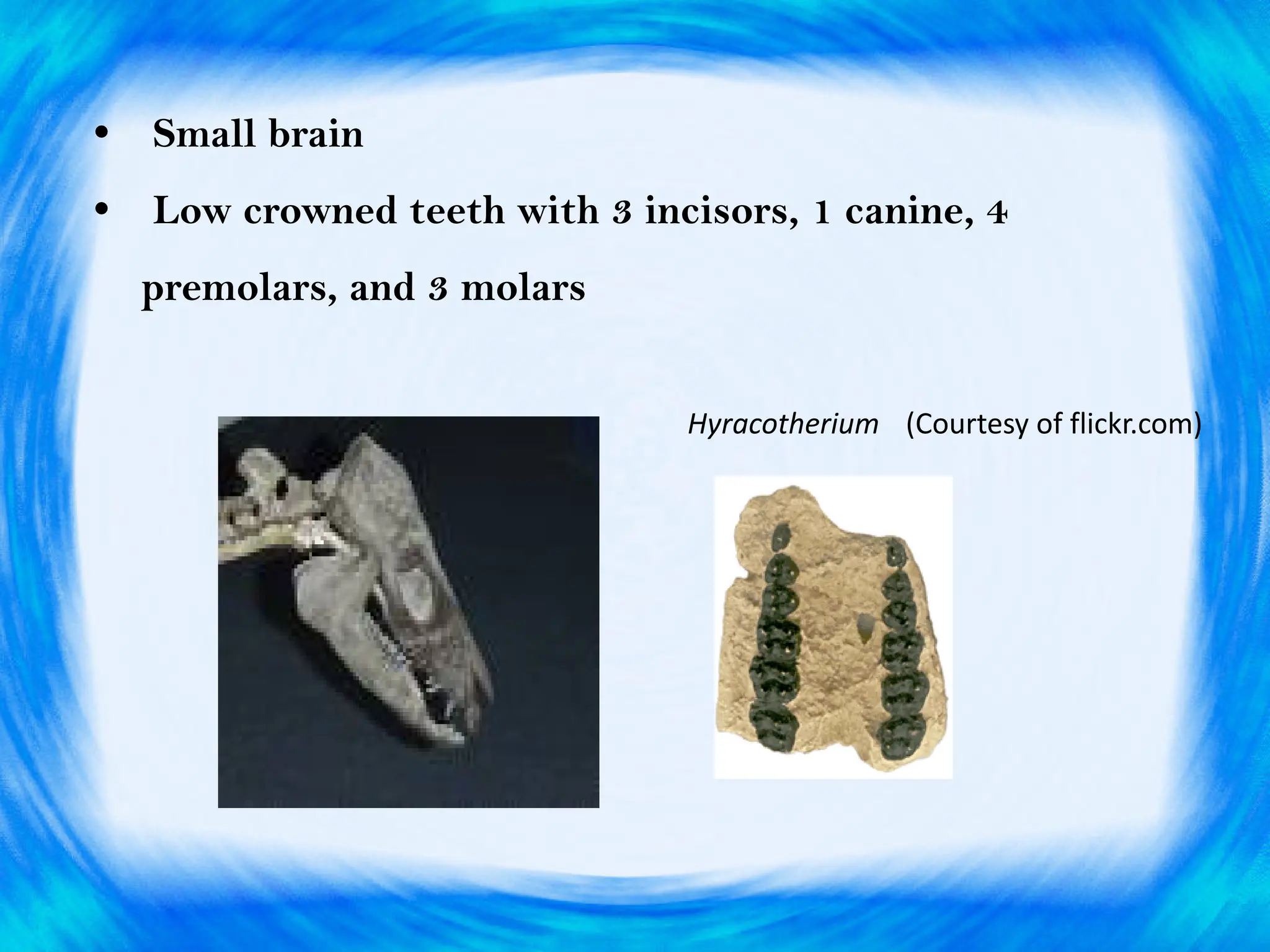
• Small brain
• Low crowned teeth with 3 incisors, 1 canine, 4
premolars, and 3 molars
Hyracotherium (Courtesy of flickr.com)
Orohippus (Mountain horse)
• Diverged from Hyracotherium 50 million years ago
• Height still approx 20 inches at shoulder
• Still had arched back
• Short legs, neck, snout
• Small brain
• Lost first and second toe vestiges
• Major changes occurred in teeth
• Last premolar became molar
• Crests on the teeth more pronounced most likely a result of
eating tough plant material
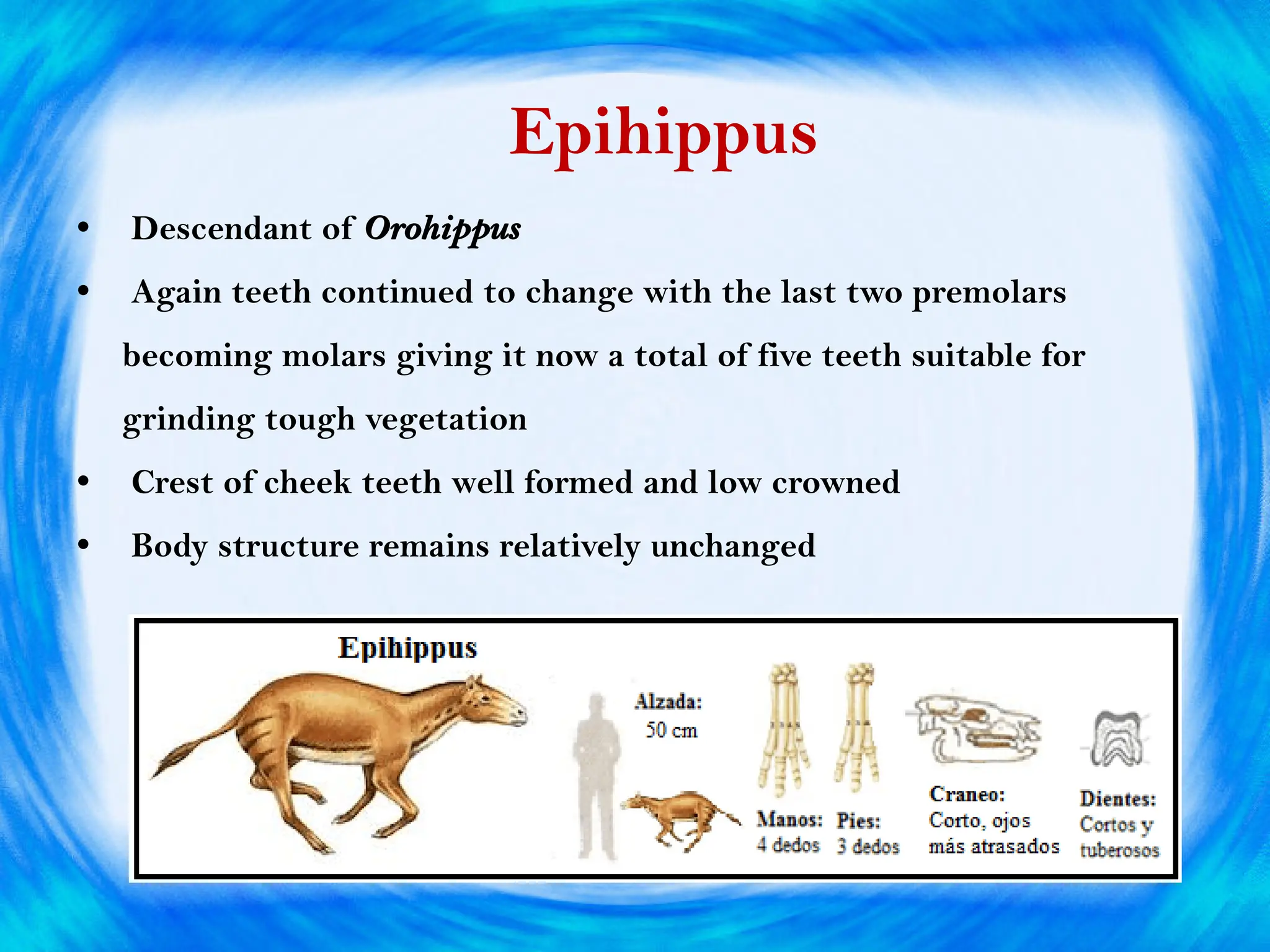
Epihippus
• Descendant of Orohippus
• Again teeth continued to change with the last two premolars
becoming molars giving it now a total of five teeth suitable for
grinding tough vegetation
• Crest of cheek teeth well formed and low crowned
• Body structure remains relatively unchanged
• Horses of Oligocene :
▪ Aridity increased during Oligocene due to continental uplift and
consequent drying of streama & lakes. Thus there were three conditions
– woodland, meadows and dry praire.
▪ However, the following genera of Oligocene horses, directly derived
from Epihippus are -
1. Genus Mesohippus
2. Genus Miohippus
Mesohippus
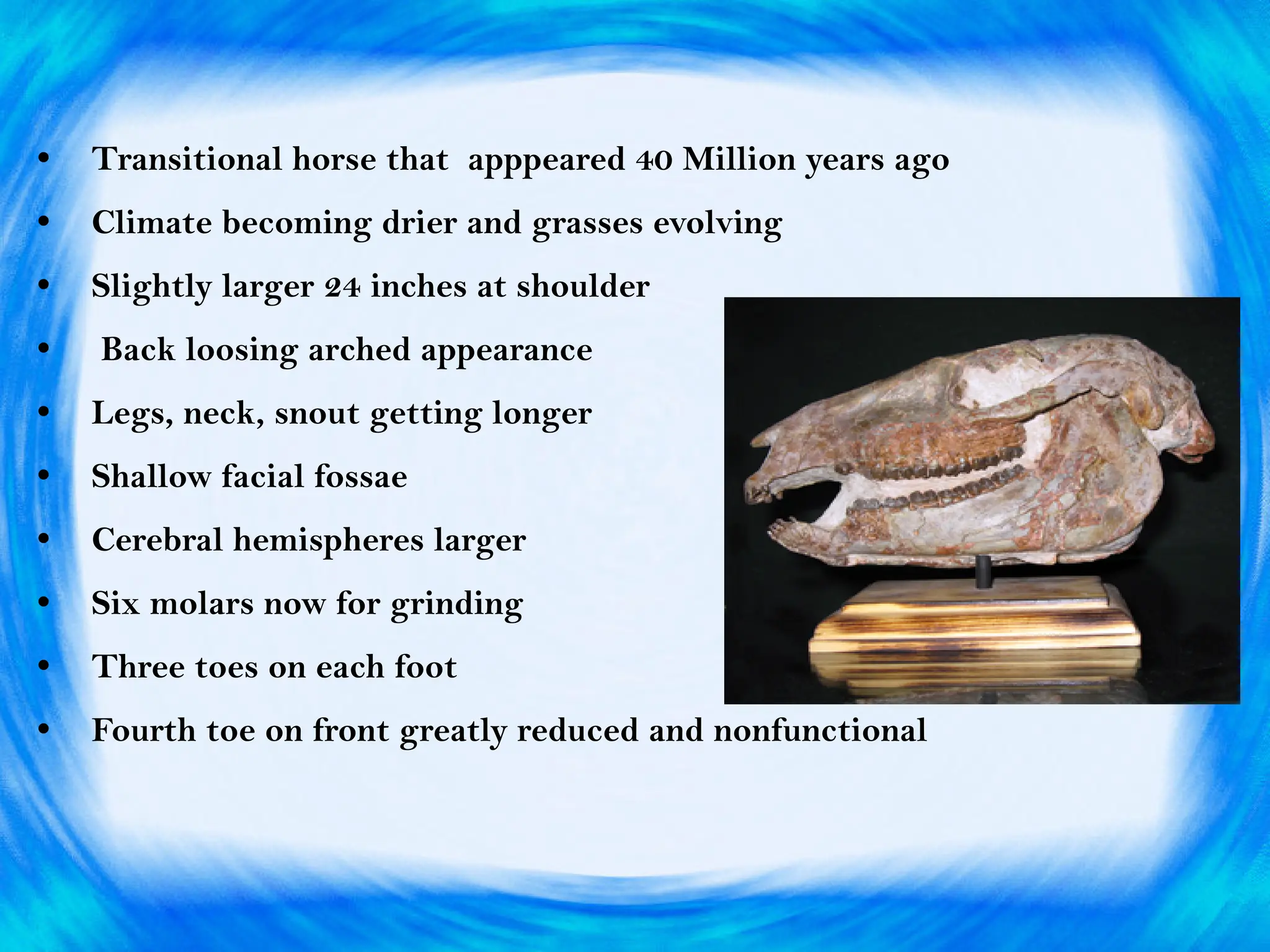
• Transitional horse that apppeared 40 Million years ago
• Climate becoming drier and grasses evolving
• Slightly larger 24 inches at shoulder
• Back loosing arched appearance
• Legs, neck, snout getting longer
• Shallow facial fossae
• Cerebral hemispheres larger
• Six molars now for grinding
• Three toes on each foot
• Fourth toe on front greatly reduced and nonfunctional
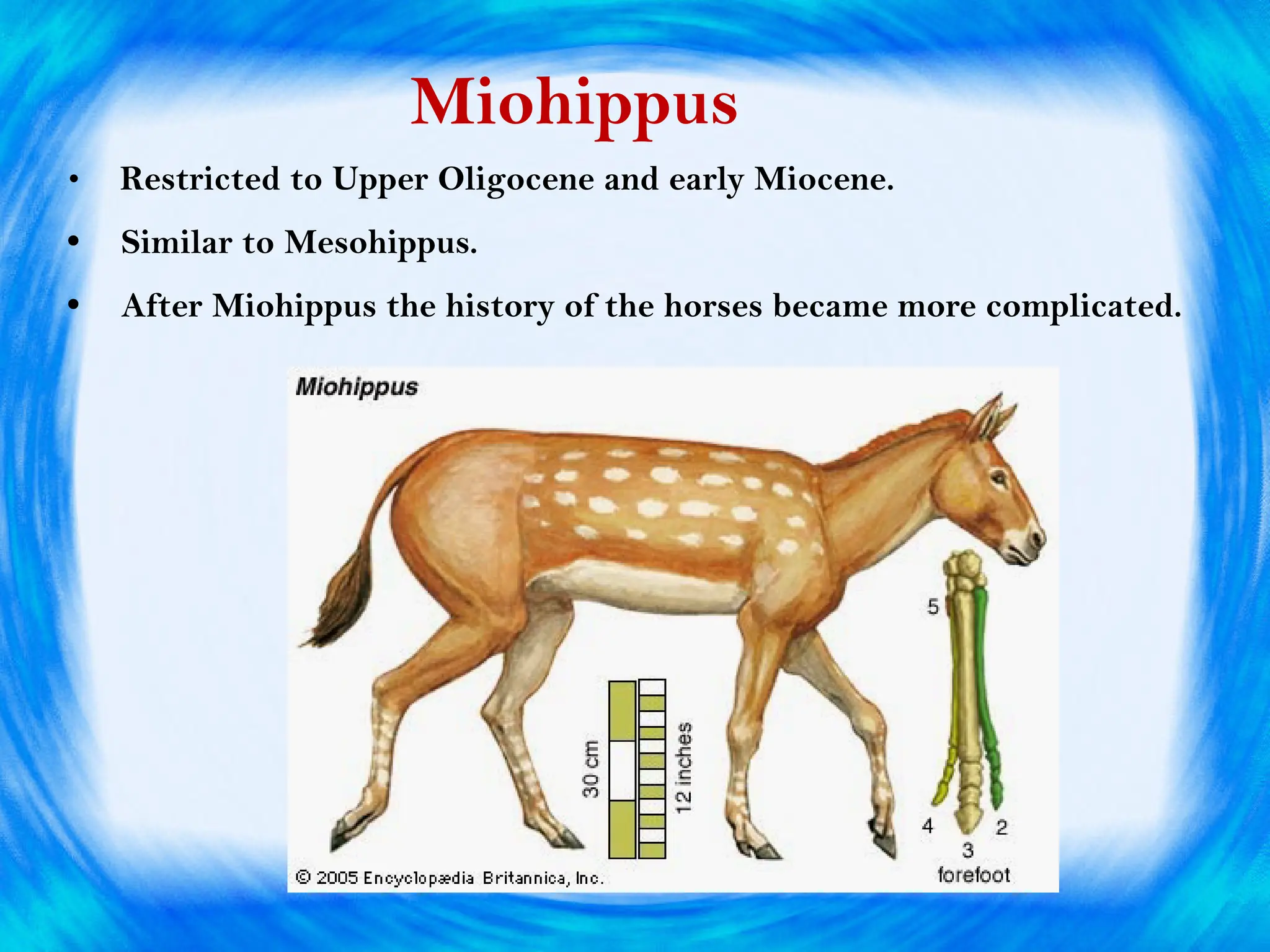
Miohippus
• Restricted to Upper Oligocene and early Miocene.
• Similar to Mesohippus.
• After Miohippus the history of the horses became more complicated.
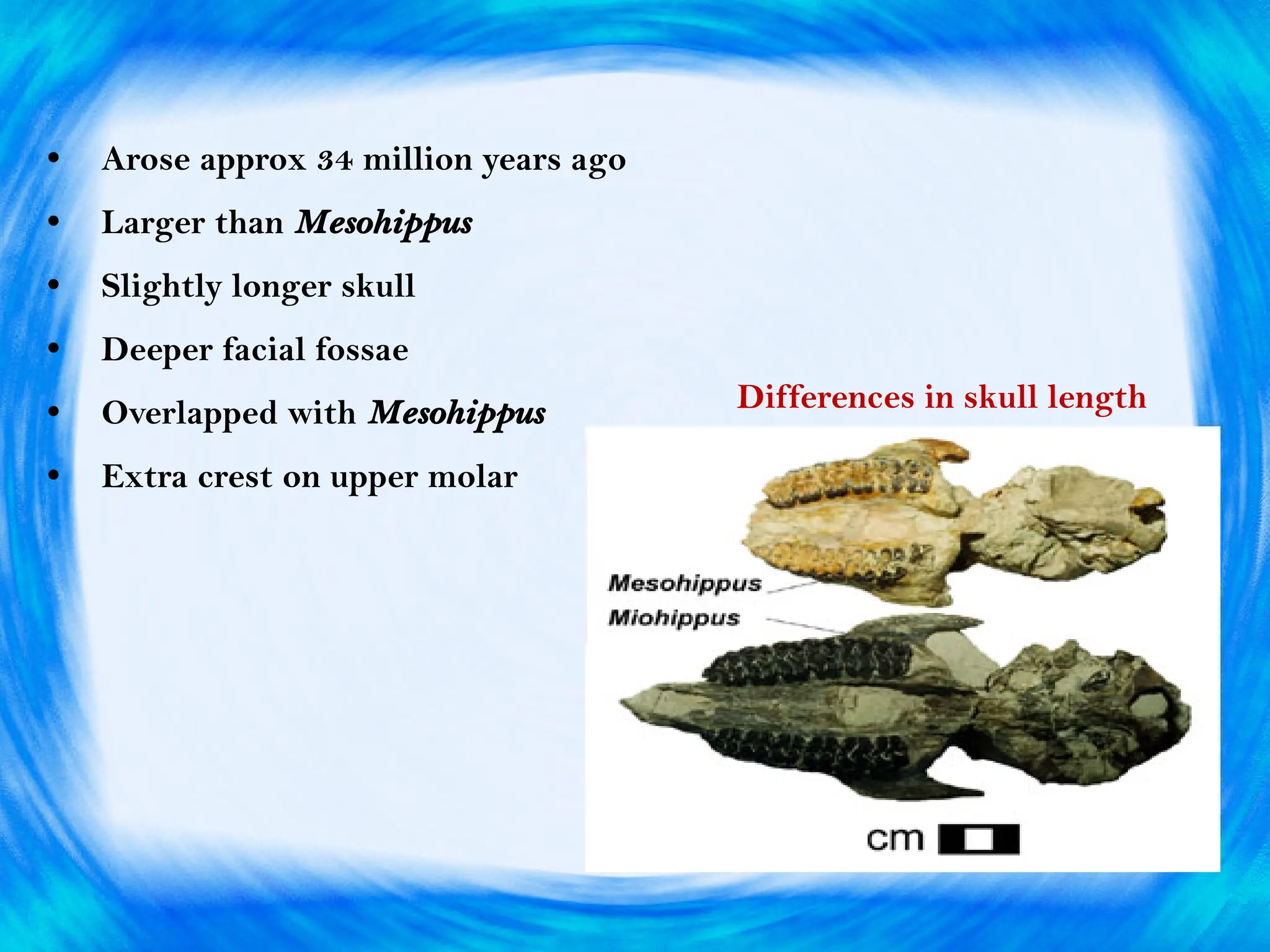
• Arose approx 34 million years ago
• Larger than Mesohippus
• Slightly longer skull
• Deeper facial fossae
• Overlapped with Mesohippus
• Extra crest on upper molar
Differences in skull length
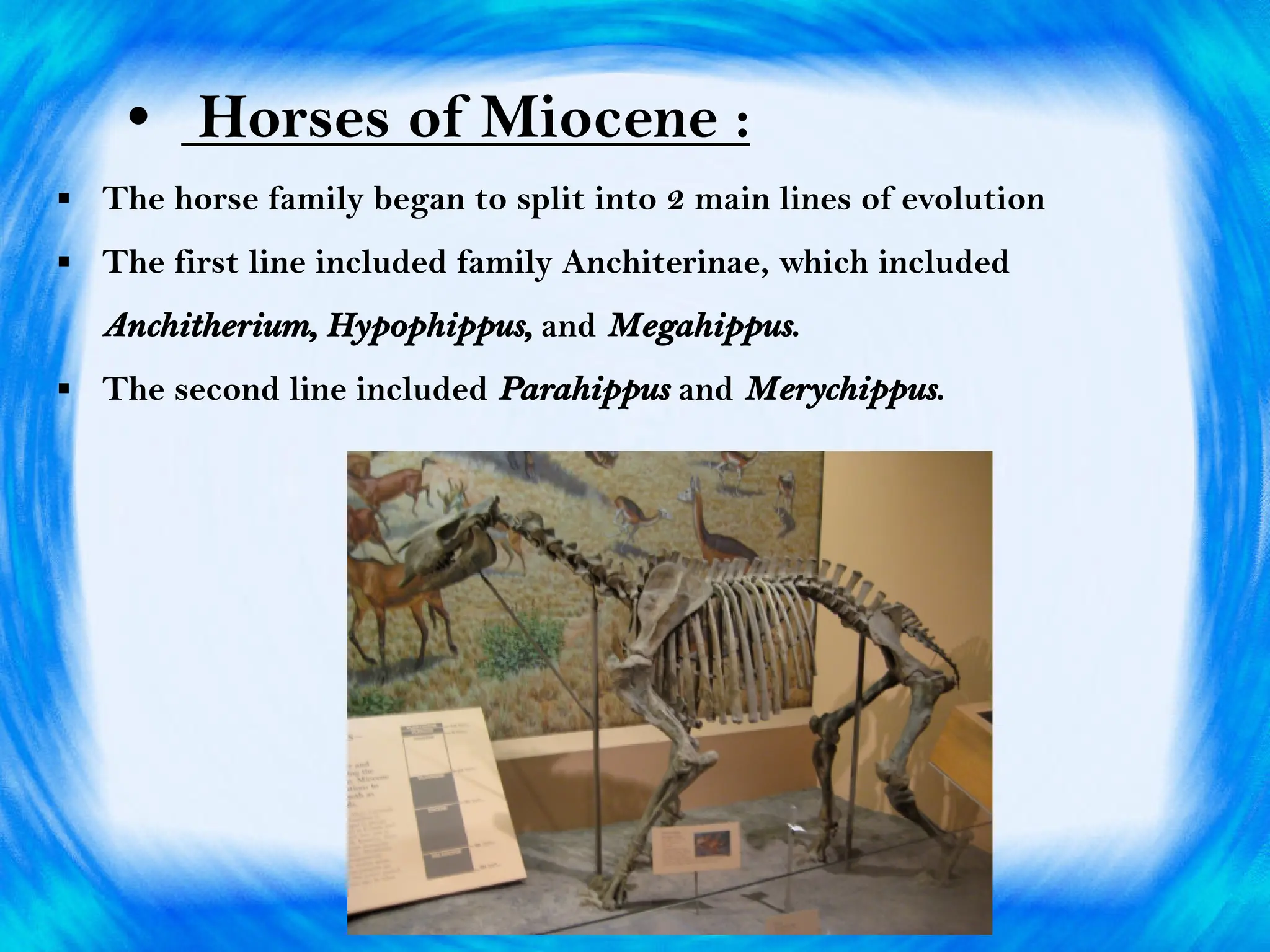
• Horses of Miocene :
▪ The horse family began to split into 2 main lines of evolution
▪ The first line included family Anchiterinae, which included
Anchitherium, Hypophippus, and Megahippus.
▪ The second line included Parahippus and Merychippus.
Anchitherium
• Evolved in North America in the early middle Miocene period
• Members of the subfamily Anchitherinae
• Had low-crowned, lophodont cheek teeth lacking cement and
three-toed feet supported by pads
• Both in the New and the Old World the fossil consisted of
isolated teeth and often very small
Hypohippus (Browsing horse)
• Size increase occurred in the North American Hypohippus, but was
not clearly evident in the North American Anchiterium
• Lived from 17-11 million years ago and was found in Nebraska,
Colorado, and Montana
• All of their species retained three toes that bore a lot of the animals
weight and were well adapted for the soft ground of forests
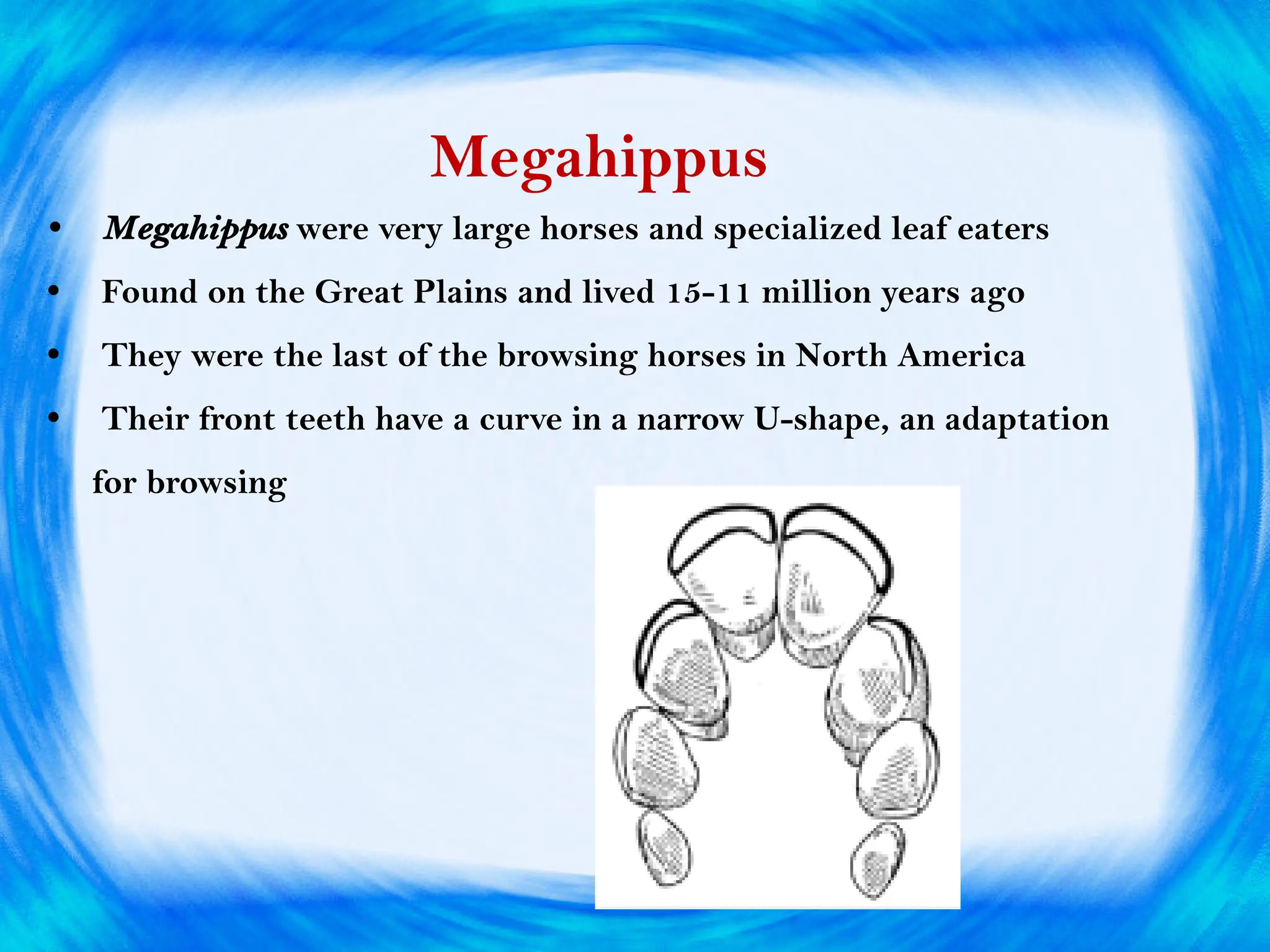
Megahippus
• Megahippus were very large horses and specialized leaf eaters
• Found on the Great Plains and lived 15-11 million years ago
• They were the last of the browsing horses in North America
• Their front teeth have a curve in a narrow U-shape, an adaptation
for browsing
Parahippus
• Arose 23 million years ago (early Miocene)
• Found in Great Plains and Florida
• Between 18-17 million years ago Parahippus developed springy
ligaments under the foot
• Showed fluctuation changes in its teeth, including the permanent
establishment or a stronger crest with slightly taller tooth crowns
• Transitional form between Miohippus and Merychippus
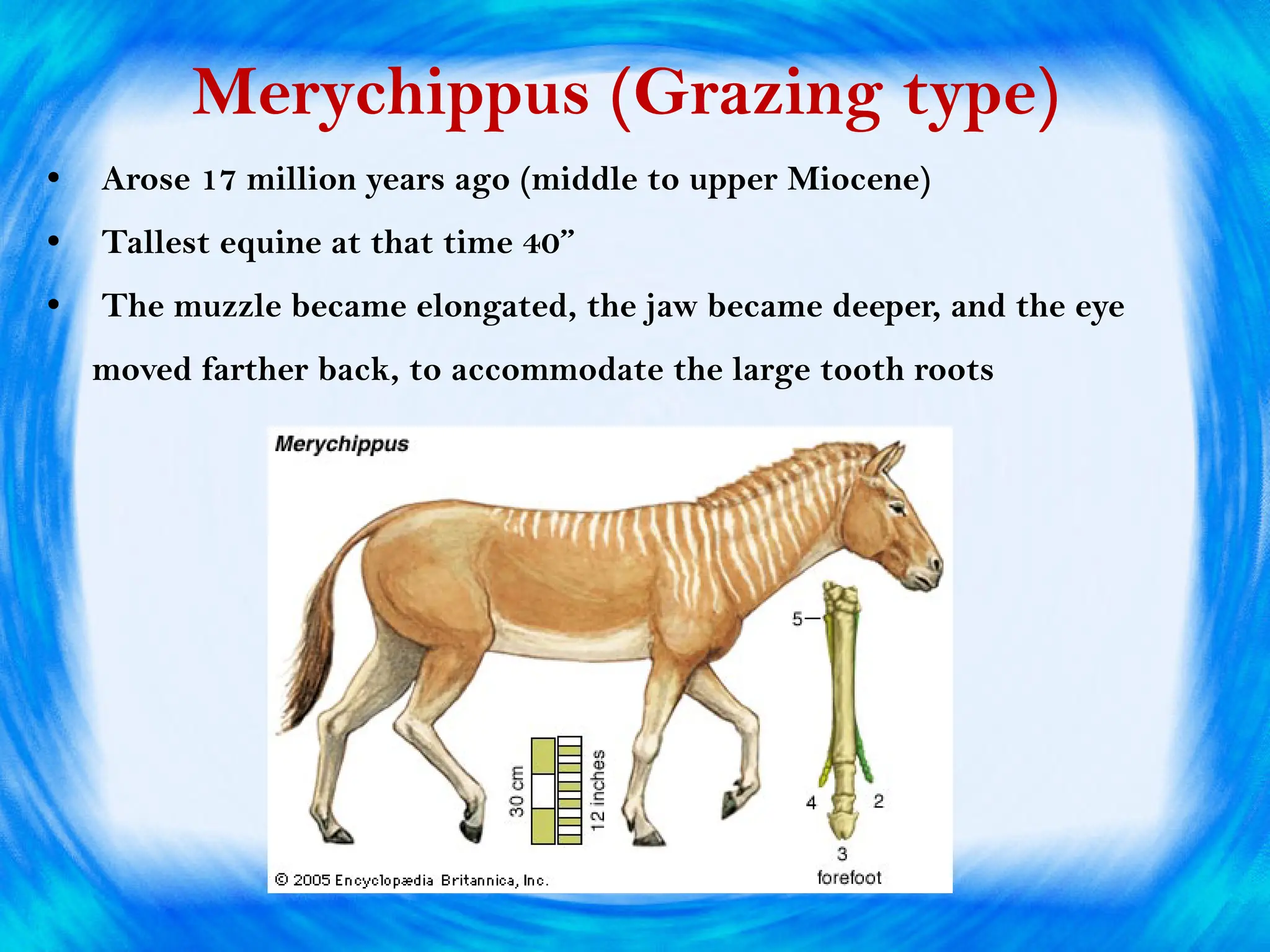
Merychippus (Grazing type)
• Arose 17 million years ago (middle to upper Miocene)
• Tallest equine at that time 40”
• The muzzle became elongated, the jaw became deeper, and the eye
moved farther back, to accommodate the large tooth roots
• Developed full high-crowned teeth with a thick layer of cement
• Brain became bigger with a fissured neocortex and larger
cerebellum
• Radius and ulna of the forearm fused eliminating leg rotation
• Fibula of the shin was reduced
• Side toes became smaller and only touched the ground while
running
• Stood permanently on its tiptoe
• This line gave rise to the “true equines”
Hipparion
• First horse which entered in Africa.
• About one metre in size.
• Teeth were usually straight.
• Retained complete side toes as in Merychippus.
• In India, Hippararion was represented by H.theobalidi in the Chingi,
Dhok Pathan and Tatrot formations of Siwalik rocks.
• This species was single-toed and it was believed to be the fore runner to
the modern Zebra.
• Horses of Pliocene :
• This era in the horses evolutionary time frame happened to be
during and after the last Ice Age.
• Many animals did not survive this drastic shift in climate.
1. Genus Pliohippus
2. Genus Plesihippus
3. Genus Hippidion
Pliohippus
• Arose from Merychippus in Late Miocene.
• First one-toed horse & lateral digits had lost.
• Teeth increased in height more than Merychippus.
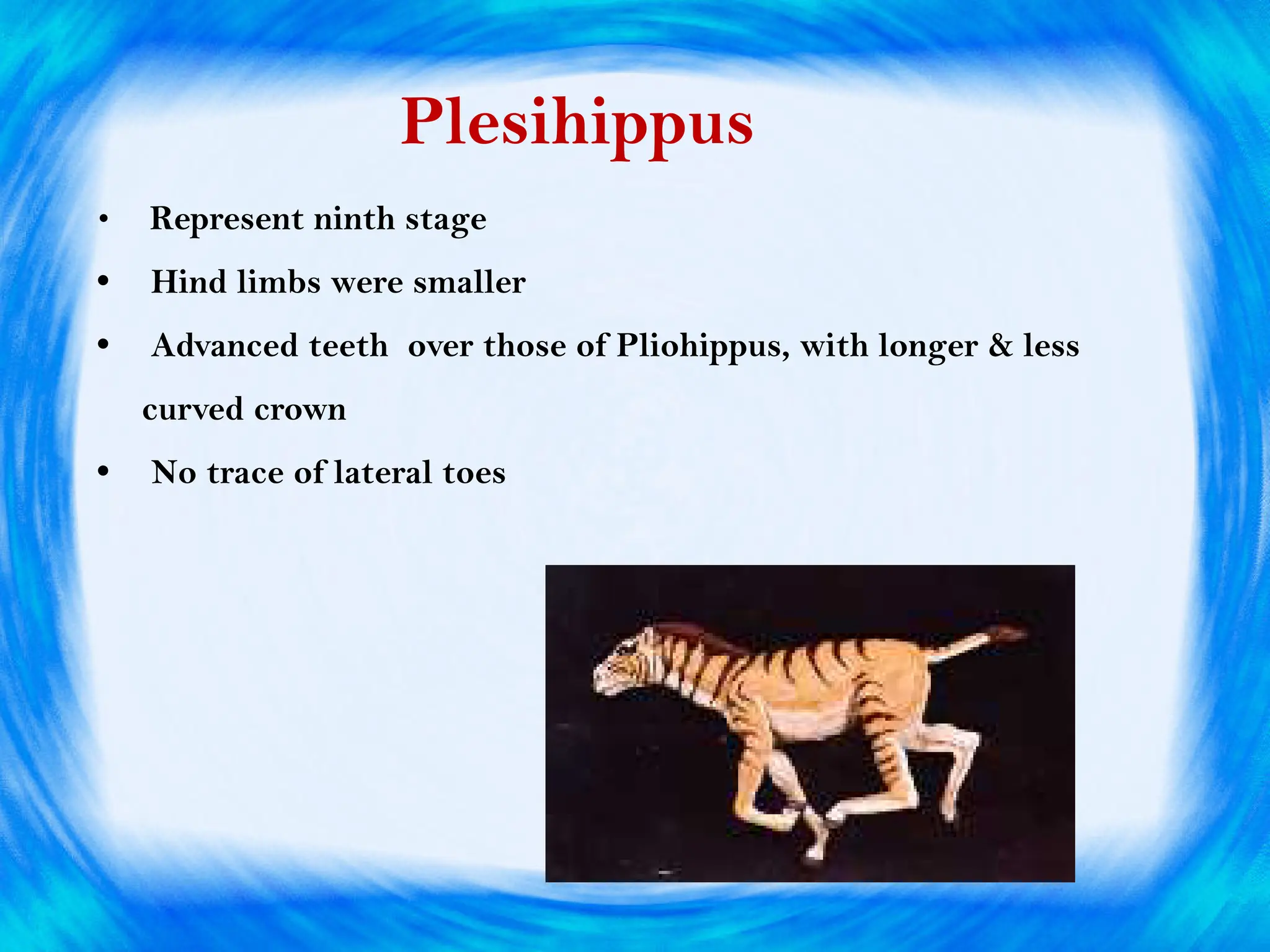
Plesihippus
• Represent ninth stage
• Hind limbs were smaller
• Advanced teeth over those of Pliohippus, with longer & less
curved crown
• No trace of lateral toes
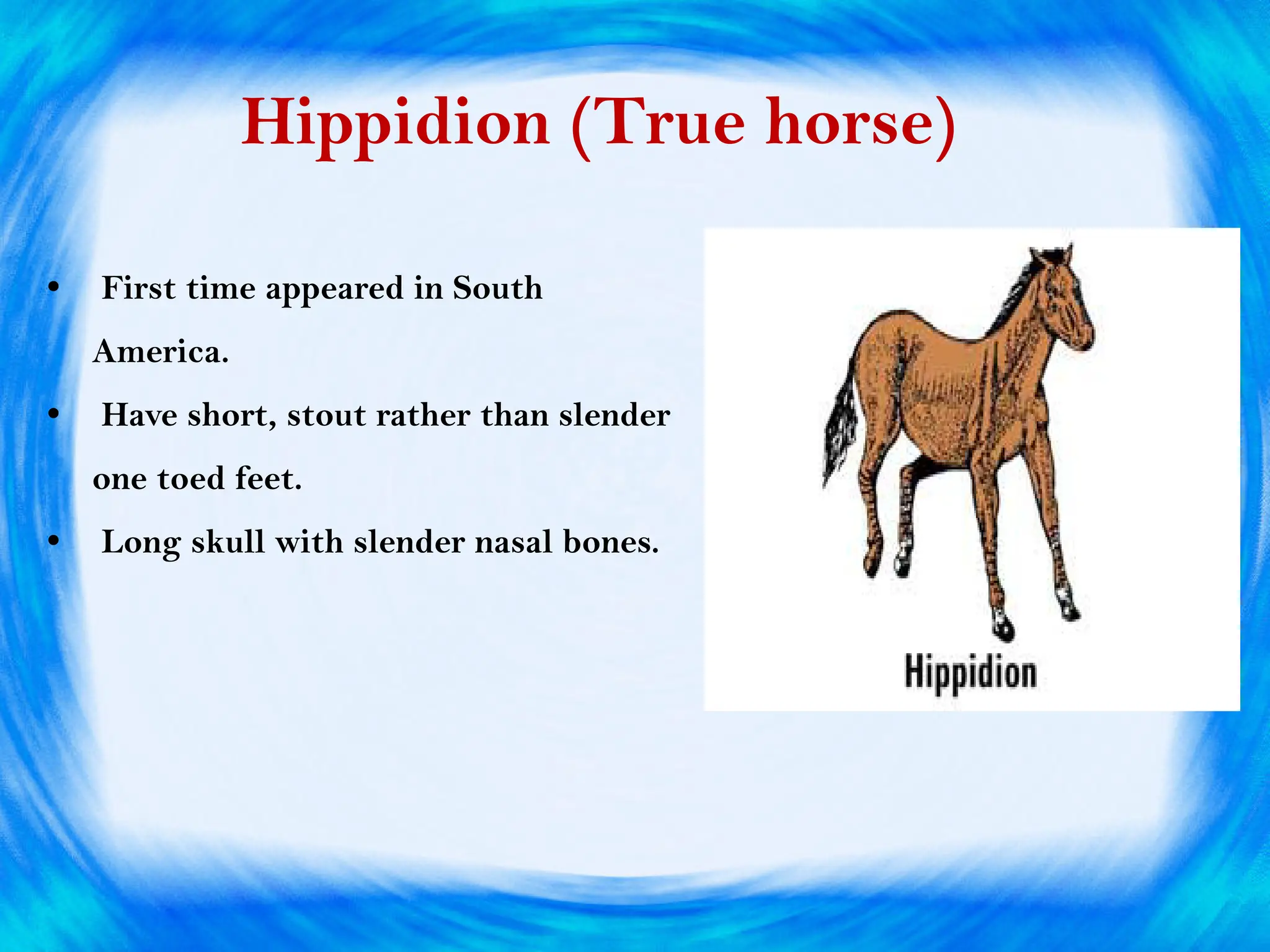
Hippidion (True horse)
• First time appeared in South
America.
• Have short, stout rather than slender
one toed feet.
• Long skull with slender nasal bones.
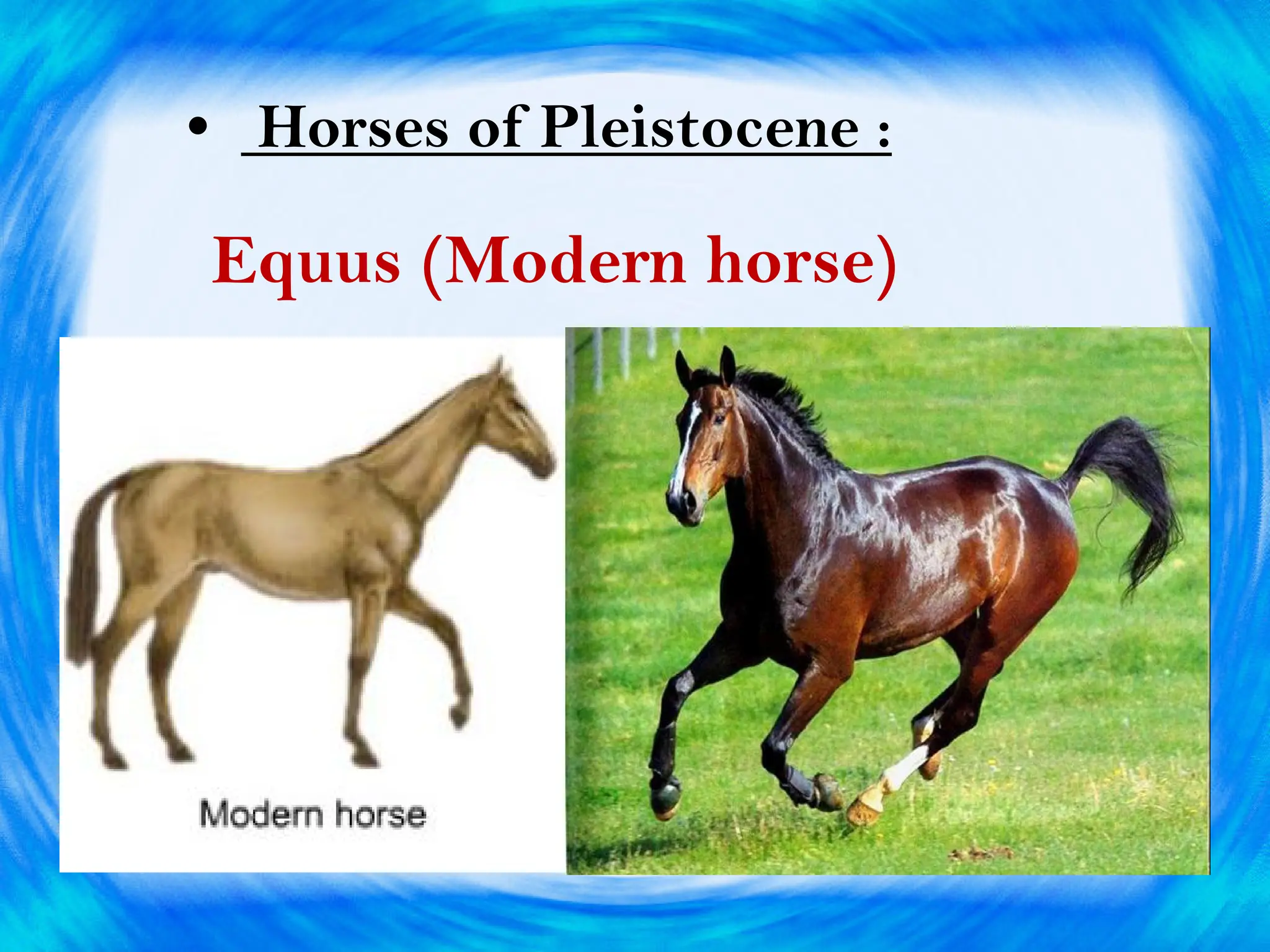
• Horses of Pleistocene :
Equus (Modern horse)
• First appeared in Upper Pliocene beds of Eurasia and North
America.
• During Pleistocene it achieved world-wide distribution.
• Height of about 1.5 to 2 metres.
• Feet are one-toed with well developed hoof.
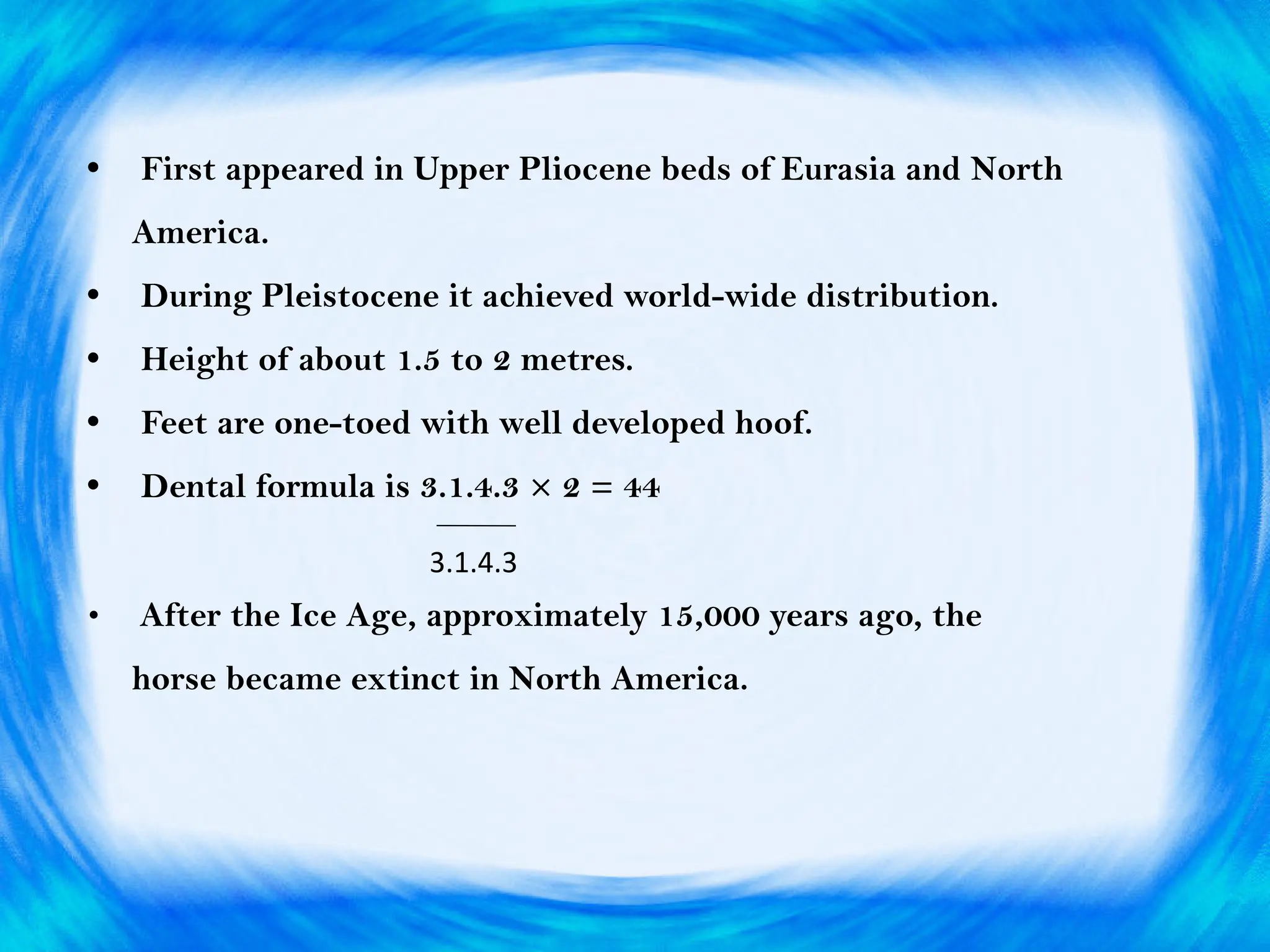
• Dental formula is 3.1.4.3 × 2 = 44
3.1.4.3
• After the Ice Age, approximately 15,000 years ago, the
horse became extinct in North America.
.. Thank

Evolution Of Horse - Introduction, Taxonomy, Evolutionary trends, Types

  • 1.
    Evolution Of Horse (Equus) PresentedBy : Chinmayee Das Roll No. 03 M.Sc 4th Semester
  • 2.
    ▪ Of allthe evolutionary histories, the origin & evolutionary history of horse is widely known because the fossil records of the horses are remarkably complete and well understood. ▪ The evolutionary history of horse is a classical example of Orthogenesis or straight course of evolution. ▪ Further, it offers the finest example of progressive evolution through natural selection. ▪ This is because of the pattern of evolution of horse found is remarkably simple showing a single line of adaptation instead of showing diversification through multiple radiation along different lines & it also exhibits progressive change of characters in some predetermined directions. ▪ This evolutionary course of Equidae is often viewed as a typical example of macroevolution. INTRODUCTION
  • 3.
  • 4.
    EVOLUTIONARY TRENDS ▪ During thecourse of evolution, horses have undergone certain changes, initiated in Eocene times and continued to the end of Cenozoic Era. These trends may be summarised as follows – 1. Increase in size with height increasing from 12 inches to above 72 inches. 2. Lengthening of limbs with gradual shifting of ankle & wrist away from the toe. Merychippus 20Ma Equus
  • 5.
    3. Lengthening ofneck & straightening & stiffening of back producing a stream-lined body. 4. Reduction of ulna & fibula with a consequent limitation of the range of movement. 5. Lengthening of the portion of head or face in front of eyes forming a muzzle. 6. Perfection of the hoof.
  • 6.
    7. Change offoot posture from semiplantigrade (metapodials partly touch the ground) to unguligrade (metapodials are entirely lifted from the ground & last phalanges bear the weight of the body) & loss of digits from five to one. (These above changes have been brought about to acquire fast running on the plains.)
  • 8.
    8. Widening ofincisors with very sharp edges. 9. Molarization of premolars. 10. Development of high-crowned cheek teeth (hypsodont) from original low-crowned brachydont type with consequent deepening of frontal part of skull & lower jaw to accommodate those teeth.
  • 9.
    11. Elongation &complexity of teeth with an increase in the height of the crown of the teeth. 12. Gradual increase of size and complexity of the brain.
  • 11.
    ▪ These changesare in response to their change in food-habit from browsing to grazing type. The change of food habit has been attributed to a great environmental change at Late Oligocene in North America causing retreat of humid forests and spread of grasslands. From…….. rich rainforest which covered most of the Earth in which the horses ancestors browsed on leaves and hid from predators. To ……. open savannah grassland where the modern horses grazed grass and had to run from predators. ▪ These changes were observed in North America, which was the main theatre of the evolution of horses.
  • 12.
  • 13.
    • Horses ofEocene : ▪ Eocene was a time of warm & moist climate with a luxuriant vegetation of both evergreen & deciduous trees, grassy plains and numerous lakes. During this period the following horses were known : 1. Genus Eohippus (Hyracotherium) 2. Genus Orohippus 3. Genus Epihippus
  • 14.
    • Earliest fossilremains of horse in equine evolution and is called the ‘Dawn horse’. • Eohippus of North America & Hyracotherium of Europe were closely related to each other. • About 30 cms high with arched & flexible back. • Head & neck were short. • Limbs were digitigrade. • Ulna & fibula bones were separate from radius & tibia. • Teeth were low crowned.
  • 15.
  • 16.
    • Legs wereflexible and rotatable with all major bones present and unfused. • 4 toes on each front foot and 3 on the hind feet. • Walked on pads like a dog but instead of nails had small hoofs on each toe. Hyracotherium (Courtesy of web.fccj.org)
  • 17.
    • Small brain •Low crowned teeth with 3 incisors, 1 canine, 4 premolars, and 3 molars Hyracotherium (Courtesy of flickr.com)
  • 18.
  • 19.
    • Diverged fromHyracotherium 50 million years ago • Height still approx 20 inches at shoulder • Still had arched back • Short legs, neck, snout • Small brain • Lost first and second toe vestiges • Major changes occurred in teeth • Last premolar became molar • Crests on the teeth more pronounced most likely a result of eating tough plant material
  • 20.
    Epihippus • Descendant ofOrohippus • Again teeth continued to change with the last two premolars becoming molars giving it now a total of five teeth suitable for grinding tough vegetation • Crest of cheek teeth well formed and low crowned • Body structure remains relatively unchanged
  • 21.
    • Horses ofOligocene : ▪ Aridity increased during Oligocene due to continental uplift and consequent drying of streama & lakes. Thus there were three conditions – woodland, meadows and dry praire. ▪ However, the following genera of Oligocene horses, directly derived from Epihippus are - 1. Genus Mesohippus 2. Genus Miohippus
  • 22.
  • 23.
    • Transitional horsethat apppeared 40 Million years ago • Climate becoming drier and grasses evolving • Slightly larger 24 inches at shoulder • Back loosing arched appearance • Legs, neck, snout getting longer • Shallow facial fossae • Cerebral hemispheres larger • Six molars now for grinding • Three toes on each foot • Fourth toe on front greatly reduced and nonfunctional
  • 24.
    Miohippus • Restricted toUpper Oligocene and early Miocene. • Similar to Mesohippus. • After Miohippus the history of the horses became more complicated.
  • 25.
    • Arose approx34 million years ago • Larger than Mesohippus • Slightly longer skull • Deeper facial fossae • Overlapped with Mesohippus • Extra crest on upper molar Differences in skull length
  • 26.
    • Horses ofMiocene : ▪ The horse family began to split into 2 main lines of evolution ▪ The first line included family Anchiterinae, which included Anchitherium, Hypophippus, and Megahippus. ▪ The second line included Parahippus and Merychippus.
  • 27.
    Anchitherium • Evolved inNorth America in the early middle Miocene period • Members of the subfamily Anchitherinae • Had low-crowned, lophodont cheek teeth lacking cement and three-toed feet supported by pads • Both in the New and the Old World the fossil consisted of isolated teeth and often very small
  • 28.
    Hypohippus (Browsing horse) •Size increase occurred in the North American Hypohippus, but was not clearly evident in the North American Anchiterium • Lived from 17-11 million years ago and was found in Nebraska, Colorado, and Montana • All of their species retained three toes that bore a lot of the animals weight and were well adapted for the soft ground of forests
  • 29.
    Megahippus • Megahippus werevery large horses and specialized leaf eaters • Found on the Great Plains and lived 15-11 million years ago • They were the last of the browsing horses in North America • Their front teeth have a curve in a narrow U-shape, an adaptation for browsing
  • 30.
    Parahippus • Arose 23million years ago (early Miocene) • Found in Great Plains and Florida • Between 18-17 million years ago Parahippus developed springy ligaments under the foot • Showed fluctuation changes in its teeth, including the permanent establishment or a stronger crest with slightly taller tooth crowns • Transitional form between Miohippus and Merychippus
  • 31.
    Merychippus (Grazing type) •Arose 17 million years ago (middle to upper Miocene) • Tallest equine at that time 40” • The muzzle became elongated, the jaw became deeper, and the eye moved farther back, to accommodate the large tooth roots
  • 32.
    • Developed fullhigh-crowned teeth with a thick layer of cement • Brain became bigger with a fissured neocortex and larger cerebellum • Radius and ulna of the forearm fused eliminating leg rotation • Fibula of the shin was reduced • Side toes became smaller and only touched the ground while running • Stood permanently on its tiptoe • This line gave rise to the “true equines”
  • 33.
    Hipparion • First horsewhich entered in Africa. • About one metre in size. • Teeth were usually straight. • Retained complete side toes as in Merychippus. • In India, Hippararion was represented by H.theobalidi in the Chingi, Dhok Pathan and Tatrot formations of Siwalik rocks. • This species was single-toed and it was believed to be the fore runner to the modern Zebra.
  • 34.
    • Horses ofPliocene : • This era in the horses evolutionary time frame happened to be during and after the last Ice Age. • Many animals did not survive this drastic shift in climate. 1. Genus Pliohippus 2. Genus Plesihippus 3. Genus Hippidion
  • 35.
    Pliohippus • Arose fromMerychippus in Late Miocene. • First one-toed horse & lateral digits had lost. • Teeth increased in height more than Merychippus.
  • 36.
    Plesihippus • Represent ninthstage • Hind limbs were smaller • Advanced teeth over those of Pliohippus, with longer & less curved crown • No trace of lateral toes
  • 37.
    Hippidion (True horse) •First time appeared in South America. • Have short, stout rather than slender one toed feet. • Long skull with slender nasal bones.
  • 38.
    • Horses ofPleistocene : Equus (Modern horse)
  • 39.
    • First appearedin Upper Pliocene beds of Eurasia and North America. • During Pleistocene it achieved world-wide distribution. • Height of about 1.5 to 2 metres. • Feet are one-toed with well developed hoof. • Dental formula is 3.1.4.3 × 2 = 44 3.1.4.3 • After the Ice Age, approximately 15,000 years ago, the horse became extinct in North America.
  • 41.