Heredity Heredity
Terms you should know CHROMOSOME : thread of DNA, made up of a string of genes. GENE : a length of DNA that is the unit of heredity and codes for a specific protein.  A gene may be copied and passed on to the next generation. ALLELE : any of two or more alternative forms of a gene. HAPLOID NUCLEUS : a nucleus containing a single set of unpaired chromosomes (e.g. sperm and egg) DIPLOID NUCLEUS : a nucleus containing two sets of chromosomes (e.g. in body cells)
Recap Genes control the characteristics of living  organisms Genes are carried on the chromosomes Chromosomes are in pairs, one from each parent   Genes are in pairs Genes controlling the same characteristics occupy identical positions on corresponding chromosomes 2
Dominance The gene pairs control one characteristic, but they do not always control it in the same way. Of the gene pair which help determine coat colour in mice, one might try to produce black fur and its  partner might try to produce brown fur. The gene for black fur is  dominant  to the gene for brown fur.   3
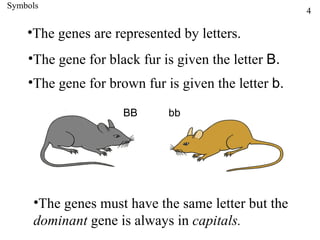
Symbols The genes are represented by letters. The gene for black fur is given the letter  B. The gene for brown fur is given the letter  b. BB bb The genes must have the same letter but the dominant  gene is always in  capitals. 4
Alleles The genes of a corresponding pair are called  alleles. This means  alternative forms  of the same gene - B   and  b  are alleles of the gene for coat colour - B  is the  dominant  allele - b   is the  recessive  allele 5
Terms you should know : GENOTYPE : genetic makeup of an organism in term of the alleles present ( e.g.  Tt  or  GG) . PHENOTYPE :  physical or other features of an organism due to both its genotype and its environment (e.g.  tall plant  or  green seed ) HOMOZYGOUS : having two identical alleles of a particulat gene (e.g.  TT  or  gg ).Two identical homozygous individuals that breed together will be pure-breeding.  HETEROZYGOUS : having two different alleles of a particular gene (e.g.  Tt  or  Gg ), not pure- breeding. DOMINANT : an allele that is expresed if it is present (e.g.  T  or  G )  RECESSIVE :  an allele that is only expresses when there is no dominant allele of the gene present. ( e.g  t  or  g  )
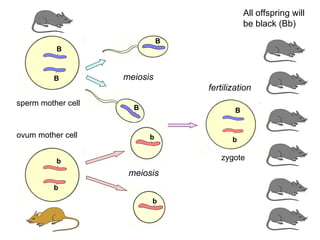
F 1 A black male mouse  ( BB )  is mated (crossed) with a female brown mouse  ( bb ) In gamete production by meiosis, the alleles are separated. Sperms will carry one copy of  the  B   allele  Ova will carry one copy of the  b  allele When the sperm fertilizes the ovum, the alleles  B  and  b  come together in the zygote 6
meiosis meiosis fertilization All offspring will be black (Bb) sperm mother cell ovum mother cell zygote B B B B b b b b B b
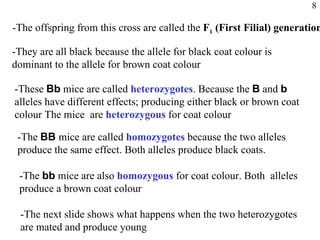
-The offspring from this cross are called the  F 1  (First Filial) generation -They are all black because the allele for black coat colour is dominant to the allele for brown coat colour -These  Bb  mice are called  heterozygotes . Because the  B  and  b   alleles have different effects; producing either black or brown coat  colour The mice  are  heterozygous  for coat colour -The  BB  mice are called  homozygotes  because the two alleles produce the same effect. Both alleles produce black coats. -The  bb  mice are also  homozygous  for coat colour. Both  alleles produce a brown coat colour -The next slide shows what happens when the two heterozygotes  are mated and produce young 8
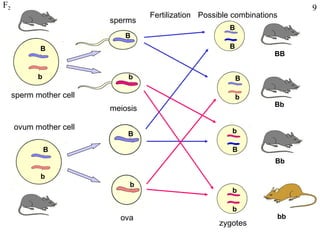
F 2 BB Bb Bb bb sperm mother cell ovum mother cell meiosis Possible combinations Fertilization sperms ova zygotes 9 B b B b B b B b B B B b B b b b
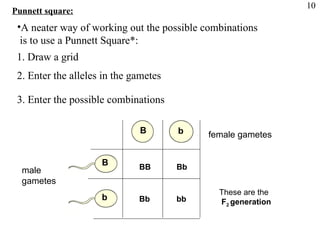
Punnett square: A neater way of working out the possible combinations is to use a Punnett Square*: 1. Draw a grid  2. Enter the alleles in the gametes 3. Enter the possible combinations female gametes male gametes BB Bb Bb bb These are the F 2  generation 10 b B B b
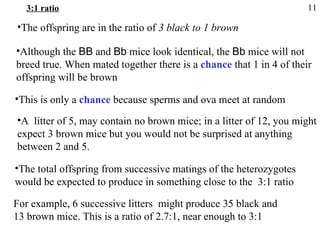
3:1 ratio The offspring are in the ratio of  3 black to 1 brown Although the  BB   and  Bb  mice look identical, the  Bb  mice will not breed true. When mated together there is a  chance   that 1 in 4 of their offspring will be brown This is only a  chance  because sperms and ova meet at random A  litter of 5, may contain no brown mice; in a litter of 12, you might expect 3 brown mice but you would not be surprised at anything  between 2 and 5. The total offspring from successive matings of the heterozygotes  would be expected to produce in something close to the  3:1 ratio For example, 6 successive litters  might produce 35 black and  13 brown mice. This is a ratio of 2.7:1, near enough to 3:1 11
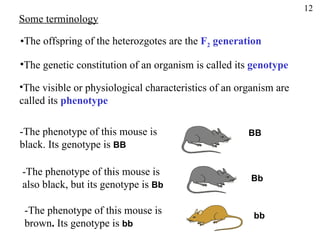
Some terminology The offspring of the heterozgotes are the  F 2  generation The genetic constitution of an organism is called its  genotype The visible or physiological characteristics of an organism are  called its  phenotype -The phenotype of this mouse is black. Its genotype is  BB BB -The phenotype of this mouse is  also black, but its genotype is  Bb Bb -The phenotype of this mouse is  brown .  Its genotype is  bb   bb 12
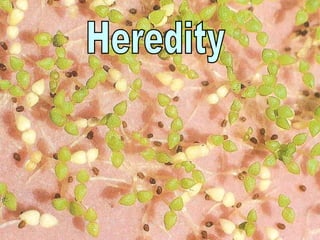
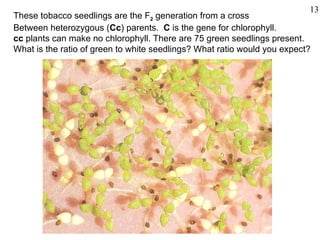
These tobacco seedlings are the F 2  generation from a cross  Between heterozygous ( Cc ) parents.  C  is the gene for chlorophyll. cc  plants can make no chlorophyll. There are 75 green seedlings present. What is the ratio of green to white seedlings? What ratio would you expect? 13
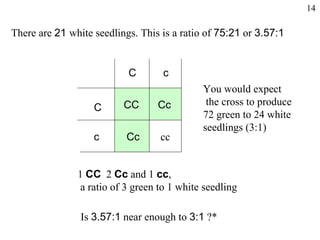
There are  21  white seedlings. This is a ratio of  75:21  or  3.57:1 Is  3.57:1  near enough to  3:1  ?* 1  CC   2  Cc   and 1  cc , a ratio of 3 green to 1 white seedling You would expect the cross to produce  72 green to 24 white  seedlings (3:1) c C c C cc 14 CC Cc Cc
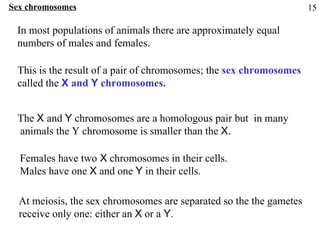
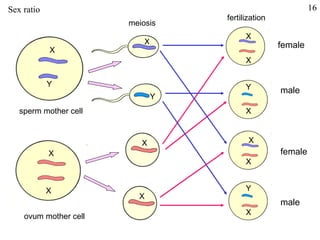
Sex chromosomes In most populations of animals there are approximately equal  numbers of males and females. This is the result of a pair of chromosomes; the  sex chromosomes called the   X  and  Y  chromosomes. The  X  and  Y  chromosomes are a homologous pair but  in many animals the Y chromosome is smaller than the  X. Females have two  X  chromosomes in their cells. Males have one  X  and one  Y  in their cells. At meiosis, the sex chromosomes are separated so the the gametes receive only one: either an  X  or a  Y . 15
Sex ratio sperm mother cell ovum mother cell meiosis fertilization female female male male 16 X Y X X X Y X X X X X X X Y X Y
Single gene effects - Very few human characteristics are controlled by a single gene - Characteristics such as height or skin colour are controlled by several genes acting together - Those characteristics which are controlled by a single gene are usually responsible for  inherited defects  ( see slide 19 ) 17
ABO blood groups An exception is the inheritance of the ABO blood group -The  I A   allele produces group A  -The  I B  allele produces group B -The  I O   allele produces group O -I O   is recessive to  I A  and  I B The group  A  phenotype can result from genotypes  I A I A  or  I A I O The group  B  phenotype can result from genotypes  I B I B  or  I B I O The group  O  phenotype can result only from genotype  I O I O The  AB  phenotype results from the genotype  I A I B The alleles  I A  and  I B  are equally dominant ( co-dominant ) 18
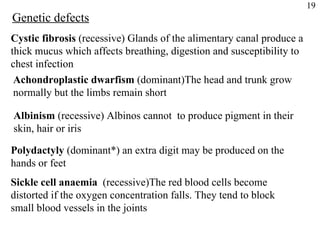
Genetic defects Cystic fibrosis  (recessive) Glands of the alimentary canal produce a  thick mucus which affects breathing, digestion and susceptibility to  chest infection Achondroplastic dwarfism  (dominant)The head and trunk grow  normally but the limbs remain short Albinism  (recessive) Albinos cannot  to produce pigment in their  skin, hair or iris Polydactyly  (dominant*) an extra digit may be produced on the hands or feet Sickle cell anaemia  (recessive)The red blood cells become distorted if the oxygen concentration falls. They tend to block  small blood vessels in the joints 19
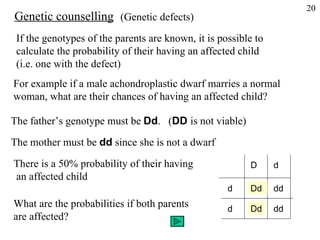
Genetic counselling If the genotypes of the parents are known, it is possible to  calculate the probability of their having an affected child  (i.e. one with the defect) For example if a male achondroplastic dwarf marries a normal woman, what are their chances of having an affected child? The father’s genotype must be  Dd .  ( DD  is not viable)  The mother must be  dd  since she is not a dwarf There is a 50% probability of their having an affected child What are the probabilities if both parents  are affected? (Genetic defects) 20 D d d d Dd Dd dd dd
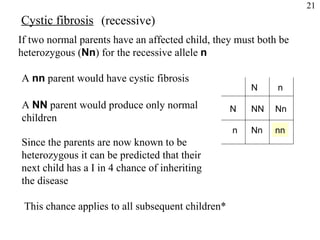
Cystic fibrosis If two normal parents have an affected child, they must both be  heterozygous ( Nn ) for the recessive allele  n  NN Nn Nn nn A  nn  parent would have cystic fibrosis A  NN  parent would produce only normal children Since the parents are now known to be heterozygous it can be predicted that their next child has a I in 4 chance of inheriting the disease This chance applies to all subsequent children* (recessive) 21 N n N n
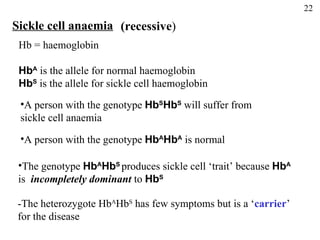
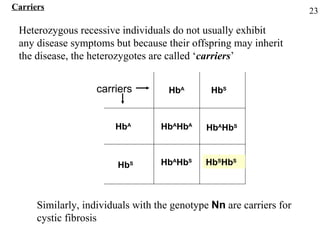
Sickle cell anaemia Hb = haemoglobin Hb A  is the allele for normal haemoglobin Hb S  is the allele for sickle cell haemoglobin A person with the genotype  Hb S Hb S  will suffer from  sickle cell anaemia A person with the genotype  Hb A Hb A  is normal The genotype  Hb A Hb S   produces sickle cell ‘trait’ because  Hb A is  incompletely dominant  to  Hb S -The heterozygote Hb A Hb S  has few symptoms but is a ‘ carrier ’  for the disease (recessive ) 22
Carriers Heterozygous recessive individuals do not usually exhibit  any disease symptoms but because their offspring may inherit the disease, the heterozygotes are called ‘ carriers ’ Hb A Hb A Hb A Hb A Hb A Hb S Hb A Hb S Hb S Hb S Hb S Hb S carriers Similarly, individuals with the genotype  Nn  are carriers for cystic fibrosis 23
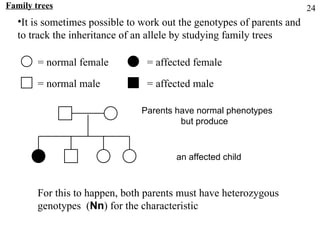
Family trees It is sometimes possible to work out the genotypes of parents and to track the inheritance of an allele by studying family trees Parents have normal phenotypes but produce an affected child For this to happen, both parents must have heterozygous genotypes  ( Nn ) for the characteristic 24 = normal female = affected female = normal male = affected male
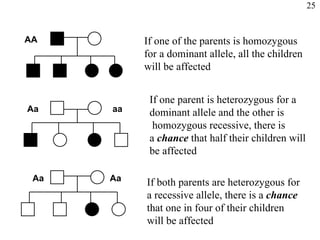
If one of the parents is homozygous for a dominant allele, all the children will be affected If one parent is heterozygous for a  dominant allele and the other is homozygous recessive, there is a  chance  that half their children will be affected If both parents are heterozygous for a recessive allele, there is a  chance   that one in four of their children  will be affected 25 AA Aa aa Aa Aa
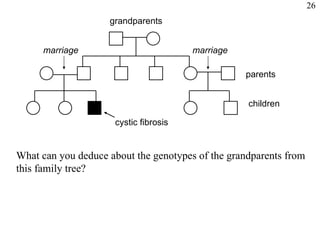
grandparents parents children cystic fibrosis What can you deduce about the genotypes of the grandparents from this family tree? marriage marriage 26
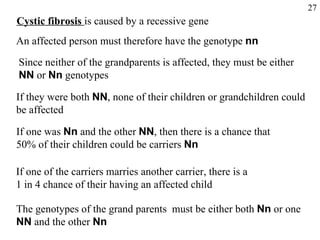
Cystic fibrosis  is caused by a recessive gene An affected person must therefore have the genotype  nn Since neither of the grandparents is affected, they must be either NN  or  Nn  genotypes If they were both  NN , none of their children or grandchildren could be affected If one was  Nn  and the other  NN , then there is a chance that  50% of their children could be carriers  Nn   If one of the carriers marries another carrier, there is a  1 in 4 chance of their having an affected child The genotypes of the grand parents  must be either both  Nn  or one NN  and the other  Nn 27
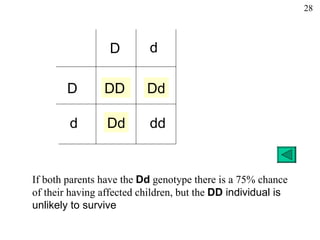
If both parents have the  Dd  genotype there is a 75% chance of their having affected children, but the  DD  individual is unlikely to survive   D D DD Dd Dd dd d d 28
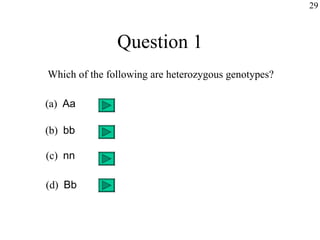
Question 1 Which of the following are heterozygous genotypes? (a)  Aa (b)  bb (c)  nn (d)  Bb 29
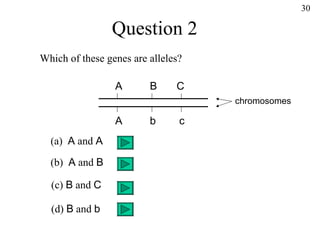
Question 2 Which of these genes are alleles? (a)  A  and  A (b)  A  and  B (c)  B  and  C (d)  B  and  b chromosomes 30 A B C A b c
Question 3 Which of the following processes separates  homologous chromosomes ? (a) mitosis (b) cell division (c) meiosis (d) fertilization 31
Question 4 Which of the following terms correctly describes the genotype  bb ? (a) homozygous dominant (b) heterozygous dominant (c) homozygous recessive (d) heterozygous recessive 32
Question 5 What is the likely ratio of affected children born to parents both of whom are heterozygous for cystic fibrosis ? 1 affected: 3 normal (b)  3 affected: 1 normal (c)  2 affected: 2 normal (d)  all affected 33
Question 6 Which of the following phenotypes corresponds to the  Genotype I A I O  ? Blood group A (b) Blood group B (c) Blood group O (d) Blood group AB 34
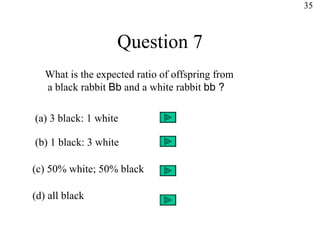
Question 7 What is the expected ratio of offspring from a black rabbit  Bb  and a white rabbit  bb ? (c) 50% white; 50% black (a) 3 black: 1 white (b) 1 black: 3 white (d) all black 35
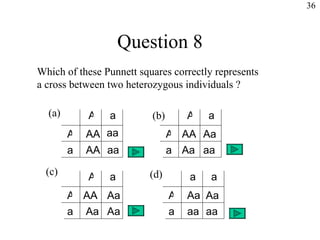
Question 8 Which of these Punnett squares correctly represents a cross between two heterozygous individuals ? AA AA AA aa aa a Aa Aa aa Aa aa aa Aa AA Aa Aa Aa (a) (b) (c) (d) 36 A a A a A a A a A a A a a A a
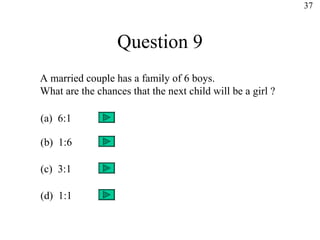
Question 9 A married couple has a family of 6 boys. What are the chances that the next child will be a girl ? (d)  1:1 (a)  6:1 (b)  1:6 (c)  3:1 37
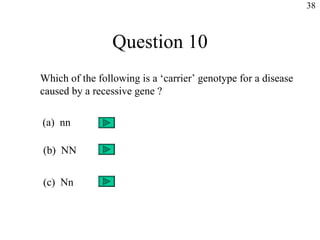
Question 10 Which of the following is a ‘carrier’ genotype for a disease  caused by a recessive gene ? (a)  nn (b)  NN (c)  Nn 38
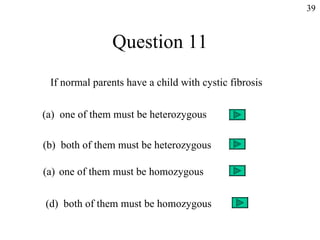
Question 11 If normal parents have a child with cystic fibrosis (a)  one of them must be heterozygous (b)  both of them must be heterozygous one of them must be homozygous (d)  both of them must be homozygous 39
Answer Correct 40
Answer Incorrect 41

Powerpoint heredity

  • 1.
  • 2.
    Terms you shouldknow CHROMOSOME : thread of DNA, made up of a string of genes. GENE : a length of DNA that is the unit of heredity and codes for a specific protein. A gene may be copied and passed on to the next generation. ALLELE : any of two or more alternative forms of a gene. HAPLOID NUCLEUS : a nucleus containing a single set of unpaired chromosomes (e.g. sperm and egg) DIPLOID NUCLEUS : a nucleus containing two sets of chromosomes (e.g. in body cells)
  • 3.
    Recap Genes controlthe characteristics of living organisms Genes are carried on the chromosomes Chromosomes are in pairs, one from each parent Genes are in pairs Genes controlling the same characteristics occupy identical positions on corresponding chromosomes 2
  • 4.
    Dominance The genepairs control one characteristic, but they do not always control it in the same way. Of the gene pair which help determine coat colour in mice, one might try to produce black fur and its partner might try to produce brown fur. The gene for black fur is dominant to the gene for brown fur. 3
  • 5.
    Symbols The genesare represented by letters. The gene for black fur is given the letter B. The gene for brown fur is given the letter b. BB bb The genes must have the same letter but the dominant gene is always in capitals. 4
  • 6.
    Alleles The genesof a corresponding pair are called alleles. This means alternative forms of the same gene - B and b are alleles of the gene for coat colour - B is the dominant allele - b is the recessive allele 5
  • 7.
    Terms you shouldknow : GENOTYPE : genetic makeup of an organism in term of the alleles present ( e.g. Tt or GG) . PHENOTYPE : physical or other features of an organism due to both its genotype and its environment (e.g. tall plant or green seed ) HOMOZYGOUS : having two identical alleles of a particulat gene (e.g. TT or gg ).Two identical homozygous individuals that breed together will be pure-breeding. HETEROZYGOUS : having two different alleles of a particular gene (e.g. Tt or Gg ), not pure- breeding. DOMINANT : an allele that is expresed if it is present (e.g. T or G ) RECESSIVE : an allele that is only expresses when there is no dominant allele of the gene present. ( e.g t or g )
  • 8.
    F 1 Ablack male mouse ( BB ) is mated (crossed) with a female brown mouse ( bb ) In gamete production by meiosis, the alleles are separated. Sperms will carry one copy of the B allele Ova will carry one copy of the b allele When the sperm fertilizes the ovum, the alleles B and b come together in the zygote 6
  • 9.
    meiosis meiosis fertilizationAll offspring will be black (Bb) sperm mother cell ovum mother cell zygote B B B B b b b b B b
  • 10.
    -The offspring fromthis cross are called the F 1 (First Filial) generation -They are all black because the allele for black coat colour is dominant to the allele for brown coat colour -These Bb mice are called heterozygotes . Because the B and b alleles have different effects; producing either black or brown coat colour The mice are heterozygous for coat colour -The BB mice are called homozygotes because the two alleles produce the same effect. Both alleles produce black coats. -The bb mice are also homozygous for coat colour. Both alleles produce a brown coat colour -The next slide shows what happens when the two heterozygotes are mated and produce young 8
  • 11.
    F 2 BBBb Bb bb sperm mother cell ovum mother cell meiosis Possible combinations Fertilization sperms ova zygotes 9 B b B b B b B b B B B b B b b b
  • 12.
    Punnett square: Aneater way of working out the possible combinations is to use a Punnett Square*: 1. Draw a grid 2. Enter the alleles in the gametes 3. Enter the possible combinations female gametes male gametes BB Bb Bb bb These are the F 2 generation 10 b B B b
  • 13.
    3:1 ratio Theoffspring are in the ratio of 3 black to 1 brown Although the BB and Bb mice look identical, the Bb mice will not breed true. When mated together there is a chance that 1 in 4 of their offspring will be brown This is only a chance because sperms and ova meet at random A litter of 5, may contain no brown mice; in a litter of 12, you might expect 3 brown mice but you would not be surprised at anything between 2 and 5. The total offspring from successive matings of the heterozygotes would be expected to produce in something close to the 3:1 ratio For example, 6 successive litters might produce 35 black and 13 brown mice. This is a ratio of 2.7:1, near enough to 3:1 11
  • 14.
    Some terminology Theoffspring of the heterozgotes are the F 2 generation The genetic constitution of an organism is called its genotype The visible or physiological characteristics of an organism are called its phenotype -The phenotype of this mouse is black. Its genotype is BB BB -The phenotype of this mouse is also black, but its genotype is Bb Bb -The phenotype of this mouse is brown . Its genotype is bb bb 12
  • 15.
    These tobacco seedlingsare the F 2 generation from a cross Between heterozygous ( Cc ) parents. C is the gene for chlorophyll. cc plants can make no chlorophyll. There are 75 green seedlings present. What is the ratio of green to white seedlings? What ratio would you expect? 13
  • 16.
    There are 21 white seedlings. This is a ratio of 75:21 or 3.57:1 Is 3.57:1 near enough to 3:1 ?* 1 CC 2 Cc and 1 cc , a ratio of 3 green to 1 white seedling You would expect the cross to produce 72 green to 24 white seedlings (3:1) c C c C cc 14 CC Cc Cc
  • 17.
    Sex chromosomes Inmost populations of animals there are approximately equal numbers of males and females. This is the result of a pair of chromosomes; the sex chromosomes called the X and Y chromosomes. The X and Y chromosomes are a homologous pair but in many animals the Y chromosome is smaller than the X. Females have two X chromosomes in their cells. Males have one X and one Y in their cells. At meiosis, the sex chromosomes are separated so the the gametes receive only one: either an X or a Y . 15
  • 18.
    Sex ratio spermmother cell ovum mother cell meiosis fertilization female female male male 16 X Y X X X Y X X X X X X X Y X Y
  • 19.
    Single gene effects- Very few human characteristics are controlled by a single gene - Characteristics such as height or skin colour are controlled by several genes acting together - Those characteristics which are controlled by a single gene are usually responsible for inherited defects ( see slide 19 ) 17
  • 20.
    ABO blood groupsAn exception is the inheritance of the ABO blood group -The I A allele produces group A -The I B allele produces group B -The I O allele produces group O -I O is recessive to I A and I B The group A phenotype can result from genotypes I A I A or I A I O The group B phenotype can result from genotypes I B I B or I B I O The group O phenotype can result only from genotype I O I O The AB phenotype results from the genotype I A I B The alleles I A and I B are equally dominant ( co-dominant ) 18
  • 21.
    Genetic defects Cysticfibrosis (recessive) Glands of the alimentary canal produce a thick mucus which affects breathing, digestion and susceptibility to chest infection Achondroplastic dwarfism (dominant)The head and trunk grow normally but the limbs remain short Albinism (recessive) Albinos cannot to produce pigment in their skin, hair or iris Polydactyly (dominant*) an extra digit may be produced on the hands or feet Sickle cell anaemia (recessive)The red blood cells become distorted if the oxygen concentration falls. They tend to block small blood vessels in the joints 19
  • 22.
    Genetic counselling Ifthe genotypes of the parents are known, it is possible to calculate the probability of their having an affected child (i.e. one with the defect) For example if a male achondroplastic dwarf marries a normal woman, what are their chances of having an affected child? The father’s genotype must be Dd . ( DD is not viable) The mother must be dd since she is not a dwarf There is a 50% probability of their having an affected child What are the probabilities if both parents are affected? (Genetic defects) 20 D d d d Dd Dd dd dd
  • 23.
    Cystic fibrosis Iftwo normal parents have an affected child, they must both be heterozygous ( Nn ) for the recessive allele n NN Nn Nn nn A nn parent would have cystic fibrosis A NN parent would produce only normal children Since the parents are now known to be heterozygous it can be predicted that their next child has a I in 4 chance of inheriting the disease This chance applies to all subsequent children* (recessive) 21 N n N n
  • 24.
    Sickle cell anaemiaHb = haemoglobin Hb A is the allele for normal haemoglobin Hb S is the allele for sickle cell haemoglobin A person with the genotype Hb S Hb S will suffer from sickle cell anaemia A person with the genotype Hb A Hb A is normal The genotype Hb A Hb S produces sickle cell ‘trait’ because Hb A is incompletely dominant to Hb S -The heterozygote Hb A Hb S has few symptoms but is a ‘ carrier ’ for the disease (recessive ) 22
  • 25.
    Carriers Heterozygous recessiveindividuals do not usually exhibit any disease symptoms but because their offspring may inherit the disease, the heterozygotes are called ‘ carriers ’ Hb A Hb A Hb A Hb A Hb A Hb S Hb A Hb S Hb S Hb S Hb S Hb S carriers Similarly, individuals with the genotype Nn are carriers for cystic fibrosis 23
  • 26.
    Family trees Itis sometimes possible to work out the genotypes of parents and to track the inheritance of an allele by studying family trees Parents have normal phenotypes but produce an affected child For this to happen, both parents must have heterozygous genotypes ( Nn ) for the characteristic 24 = normal female = affected female = normal male = affected male
  • 27.
    If one ofthe parents is homozygous for a dominant allele, all the children will be affected If one parent is heterozygous for a dominant allele and the other is homozygous recessive, there is a chance that half their children will be affected If both parents are heterozygous for a recessive allele, there is a chance that one in four of their children will be affected 25 AA Aa aa Aa Aa
  • 28.
    grandparents parents childrencystic fibrosis What can you deduce about the genotypes of the grandparents from this family tree? marriage marriage 26
  • 29.
    Cystic fibrosis is caused by a recessive gene An affected person must therefore have the genotype nn Since neither of the grandparents is affected, they must be either NN or Nn genotypes If they were both NN , none of their children or grandchildren could be affected If one was Nn and the other NN , then there is a chance that 50% of their children could be carriers Nn If one of the carriers marries another carrier, there is a 1 in 4 chance of their having an affected child The genotypes of the grand parents must be either both Nn or one NN and the other Nn 27
  • 30.
    If both parentshave the Dd genotype there is a 75% chance of their having affected children, but the DD individual is unlikely to survive D D DD Dd Dd dd d d 28
  • 31.
    Question 1 Whichof the following are heterozygous genotypes? (a) Aa (b) bb (c) nn (d) Bb 29
  • 32.
    Question 2 Whichof these genes are alleles? (a) A and A (b) A and B (c) B and C (d) B and b chromosomes 30 A B C A b c
  • 33.
    Question 3 Whichof the following processes separates homologous chromosomes ? (a) mitosis (b) cell division (c) meiosis (d) fertilization 31
  • 34.
    Question 4 Whichof the following terms correctly describes the genotype bb ? (a) homozygous dominant (b) heterozygous dominant (c) homozygous recessive (d) heterozygous recessive 32
  • 35.
    Question 5 Whatis the likely ratio of affected children born to parents both of whom are heterozygous for cystic fibrosis ? 1 affected: 3 normal (b) 3 affected: 1 normal (c) 2 affected: 2 normal (d) all affected 33
  • 36.
    Question 6 Whichof the following phenotypes corresponds to the Genotype I A I O ? Blood group A (b) Blood group B (c) Blood group O (d) Blood group AB 34
  • 37.
    Question 7 Whatis the expected ratio of offspring from a black rabbit Bb and a white rabbit bb ? (c) 50% white; 50% black (a) 3 black: 1 white (b) 1 black: 3 white (d) all black 35
  • 38.
    Question 8 Whichof these Punnett squares correctly represents a cross between two heterozygous individuals ? AA AA AA aa aa a Aa Aa aa Aa aa aa Aa AA Aa Aa Aa (a) (b) (c) (d) 36 A a A a A a A a A a A a a A a
  • 39.
    Question 9 Amarried couple has a family of 6 boys. What are the chances that the next child will be a girl ? (d) 1:1 (a) 6:1 (b) 1:6 (c) 3:1 37
  • 40.
    Question 10 Whichof the following is a ‘carrier’ genotype for a disease caused by a recessive gene ? (a) nn (b) NN (c) Nn 38
  • 41.
    Question 11 Ifnormal parents have a child with cystic fibrosis (a) one of them must be heterozygous (b) both of them must be heterozygous one of them must be homozygous (d) both of them must be homozygous 39
  • 42.
  • 43.

Editor's Notes

  • #2 The slide shows tobacco seedlings some of which have no chlorophyll, See slide No.13
  • #13 * After Dr. R.C. Punnett, Professor of Genetics in Cambridge in the first half of the 20 th century.
  • #14 The 3:1 ratio is sometimes called a Mendelian ratio after Gregor Mendel (1822-84), an Austrian Monk with an interest in plant breeding and mathematics. He made experimental crosses, particularly of pea plants, to see how characteristics were inherited. He realised that although certain characteristics seemed to disappear in the first generation, they could reappear in the second generation, and so he developed the idea of dominant and recessive characteristics with the recessive characteristics being suppressed in the first generation.. His second generation crosses, involving single characteristics, produced ratios approximating to 3;1. From these results he drew accurate conclusions about the mechanism of inheritance although he knew nothing about chromosomes and genes at this time.
  • #17 *There are 75 green seedlings + 21 white seedlings. This is the ‘observed result’. If the 3:1 ratio is operating, the ‘expected result’ would be 72 green and 24 white seedlings. A statistical test on these figures tells us that the difference between the observed and expected results is sufficiently small to be ignored and the 75:21 ratio is near enough to 3:1 to be confident that this is the outcome of a genetic process.
  • #19 This shows that there is a 50% chance of a boy or a girl baby. Because this ratio depends on the chance meeting of X and Y gametes and human families are small, the 1:1 ratio is rarely seen, even in large families. A family with 6 boys may hope for a girl next time but there is still only a 50% chance of getting a girl. In the population as a whole, the 1:1 ratio holds good.
  • #22 *Even though the allele is dominant, it may not always be fully expressed. X-rays will reveal an extra metacarpal but this may not form a separate digit so the hand looks normal, In some cases only one of the hands shows the extra digit.
  • #23 The incidence of achondroplasia is about 1 in 30000. These cases arise as a result of a mutation; the affected children are born to normal parents. A mutation is a spontaneous change in a gene or a chromosome. Mutations are mostly harmful.
  • #24 Even if the parents have five normal children, there is still a 1 in 4 chance of the next child being affected. If the heterozygotes could be detected before they had children, they could be counselled about the likelihood of having affected children. Families at risk (I.e. cystic fibrosis in a relative) may be offered DNA testing to look for one or more of the genes which cause the disease.