4/22/20152/3/03 10:39 AM
1
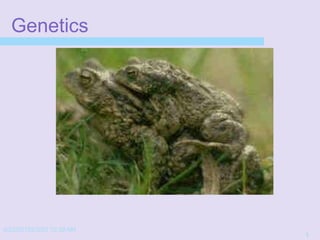
Genetics
4/22/2015
2
Genetics & Inheritance
What you get isn’t always what you see
Intro to Inheritance
What is Heredity?
 http://learn.genetics.utah.edu/content/inheri
tance/intro/
What is a Trait?
 http://learn.genetics.utah.edu/content/inheri
tance/traits/
 http://learn.genetics.utah.edu/content/begin/t
our/inheritance.swf
4/22/20152/3/03 10:39 AM
3
4/22/20152/3/03 10:39 AM
4
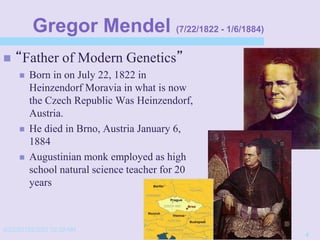
Gregor Mendel (7/22/1822 - 1/6/1884)
 “Father of Modern Genetics”
 Born in on July 22, 1822 in
Heinzendorf Moravia in what is now
the Czech Republic Was Heinzendorf,
Austria.
 He died in Brno, Austria January 6,
1884
 Augustinian monk employed as high
school natural science teacher for 20
years
4/22/20152/3/03 10:39 AM
5
Gregor Mendel (7/22/1822 - 1884)
 Experimented with garden peas Pisum
sativum
 Tested some 28,000 pea plants in 7 years
 Used artificial fertilization
 Worked in limited space in monastery
garden
 First to consider single traits of
hybridization experiments results
 Devised precise mathematical pattern
 Did not understand biological process, eg.
chromosomes & DNA
 1900 three botanists “discovered” his
papers while researching their own
findings
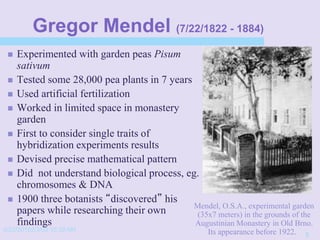
Mendel, O.S.A., experimental garden
(35x7 meters) in the grounds of the
Augustinian Monastery in Old Brno.
Its appearance before 1922.
4/22/20152/3/03 10:39 AM
6
Mendel’s Pea Plants
 Scientific name:
Pisum sativum
 Diploid
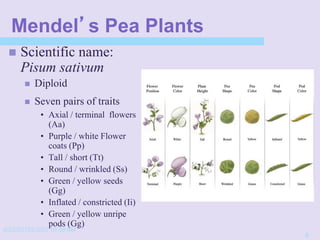
 Seven pairs of traits
• Axial / terminal flowers
(Aa)
• Purple / white Flower
coats (Pp)
• Tall / short (Tt)
• Round / wrinkled (Ss)
• Green / yellow seeds
(Gg)
• Inflated / constricted (Ii)
• Green / yellow unripe
pods (Gg)
Mendel’s
Pea Plants
 Pisum sativum
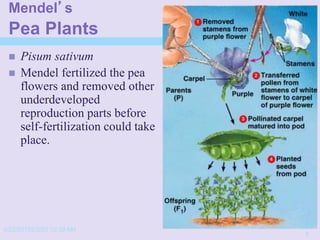
 Mendel fertilized the pea
flowers and removed other
underdeveloped
reproduction parts before
self-fertilization could take
place.
4/22/20152/3/03 10:39 AM
7
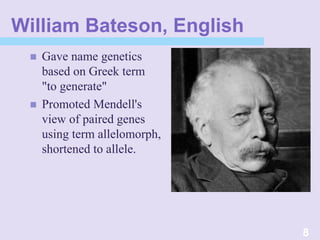
William Bateson, English
 Gave name genetics
based on Greek term
"to generate"
 Promoted Mendell's
view of paired genes
using term allelomorph,
shortened to allele.
8
4/22/20152/3/03 10:39 AM
9
Basic Ideas
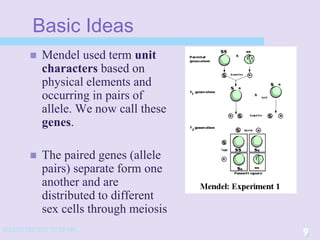
 Mendel used term unit
characters based on
physical elements and
occurring in pairs of
allele. We now call these
genes.
 The paired genes (allele
pairs) separate form one
another and are
distributed to different
sex cells through meiosis
9
Mendel's 3 Laws
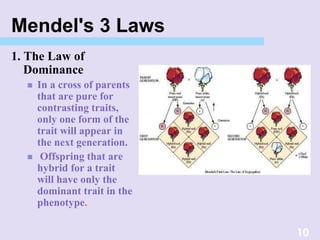
1. The Law of
Dominance
 In a cross of parents
that are pure for
contrasting traits,
only one form of the
trait will appear in
the next generation.
 Offspring that are
hybrid for a trait
will have only the
dominant trait in the
phenotype.
10
Mendel's 3 Laws
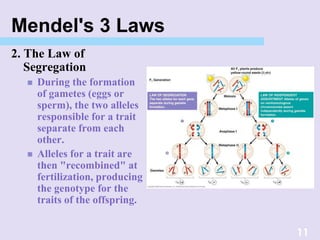
2. The Law of
Segregation
 During the formation
of gametes (eggs or
sperm), the two alleles
responsible for a trait
separate from each
other.
 Alleles for a trait are
then "recombined" at
fertilization, producing
the genotype for the
traits of the offspring.
11
Mendel's 3 Laws
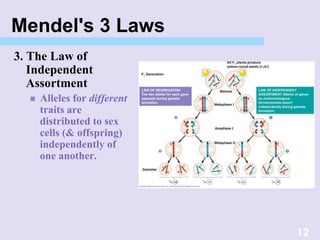
3. The Law of
Independent
Assortment
 Alleles for different
traits are
distributed to sex
cells (& offspring)
independently of
one another.
12
4/22/20152/3/03 10:39 AM
13
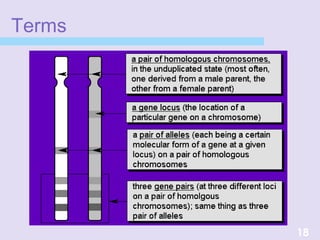
Terms
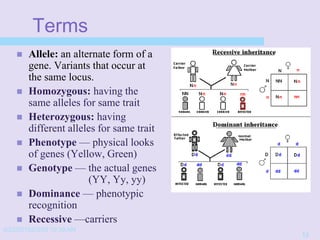
 Allele: an alternate form of a
gene. Variants that occur at
the same locus.
 Homozygous: having the
same alleles for same trait
 Heterozygous: having
different alleles for same trait
 Phenotype — physical looks
of genes (Yellow, Green)
 Genotype — the actual genes
(YY, Yy, yy)
 Dominance — phenotypic
recognition
 Recessive —carriers
4/22/20152/3/03 10:39 AM
14
Labeling:
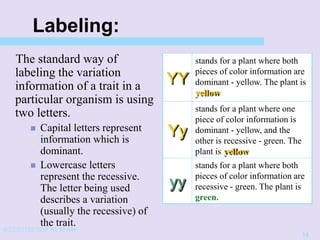
The standard way of
labeling the variation
information of a trait in a
particular organism is using
two letters.
 Capital letters represent
information which is
dominant.
 Lowercase letters
represent the recessive.
The letter being used
describes a variation
(usually the recessive) of
the trait.
YY
stands for a plant where both
pieces of color information are
dominant - yellow. The plant is
yellow.
Yy
stands for a plant where one
piece of color information is
dominant - yellow, and the
other is recessive - green. The
plant is yellow.
yy
stands for a plant where both
pieces of color information are
recessive - green. The plant is
green.
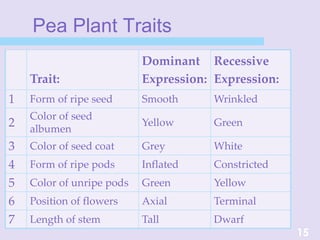
Pea Plant Traits
Trait:
Dominant
Expression:
Recessive
Expression:
1 Form of ripe seed Smooth Wrinkled
2
Color of seed
albumen
Yellow Green
3 Color of seed coat Grey White
4 Form of ripe pods Inflated Constricted
5 Color of unripe pods Green Yellow
6 Position of flowers Axial Terminal
7 Length of stem Tall Dwarf
15
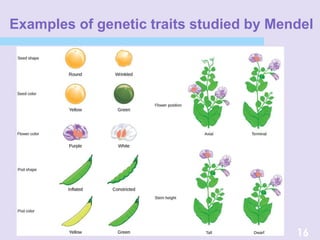
Examples of genetic traits studied by Mendel
16
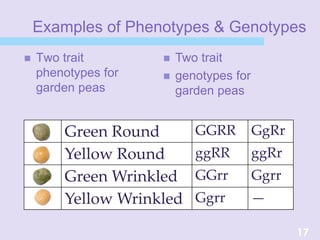
Examples of Phenotypes & Genotypes
 Two trait
phenotypes for
garden peas
 Two trait
 genotypes for
garden peas
17
Green Round GGRR GgRr
Yellow Round ggRR ggRr
Green Wrinkled GGrr Ggrr
Yellow Wrinkled Ggrr —
Terms
18
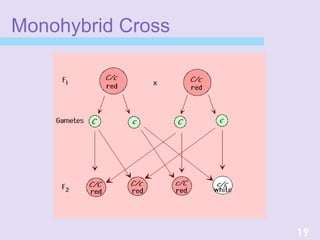
Monohybrid Cross
19
4/22/20152/3/03 10:39 AM
20
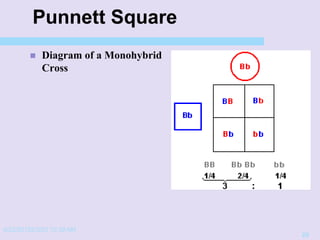
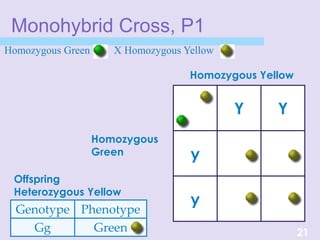
Punnett Square
 Diagram of a Monohybrid
Cross
Y Y
y
y
Monohybrid Cross, P1
Genotype Phenotype
Gg Green
Homozygous Green X Homozygous Yellow
21
Homozygous Yellow
Homozygous
Green
Offspring
Heterozygous Yellow
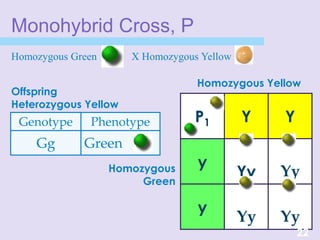
P1 Y Y
y
Yy Yy
y
Yy Yy
Monohybrid Cross, P
Genotype Phenotype
Gg Green
Homozygous Green X Homozygous Yellow
22
Homozygous Yellow
Homozygous
Green
Offspring
Heterozygous Yellow
4/22/20152/3/03 10:39 AM
23
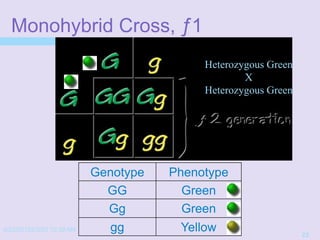
Monohybrid Cross, ƒ1
Genotype Phenotype
GG Green
Gg Green
gg Yellow
Heterozygous Green
X
Heterozygous Green
4/22/20152/3/03 10:39 AM
24
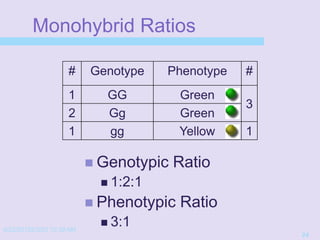
Monohybrid Ratios
 Genotypic Ratio
 1:2:1
 Phenotypic Ratio
 3:1
# Genotype Phenotype #
1 GG Green
3
2 Gg Green
1 gg Yellow 1
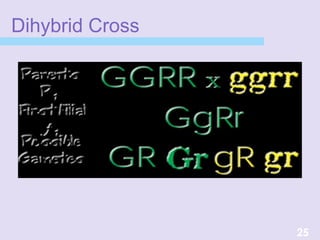
Dihybrid Cross
25
4/22/20152/3/03 10:39 AM
26
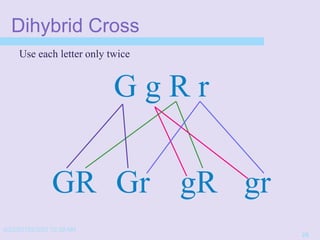
Dihybrid Cross
Use each letter only twice
G g R r
GR Gr gR gr
4/22/20152/3/03 10:39 AM
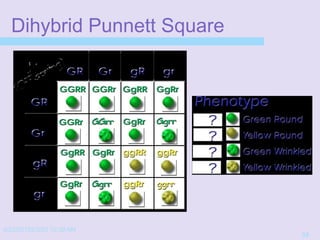
27
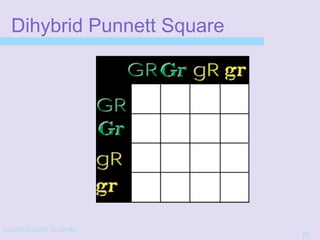
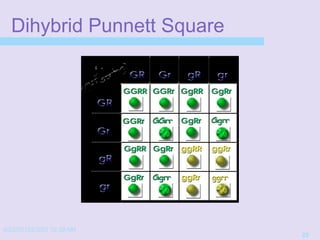
Dihybrid Punnett Square
4/22/20152/3/03 10:39 AM
28
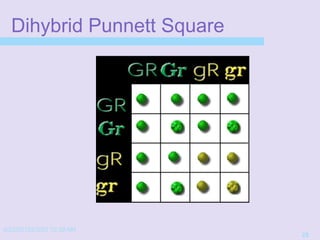
Dihybrid Punnett Square
4/22/20152/3/03 10:39 AM
29
Dihybrid Punnett Square
4/22/20152/3/03 10:39 AM
30
Dihybrid Punnett Square
4/22/20152/3/03 10:39 AM
31
Dihybrid Punnett Square
4/22/20152/3/03 10:39 AM
32
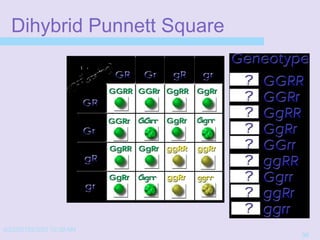
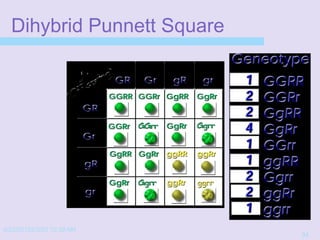
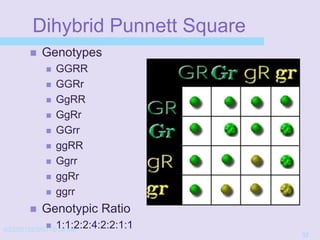
Dihybrid Punnett Square
 Genotypes
 GGRR
 GGRr
 GgRR
 GgRr
 GGrr
 ggRR
 Ggrr
 ggRr
 ggrr
 Genotypic Ratio
 1:1:2:2:4:2:2:1:1
4/22/20152/3/03 10:39 AM
33
Dihybrid Punnett Square
4/22/20152/3/03 10:39 AM
34
Dihybrid Punnett Square
4/22/20152/3/03 10:39 AM
35
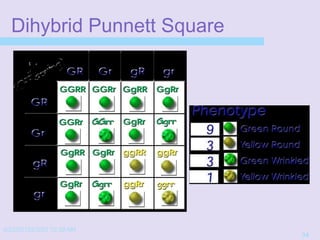
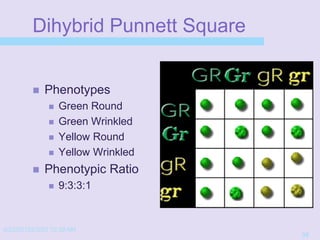
Dihybrid Punnett Square
 Phenotypes
 Green Round
 Green Wrinkled
 Yellow Round
 Yellow Wrinkled
 Phenotypic Ratio
 9:3:3:1
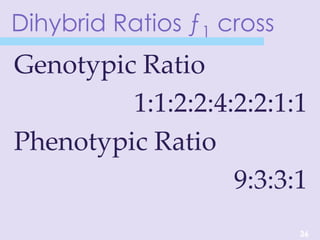
Dihybrid Ratios ƒ1 cross
Genotypic Ratio
1:1:2:2:4:2:2:1:1
Phenotypic Ratio
9:3:3:1
36
Law of Probability
 The chance of two
or more independent
events occurring
together is the
product of the
chances for their
separate
occurrences.
37
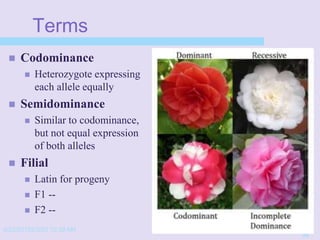
Terms
 Codominance
 Heterozygote expressing
each allele equally
 Semidominance
 Similar to codominance,
but not equal expression
of both alleles
 Filial
 Latin for progeny
 F1 --
 F2 --
4/22/20152/3/03 10:39 AM
38
4/22/20152/3/03 10:39 AM
39
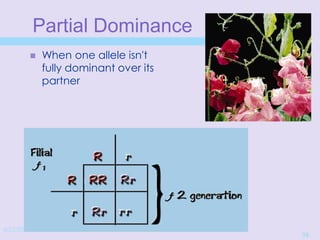
Partial Dominance
 When one allele isn't
fully dominant over its
partner
4/22/20152/3/03 10:39 AM
40
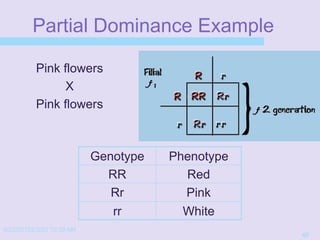
Partial Dominance Example
Genotype Phenotype
RR Red
Rr Pink
rr White
Pink flowers
X
Pink flowers
4/22/20152/3/03 10:39 AM
41
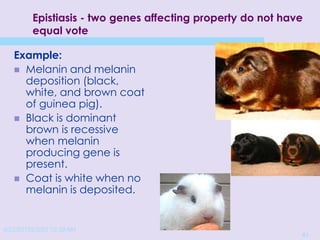
Epistiasis - two genes affecting property do not have
equal vote
Example:
 Melanin and melanin
deposition (black,
white, and brown coat
of guinea pig).
 Black is dominant
brown is recessive
when melanin
producing gene is
present.
 Coat is white when no
melanin is deposited.
4/22/20152/3/03 10:39 AM
42
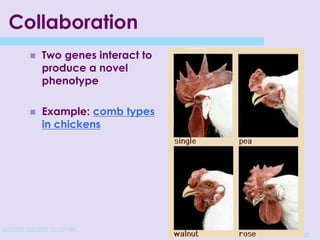
Collaboration
 Two genes interact to
produce a novel
phenotype
 Example: comb types
in chickens
43
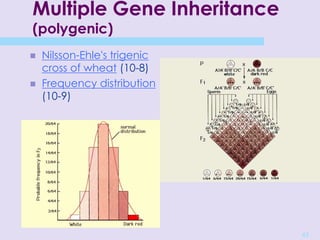
Multiple Gene Inheritance
(polygenic)
 Nilsson-Ehle's trigenic
cross of wheat (10-8)
 Frequency distribution
(10-9)
4/22/20152/3/03 10:39 AM
44
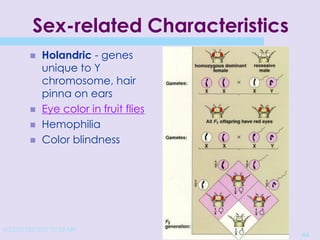
Sex-related Characteristics
 Holandric - genes
unique to Y
chromosome, hair
pinna on ears
 Eye color in fruit flies
 Hemophilia
 Color blindness
45
Sex-Linked Characteristics
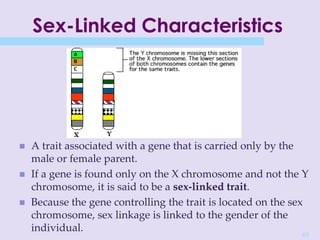
 A trait associated with a gene that is carried only by the
male or female parent.
 If a gene is found only on the X chromosome and not the Y
chromosome, it is said to be a sex-linked trait.
 Because the gene controlling the trait is located on the sex
chromosome, sex linkage is linked to the gender of the
individual.
4/22/20152/3/03 10:39 AM
46
Sex-linked Inheritance
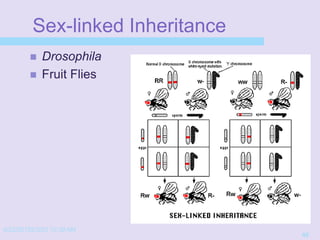
 Drosophila
 Fruit Flies
47
Sex-linked Inheritance
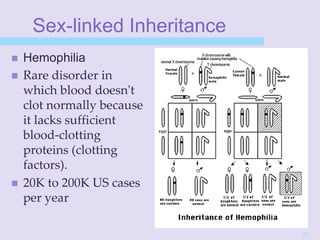
 Hemophilia
 Rare disorder in
which blood doesn't
clot normally because
it lacks sufficient
blood-clotting
proteins (clotting
factors).
 20K to 200K US cases
per year
48
Sex-linked Inheritance
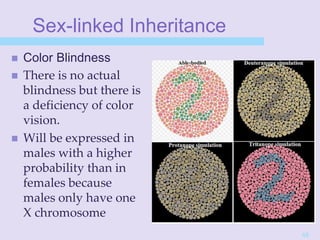
 Color Blindness
 There is no actual
blindness but there is
a deficiency of color
vision.
 Will be expressed in
males with a higher
probability than in
females because
males only have one
X chromosome
4/22/20152/3/03 10:39 AM
49
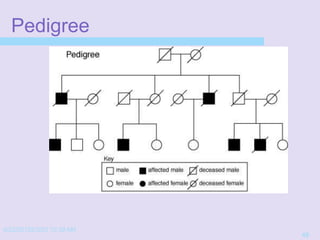
Pedigree
4/22/20152/3/03 10:39 AM
50
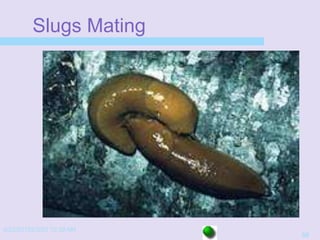
Slugs Mating
4/22/20152/3/03 10:39 AM
51
Webpage Links
 The Genetic Code - S.D. Black, U. of Texas Health Center at Tyler Table relating nucleic acid
triplet to the corresponding amino acid.
 Molecular Biology - The Biology Project, Biology, University of Arizona Activities, Problems sets,
and Tutorials: Molecular Genetics; Nucleic Acids; Recombinant DNA Technology; Eukaryotic
Gene Expression
 Prokaryotic Genetics and Gene Expression from the MIT Hypertextbook - M.I.T. Tools for
studying prokaryotic genetics, biochemical genetics, Lac operation, etc.
 The making of the nucleosome - D. Pruss Simplified images and a tour.
 http://www.agen.ufl.edu/~chyn/age2062/lect/lect_10/lect_10.htm
 http://www.borg.com/~lubehawk/mendel.htm
 http://www.sonic.net/~nbs/projects/anthro201/disc/

Genetics presentation ’15

  • 1.
  • 2.
    4/22/2015 2 Genetics & Inheritance Whatyou get isn’t always what you see
  • 3.
    Intro to Inheritance Whatis Heredity?  http://learn.genetics.utah.edu/content/inheri tance/intro/ What is a Trait?  http://learn.genetics.utah.edu/content/inheri tance/traits/  http://learn.genetics.utah.edu/content/begin/t our/inheritance.swf 4/22/20152/3/03 10:39 AM 3
  • 4.
    4/22/20152/3/03 10:39 AM 4 GregorMendel (7/22/1822 - 1/6/1884)  “Father of Modern Genetics”  Born in on July 22, 1822 in Heinzendorf Moravia in what is now the Czech Republic Was Heinzendorf, Austria.  He died in Brno, Austria January 6, 1884  Augustinian monk employed as high school natural science teacher for 20 years
  • 5.
    4/22/20152/3/03 10:39 AM 5 GregorMendel (7/22/1822 - 1884)  Experimented with garden peas Pisum sativum  Tested some 28,000 pea plants in 7 years  Used artificial fertilization  Worked in limited space in monastery garden  First to consider single traits of hybridization experiments results  Devised precise mathematical pattern  Did not understand biological process, eg. chromosomes & DNA  1900 three botanists “discovered” his papers while researching their own findings Mendel, O.S.A., experimental garden (35x7 meters) in the grounds of the Augustinian Monastery in Old Brno. Its appearance before 1922.
  • 6.
    4/22/20152/3/03 10:39 AM 6 Mendel’sPea Plants  Scientific name: Pisum sativum  Diploid  Seven pairs of traits • Axial / terminal flowers (Aa) • Purple / white Flower coats (Pp) • Tall / short (Tt) • Round / wrinkled (Ss) • Green / yellow seeds (Gg) • Inflated / constricted (Ii) • Green / yellow unripe pods (Gg)
  • 7.
    Mendel’s Pea Plants  Pisumsativum  Mendel fertilized the pea flowers and removed other underdeveloped reproduction parts before self-fertilization could take place. 4/22/20152/3/03 10:39 AM 7
  • 8.
    William Bateson, English Gave name genetics based on Greek term "to generate"  Promoted Mendell's view of paired genes using term allelomorph, shortened to allele. 8
  • 9.
    4/22/20152/3/03 10:39 AM 9 BasicIdeas  Mendel used term unit characters based on physical elements and occurring in pairs of allele. We now call these genes.  The paired genes (allele pairs) separate form one another and are distributed to different sex cells through meiosis 9
  • 10.
    Mendel's 3 Laws 1.The Law of Dominance  In a cross of parents that are pure for contrasting traits, only one form of the trait will appear in the next generation.  Offspring that are hybrid for a trait will have only the dominant trait in the phenotype. 10
  • 11.
    Mendel's 3 Laws 2.The Law of Segregation  During the formation of gametes (eggs or sperm), the two alleles responsible for a trait separate from each other.  Alleles for a trait are then "recombined" at fertilization, producing the genotype for the traits of the offspring. 11
  • 12.
    Mendel's 3 Laws 3.The Law of Independent Assortment  Alleles for different traits are distributed to sex cells (& offspring) independently of one another. 12
  • 13.
    4/22/20152/3/03 10:39 AM 13 Terms Allele: an alternate form of a gene. Variants that occur at the same locus.  Homozygous: having the same alleles for same trait  Heterozygous: having different alleles for same trait  Phenotype — physical looks of genes (Yellow, Green)  Genotype — the actual genes (YY, Yy, yy)  Dominance — phenotypic recognition  Recessive —carriers
  • 14.
    4/22/20152/3/03 10:39 AM 14 Labeling: Thestandard way of labeling the variation information of a trait in a particular organism is using two letters.  Capital letters represent information which is dominant.  Lowercase letters represent the recessive. The letter being used describes a variation (usually the recessive) of the trait. YY stands for a plant where both pieces of color information are dominant - yellow. The plant is yellow. Yy stands for a plant where one piece of color information is dominant - yellow, and the other is recessive - green. The plant is yellow. yy stands for a plant where both pieces of color information are recessive - green. The plant is green.
  • 15.
    Pea Plant Traits Trait: Dominant Expression: Recessive Expression: 1Form of ripe seed Smooth Wrinkled 2 Color of seed albumen Yellow Green 3 Color of seed coat Grey White 4 Form of ripe pods Inflated Constricted 5 Color of unripe pods Green Yellow 6 Position of flowers Axial Terminal 7 Length of stem Tall Dwarf 15
  • 16.
    Examples of genetictraits studied by Mendel 16
  • 17.
    Examples of Phenotypes& Genotypes  Two trait phenotypes for garden peas  Two trait  genotypes for garden peas 17 Green Round GGRR GgRr Yellow Round ggRR ggRr Green Wrinkled GGrr Ggrr Yellow Wrinkled Ggrr —
  • 18.
  • 19.
  • 20.
    4/22/20152/3/03 10:39 AM 20 PunnettSquare  Diagram of a Monohybrid Cross
  • 21.
    Y Y y y Monohybrid Cross,P1 Genotype Phenotype Gg Green Homozygous Green X Homozygous Yellow 21 Homozygous Yellow Homozygous Green Offspring Heterozygous Yellow
  • 22.
    P1 Y Y y YyYy y Yy Yy Monohybrid Cross, P Genotype Phenotype Gg Green Homozygous Green X Homozygous Yellow 22 Homozygous Yellow Homozygous Green Offspring Heterozygous Yellow
  • 23.
    4/22/20152/3/03 10:39 AM 23 MonohybridCross, ƒ1 Genotype Phenotype GG Green Gg Green gg Yellow Heterozygous Green X Heterozygous Green
  • 24.
    4/22/20152/3/03 10:39 AM 24 MonohybridRatios  Genotypic Ratio  1:2:1  Phenotypic Ratio  3:1 # Genotype Phenotype # 1 GG Green 3 2 Gg Green 1 gg Yellow 1
  • 25.
  • 26.
    4/22/20152/3/03 10:39 AM 26 DihybridCross Use each letter only twice G g R r GR Gr gR gr
  • 27.
  • 28.
  • 29.
  • 30.
  • 31.
  • 32.
    4/22/20152/3/03 10:39 AM 32 DihybridPunnett Square  Genotypes  GGRR  GGRr  GgRR  GgRr  GGrr  ggRR  Ggrr  ggRr  ggrr  Genotypic Ratio  1:1:2:2:4:2:2:1:1
  • 33.
  • 34.
  • 35.
    4/22/20152/3/03 10:39 AM 35 DihybridPunnett Square  Phenotypes  Green Round  Green Wrinkled  Yellow Round  Yellow Wrinkled  Phenotypic Ratio  9:3:3:1
  • 36.
    Dihybrid Ratios ƒ1cross Genotypic Ratio 1:1:2:2:4:2:2:1:1 Phenotypic Ratio 9:3:3:1 36
  • 37.
    Law of Probability The chance of two or more independent events occurring together is the product of the chances for their separate occurrences. 37
  • 38.
    Terms  Codominance  Heterozygoteexpressing each allele equally  Semidominance  Similar to codominance, but not equal expression of both alleles  Filial  Latin for progeny  F1 --  F2 -- 4/22/20152/3/03 10:39 AM 38
  • 39.
    4/22/20152/3/03 10:39 AM 39 PartialDominance  When one allele isn't fully dominant over its partner
  • 40.
    4/22/20152/3/03 10:39 AM 40 PartialDominance Example Genotype Phenotype RR Red Rr Pink rr White Pink flowers X Pink flowers
  • 41.
    4/22/20152/3/03 10:39 AM 41 Epistiasis- two genes affecting property do not have equal vote Example:  Melanin and melanin deposition (black, white, and brown coat of guinea pig).  Black is dominant brown is recessive when melanin producing gene is present.  Coat is white when no melanin is deposited.
  • 42.
    4/22/20152/3/03 10:39 AM 42 Collaboration Two genes interact to produce a novel phenotype  Example: comb types in chickens
  • 43.
    43 Multiple Gene Inheritance (polygenic) Nilsson-Ehle's trigenic cross of wheat (10-8)  Frequency distribution (10-9)
  • 44.
    4/22/20152/3/03 10:39 AM 44 Sex-relatedCharacteristics  Holandric - genes unique to Y chromosome, hair pinna on ears  Eye color in fruit flies  Hemophilia  Color blindness
  • 45.
    45 Sex-Linked Characteristics  Atrait associated with a gene that is carried only by the male or female parent.  If a gene is found only on the X chromosome and not the Y chromosome, it is said to be a sex-linked trait.  Because the gene controlling the trait is located on the sex chromosome, sex linkage is linked to the gender of the individual.
  • 46.
    4/22/20152/3/03 10:39 AM 46 Sex-linkedInheritance  Drosophila  Fruit Flies
  • 47.
    47 Sex-linked Inheritance  Hemophilia Rare disorder in which blood doesn't clot normally because it lacks sufficient blood-clotting proteins (clotting factors).  20K to 200K US cases per year
  • 48.
    48 Sex-linked Inheritance  ColorBlindness  There is no actual blindness but there is a deficiency of color vision.  Will be expressed in males with a higher probability than in females because males only have one X chromosome
  • 49.
  • 50.
  • 51.
    4/22/20152/3/03 10:39 AM 51 WebpageLinks  The Genetic Code - S.D. Black, U. of Texas Health Center at Tyler Table relating nucleic acid triplet to the corresponding amino acid.  Molecular Biology - The Biology Project, Biology, University of Arizona Activities, Problems sets, and Tutorials: Molecular Genetics; Nucleic Acids; Recombinant DNA Technology; Eukaryotic Gene Expression  Prokaryotic Genetics and Gene Expression from the MIT Hypertextbook - M.I.T. Tools for studying prokaryotic genetics, biochemical genetics, Lac operation, etc.  The making of the nucleosome - D. Pruss Simplified images and a tour.  http://www.agen.ufl.edu/~chyn/age2062/lect/lect_10/lect_10.htm  http://www.borg.com/~lubehawk/mendel.htm  http://www.sonic.net/~nbs/projects/anthro201/disc/