V.SAKTHIPRIYA
II-MSC (IT)
NADAR SARASWATHI COLLEGE OF ARTS AND SCIENCE
CDMA:COD DIVISION MULTIPLE
ACCESS
 Codes with certain can be applied to the transmission
to enable the use of “code division multiplexing”(cdm).
 Code division multiple access(cdma) system use
exactly these codes to separate different users in code
space and to enable access medium without
interference.
 The main problem is how to find “good”codes and how
to separate the signal from noise generated by other
signal and the environment.
CDMA:ORTHOGONAL CODE
 Orthogonal in code space has the same meaning as in
standard space.vectors starting at the orgin(0,0,0).
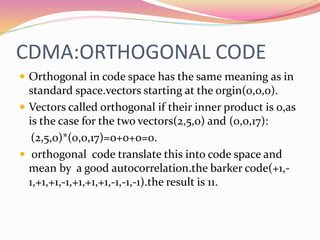
 Vectors called orthogonal if their inner product is 0,as
is the case for the two vectors(2,5,0) and (0,0,17):
(2,5,0)*(0,0,17)=0+0+0=0.
 orthogonal code translate this into code space and
mean by a good autocorrelation.the barker code(+1,-
1,+1,+1,-1,+1,+1,+1,-1,-1,-1).the result is 11.
CDMA:spread aloha multiple
access
 Cdma using different codes with certain properties for
spreading data result in a powerful multiple access
scheme in cdma.
 The wireless and mobile devices communicate with
the base station.it include many different spreading
codes .for,e.g ..,ad-hoc network.
CDMA (cond…,)
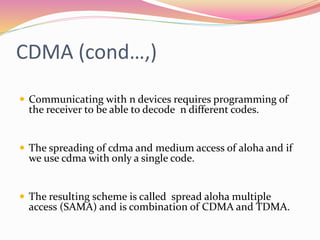
 Communicating with n devices requires programming of
the receiver to be able to decode n different codes.
 The spreading of cdma and medium access of aloha and if
we use cdma with only a single code.
 The resulting scheme is called spread aloha multiple
access (SAMA) and is combination of CDMA and TDMA.
CDMA (cond…,)
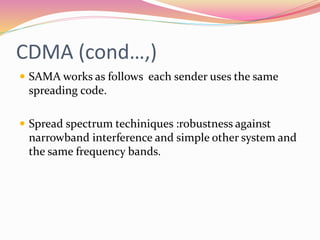
 SAMA works as follows each sender uses the same
spreading code.
 Spread spectrum techiniques :robustness against
narrowband interference and simple other system and
the same frequency bands.
COMPARSION OF S/T/F/CDMA:
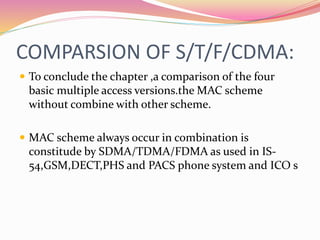
 To conclude the chapter ,a comparison of the four
basic multiple access versions.the MAC scheme
without combine with other scheme.
 MAC scheme always occur in combination is
constitude by SDMA/TDMA/FDMA as used in IS-
54,GSM,DECT,PHS and PACS phone system and ICO s
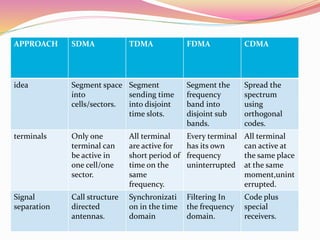
APPROACH SDMA TDMA FDMA CDMA
idea Segment space
into
cells/sectors.
Segment
sending time
into disjoint
time slots.
Segment the
frequency
band into
disjoint sub
bands.
Spread the
spectrum
using
orthogonal
codes.
terminals Only one
terminal can
be active in
one cell/one
sector.
All terminal
are active for
short period of
time on the
same
frequency.
Every terminal
has its own
frequency
uninterrupted
All terminal
can active at
the same place
at the same
moment,unint
errupted.
Signal
separation
Call structure
directed
antennas.
Synchronizati
on in the time
domain
Filtering In
the frequency
domain.
Code plus
special
receivers.
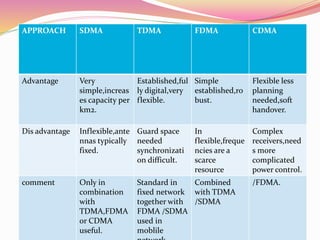
APPROACH SDMA TDMA FDMA CDMA
Advantage Very
simple,increas
es capacity per
km2.
Established,ful
ly digital,very
flexible.
Simple
established,ro
bust.
Flexible less
planning
needed,soft
handover.
Dis advantage Inflexible,ante
nnas typically
fixed.
Guard space
needed
synchronizati
on difficult.
In
flexible,freque
ncies are a
scarce
resource
Complex
receivers,need
s more
complicated
power control.
comment Only in
combination
with
TDMA,FDMA
or CDMA
useful.
Standard in
fixed network
together with
FDMA /SDMA
used in
moblile
Combined
with TDMA
/SDMA
/FDMA.
COMPARSION OF
S/T/F/CDMA:(cond..,)
 Mobile phones system using SDMA/TDMA/FDMA
and CDMA are centralized system a base station
controls many mobile station using MAC algorithm.
 A CSMA version is used to access the medium during
periods, and MACA can be used to avoid hidden
terminals or in cases where no base station exits.
THANK YOU

Mobile computing

  • 1.
    V.SAKTHIPRIYA II-MSC (IT) NADAR SARASWATHICOLLEGE OF ARTS AND SCIENCE
  • 2.
    CDMA:COD DIVISION MULTIPLE ACCESS Codes with certain can be applied to the transmission to enable the use of “code division multiplexing”(cdm).  Code division multiple access(cdma) system use exactly these codes to separate different users in code space and to enable access medium without interference.  The main problem is how to find “good”codes and how to separate the signal from noise generated by other signal and the environment.
  • 3.
    CDMA:ORTHOGONAL CODE  Orthogonalin code space has the same meaning as in standard space.vectors starting at the orgin(0,0,0).  Vectors called orthogonal if their inner product is 0,as is the case for the two vectors(2,5,0) and (0,0,17): (2,5,0)*(0,0,17)=0+0+0=0.  orthogonal code translate this into code space and mean by a good autocorrelation.the barker code(+1,- 1,+1,+1,-1,+1,+1,+1,-1,-1,-1).the result is 11.
  • 4.
    CDMA:spread aloha multiple access Cdma using different codes with certain properties for spreading data result in a powerful multiple access scheme in cdma.  The wireless and mobile devices communicate with the base station.it include many different spreading codes .for,e.g ..,ad-hoc network.
  • 5.
    CDMA (cond…,)  Communicatingwith n devices requires programming of the receiver to be able to decode n different codes.  The spreading of cdma and medium access of aloha and if we use cdma with only a single code.  The resulting scheme is called spread aloha multiple access (SAMA) and is combination of CDMA and TDMA.
  • 6.
    CDMA (cond…,)  SAMAworks as follows each sender uses the same spreading code.  Spread spectrum techiniques :robustness against narrowband interference and simple other system and the same frequency bands.
  • 7.
    COMPARSION OF S/T/F/CDMA: To conclude the chapter ,a comparison of the four basic multiple access versions.the MAC scheme without combine with other scheme.  MAC scheme always occur in combination is constitude by SDMA/TDMA/FDMA as used in IS- 54,GSM,DECT,PHS and PACS phone system and ICO s
  • 8.
    APPROACH SDMA TDMAFDMA CDMA idea Segment space into cells/sectors. Segment sending time into disjoint time slots. Segment the frequency band into disjoint sub bands. Spread the spectrum using orthogonal codes. terminals Only one terminal can be active in one cell/one sector. All terminal are active for short period of time on the same frequency. Every terminal has its own frequency uninterrupted All terminal can active at the same place at the same moment,unint errupted. Signal separation Call structure directed antennas. Synchronizati on in the time domain Filtering In the frequency domain. Code plus special receivers.
  • 9.
    APPROACH SDMA TDMAFDMA CDMA Advantage Very simple,increas es capacity per km2. Established,ful ly digital,very flexible. Simple established,ro bust. Flexible less planning needed,soft handover. Dis advantage Inflexible,ante nnas typically fixed. Guard space needed synchronizati on difficult. In flexible,freque ncies are a scarce resource Complex receivers,need s more complicated power control. comment Only in combination with TDMA,FDMA or CDMA useful. Standard in fixed network together with FDMA /SDMA used in moblile Combined with TDMA /SDMA /FDMA.
  • 10.
    COMPARSION OF S/T/F/CDMA:(cond..,)  Mobilephones system using SDMA/TDMA/FDMA and CDMA are centralized system a base station controls many mobile station using MAC algorithm.  A CSMA version is used to access the medium during periods, and MACA can be used to avoid hidden terminals or in cases where no base station exits.
  • 11.