DEPARTMENT OF MICROBIOLOGY
SUBJECT: MEDICAL BACTERIOLOGY
TOPIC: ENTEROCOCCUS FAECALIS
SUBJECT INCHARGE, SUMMITED BY
DR. MYTHILI RAVICHANDRAN, T.PRIYA
HEAD OF DEPARTMENT, III-BSC-MICROBIOLOGY
DEPARTMENT OF MICROBIOLOGY, DEPARTMENT OF MICROBIOLOGY
VIAAS, SANKAGIRI, VIAAS, SANKAGIRI
VIVEKANANDHA
ARTS AND SCIENCE COLLEGE FOR WOMEN
VEERACHIPALAYAM-636007, SANKAGIRI,TAMIL NADU
ENTEROCOCCUS FAECALIS
INTRODUCTION
 Enterococcus faecalis is a Gram-positive bacterium that
commonly inhabits the gastrointestinal tract of humans
and other mammals as part of their normal flora
 It can also be found in the environment and in sewage.
 It is known for its ability to survive harsh conditions such
as extreme temperatures and high salinity, which
contributes to its resilience in various environments.
INTRODUCTION
 It is part of the normal gut microbiota but can also be an
opportunistic pathogen.
 E. Faecalis is known for its ability to survive in harsh
conditions, including high salt concentrations and extreme
pH levels.
 Common infections include urinary tract infections,
endocarditis, and wound infections. Its resistance to many
antibiotics, including vancomycin in some strains, poses
significant challenges in treatment.
 Here are the key points regarding the morphology
of Enterococcus faecalis:

 Shape : Spherical (cocci).
 Arrangement : Often seen in pairs or short chains.
 Gram Stain : Gram-positive.
 Size : Typically around 0.5 to 1.0 micrometers in diameter.
MORPHOLOGY OF ENTEROCOCCUS FAECALIS
 Cell Wall : Has a thick peptidoglycan layer characteristic of
gram-positive bacteria.
 Capsule : It generally lacks a distinct capsule.
 Colony Appearance : On solid media, E. Faecalis colonies
are generally small, round, and may be grayish or white.They
are often described as having a somewhat mucoid
appearance.
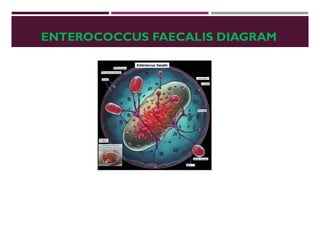
ENTEROCOCCUS FAECALIS DIAGRAM
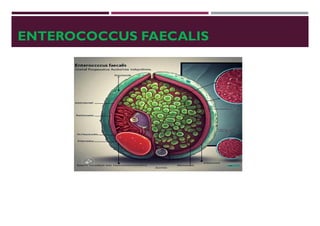
ENTEROCOCCUS FAECALIS
PATHOGENICITY
 Enterococcus faecalis is a bacterium commonly found in the
human gut but can become pathogenic under certain
conditions. Its pathogenicity is primarily attributed to the
following factors:
 1.Antibiotic Resistance : Enterococcus faecalis is known
for its ability to acquire and maintain resistance to multiple
antibiotics, including vancomycin.This resistance complicates
treatment options.
PATHOGENICITY
 2.Biofilm Formation : It can form biofilms on medical
devices such as catheters and prosthetic valves, which protects
it from both the host immune system and antibiotic treatment.
 3.Virulence Factors : E. Faecalis produces various virulence
factors, including surface proteins and enzymes that contribute
to its ability to invade tissues and evade immune responses.
PATHOGENICITY
 4.Opportunistic Infections : It is an opportunistic pathogen
that can cause infections in immunocompromised individuals or
those with underlying health conditions, leading to serious
infections like endocarditis, urinary tract infections, and wound
infections.
Effective management of E. Faecalis infections often requires a
combination of careful antibiotic selection, surgical intervention (if
applicable), and sometimes, the use of combination therapies to
address antibiotic resistance.
BIOCHEMICAL LABORATORY DIAGNOSIS
 Enterococcus faecalis is a common bacterium that can be diagnosed
in the laboratory using several biochemical tests. Here are some key
tests used to identify E. Faecalis:

 1. Gram Staining : E. Faecalis is a Gram-positive cocci that
typically appear in pairs or short chains.
 2. CatalaseTest : E. Faecalis is catalase-negative, which means it
does not produce bubbles when hydrogen peroxide is added.

BIOCHEMICAL LABORATORY DIAGNOSIS
3. Bile EsculinTest : E. Faecalis can hydrolyze esculin in the
presence of bile salts, turning the medium dark brown or black.
4. Growth in 6.5% NaCl : E. Faecalis can grow in 6.5% sodium
chloride (NaCl) broth, distinguishing it from other enterococci
and related species.
BIOCHEMICAL LABORATORY DIAGNOSIS
5. PYR Test : E. Faecalis is PYR-positive, meaning it hydrolyzes L-
pyrrolidonyl-beta-naphthylamide to produce a red color.
6. Hemolysis on Blood Agar : E. Faecalis usually exhibits gamma-
hemolysis (no hemolysis) on blood agar.
These tests, often used in combination, help confirm the presence of
Enterococcus faecalis and differentiate it from other bacteria.
ADVANTAGES
 Enterococcus faecalis is a type of bacteria commonly found in
the human gut.While it’s often noted for its potential to cause
infections, it also has some beneficial aspects:

 1. Gut Health : E. Faecalis is part of the normal intestinal
microbiota, where it helps maintain a balanced microbial
community.
ADVANTAGES
2. Competitive Exclusion : It can inhibit the growth of
pathogenic bacteria by competing for resources and producing
substances that suppress their growth.
3. Probiotic Potential : Some strains of E. Faecalis are used in
probiotics, where they may contribute to gut health and aid
digestion.
DISADVANTAGES
1. Opportunistic Infections : E. Faecalis can cause infections,
especially in individuals with weakened immune systems, or those with
underlying health conditions.These infections can include urinary tract
infections, endocarditis, and wound infections.
2.Antibiotic Resistance : Some strains of E. Faecalis are resistant
to multiple antibiotics, including vancomycin, which can make
infections difficult to treat and manage.
DISADVANTAGES
3. Nosocomial Infections : E. Faecalis is a common cause of
hospital-acquired infections, where its resistance to antibiotics can
complicate treatment and recovery.
4. Pathogenic Potential : In certain situations, E. Faecalis can act
as a pathogen, leading to serious health issues if it escapes its
normal habitat in the gut.
THANKYOU

Medical bacteriology - Enterococcus Faecals

  • 1.
    DEPARTMENT OF MICROBIOLOGY SUBJECT:MEDICAL BACTERIOLOGY TOPIC: ENTEROCOCCUS FAECALIS SUBJECT INCHARGE, SUMMITED BY DR. MYTHILI RAVICHANDRAN, T.PRIYA HEAD OF DEPARTMENT, III-BSC-MICROBIOLOGY DEPARTMENT OF MICROBIOLOGY, DEPARTMENT OF MICROBIOLOGY VIAAS, SANKAGIRI, VIAAS, SANKAGIRI VIVEKANANDHA ARTS AND SCIENCE COLLEGE FOR WOMEN VEERACHIPALAYAM-636007, SANKAGIRI,TAMIL NADU
  • 2.
  • 3.
    INTRODUCTION  Enterococcus faecalisis a Gram-positive bacterium that commonly inhabits the gastrointestinal tract of humans and other mammals as part of their normal flora  It can also be found in the environment and in sewage.  It is known for its ability to survive harsh conditions such as extreme temperatures and high salinity, which contributes to its resilience in various environments.
  • 4.
    INTRODUCTION  It ispart of the normal gut microbiota but can also be an opportunistic pathogen.  E. Faecalis is known for its ability to survive in harsh conditions, including high salt concentrations and extreme pH levels.  Common infections include urinary tract infections, endocarditis, and wound infections. Its resistance to many antibiotics, including vancomycin in some strains, poses significant challenges in treatment.
  • 5.
     Here arethe key points regarding the morphology of Enterococcus faecalis:   Shape : Spherical (cocci).  Arrangement : Often seen in pairs or short chains.  Gram Stain : Gram-positive.  Size : Typically around 0.5 to 1.0 micrometers in diameter. MORPHOLOGY OF ENTEROCOCCUS FAECALIS
  • 6.
    MORPHOLOGY OF ENTEROCOCCUSFAECALIS  Cell Wall : Has a thick peptidoglycan layer characteristic of gram-positive bacteria.  Capsule : It generally lacks a distinct capsule.  Colony Appearance : On solid media, E. Faecalis colonies are generally small, round, and may be grayish or white.They are often described as having a somewhat mucoid appearance.
  • 7.
  • 8.
  • 9.
    PATHOGENICITY  Enterococcus faecalisis a bacterium commonly found in the human gut but can become pathogenic under certain conditions. Its pathogenicity is primarily attributed to the following factors:  1.Antibiotic Resistance : Enterococcus faecalis is known for its ability to acquire and maintain resistance to multiple antibiotics, including vancomycin.This resistance complicates treatment options.
  • 10.
    PATHOGENICITY  2.Biofilm Formation: It can form biofilms on medical devices such as catheters and prosthetic valves, which protects it from both the host immune system and antibiotic treatment.  3.Virulence Factors : E. Faecalis produces various virulence factors, including surface proteins and enzymes that contribute to its ability to invade tissues and evade immune responses.
  • 11.
    PATHOGENICITY  4.Opportunistic Infections: It is an opportunistic pathogen that can cause infections in immunocompromised individuals or those with underlying health conditions, leading to serious infections like endocarditis, urinary tract infections, and wound infections. Effective management of E. Faecalis infections often requires a combination of careful antibiotic selection, surgical intervention (if applicable), and sometimes, the use of combination therapies to address antibiotic resistance.
  • 12.
    BIOCHEMICAL LABORATORY DIAGNOSIS Enterococcus faecalis is a common bacterium that can be diagnosed in the laboratory using several biochemical tests. Here are some key tests used to identify E. Faecalis:   1. Gram Staining : E. Faecalis is a Gram-positive cocci that typically appear in pairs or short chains.  2. CatalaseTest : E. Faecalis is catalase-negative, which means it does not produce bubbles when hydrogen peroxide is added. 
  • 13.
    BIOCHEMICAL LABORATORY DIAGNOSIS 3.Bile EsculinTest : E. Faecalis can hydrolyze esculin in the presence of bile salts, turning the medium dark brown or black. 4. Growth in 6.5% NaCl : E. Faecalis can grow in 6.5% sodium chloride (NaCl) broth, distinguishing it from other enterococci and related species.
  • 14.
    BIOCHEMICAL LABORATORY DIAGNOSIS 5.PYR Test : E. Faecalis is PYR-positive, meaning it hydrolyzes L- pyrrolidonyl-beta-naphthylamide to produce a red color. 6. Hemolysis on Blood Agar : E. Faecalis usually exhibits gamma- hemolysis (no hemolysis) on blood agar. These tests, often used in combination, help confirm the presence of Enterococcus faecalis and differentiate it from other bacteria.
  • 15.
    ADVANTAGES  Enterococcus faecalisis a type of bacteria commonly found in the human gut.While it’s often noted for its potential to cause infections, it also has some beneficial aspects:   1. Gut Health : E. Faecalis is part of the normal intestinal microbiota, where it helps maintain a balanced microbial community.
  • 16.
    ADVANTAGES 2. Competitive Exclusion: It can inhibit the growth of pathogenic bacteria by competing for resources and producing substances that suppress their growth. 3. Probiotic Potential : Some strains of E. Faecalis are used in probiotics, where they may contribute to gut health and aid digestion.
  • 17.
    DISADVANTAGES 1. Opportunistic Infections: E. Faecalis can cause infections, especially in individuals with weakened immune systems, or those with underlying health conditions.These infections can include urinary tract infections, endocarditis, and wound infections. 2.Antibiotic Resistance : Some strains of E. Faecalis are resistant to multiple antibiotics, including vancomycin, which can make infections difficult to treat and manage.
  • 18.
    DISADVANTAGES 3. Nosocomial Infections: E. Faecalis is a common cause of hospital-acquired infections, where its resistance to antibiotics can complicate treatment and recovery. 4. Pathogenic Potential : In certain situations, E. Faecalis can act as a pathogen, leading to serious health issues if it escapes its normal habitat in the gut.
  • 19.