Mediation Skills
Topics to be covered
1. What is Mediation?
2. Mediation Principles
3. Mediation Process
4. Active listening
5. Effective Questioning
6. Feedback
7. Reframing
8. Managing Anger
9. Separate Sessions
10. Summarizing
11. Reaching to Solution
12. Negotiations
13. Agreements
14. Monitoring
What is Mediation?
 Mediation refers to a third-party conflict
resolution process whereby people trained in
mediation skills work with parties in conflict.
 It aims to assist the parties in resolving the
conflict through help facilitate
communications between the parties.
 The mediator may suggest solutions, but no
solution shall be imposed on a party; the
parties must agree before any compromise
or solution shall take effect.
Mediation Principles
 Voluntary Participation in Good Faith
 Confidentiality
 Safe Environment
 Self Determination
 Mediator Impartiality
 Cultural Appropriateness
 Harmless process
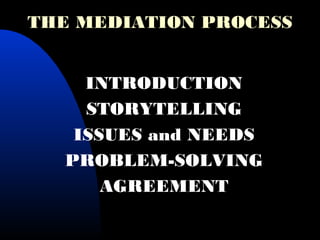
THE MEDIATION PROCESS
INTRODUCTION
STORYTELLING
ISSUES and NEEDS
PROBLEM-SOLVING
AGREEMENT
INTRODUCTIONS
 Introduce Everyone
 Explain your role
 Explain the process
 Rules
 Confidentiality
STORYTELLING
 Each person has a chance to tell their side of the
story
 Listen without interrupting
 Use active listening to provide feedback to the
speaker
Active Listening
• Attentive listening without interrupting.
• Attention focused on the speaker.
• Maintain eye contact, use encouraging
comments
• Convey empathy
• Paraphrasing reflects both facts and
feelings in your own words.
Effective Questioning
Use Open Ended Questions
Make sure questions don’t sound like accusations.
Probe for additional information by reflecting what the
parties have said and then asking:
Can you tell me more about that?
How ? When? Where? What else?
Clarify by asking questions to find out more about what
they have said.
How did you feel about that?
Conflict Analysis Questions
 What is the conflict? (What is it all about?)
 Who are the (primary, secondary) parties
involved?,
 What are the (underlying) issues involved in the
conflict?
 How complex is the conflict? Is there one focal
point or are there many levels? How long has it
been going on?
 What is causing or has caused the conflict to
occur?
 What do the parties want? How do they see it
being resolved?
 Do the parties want the conflict resolved?
Feedback
 When the speaker pauses, there is an opportunity for
you as the neutral to confirm that you have been
listening; you understand what has been said. This is
called “Feeding Back”.
 Feeding back is also a good way to check that your
perception of what you think you heard/observed is
accurate, as well as a way to validate for the speaker
what he/she is feeling.
Feedback
• Repeat or paraphrase what the speaker has said (or
displayed as unspoken feelings)
 
Examples:
“So, when that incident happened, you felt like….”
“It sounds like an important issue for you is how to deal
with…”
“What I think I’m hearing is that you really need….”
“I can see that you really have strong feelings about that…”
Note: A common sign that you’ve done this correctly is the
speaker will not vigorously or respond, “yes, that’s right!”
Feedback
 • Do not repeat what the speaker says verbatim.
That will become annoying - paraphrase instead.
 However, remain conscious of particular words that
seem important to the speaker and use them, if
appropriate, in your paraphrasing.
REFRAMING
Reframing is a special way of feeding back, and is one of
the MOST important tools a third-party neutral
intervener can use. It serves 3 important functions:
1) to restate what a party has said to capture the essence;
2) remove negative overtones; and
3) move the process forward.
Reframing is also a way to translate a positional statement into
a statement of interests or needs.
REFRAMING
Example:
A member of the XYZ says angrily, “She’s so irresponsible!
We can never depend on her to show up for meetings on
time.”
Simple FEED BACK might be:
“So…it really bothers you when she is not on time for
meetings.”
While a REFRAMED response might be:
“So…it is really important to you that members adhere to our
established meeting schedules.”
The difference is subtle…but important!
REFRAMING EXERCISE
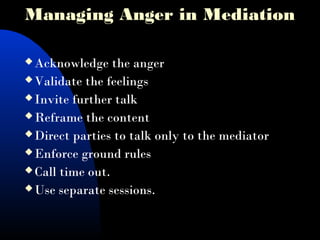
Managing Anger in Mediation
 It is important that you understand and manage
anger, especially if you are being asked to intervene in
a dispute as a neutral. Anger that is poorly
managed…or not managed at all will likely:
 Cause positions to become increasingly rigid;
 Lead to escalation (anger begets anger);
and
 Cause parties to withdraw from the process all
together
 Acknowledge the anger
 Validate the feelings
 Invite further talk
 Reframe the content
 Direct parties to talk only to the mediator
 Enforce ground rules
 Call time out.
 Use separate sessions.
Managing Anger in Mediation
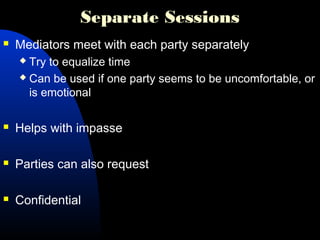
Separate Sessions
 Mediators meet with each party separately
 Try to equalize time
 Can be used if one party seems to be uncomfortable, or
is emotional
 Helps with impasse
 Parties can also request
 Confidential
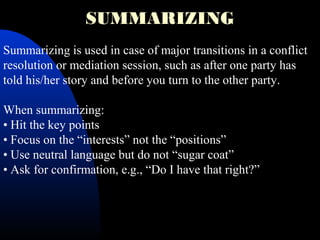
SUMMARIZING
Summarizing is used in case of major transitions in a conflict
resolution or mediation session, such as after one party has
told his/her story and before you turn to the other party.
When summarizing:
• Hit the key points
• Focus on the “interests” not the “positions”
• Use neutral language but do not “sugar coat”
• Ask for confirmation, e.g., “Do I have that right?”
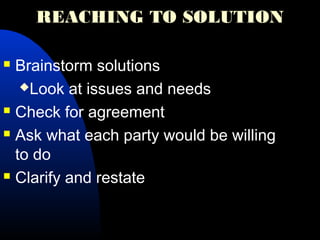
REACHING TO SOLUTION
 Brainstorm solutions
Look at issues and needs
 Check for agreement
 Ask what each party would be willing
to do
 Clarify and restate
EXERCISE:
ROLE PLAY - I
NEGOTIATION
 The process of making joint decisions
when the parties involved have different
preferences.
NEGOTIATION STYLES
POSITION BASED NEGOTIATION (PBN)
The theory of Position Based Negotiation or PBN is
where each party’s gain is in proportion to the other
party’s loss. This is referred to as the “FIXED PIE”
concept and disputing parties naturally engage in this
style of negotiation.
NEGOTIATION STYLES
INTEREST BASED NEGOTIATION (IBN)
The theory of Interest Based Negotiation or IBN is
that a “win-win” solution to the dispute (allowing both
parties to have their interests met by the same
settlement) is POSSIBLE. This is referred to as
“EXPANDING THE PIE”
AGREEMENT
 Review brainstormed solutions and check for
agreement from both sides on all points.
 Nail down the solutions.
 Ask questions USING SIX HELPERS:
 WHO? WHAT? WHEN? WHERE? HOW?
 WHAT IF?
SPECIFY EXACTLY WHAT EACH PERSON WILL
DO.
WRITING THE AGREEMENT
 State the problem.
 Write down what each person will do.
 Have the disputants sign the agreement.
 Remind the disputants that this is a contract.
EXERCISE:
ROLE PLAY - II
?
Mediation skills

Mediation skills

  • 1.
  • 2.
    Topics to becovered 1. What is Mediation? 2. Mediation Principles 3. Mediation Process 4. Active listening 5. Effective Questioning 6. Feedback 7. Reframing 8. Managing Anger 9. Separate Sessions 10. Summarizing 11. Reaching to Solution 12. Negotiations 13. Agreements 14. Monitoring
  • 3.
    What is Mediation? Mediation refers to a third-party conflict resolution process whereby people trained in mediation skills work with parties in conflict.  It aims to assist the parties in resolving the conflict through help facilitate communications between the parties.  The mediator may suggest solutions, but no solution shall be imposed on a party; the parties must agree before any compromise or solution shall take effect.
  • 4.
    Mediation Principles  VoluntaryParticipation in Good Faith  Confidentiality  Safe Environment  Self Determination  Mediator Impartiality  Cultural Appropriateness  Harmless process
  • 5.
    THE MEDIATION PROCESS INTRODUCTION STORYTELLING ISSUESand NEEDS PROBLEM-SOLVING AGREEMENT
  • 6.
    INTRODUCTIONS  Introduce Everyone Explain your role  Explain the process  Rules  Confidentiality
  • 7.
    STORYTELLING  Each personhas a chance to tell their side of the story  Listen without interrupting  Use active listening to provide feedback to the speaker
  • 8.
    Active Listening • Attentivelistening without interrupting. • Attention focused on the speaker. • Maintain eye contact, use encouraging comments • Convey empathy • Paraphrasing reflects both facts and feelings in your own words.
  • 9.
    Effective Questioning Use OpenEnded Questions Make sure questions don’t sound like accusations. Probe for additional information by reflecting what the parties have said and then asking: Can you tell me more about that? How ? When? Where? What else? Clarify by asking questions to find out more about what they have said. How did you feel about that?
  • 10.
    Conflict Analysis Questions What is the conflict? (What is it all about?)  Who are the (primary, secondary) parties involved?,  What are the (underlying) issues involved in the conflict?  How complex is the conflict? Is there one focal point or are there many levels? How long has it been going on?  What is causing or has caused the conflict to occur?  What do the parties want? How do they see it being resolved?  Do the parties want the conflict resolved?
  • 11.
    Feedback  When thespeaker pauses, there is an opportunity for you as the neutral to confirm that you have been listening; you understand what has been said. This is called “Feeding Back”.  Feeding back is also a good way to check that your perception of what you think you heard/observed is accurate, as well as a way to validate for the speaker what he/she is feeling.
  • 12.
    Feedback • Repeat orparaphrase what the speaker has said (or displayed as unspoken feelings)   Examples: “So, when that incident happened, you felt like….” “It sounds like an important issue for you is how to deal with…” “What I think I’m hearing is that you really need….” “I can see that you really have strong feelings about that…” Note: A common sign that you’ve done this correctly is the speaker will not vigorously or respond, “yes, that’s right!”
  • 13.
    Feedback  • Donot repeat what the speaker says verbatim. That will become annoying - paraphrase instead.  However, remain conscious of particular words that seem important to the speaker and use them, if appropriate, in your paraphrasing.
  • 14.
    REFRAMING Reframing is aspecial way of feeding back, and is one of the MOST important tools a third-party neutral intervener can use. It serves 3 important functions: 1) to restate what a party has said to capture the essence; 2) remove negative overtones; and 3) move the process forward. Reframing is also a way to translate a positional statement into a statement of interests or needs.
  • 15.
    REFRAMING Example: A member ofthe XYZ says angrily, “She’s so irresponsible! We can never depend on her to show up for meetings on time.” Simple FEED BACK might be: “So…it really bothers you when she is not on time for meetings.” While a REFRAMED response might be: “So…it is really important to you that members adhere to our established meeting schedules.” The difference is subtle…but important!
  • 16.
  • 17.
    Managing Anger inMediation  It is important that you understand and manage anger, especially if you are being asked to intervene in a dispute as a neutral. Anger that is poorly managed…or not managed at all will likely:  Cause positions to become increasingly rigid;  Lead to escalation (anger begets anger); and  Cause parties to withdraw from the process all together
  • 18.
     Acknowledge theanger  Validate the feelings  Invite further talk  Reframe the content  Direct parties to talk only to the mediator  Enforce ground rules  Call time out.  Use separate sessions. Managing Anger in Mediation
  • 19.
    Separate Sessions  Mediatorsmeet with each party separately  Try to equalize time  Can be used if one party seems to be uncomfortable, or is emotional  Helps with impasse  Parties can also request  Confidential
  • 20.
    SUMMARIZING Summarizing is usedin case of major transitions in a conflict resolution or mediation session, such as after one party has told his/her story and before you turn to the other party. When summarizing: • Hit the key points • Focus on the “interests” not the “positions” • Use neutral language but do not “sugar coat” • Ask for confirmation, e.g., “Do I have that right?”
  • 21.
    REACHING TO SOLUTION Brainstorm solutions Look at issues and needs  Check for agreement  Ask what each party would be willing to do  Clarify and restate
  • 22.
  • 23.
    NEGOTIATION  The processof making joint decisions when the parties involved have different preferences.
  • 24.
    NEGOTIATION STYLES POSITION BASEDNEGOTIATION (PBN) The theory of Position Based Negotiation or PBN is where each party’s gain is in proportion to the other party’s loss. This is referred to as the “FIXED PIE” concept and disputing parties naturally engage in this style of negotiation.
  • 25.
    NEGOTIATION STYLES INTEREST BASEDNEGOTIATION (IBN) The theory of Interest Based Negotiation or IBN is that a “win-win” solution to the dispute (allowing both parties to have their interests met by the same settlement) is POSSIBLE. This is referred to as “EXPANDING THE PIE”
  • 26.
    AGREEMENT  Review brainstormedsolutions and check for agreement from both sides on all points.  Nail down the solutions.  Ask questions USING SIX HELPERS:  WHO? WHAT? WHEN? WHERE? HOW?  WHAT IF? SPECIFY EXACTLY WHAT EACH PERSON WILL DO.
  • 27.
    WRITING THE AGREEMENT State the problem.  Write down what each person will do.  Have the disputants sign the agreement.  Remind the disputants that this is a contract.
  • 28.
  • 29.