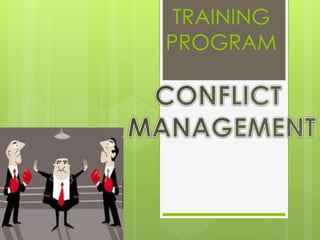
TRAINING
PROGRAM
TRAINERS FOR THE DAY
NEHA PATIL
PRERNA THAKKAR
SHRADDHA JADHAV
SUNAINA BHAT
CONFLICT MANAGEMENT
Learning objectives
 Help understand what conflict is and how
conflicts arise.
 Introduce different types of conflict, and
different styles of handling conflicts.
 Help understand conflict management
and resolution.
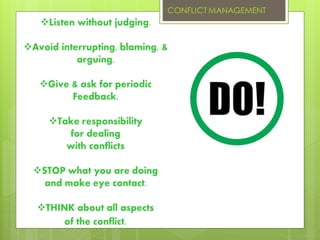
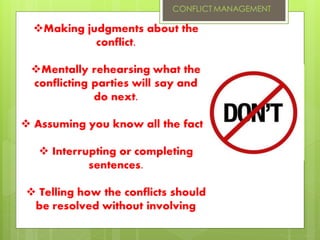
 Do’s and don’ts of conflict
CONFLICT MANAGEMENT
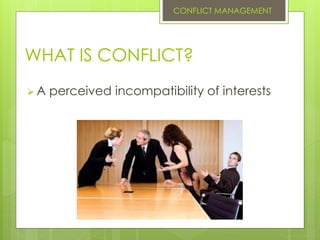
WHAT IS CONFLICT?
 A perceived incompatibility of interests
CONFLICT MANAGEMENT
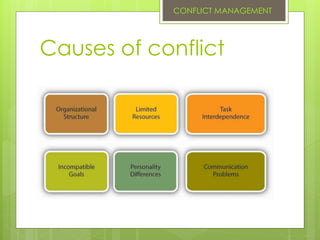
Causes of conflict
CONFLICT MANAGEMENT
LEVELS OF CONFLICTS
Intrapersonal
Interpersonal
Intragroup
Intergroup
CONFLICT MANAGEMENT
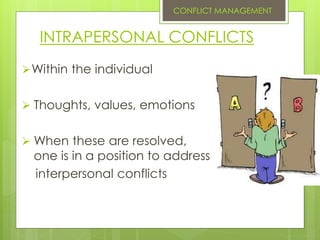
INTRAPERSONAL CONFLICTS
Within the individual
 Thoughts, values, emotions
 When these are resolved,
one is in a position to address
interpersonal conflicts
CONFLICT MANAGEMENT
INTERPERSONAL CONFLICTS
 Between two
individuals
varied personalities
which usually results to
incompatible choices
and opinions.
CONFLICT MANAGEMENT
INTRAGROUP CONFLICT
 Among individuals within a
team
 Incompatibilities and
misunderstandings among
these individuals
 Arises from interpersonal
disagreements
CONFLICT MANAGEMENT
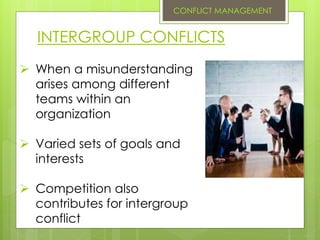
INTERGROUP CONFLICTS
 When a misunderstanding
arises among different
teams within an
organization
 Varied sets of goals and
interests
 Competition also
contributes for intergroup
conflict
CONFLICT MANAGEMENT
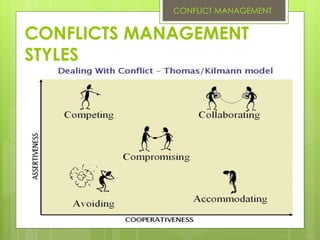
CONFLICTS MANAGEMENT
STYLES
CONFLICT MANAGEMENT
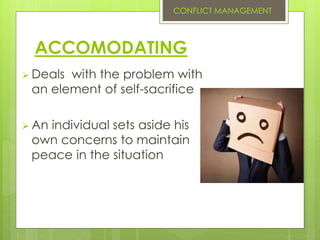
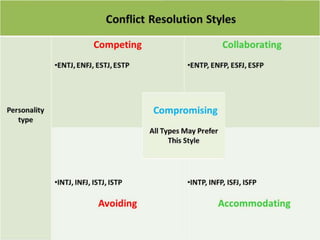
ACCOMODATING
 Deals with the problem with
an element of self-sacrifice
 An individual sets aside his
own concerns to maintain
peace in the situation
CONFLICT MANAGEMENT
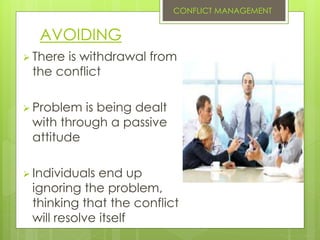
AVOIDING
 There is withdrawal from
the conflict
 Problem is being dealt
with through a passive
attitude
 Individuals end up
ignoring the problem,
thinking that the conflict
will resolve itself
CONFLICT MANAGEMENT
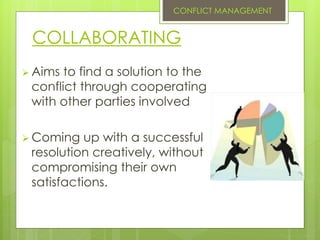
COLLABORATING
 Aims to find a solution to the
conflict through cooperating
with other parties involved
 Coming up with a successful
resolution creatively, without
compromising their own
satisfactions.
CONFLICT MANAGEMENT
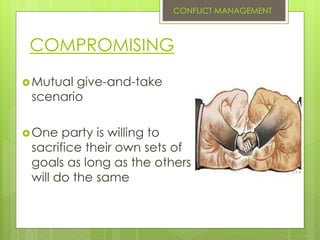
COMPROMISING
Mutual give-and-take
scenario
One party is willing to
sacrifice their own sets of
goals as long as the others
will do the same
CONFLICT MANAGEMENT
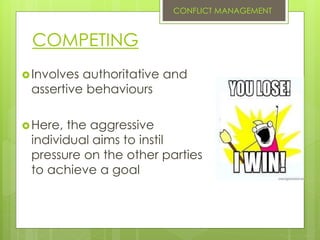
COMPETING
Involves authoritative and
assertive behaviours
Here, the aggressive
individual aims to instil
pressure on the other parties
to achieve a goal
CONFLICT MANAGEMENT
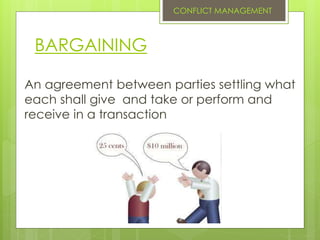
BARGAINING
An agreement between parties settling what
each shall give and take or perform and
receive in a transaction
CONFLICT MANAGEMENT
Steps in Bargaining
 Separate people from the
problem
 Focus on interests, not positions
 Invent options for mutual gains
CONFLICT MANAGEMENT
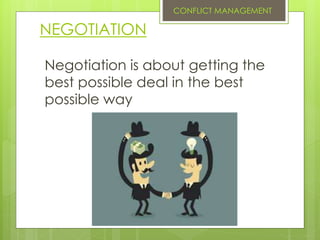
NEGOTIATION
Negotiation is about getting the
best possible deal in the best
possible way
CONFLICT MANAGEMENT
Planning to negotiate
 Establish your objectives and other party’s
objectives
 Frame negotiation
 Identify areas of agreement
 Trouble shoot disagreements
 Agreement and close
CONFLICT MANAGEMENT
CONFLICT MANAGEMENT

Conflict management