PUB 321
Strategic Negotiation
&
Mediation
Topics 1
Introduction to Negotiation & Mediation
Learning Objectives
• Define the concept of Negotiation
• Define the concept of Mediation
• Understand the purposes of Negotiation and Mediation
What is Negotiation?
 “The art of reaching an agreement by resolving differences
through creativity” (Creative Negotiating, Stephen Kozicki, Adams
Press, 1998)
 Takes place when two or more people, with differing views,
come together to attempt to reach agreement on an issue. It is
persuasive communication or bargaining.
– “Negotiation is about getting the best possible deal in the best
possible way.”
 A strategic endeavor directed toward the specific ends of
reaching agreements and satisfying negotiators’ needs.
 The process we use to satisfy our needs when someone else
controls what we are seeking.
 The process of attempting to satisfy your wants, by giving up
something you now have in exchange for something else you
want.
 “The art of letting them have your way.”
Characteristics of Negotiations
 Two or more parties are involved.
 There exists a perceived conflict of interest between those parties.
 Parties chose to negotiate because they believe they can influence each
other to get a better deal than what they would otherwise get if action
was unilateral.
 For time being, parties prefer to work together for resolution rather than
fight or seek other non-negotiated remedies.
 Parties expect to experience “give and take” during their negotiations as
each side compromises positions.
 Parties expect that negotiations will allow them to manage both the
“tangibles” and the “intangibles” contained in their issues.
Characteristics of Negotiation…
 Negotiation is voluntary process dependent upon communication
and motivation
 The process often involves less than frank and open
communication
 Need to reconcile deceptive tactics and fair agreements
 Need to establish trust
Purposes of Negotiation
 To reach a desired and durable result by including the interests
of both parties.
 To reach agreement efficiently and fairly using talents of all
participants to solve problems.
 To develop a shared sense of satisfaction from working together
successfully
 To reconcile deceptive tactics and fair agreements
 To establish trust
What is Mediation?
 Mediation:
– A neutral third party assists the parties to reach a negotiated
settlement but has no power to decide the issues in dispute.
– A structured process in which an impartial party, the mediator, helps
parties in the workplace to resolve the dispute or difficulties that
have arisen between them.
– A voluntary process, with the mediator or parties involved having
the right to end the process at any time.
 Mediator:
– Is responsible for facilitating and determining the procedure for the
mediation.
– Has no legal power, does not impose solutions and makes no
attempt to judge the situation.
– Helps those involved to communicate, negotiate and work towards
their own agreement
– Facilitates a safe and respectful discussion.
What is Mediation?
 Is an informal process in which a third-party assists others to reach a
negotiated settlement.
 Mediation is a process in which an impartial third party assists
disputants in finding a mutually acceptable solution to their
dispute.
 Mediation is both voluntary and confidential.
Purposes of Mediation
 To help organisations prevent and manage interpersonal difficulties
 To enable better working relationships,
 To build more successful teams and
 To maximise organisational performance.
Advantages of Mediation
 Faster than litigation.
 Less expensive than litigation.
 Informal compared to
litigation.
 Parties select the neutral
position.
 Non-binding until agreement
is reached.
 Creative solutions are possible
 Private and Confidential
 Parties decide who
participates.
 Parties retain control of
process and outcome.
 Outcomes tailored to needs
and interests of parties
 Broader range of issues can
be decided.
 Improves parties’ capacity to
resolve future disputes
 Greater satisfaction with
outcome, higher level of
compliance.
Disadvantages of Mediation
 One party can refuse to mediate.
 Cannot make legal precedent
 Discovery is non-existent or
limited.
 May still need adjudication.
 Difficult if there is a power
imbalance.
 No precedent created
 Societal norms for behavior not
created, refined.
 May advantage more powerful
party.
 Since voluntary, may be difficult to
ensure participation.
 Does not guarantee end to dispute.
Factors Favoring Mediation
 Desire to avoid adverse precedent.
 No need to establish precedent.
 Need to avoid publicity or need for confidentiality or privacy.
 Desire for speedy resolution; need to avoid delay.
 Need to preserve continuing relationship.
 Recognition that emotions or hostilities may bar a settlement.
 Desire to minimize risk of imposed outcome.
 Need to reduce high cost of litigation.
 Existence of collateral issues that may enhance resolution in a
mediation forum.
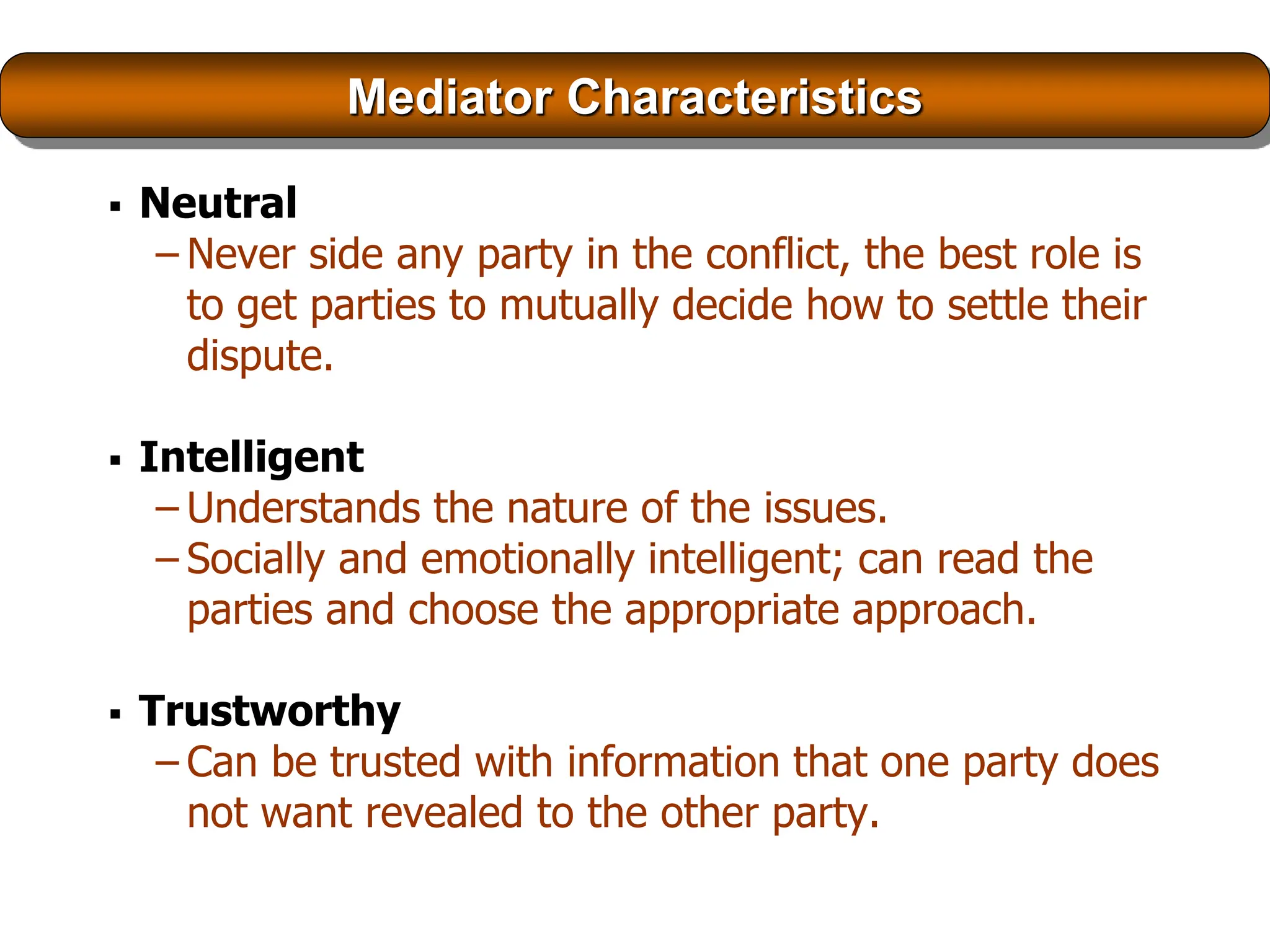
Mediator Characteristics
 Neutral
– Never side any party in the conflict, the best role is
to get parties to mutually decide how to settle their
dispute.
 Intelligent
– Understands the nature of the issues.
– Socially and emotionally intelligent; can read the
parties and choose the appropriate approach.
 Trustworthy
– Can be trusted with information that one party does
not want revealed to the other party.
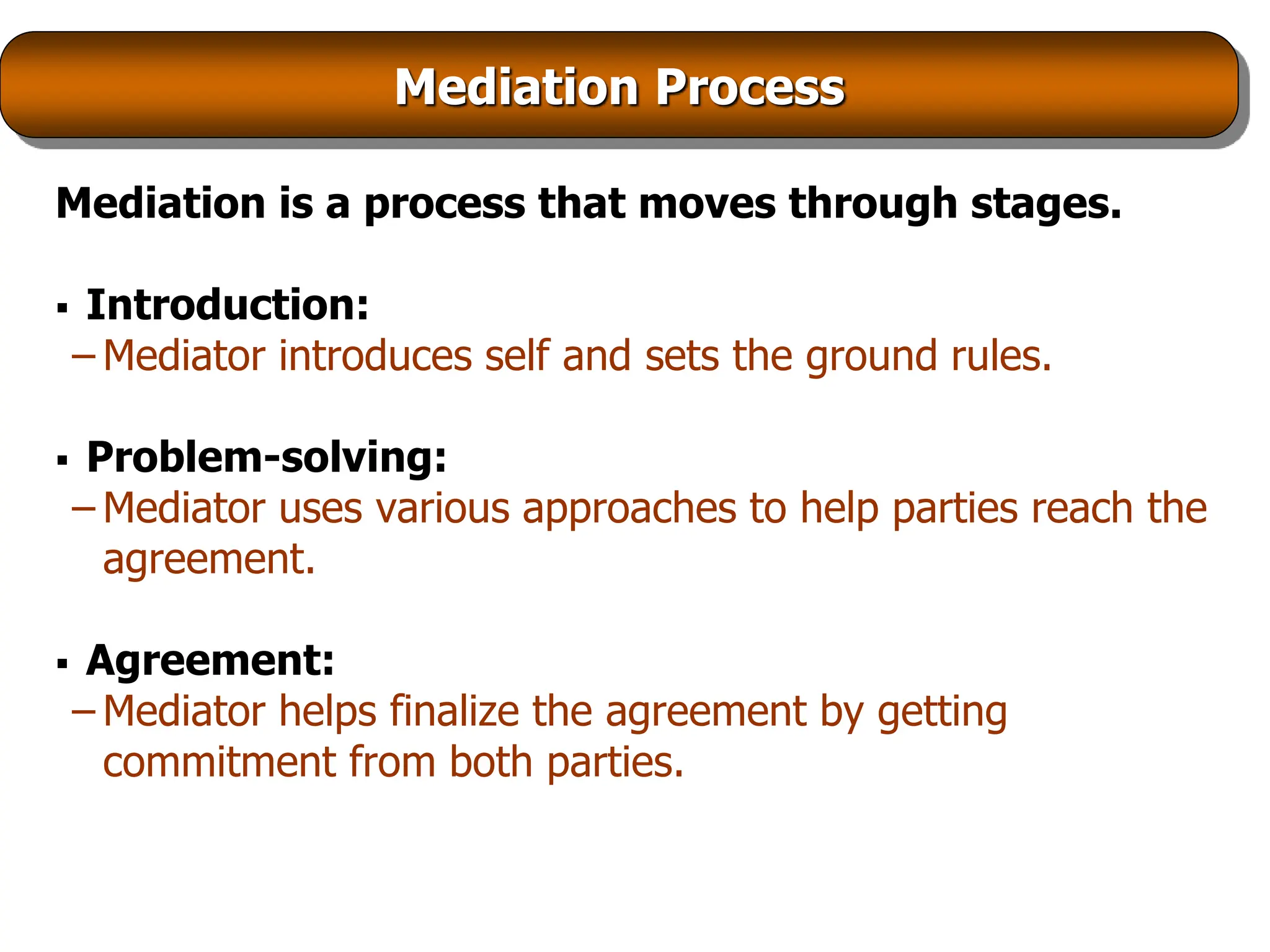
Mediation Process
Mediation is a process that moves through stages.
 Introduction:
– Mediator introduces self and sets the ground rules.
 Problem-solving:
– Mediator uses various approaches to help parties reach the
agreement.
 Agreement:
– Mediator helps finalize the agreement by getting
commitment from both parties.
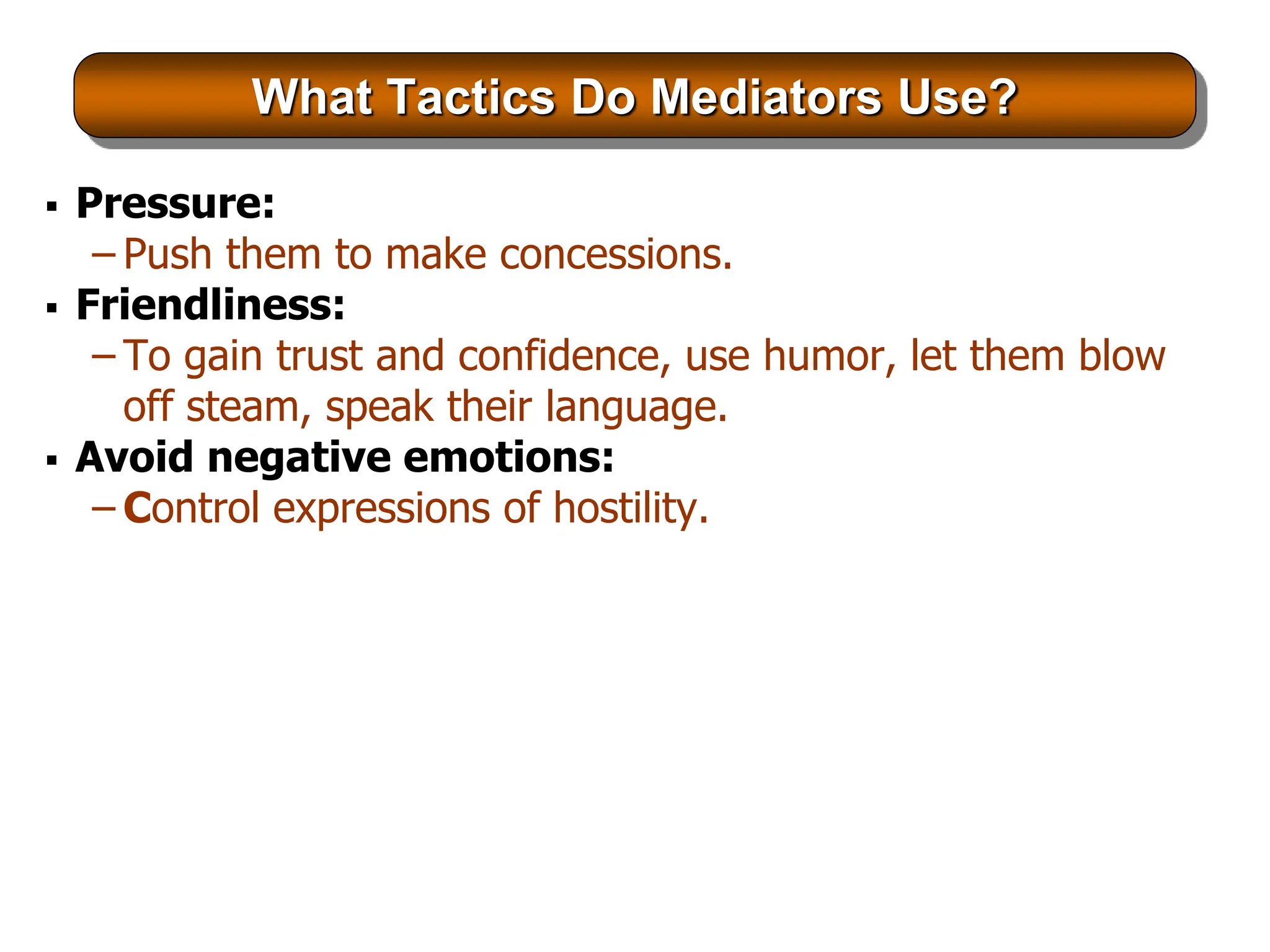
What Tactics Do Mediators Use?
 Pressure:
– Push them to make concessions.
 Friendliness:
– To gain trust and confidence, use humor, let them blow
off steam, speak their language.
 Avoid negative emotions:
– Control expressions of hostility.
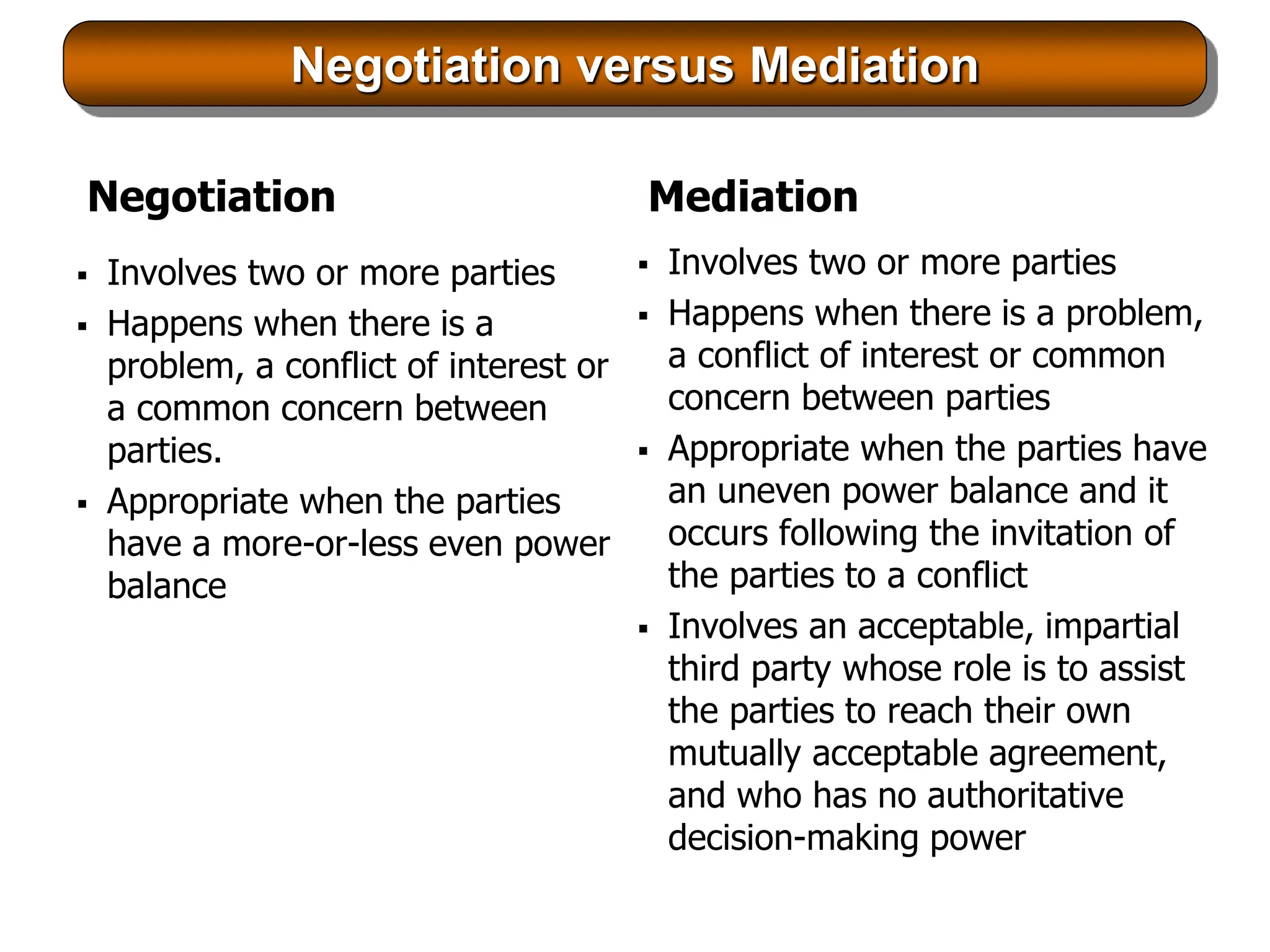
Negotiation versus Mediation
Negotiation
 Involves two or more parties
 Happens when there is a
problem, a conflict of interest or
a common concern between
parties.
 Appropriate when the parties
have a more-or-less even power
balance
Mediation
 Involves two or more parties
 Happens when there is a problem,
a conflict of interest or common
concern between parties
 Appropriate when the parties have
an uneven power balance and it
occurs following the invitation of
the parties to a conflict
 Involves an acceptable, impartial
third party whose role is to assist
the parties to reach their own
mutually acceptable agreement,
and who has no authoritative
decision-making power
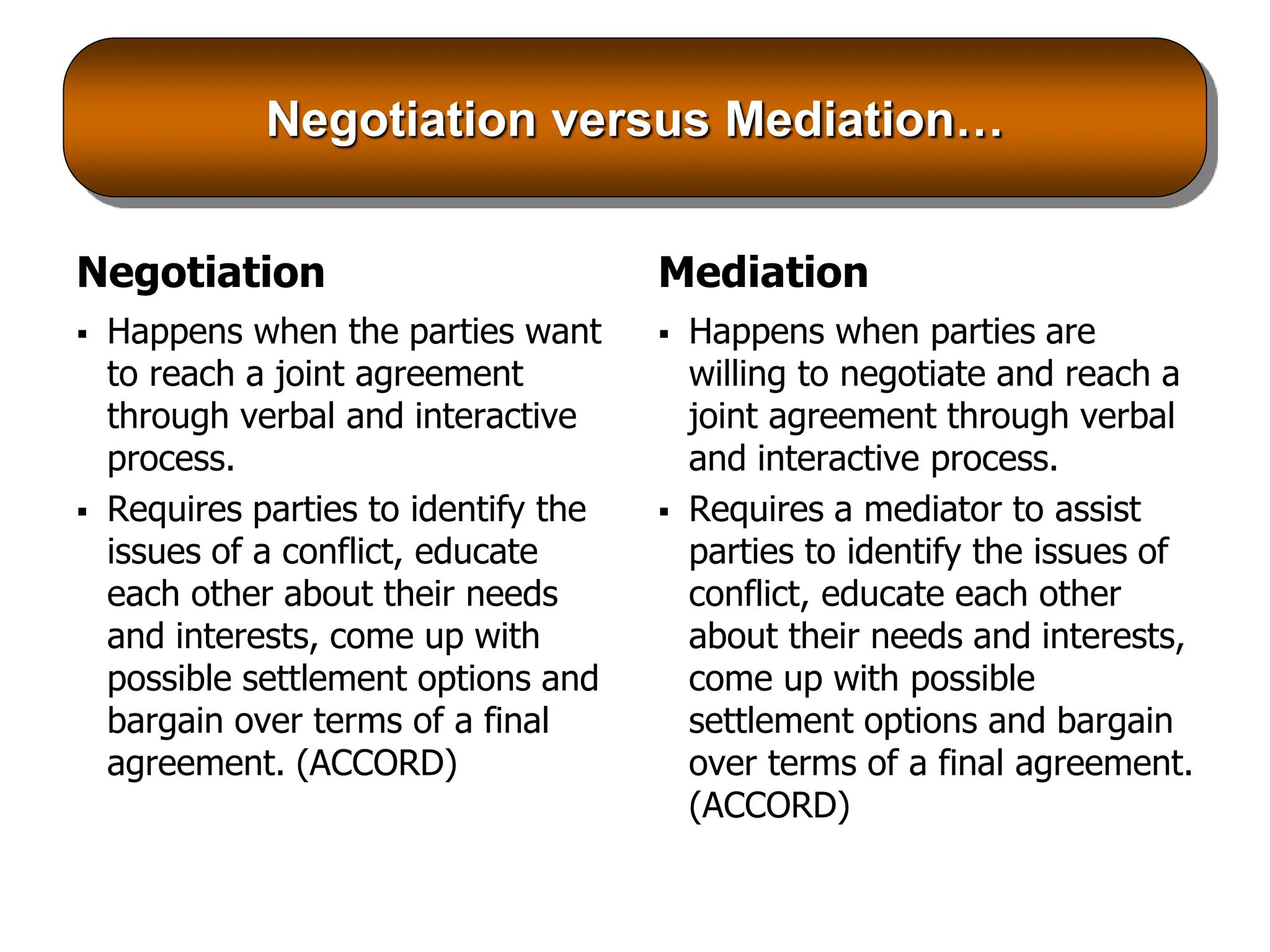
Negotiation versus Mediation…
Negotiation
 Happens when the parties want
to reach a joint agreement
through verbal and interactive
process.
 Requires parties to identify the
issues of a conflict, educate
each other about their needs
and interests, come up with
possible settlement options and
bargain over terms of a final
agreement. (ACCORD)
Mediation
 Happens when parties are
willing to negotiate and reach a
joint agreement through verbal
and interactive process.
 Requires a mediator to assist
parties to identify the issues of
conflict, educate each other
about their needs and interests,
come up with possible
settlement options and bargain
over terms of a final agreement.
(ACCORD)
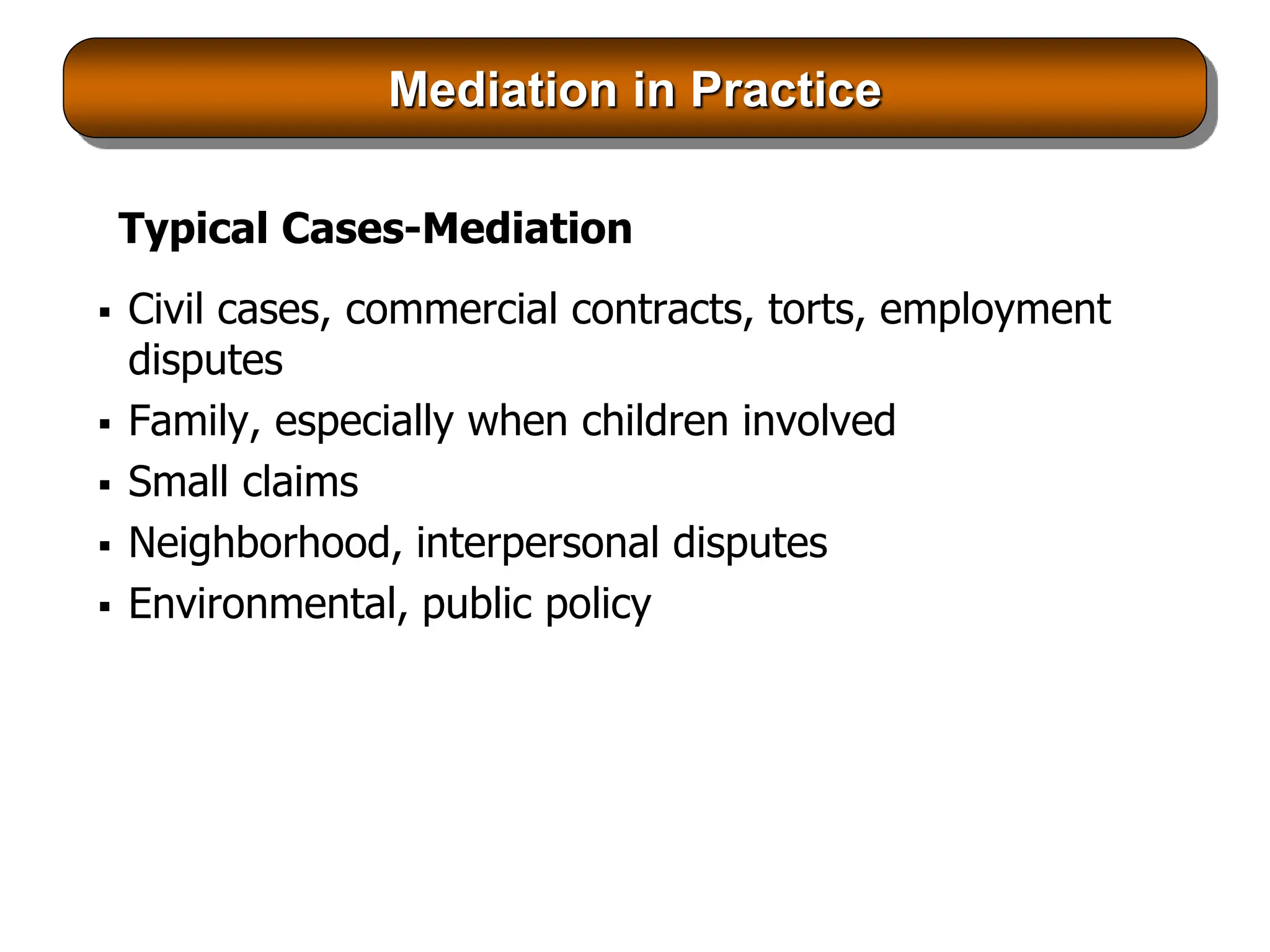
Mediation in Practice
Typical Cases-Mediation
 Civil cases, commercial contracts, torts, employment
disputes
 Family, especially when children involved
 Small claims
 Neighborhood, interpersonal disputes
 Environmental, public policy
Mediation Values
 Process is consensual
 Party self-determination
 Mediator impartiality
 Confidentiality

Topic 1 - Introduction to Negotiation and Mediation.ppt

  • 1.
    PUB 321 Strategic Negotiation & Mediation Topics1 Introduction to Negotiation & Mediation
  • 2.
    Learning Objectives • Definethe concept of Negotiation • Define the concept of Mediation • Understand the purposes of Negotiation and Mediation
  • 3.
    What is Negotiation? “The art of reaching an agreement by resolving differences through creativity” (Creative Negotiating, Stephen Kozicki, Adams Press, 1998)  Takes place when two or more people, with differing views, come together to attempt to reach agreement on an issue. It is persuasive communication or bargaining. – “Negotiation is about getting the best possible deal in the best possible way.”  A strategic endeavor directed toward the specific ends of reaching agreements and satisfying negotiators’ needs.  The process we use to satisfy our needs when someone else controls what we are seeking.  The process of attempting to satisfy your wants, by giving up something you now have in exchange for something else you want.  “The art of letting them have your way.”
  • 4.
    Characteristics of Negotiations Two or more parties are involved.  There exists a perceived conflict of interest between those parties.  Parties chose to negotiate because they believe they can influence each other to get a better deal than what they would otherwise get if action was unilateral.  For time being, parties prefer to work together for resolution rather than fight or seek other non-negotiated remedies.  Parties expect to experience “give and take” during their negotiations as each side compromises positions.  Parties expect that negotiations will allow them to manage both the “tangibles” and the “intangibles” contained in their issues.
  • 5.
    Characteristics of Negotiation… Negotiation is voluntary process dependent upon communication and motivation  The process often involves less than frank and open communication  Need to reconcile deceptive tactics and fair agreements  Need to establish trust
  • 6.
    Purposes of Negotiation To reach a desired and durable result by including the interests of both parties.  To reach agreement efficiently and fairly using talents of all participants to solve problems.  To develop a shared sense of satisfaction from working together successfully  To reconcile deceptive tactics and fair agreements  To establish trust
  • 7.
    What is Mediation? Mediation: – A neutral third party assists the parties to reach a negotiated settlement but has no power to decide the issues in dispute. – A structured process in which an impartial party, the mediator, helps parties in the workplace to resolve the dispute or difficulties that have arisen between them. – A voluntary process, with the mediator or parties involved having the right to end the process at any time.  Mediator: – Is responsible for facilitating and determining the procedure for the mediation. – Has no legal power, does not impose solutions and makes no attempt to judge the situation. – Helps those involved to communicate, negotiate and work towards their own agreement – Facilitates a safe and respectful discussion.
  • 8.
    What is Mediation? Is an informal process in which a third-party assists others to reach a negotiated settlement.  Mediation is a process in which an impartial third party assists disputants in finding a mutually acceptable solution to their dispute.  Mediation is both voluntary and confidential.
  • 9.
    Purposes of Mediation To help organisations prevent and manage interpersonal difficulties  To enable better working relationships,  To build more successful teams and  To maximise organisational performance.
  • 10.
    Advantages of Mediation Faster than litigation.  Less expensive than litigation.  Informal compared to litigation.  Parties select the neutral position.  Non-binding until agreement is reached.  Creative solutions are possible  Private and Confidential  Parties decide who participates.  Parties retain control of process and outcome.  Outcomes tailored to needs and interests of parties  Broader range of issues can be decided.  Improves parties’ capacity to resolve future disputes  Greater satisfaction with outcome, higher level of compliance.
  • 11.
    Disadvantages of Mediation One party can refuse to mediate.  Cannot make legal precedent  Discovery is non-existent or limited.  May still need adjudication.  Difficult if there is a power imbalance.  No precedent created  Societal norms for behavior not created, refined.  May advantage more powerful party.  Since voluntary, may be difficult to ensure participation.  Does not guarantee end to dispute.
  • 12.
    Factors Favoring Mediation Desire to avoid adverse precedent.  No need to establish precedent.  Need to avoid publicity or need for confidentiality or privacy.  Desire for speedy resolution; need to avoid delay.  Need to preserve continuing relationship.  Recognition that emotions or hostilities may bar a settlement.  Desire to minimize risk of imposed outcome.  Need to reduce high cost of litigation.  Existence of collateral issues that may enhance resolution in a mediation forum.
  • 13.
    Mediator Characteristics  Neutral –Never side any party in the conflict, the best role is to get parties to mutually decide how to settle their dispute.  Intelligent – Understands the nature of the issues. – Socially and emotionally intelligent; can read the parties and choose the appropriate approach.  Trustworthy – Can be trusted with information that one party does not want revealed to the other party.
  • 14.
    Mediation Process Mediation isa process that moves through stages.  Introduction: – Mediator introduces self and sets the ground rules.  Problem-solving: – Mediator uses various approaches to help parties reach the agreement.  Agreement: – Mediator helps finalize the agreement by getting commitment from both parties.
  • 15.
    What Tactics DoMediators Use?  Pressure: – Push them to make concessions.  Friendliness: – To gain trust and confidence, use humor, let them blow off steam, speak their language.  Avoid negative emotions: – Control expressions of hostility.
  • 16.
    Negotiation versus Mediation Negotiation Involves two or more parties  Happens when there is a problem, a conflict of interest or a common concern between parties.  Appropriate when the parties have a more-or-less even power balance Mediation  Involves two or more parties  Happens when there is a problem, a conflict of interest or common concern between parties  Appropriate when the parties have an uneven power balance and it occurs following the invitation of the parties to a conflict  Involves an acceptable, impartial third party whose role is to assist the parties to reach their own mutually acceptable agreement, and who has no authoritative decision-making power
  • 17.
    Negotiation versus Mediation… Negotiation Happens when the parties want to reach a joint agreement through verbal and interactive process.  Requires parties to identify the issues of a conflict, educate each other about their needs and interests, come up with possible settlement options and bargain over terms of a final agreement. (ACCORD) Mediation  Happens when parties are willing to negotiate and reach a joint agreement through verbal and interactive process.  Requires a mediator to assist parties to identify the issues of conflict, educate each other about their needs and interests, come up with possible settlement options and bargain over terms of a final agreement. (ACCORD)
  • 18.
    Mediation in Practice TypicalCases-Mediation  Civil cases, commercial contracts, torts, employment disputes  Family, especially when children involved  Small claims  Neighborhood, interpersonal disputes  Environmental, public policy
  • 19.
    Mediation Values  Processis consensual  Party self-determination  Mediator impartiality  Confidentiality