Conflict Resolution Method
CAPS 514
 Mediation is one of the non-violence method for
dispute resolution.
 Mediation brings parties together; the real issues in
the dispute become clear as well as resolve issues and
avoid the escalation of conflict.
 Furthermore in mediation, we can build a sense of
what the issues are, learn the problems, explore
possible options for resolution, and make informed
decisions whether or not resolving at that time or
moving on is the best outcome for that matter.
 Mediation also known an attempt to settle a dispute
using a neutral third party.
 Mediation offers an opportunity for all the
parties, "win-win" results. It is fair, cost-
effective, and confidential.
 Mediation encourages flexibility and allows
participants to find solutions that meet their
needs (In many countries, the law provides a
special rule of confidentiality for Mediation).
 Mediation helps to the parties concentrates
on problem solving rather than keep fighting.
 Family (family businesses, financial
distribution and spousal support, separation,
child custody, dispute between parents and
adult children, eldercare issues, divorce).
 Workplace (wrongful termination,
discrimination, harassment, grievances, labor
issues).
 Public disputes (Environmental, real-estate
issues: landlord/tenant, builders/contractors,
contracts agreement, any partnership
company, non-profit organization,
consumers and service/business
entrepreneurs’ relation, among the youth,
any types of violence).
 On-line mediation.
 Mediation in business and commerce.
 Communities mediator.
 Further more, inter-personal, inter-groups,
ethnics , ideology, inter-religion, among the
different countries with different context
(international).
 Mediator as a Facilitator/Mediator as a Reconciliator.
 Mediator as a Educator/transformative perspective.
 Mediator as a Resource expander/translator.
 Mediator explain all the producer and educate the parties
on the process, (such as established a behavior
guidelines).
 Mediator Keep in track parties’ communication.
 Mediator understand all the parties, (issues and desire).
 Mediator may convey information from one group to
another, (only with party approval).
 Mediator narrows differences between the parties.
 Mediator helps the parties find their own solution not
imposing a decision.
 Mediator facilitates between the disputant
parties and encourages them to enter into a
confidentiality agreement.
 Mediator encourages the participants to
record them in an enforceable summary
format, with formal legal documentation to
follow, (when agreements are reached).
 Understanding each participant’s perspective
through a pre-caucus.
 Increasing and evaluating participant’s interest.
in solving the challenge through mediation.
 Setting ground rules for improved
communication.
 Coaching participants through the joint session.
 Equalizing power (e.g., between persons in
different organizational levels).
 Helping participants plan for future interaction.
 Roles for third parties in mediation.
 Conditions under which mediation is useful.
 Strategies for mediators.
 Assessing effective mediation.
 Role of third parties in consensus building.
 Mediators are always guided by;
impartiality/neutrality/empathy/confidentiality/
persistence and patience as well as effectiveness
as a questioner.
 Mediator should have specific knowledge about
the subject area.
 Restatement
 Paraphrase (reframing)
 Active listening
 Summarization
 Expansion (expanded and elaborated form and verify accurate
perception)
 Ordering/requesting
 Structuring (arranging party’s thoughts and speech into a
coherent message)
 Separating or fractionating (divide an idea/issue into smaller
component part)
 Generalization (identify general points)
 Probing question (open-ended or focused question to encourage
the parties)
 Questions of clarification (clarification of particular points)
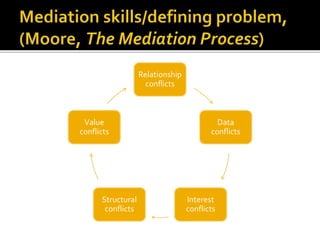
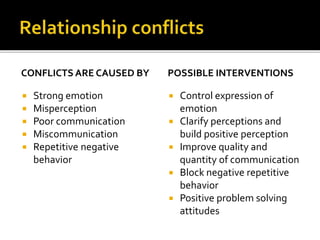
Relationship
conflicts
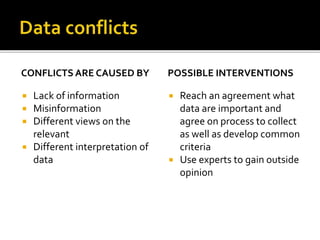
Data
conflicts
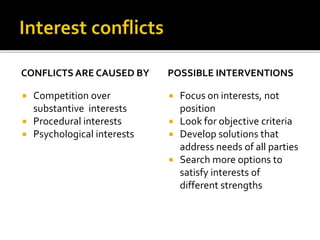
Interest
conflicts
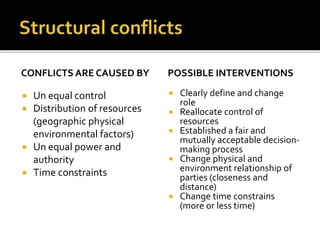
Structural
conflicts
Value
conflicts
CONFLICTS ARE CAUSED BY
 Strong emotion
 Misperception
 Poor communication
 Miscommunication
 Repetitive negative
behavior
POSSIBLE INTERVENTIONS
 Control expression of
emotion
 Clarify perceptions and
build positive perception
 Improve quality and
quantity of communication
 Block negative repetitive
behavior
 Positive problem solving
attitudes
CONFLICTS ARE CAUSED BY
 Lack of information
 Misinformation
 Different views on the
relevant
 Different interpretation of
data
POSSIBLE INTERVENTIONS
 Reach an agreement what
data are important and
agree on process to collect
as well as develop common
criteria
 Use experts to gain outside
opinion
CONFLICTS ARE CAUSED BY
 Competition over
substantive interests
 Procedural interests
 Psychological interests
POSSIBLE INTERVENTIONS
 Focus on interests, not
position
 Look for objective criteria
 Develop solutions that
address needs of all parties
 Search more options to
satisfy interests of
different strengths
CONFLICTS ARE CAUSED BY
 Un equal control
 Distribution of resources
(geographic physical
environmental factors)
 Un equal power and
authority
 Time constraints
POSSIBLE INTERVENTIONS
 Clearly define and change
role
 Reallocate control of
resources
 Established a fair and
mutually acceptable decision-
making process
 Change physical and
environment relationship of
parties (closeness and
distance)
 Change time constrains
(more or less time)
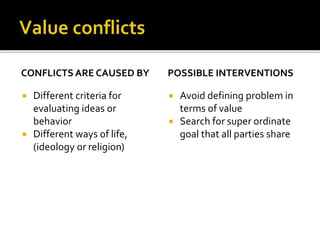
CONFLICTS ARE CAUSED BY
 Different criteria for
evaluating ideas or
behavior
 Different ways of life,
(ideology or religion)
POSSIBLE INTERVENTIONS
 Avoid defining problem in
terms of value
 Search for super ordinate
goal that all parties share
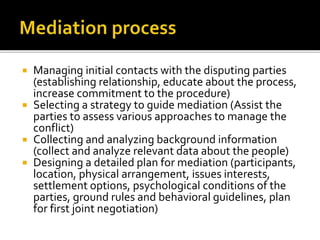
 Managing initial contacts with the disputing parties
(establishing relationship, educate about the process,
increase commitment to the procedure)
 Selecting a strategy to guide mediation (Assist the
parties to assess various approaches to manage the
conflict)
 Collecting and analyzing background information
(collect and analyze relevant data about the people)
 Designing a detailed plan for mediation (participants,
location, physical arrangement, issues interests,
settlement options, psychological conditions of the
parties, ground rules and behavioral guidelines, plan
for first joint negotiation)
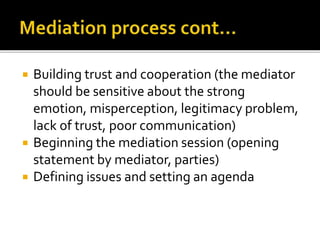
 Building trust and cooperation (the mediator
should be sensitive about the strong
emotion, misperception, legitimacy problem,
lack of trust, poor communication)
 Beginning the mediation session (opening
statement by mediator, parties)
 Defining issues and setting an agenda
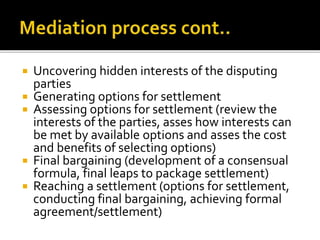
 Uncovering hidden interests of the disputing
parties
 Generating options for settlement
 Assessing options for settlement (review the
interests of the parties, asses how interests can
be met by available options and asses the cost
and benefits of selecting options)
 Final bargaining (development of a consensual
formula, final leaps to package settlement)
 Reaching a settlement (options for settlement,
conducting final bargaining, achieving formal
agreement/settlement)
Good evening and welcome to this mediation session. My name is
…….I have been working past 10 years as an independent
mediator (formal introduction with both parties).
Please accept my congratulation.We are here to explore our
differences and share each other's perspectives so we can produce
the better outcome of the mediation process. I strongly believe
that different opinions, viewpoints, functional interests and
expertise will definitely help for the solutions of our common
problems. It is the all of our job to create a safe atmosphere so we
will have an opportunity to express our ideas to provide different
points of view to assist in defining basic issues and interests, and
look forward for mutually satisfactory options. I fully trust and
respect both of you/all of you that we will be able to reach to
constructive agreement.
As I mentioned before that I am an independent mediator
therefore neutral, impartial regarding relationships and specific
outcomes are the fundamental principles. I do not judge, will not
take sides nor decide who is right or wrong. I am here to assist
both of you to reach yours own decision-one that satisfy both of
you.
We will start with each of your story than I will ask questions and
summarize so I can have better understanding about the issues. I
will also help both of you to identify the issues that are important
to you so I can help you to develop some solutions. Additionally I
will meet with both of you together but there may also be a caucus
when I meet with you individually.You can also request a separate
meeting. Meanwhile all of us can also request a break if we feel
like it.
Now I would like to talk about the ground rules. Please find the
pencil and paper on the table, which is next to you. So you can
write down your thoughts until it is your turn to speak. Please let
us avoid personal attacks in order to maintain a respectful
atmosphere and let us agree to try to solve problem. (Question
about agreeing and disagreeing ground rules and likes to know are
there any you like to add as a ground rules).
I would like to assure that I will keep all information confidential,
unless if it is against the law, like such as child abuse and I will
destroy my notes at the end of the mediation. Finally I would like
to clarify that participation in meditation is voluntary. So please
say yes if each of you wishes to proceed with mediation.
Thank you for your cooperation.
 Negotiation is one of the method (out of four;
negotiation, mediation, collaborative law and
arbitration) of alternative dispute resolution (ADR).
 Negotiation is a process involving two or more people
meeting to discuss shared or opposed interests in a
particular area of mutual concern.
 Negotiation is an educational process, which provides
the opportunities to understand each others
concerns, perceptions and aspirations.
 Note: ADR is important techniques that are outside of
government judicial process and it is usually considered
to be alternative to litigation.
 Negotiation is problem-solving processes, which
include diplomacy, discussion and consultation,
and it encourages adapting peaceable producer
for compromising differences of disputant
parties.
 In mediation and facilitation, there is a third
party, a mediator or facilitator, who facilitates
the resolution process and may even suggest a
resolution. But in negotiation, participation is
also voluntary and there is no third party who
facilitates the resolution process or imposes a
resolution.
 Good faith (honest desire to reach an
agreement and be fair and reasonable for
both sides)
 Flexibility
 Are there other criticisms you can make to the “problem-
solving approach “ for negotiations?
 Are these conflicts amenable to solution through
negotiation?
 What are the stages that a negotiation process tends to go
through?
 How do you determine a party’s interests? Why is it
important to do so?
 Might there be resistance to negotiation which needs to be
overcome?
 Are there reasons why parties might choose not to
negotiate?
 Will the importance of preparation in negotiation be
recognized?
 How did the two sides use their power? What strategies and
tactics did they employ?
 How specifically does culture influence negotiation?
 Background and Introduction, Positions, Issues
 Interests and Alternatives for each of the Parties Involved
 Primary Parties to the Negotiation
 Secondary parties to the Negotiation
 Legitimacy and Standers for Negotiations
 Preparing for negotiation
 Communicating what is to be accomplished (identify
the problem)
 Reviewing why negotiation is required
 Redefining the issue or issues (brainstorm ideas for
solution)
 Selecting when issues will be addressed
 Encouraging discussion throughout
 Addressing the fall-back compromise on each issue
 Agreeing in principle
 Recapping and summarizing
 Monitoring compliance with agreement after
settlement
 Clear sense of knowing that you want or don’t
want
 A detail research about what your counterpart
wants and doesn’t want
 Identify possible concessions (knowing what is
absolutely necessary to achieve in
consummating a successful bargain)
 Know the alternatives
 Know the counterpart and subject matter
(about personality styles, body language/ people
view the same facts and appeals differently)
 Last is rehearse (practice, practice, practice)
 Facilitation is the process of enabling groups
to work cooperatively and effectively (it is
important in circumstances where people of
diverse backgrounds, interests and
capabilities work together)
 This is the design and management of
structures and processes that help a group do
its work and minimize the common problems
p eople have working together
 Conflict resolution skills and understanding the foundation
and skills for constructive conflict
 Transformative responses to conflict through empowerment
and recognition as well resolving environment disputes.
 Building consensus for a sustainable future, the vision to
reconcile, and building bridges.
 Putting principles into practice and removing barriers to the
negotiated resolution of conflict
 Further more facilitator should be clear about
“a propose and an agenda, introduce people,
look after physical need, ground rules, open
environment, involving all participants, pay
attention to the situation, lead by example
and relax”
 Reshaping the cooperation for the future and
strategic planning skills
 Good knowledge of open space and clear idea
about consulting
 Sense of scenario design and creative
thinking/ innovative thinking
 Focusing on people and personal growth and
development
 Helping to create self sufficient teams and team building for
the future, winning work team, capturing the power of team
 Group techniques for idea building learned within a
organization
 Participative designing skills, how to start a participative
management program with methods for active participation
and process improvement and reengineering, continuous
process improving
 Understanding the feeling of the people's satisfaction in the
process of ongoing improvement
PREPARATION
 Group organized, purposes made clear, roles
clarified, logistics planned, group, work,
participants and context understood, agenda
determined and communicated
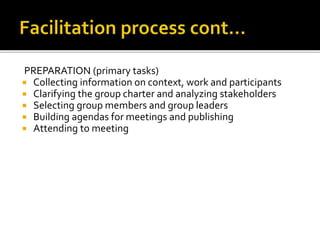
PREPARATION (primary tasks)
 Collecting information on context, work and participants
 Clarifying the group charter and analyzing stakeholders
 Selecting group members and group leaders
 Building agendas for meetings and publishing
 Attending to meeting
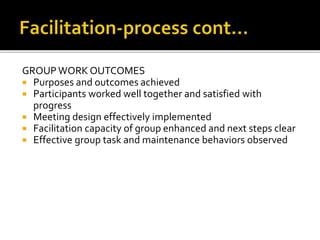
GROUPWORK OUTCOMES
 Purposes and outcomes achieved
 Participants worked well together and satisfied with
progress
 Meeting design effectively implemented
 Facilitation capacity of group enhanced and next steps clear
 Effective group task and maintenance behaviors observed
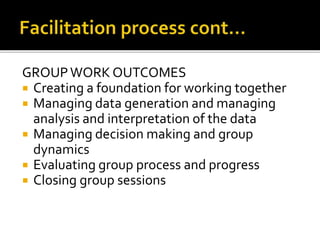
GROUPWORK OUTCOMES
 Creating a foundation for working together
 Managing data generation and managing
analysis and interpretation of the data
 Managing decision making and group
dynamics
 Evaluating group process and progress
 Closing group sessions
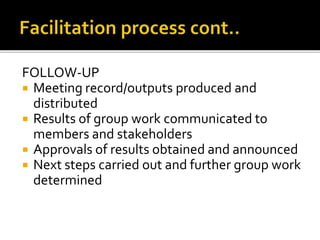
FOLLOW-UP
 Meeting record/outputs produced and
distributed
 Results of group work communicated to
members and stakeholders
 Approvals of results obtained and announced
 Next steps carried out and further group work
determined
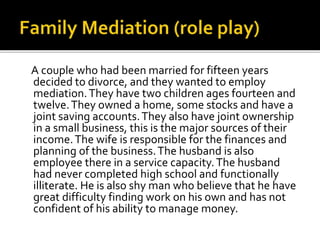
A couple who had been married for fifteen years
decided to divorce, and they wanted to employ
mediation.They have two children ages fourteen and
twelve.They owned a home, some stocks and have a
joint saving accounts.They also have joint ownership
in a small business, this is the major sources of their
income.The wife is responsible for the finances and
planning of the business.The husband is also
employee there in a service capacity.The husband
had never completed high school and functionally
illiterate. He is also shy man who believe that he have
great difficulty finding work on his own and has not
confident of his ability to manage money.
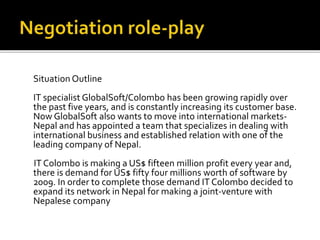
Situation Outline
IT specialist GlobalSoft/Colombo has been growing rapidly over
the past five years, and is constantly increasing its customer base.
Now GlobalSoft also wants to move into international markets-
Nepal and has appointed a team that specializes in dealing with
international business and established relation with one of the
leading company of Nepal.
IT Colombo is making a US$ fifteen million profit every year and,
there is demand for US$ fifty four millions worth of software by
2009. In order to complete those demand IT Colombo decided to
expand its network in Nepal for making a joint-venture with
Nepalese company
Character Profiles and your task
Khalizia bandaranike, ITGSC
you are a 35-year-old marketing specialist with a MA from Harvard business school. You have
been working forGlobalSoft for five years.You joined the international market team one year
ago.Your strengths are negotiating with difficult partners and generating new key cooperation.
Your job is identifying potential partner and sign joint-venture agreement with EIT, Nepal.
Because of your company’s Market Excellency and your demand within the international markets
you are not supposed to pay more than 25% of total profit to EIT, Nepal.
Character profile and your task
Mahanta Aatma, EIT
you are 55 and the ExecutiveVice President and General Manager of EIT, Nepal, a reputed IT
company (Everest InternationalTechnology of Nepal has been working past ten years in local
business and have extensive logistic and skill labor support).You are married and have two adult
children.You have a Master of Business Administration from University of Colombo/Srilanka.You
pay great attention to detail and you are always looking for ways of increasing your revenue and
reducing operating costs and increasing business efficiency.You then followed up by contacting
MS. Bandarnike on the phone, arranging a face-to-face meeting with her.Your goal in this
dialogue is to sell your reputation logistic support and skilled labors to ITGST.
 The eleven staff members of international organization (four female and
seven man and two of them are patient of blood pressure) were
abducted by an armed group onThursday 1-2007 in the province of dead
hill, south west ofTitinic.They were making their way back to the
International delegation inTitnic following a humanitarian mission.They
are being held in an undisclosed location, but the revel-group’s army just
announces that he is ready to negotiate if international organization is
ready to give a pressure to the government to release their party carders.
The International organization is not in a position to say more at this
stage about the process involved in seeking the release of its eleven
employees or about confidential discussions with the different parties
concerned.
You are senior officer of the International organization and assigned to
negotiate with a revels group.
 Strategies for Resolving Conflicts (3rd ed.)
 San Francisco: Jossey-Bass, 2003 Bush, Robert A.
Brauch & Folger, J.P.,The Promise of Mediation, San
Francisco: Jossey-Bass, 1994Broom, Benjamin J.
(2003). Responding to the challenges of third-party
facilitation:Broom, Benjamin J. (1997). Designing a
collective approach to peace:Interactive design and
problem-solving workshops with Greek-Cypriot
communities in Cyprus. Schwarz, R M. (2002).The
Skilled Facilitator. Jossey-Bass.
 Justice,T& Jamieson, D.W. (1999).The Facilitator’s
Fieldbook. NewYork : amacom.

Conflict Resolution Principle techniques.pptx

  • 1.
  • 2.
     Mediation isone of the non-violence method for dispute resolution.  Mediation brings parties together; the real issues in the dispute become clear as well as resolve issues and avoid the escalation of conflict.  Furthermore in mediation, we can build a sense of what the issues are, learn the problems, explore possible options for resolution, and make informed decisions whether or not resolving at that time or moving on is the best outcome for that matter.  Mediation also known an attempt to settle a dispute using a neutral third party.
  • 3.
     Mediation offersan opportunity for all the parties, "win-win" results. It is fair, cost- effective, and confidential.  Mediation encourages flexibility and allows participants to find solutions that meet their needs (In many countries, the law provides a special rule of confidentiality for Mediation).  Mediation helps to the parties concentrates on problem solving rather than keep fighting.
  • 4.
     Family (familybusinesses, financial distribution and spousal support, separation, child custody, dispute between parents and adult children, eldercare issues, divorce).  Workplace (wrongful termination, discrimination, harassment, grievances, labor issues).
  • 5.
     Public disputes(Environmental, real-estate issues: landlord/tenant, builders/contractors, contracts agreement, any partnership company, non-profit organization, consumers and service/business entrepreneurs’ relation, among the youth, any types of violence).  On-line mediation.  Mediation in business and commerce.  Communities mediator.
  • 6.
     Further more,inter-personal, inter-groups, ethnics , ideology, inter-religion, among the different countries with different context (international).
  • 7.
     Mediator asa Facilitator/Mediator as a Reconciliator.  Mediator as a Educator/transformative perspective.  Mediator as a Resource expander/translator.  Mediator explain all the producer and educate the parties on the process, (such as established a behavior guidelines).  Mediator Keep in track parties’ communication.  Mediator understand all the parties, (issues and desire).  Mediator may convey information from one group to another, (only with party approval).  Mediator narrows differences between the parties.  Mediator helps the parties find their own solution not imposing a decision.
  • 8.
     Mediator facilitatesbetween the disputant parties and encourages them to enter into a confidentiality agreement.  Mediator encourages the participants to record them in an enforceable summary format, with formal legal documentation to follow, (when agreements are reached).
  • 9.
     Understanding eachparticipant’s perspective through a pre-caucus.  Increasing and evaluating participant’s interest. in solving the challenge through mediation.  Setting ground rules for improved communication.  Coaching participants through the joint session.  Equalizing power (e.g., between persons in different organizational levels).  Helping participants plan for future interaction.
  • 10.
     Roles forthird parties in mediation.  Conditions under which mediation is useful.  Strategies for mediators.  Assessing effective mediation.  Role of third parties in consensus building.  Mediators are always guided by; impartiality/neutrality/empathy/confidentiality/ persistence and patience as well as effectiveness as a questioner.  Mediator should have specific knowledge about the subject area.
  • 11.
     Restatement  Paraphrase(reframing)  Active listening  Summarization  Expansion (expanded and elaborated form and verify accurate perception)  Ordering/requesting  Structuring (arranging party’s thoughts and speech into a coherent message)  Separating or fractionating (divide an idea/issue into smaller component part)  Generalization (identify general points)  Probing question (open-ended or focused question to encourage the parties)  Questions of clarification (clarification of particular points)
  • 12.
  • 13.
    CONFLICTS ARE CAUSEDBY  Strong emotion  Misperception  Poor communication  Miscommunication  Repetitive negative behavior POSSIBLE INTERVENTIONS  Control expression of emotion  Clarify perceptions and build positive perception  Improve quality and quantity of communication  Block negative repetitive behavior  Positive problem solving attitudes
  • 14.
    CONFLICTS ARE CAUSEDBY  Lack of information  Misinformation  Different views on the relevant  Different interpretation of data POSSIBLE INTERVENTIONS  Reach an agreement what data are important and agree on process to collect as well as develop common criteria  Use experts to gain outside opinion
  • 15.
    CONFLICTS ARE CAUSEDBY  Competition over substantive interests  Procedural interests  Psychological interests POSSIBLE INTERVENTIONS  Focus on interests, not position  Look for objective criteria  Develop solutions that address needs of all parties  Search more options to satisfy interests of different strengths
  • 16.
    CONFLICTS ARE CAUSEDBY  Un equal control  Distribution of resources (geographic physical environmental factors)  Un equal power and authority  Time constraints POSSIBLE INTERVENTIONS  Clearly define and change role  Reallocate control of resources  Established a fair and mutually acceptable decision- making process  Change physical and environment relationship of parties (closeness and distance)  Change time constrains (more or less time)
  • 17.
    CONFLICTS ARE CAUSEDBY  Different criteria for evaluating ideas or behavior  Different ways of life, (ideology or religion) POSSIBLE INTERVENTIONS  Avoid defining problem in terms of value  Search for super ordinate goal that all parties share
  • 18.
     Managing initialcontacts with the disputing parties (establishing relationship, educate about the process, increase commitment to the procedure)  Selecting a strategy to guide mediation (Assist the parties to assess various approaches to manage the conflict)  Collecting and analyzing background information (collect and analyze relevant data about the people)  Designing a detailed plan for mediation (participants, location, physical arrangement, issues interests, settlement options, psychological conditions of the parties, ground rules and behavioral guidelines, plan for first joint negotiation)
  • 19.
     Building trustand cooperation (the mediator should be sensitive about the strong emotion, misperception, legitimacy problem, lack of trust, poor communication)  Beginning the mediation session (opening statement by mediator, parties)  Defining issues and setting an agenda
  • 20.
     Uncovering hiddeninterests of the disputing parties  Generating options for settlement  Assessing options for settlement (review the interests of the parties, asses how interests can be met by available options and asses the cost and benefits of selecting options)  Final bargaining (development of a consensual formula, final leaps to package settlement)  Reaching a settlement (options for settlement, conducting final bargaining, achieving formal agreement/settlement)
  • 21.
    Good evening andwelcome to this mediation session. My name is …….I have been working past 10 years as an independent mediator (formal introduction with both parties). Please accept my congratulation.We are here to explore our differences and share each other's perspectives so we can produce the better outcome of the mediation process. I strongly believe that different opinions, viewpoints, functional interests and expertise will definitely help for the solutions of our common problems. It is the all of our job to create a safe atmosphere so we will have an opportunity to express our ideas to provide different points of view to assist in defining basic issues and interests, and look forward for mutually satisfactory options. I fully trust and respect both of you/all of you that we will be able to reach to constructive agreement.
  • 22.
    As I mentionedbefore that I am an independent mediator therefore neutral, impartial regarding relationships and specific outcomes are the fundamental principles. I do not judge, will not take sides nor decide who is right or wrong. I am here to assist both of you to reach yours own decision-one that satisfy both of you. We will start with each of your story than I will ask questions and summarize so I can have better understanding about the issues. I will also help both of you to identify the issues that are important to you so I can help you to develop some solutions. Additionally I will meet with both of you together but there may also be a caucus when I meet with you individually.You can also request a separate meeting. Meanwhile all of us can also request a break if we feel like it.
  • 23.
    Now I wouldlike to talk about the ground rules. Please find the pencil and paper on the table, which is next to you. So you can write down your thoughts until it is your turn to speak. Please let us avoid personal attacks in order to maintain a respectful atmosphere and let us agree to try to solve problem. (Question about agreeing and disagreeing ground rules and likes to know are there any you like to add as a ground rules). I would like to assure that I will keep all information confidential, unless if it is against the law, like such as child abuse and I will destroy my notes at the end of the mediation. Finally I would like to clarify that participation in meditation is voluntary. So please say yes if each of you wishes to proceed with mediation. Thank you for your cooperation.
  • 24.
     Negotiation isone of the method (out of four; negotiation, mediation, collaborative law and arbitration) of alternative dispute resolution (ADR).  Negotiation is a process involving two or more people meeting to discuss shared or opposed interests in a particular area of mutual concern.  Negotiation is an educational process, which provides the opportunities to understand each others concerns, perceptions and aspirations.  Note: ADR is important techniques that are outside of government judicial process and it is usually considered to be alternative to litigation.
  • 25.
     Negotiation isproblem-solving processes, which include diplomacy, discussion and consultation, and it encourages adapting peaceable producer for compromising differences of disputant parties.  In mediation and facilitation, there is a third party, a mediator or facilitator, who facilitates the resolution process and may even suggest a resolution. But in negotiation, participation is also voluntary and there is no third party who facilitates the resolution process or imposes a resolution.
  • 26.
     Good faith(honest desire to reach an agreement and be fair and reasonable for both sides)  Flexibility
  • 27.
     Are thereother criticisms you can make to the “problem- solving approach “ for negotiations?  Are these conflicts amenable to solution through negotiation?  What are the stages that a negotiation process tends to go through?  How do you determine a party’s interests? Why is it important to do so?
  • 28.
     Might therebe resistance to negotiation which needs to be overcome?  Are there reasons why parties might choose not to negotiate?  Will the importance of preparation in negotiation be recognized?  How did the two sides use their power? What strategies and tactics did they employ?  How specifically does culture influence negotiation?
  • 29.
     Background andIntroduction, Positions, Issues  Interests and Alternatives for each of the Parties Involved  Primary Parties to the Negotiation  Secondary parties to the Negotiation  Legitimacy and Standers for Negotiations
  • 30.
     Preparing fornegotiation  Communicating what is to be accomplished (identify the problem)  Reviewing why negotiation is required  Redefining the issue or issues (brainstorm ideas for solution)  Selecting when issues will be addressed  Encouraging discussion throughout  Addressing the fall-back compromise on each issue  Agreeing in principle  Recapping and summarizing  Monitoring compliance with agreement after settlement
  • 31.
     Clear senseof knowing that you want or don’t want  A detail research about what your counterpart wants and doesn’t want  Identify possible concessions (knowing what is absolutely necessary to achieve in consummating a successful bargain)  Know the alternatives  Know the counterpart and subject matter (about personality styles, body language/ people view the same facts and appeals differently)  Last is rehearse (practice, practice, practice)
  • 32.
     Facilitation isthe process of enabling groups to work cooperatively and effectively (it is important in circumstances where people of diverse backgrounds, interests and capabilities work together)  This is the design and management of structures and processes that help a group do its work and minimize the common problems p eople have working together
  • 33.
     Conflict resolutionskills and understanding the foundation and skills for constructive conflict  Transformative responses to conflict through empowerment and recognition as well resolving environment disputes.  Building consensus for a sustainable future, the vision to reconcile, and building bridges.  Putting principles into practice and removing barriers to the negotiated resolution of conflict
  • 34.
     Further morefacilitator should be clear about “a propose and an agenda, introduce people, look after physical need, ground rules, open environment, involving all participants, pay attention to the situation, lead by example and relax”
  • 35.
     Reshaping thecooperation for the future and strategic planning skills  Good knowledge of open space and clear idea about consulting  Sense of scenario design and creative thinking/ innovative thinking  Focusing on people and personal growth and development
  • 36.
     Helping tocreate self sufficient teams and team building for the future, winning work team, capturing the power of team  Group techniques for idea building learned within a organization  Participative designing skills, how to start a participative management program with methods for active participation and process improvement and reengineering, continuous process improving  Understanding the feeling of the people's satisfaction in the process of ongoing improvement
  • 37.
    PREPARATION  Group organized,purposes made clear, roles clarified, logistics planned, group, work, participants and context understood, agenda determined and communicated
  • 38.
    PREPARATION (primary tasks) Collecting information on context, work and participants  Clarifying the group charter and analyzing stakeholders  Selecting group members and group leaders  Building agendas for meetings and publishing  Attending to meeting
  • 39.
    GROUPWORK OUTCOMES  Purposesand outcomes achieved  Participants worked well together and satisfied with progress  Meeting design effectively implemented  Facilitation capacity of group enhanced and next steps clear  Effective group task and maintenance behaviors observed
  • 40.
    GROUPWORK OUTCOMES  Creatinga foundation for working together  Managing data generation and managing analysis and interpretation of the data  Managing decision making and group dynamics  Evaluating group process and progress  Closing group sessions
  • 41.
    FOLLOW-UP  Meeting record/outputsproduced and distributed  Results of group work communicated to members and stakeholders  Approvals of results obtained and announced  Next steps carried out and further group work determined
  • 42.
    A couple whohad been married for fifteen years decided to divorce, and they wanted to employ mediation.They have two children ages fourteen and twelve.They owned a home, some stocks and have a joint saving accounts.They also have joint ownership in a small business, this is the major sources of their income.The wife is responsible for the finances and planning of the business.The husband is also employee there in a service capacity.The husband had never completed high school and functionally illiterate. He is also shy man who believe that he have great difficulty finding work on his own and has not confident of his ability to manage money.
  • 43.
    Situation Outline IT specialistGlobalSoft/Colombo has been growing rapidly over the past five years, and is constantly increasing its customer base. Now GlobalSoft also wants to move into international markets- Nepal and has appointed a team that specializes in dealing with international business and established relation with one of the leading company of Nepal. IT Colombo is making a US$ fifteen million profit every year and, there is demand for US$ fifty four millions worth of software by 2009. In order to complete those demand IT Colombo decided to expand its network in Nepal for making a joint-venture with Nepalese company
  • 44.
    Character Profiles andyour task Khalizia bandaranike, ITGSC you are a 35-year-old marketing specialist with a MA from Harvard business school. You have been working forGlobalSoft for five years.You joined the international market team one year ago.Your strengths are negotiating with difficult partners and generating new key cooperation. Your job is identifying potential partner and sign joint-venture agreement with EIT, Nepal. Because of your company’s Market Excellency and your demand within the international markets you are not supposed to pay more than 25% of total profit to EIT, Nepal. Character profile and your task Mahanta Aatma, EIT you are 55 and the ExecutiveVice President and General Manager of EIT, Nepal, a reputed IT company (Everest InternationalTechnology of Nepal has been working past ten years in local business and have extensive logistic and skill labor support).You are married and have two adult children.You have a Master of Business Administration from University of Colombo/Srilanka.You pay great attention to detail and you are always looking for ways of increasing your revenue and reducing operating costs and increasing business efficiency.You then followed up by contacting MS. Bandarnike on the phone, arranging a face-to-face meeting with her.Your goal in this dialogue is to sell your reputation logistic support and skilled labors to ITGST.
  • 45.
     The elevenstaff members of international organization (four female and seven man and two of them are patient of blood pressure) were abducted by an armed group onThursday 1-2007 in the province of dead hill, south west ofTitinic.They were making their way back to the International delegation inTitnic following a humanitarian mission.They are being held in an undisclosed location, but the revel-group’s army just announces that he is ready to negotiate if international organization is ready to give a pressure to the government to release their party carders. The International organization is not in a position to say more at this stage about the process involved in seeking the release of its eleven employees or about confidential discussions with the different parties concerned. You are senior officer of the International organization and assigned to negotiate with a revels group.
  • 46.
     Strategies forResolving Conflicts (3rd ed.)  San Francisco: Jossey-Bass, 2003 Bush, Robert A. Brauch & Folger, J.P.,The Promise of Mediation, San Francisco: Jossey-Bass, 1994Broom, Benjamin J. (2003). Responding to the challenges of third-party facilitation:Broom, Benjamin J. (1997). Designing a collective approach to peace:Interactive design and problem-solving workshops with Greek-Cypriot communities in Cyprus. Schwarz, R M. (2002).The Skilled Facilitator. Jossey-Bass.  Justice,T& Jamieson, D.W. (1999).The Facilitator’s Fieldbook. NewYork : amacom.