Getting to Yes

© 2008 Martijn Sjoorda
For This Summary
Buy the book…

          See this book on Amazon »
The Problem
• Don’t Bargain Over Positions
   – Arguing over positions produces unwise
     outcomes
   – Arguing over positions is inefficient
   – Arguing over positions endangers an ongoing
     relationship
   – When there are many parties, positional
     bargaining is even worse
   – Being nice is no answer
   – There is an alternative…
The Method

• Separate the People from the Problem
  – Negotiators are people first
  – Every negotiator has two kinds of
    interests: substance & relationship
  – The relationship tends to become
    entangled with the problem
  – Positional bargaining puts relationship &
    substance in conflict
  – Separate the relationship from the
    substance, deal directly with the people
    problem
Perception
• Put yourself in their shoes
• Don’t deduce their intentions from your
  fears
• Don’t blame them for your problem
• Discuss each other’s perceptions
• Look for opportunities to act inconsistently
  with their perceptions
• Give them a stake in the outcome by
  making sure they participate in the process
• Face-saving: make your proposals
  consistent with their values
Emotion

• First recognise and understand
  emotions, theirs and yours
• Make emotions explicit and
  acknowledge them as legitimate
• Allow the other side to let off steam
• Don’t react to emotional outbursts
• Use symbolic gestures
Communication

• Listen actively and acknowledge
  what is being said
• Speak to be understood
• Speak about yourself, not about
  them
• Speak for a purpose
Prevention works best

• Build a working relationship
• Face the problem, not the people
Focus on interests, not
positions
• For a wise solution reconcile interests, not
  positions
   – Interests define the problem
   – Behind opposed positions lie shared and
     compatible interests, as well as conflicting ones
• How do you identify interests?
   – Ask “Why?”
   – Ask “Why not?”
   – Realize that each side has multiple interests
   – The most powerful interests are basic human
     needs
   – Make a list
Talking about interests

• Make your interests come alive
• Acknowledge their interests as part
  of the problem
• Put the problem before your answer
• Look forward, not back
• Be concrete but flexible
• Be hard on the problem, soft on the
  people
Invent options for mutual gain

Diagnosis
• Pitfalls:
  – Premature judgement
  – Searching for the single answer
  – The assumption of a fixed pie
  – Thinking that ‘solving their problem is
    their problem’
Invent options for mutual gain II

Prescription
• Separate inventing from deciding
   – (brainstorming)
   – Consider brainstorming with the other side
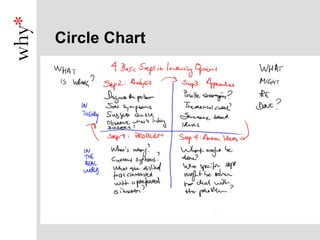
• Broaden your options (Circle Chart)
   – Look through the eyes of different experts
   – Invent agreements of different strengths
   – Change the scope of a proposed agreement
Circle Chart
Invent options for mutual gain
III
• Look for mutual gain
  – Identify shared interests
  – Dovetail different interests
     •   Any difference in interests?
     •   Different beliefs?
     •   Different values placed on time?
     •   Different forecasts?
     •   Differences in aversion to risk?
  – Ask for their preferences
  – Make their decision easy
     • Whose shoes?
     • What decision?
     • Making threats is not enough?
Insist on using objective criteria
• Deciding on the basis of will is costly
• The case for using objective criteria:
   – Principled negotiation produces wise agreements
     amicably & efficiently
• Developing objective criteria:
   – Fair standards
   – Fair procedures
• Negotiating with objective criteria:
   – Frame each issue as a joint search for objective
     criteria
   – Ask “What’s your theory?”
   – Reason and be open to reason
   – Never yield to pressure
Yes, BUT…

• What if they are more powerful?
  Develop your BATNA (Best
  Alternative To a Negotiated
  Agreement)
  – Protecting yourself
    •   The costs of using a bottom line
    •   Know your BATNA
    •   The insecurity of an unknown BATNA
    •   Formulate a trip wire
Yes, BUT…

• Making the most of your BATNA
  – The better you BATNA, the greater
    your power
  – Develop your BATNA
  – The insecurity of an unknown BATNA
  – Consider the other side’s BATNA
Yes, BUT…

• The other side won’t play – Use
  negotiation jujitsu
  – Don’t attack their position, look behind
    it
  – Don’t defend your ideas, invite criticism
    and advice
  – Recast an attack on you as an attack
    on the problem
  – Ask questions and pause…
Yes, BUT…
• What if they use dirty tricks? – Taming the hard
  bargainer
   – How do you negotiate about the rules of the
     game? Use the basics (Separate, Focus, Invent,
     Insist)
   – Common tricky tactics:
      • Deliberate deception
          –   Phony facts
          –   Ambiguous authority
          –   Dubious intentions
          –   Less than full disclosure is not the same as deception
      • Psychological warfare
          –   Stressful situations
          –   Personal attacks
          –   Good guy/bad guy routine
          –   Threats
Yes, BUT…
   •   Positional pressure tactics
       –   Refusal to negotiate
       –   Extreme demands
       –   Escalating demands
       –   Lock-in tactics
       –   Hardhearted partner
       –   A calculated delay
       –   “Take it or leave it”
Want to talk?
• Martijn Sjoorda martijn.sjoorda@whyconsulting.nl
  +31 614908830 www.whyconsulting.nl
• Or check out our facebook page:
  www.facebook.com/WhyConsulting

Getting To Yes Excerpt

  • 1.
    Getting to Yes ©2008 Martijn Sjoorda For This Summary
  • 2.
    Buy the book… See this book on Amazon »
  • 3.
    The Problem • Don’tBargain Over Positions – Arguing over positions produces unwise outcomes – Arguing over positions is inefficient – Arguing over positions endangers an ongoing relationship – When there are many parties, positional bargaining is even worse – Being nice is no answer – There is an alternative…
  • 4.
    The Method • Separatethe People from the Problem – Negotiators are people first – Every negotiator has two kinds of interests: substance & relationship – The relationship tends to become entangled with the problem – Positional bargaining puts relationship & substance in conflict – Separate the relationship from the substance, deal directly with the people problem
  • 5.
    Perception • Put yourselfin their shoes • Don’t deduce their intentions from your fears • Don’t blame them for your problem • Discuss each other’s perceptions • Look for opportunities to act inconsistently with their perceptions • Give them a stake in the outcome by making sure they participate in the process • Face-saving: make your proposals consistent with their values
  • 6.
    Emotion • First recogniseand understand emotions, theirs and yours • Make emotions explicit and acknowledge them as legitimate • Allow the other side to let off steam • Don’t react to emotional outbursts • Use symbolic gestures
  • 7.
    Communication • Listen activelyand acknowledge what is being said • Speak to be understood • Speak about yourself, not about them • Speak for a purpose
  • 8.
    Prevention works best •Build a working relationship • Face the problem, not the people
  • 9.
    Focus on interests,not positions • For a wise solution reconcile interests, not positions – Interests define the problem – Behind opposed positions lie shared and compatible interests, as well as conflicting ones • How do you identify interests? – Ask “Why?” – Ask “Why not?” – Realize that each side has multiple interests – The most powerful interests are basic human needs – Make a list
  • 10.
    Talking about interests •Make your interests come alive • Acknowledge their interests as part of the problem • Put the problem before your answer • Look forward, not back • Be concrete but flexible • Be hard on the problem, soft on the people
  • 11.
    Invent options formutual gain Diagnosis • Pitfalls: – Premature judgement – Searching for the single answer – The assumption of a fixed pie – Thinking that ‘solving their problem is their problem’
  • 12.
    Invent options formutual gain II Prescription • Separate inventing from deciding – (brainstorming) – Consider brainstorming with the other side • Broaden your options (Circle Chart) – Look through the eyes of different experts – Invent agreements of different strengths – Change the scope of a proposed agreement
  • 13.
  • 14.
    Invent options formutual gain III • Look for mutual gain – Identify shared interests – Dovetail different interests • Any difference in interests? • Different beliefs? • Different values placed on time? • Different forecasts? • Differences in aversion to risk? – Ask for their preferences – Make their decision easy • Whose shoes? • What decision? • Making threats is not enough?
  • 15.
    Insist on usingobjective criteria • Deciding on the basis of will is costly • The case for using objective criteria: – Principled negotiation produces wise agreements amicably & efficiently • Developing objective criteria: – Fair standards – Fair procedures • Negotiating with objective criteria: – Frame each issue as a joint search for objective criteria – Ask “What’s your theory?” – Reason and be open to reason – Never yield to pressure
  • 16.
    Yes, BUT… • Whatif they are more powerful? Develop your BATNA (Best Alternative To a Negotiated Agreement) – Protecting yourself • The costs of using a bottom line • Know your BATNA • The insecurity of an unknown BATNA • Formulate a trip wire
  • 17.
    Yes, BUT… • Makingthe most of your BATNA – The better you BATNA, the greater your power – Develop your BATNA – The insecurity of an unknown BATNA – Consider the other side’s BATNA
  • 18.
    Yes, BUT… • Theother side won’t play – Use negotiation jujitsu – Don’t attack their position, look behind it – Don’t defend your ideas, invite criticism and advice – Recast an attack on you as an attack on the problem – Ask questions and pause…
  • 19.
    Yes, BUT… • Whatif they use dirty tricks? – Taming the hard bargainer – How do you negotiate about the rules of the game? Use the basics (Separate, Focus, Invent, Insist) – Common tricky tactics: • Deliberate deception – Phony facts – Ambiguous authority – Dubious intentions – Less than full disclosure is not the same as deception • Psychological warfare – Stressful situations – Personal attacks – Good guy/bad guy routine – Threats
  • 20.
    Yes, BUT… • Positional pressure tactics – Refusal to negotiate – Extreme demands – Escalating demands – Lock-in tactics – Hardhearted partner – A calculated delay – “Take it or leave it”
  • 21.
    Want to talk? •Martijn Sjoorda martijn.sjoorda@whyconsulting.nl +31 614908830 www.whyconsulting.nl • Or check out our facebook page: www.facebook.com/WhyConsulting