Conflict ManagementPresented by:Bill TaylorUniversity of Wyoming Cooperative Extension ServiceNortheast Area Community Development Educator
What are your attitudes towards conflict?Worksheet: What Are Your Attitudes on Conflict?; 8 minutesDo worksheet, then read suggested answers
Conflict is natural, inevitable and necessary !           Conflict creates tensionand pressurefor changeandall change createssome conflict.
What happens during a conflict?Emotions rise.Communication decreases and becomes more indirect (triangulation)Opponents are demonizedSides are taken; camps are formed in the organizationIssues become blurred and new issues added
What happens during a conflict? (cont.)Differences are magnified;  similarities minimizedCompetitive processes (including rigid commitments and dirty tricks) are increasingly employedStop helping, attempt to avoid the situation
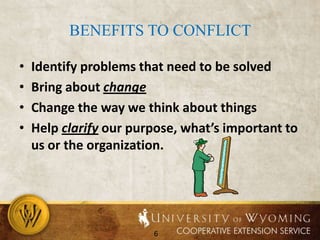
Benefits to Conflict  Identify problems that need to be solvedBring about changeChange the way we think about thingsHelp clarify our purpose, what’s important to us or the organization.
Benefits to Conflict (cont.)Personal and group leadership developmentOrganizational/interpersonal growth and commitmentCreative decision makingOthers?
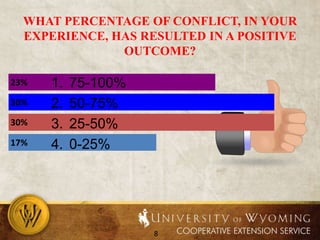
What percentage of conflict, in your experience, has resulted in a positive outcome?75-100%50-75%25-50%0-25%
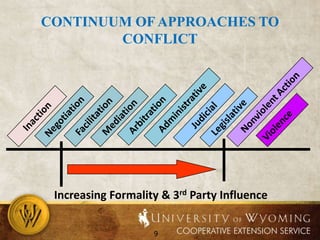
Continuum of Approaches to ConflictNonviolent ActionAdministrativeArbitrationInactionFacilitationJudicialNegotiationMediationLegislativeViolenceIncreasing Formality & 3rd Party Influence
Potential responses to conflictDo nothing: Yield (and change their beliefs)Yield (and retain their beliefs)Stonewall/AvoidanceExit (flight)
Potential responses to conflict (cont.)Fight (exercise power):Guerrilla warfare:  Looks like doing nothing, but isn'tOpen warfare
Potential responses to conflict (cont.)Negotiate:  Contend.  Try to win;  defeat the other sideCompromise.  Split the difference;  find the middleProblem Solve.  Look for new solutions which address the concerns of all parties
Potential responses to conflict (cont.)Seek Assisted Negotiation: Use a third party to aid in finding a mutually agreeable solution to a shared problem MediationFact finderOmbudsman
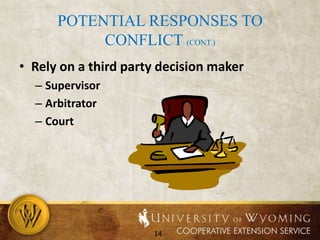
Potential responses to conflict (cont.)Rely on a third party decision maker SupervisorArbitrator Court
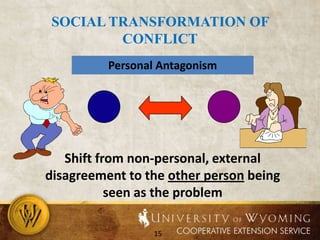
Social Transformation of ConflictPersonal AntagonismShift from non-personal, external disagreement to the other person being seen as the problem
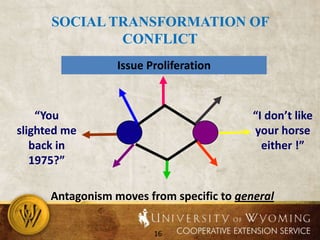
Social Transformation of ConflictIssue Proliferation“I don’t like your horse either !”“You slighted me back in 1975?”Antagonism moves from specific to general
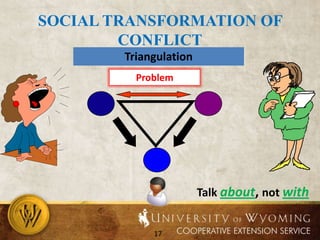
Social Transformation of ConflictTriangulationProblemTalk about, not with
Did you say what I heard?
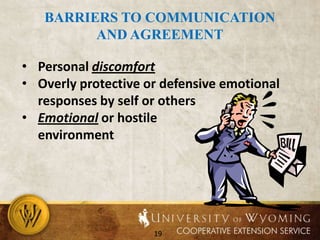
Barriers to Communicationand AgreementPersonal discomfort
Overly protective or defensive emotional responses by self or others
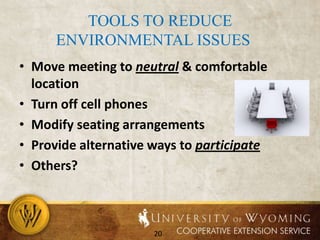
Emotionalor hostile environmentTools to reduce environmental issues	Move meeting to neutral & comfortable locationTurn off cell phonesModify seating arrangementsProvide alternative ways to participateOthers?
Tools to reduce structural factorsSimplify the messageCombine messages and show linkagesActive listeningAsk speaker to restate message in different wordsAsk open-ended questionsPut unrelated messages “in the bin”Others?
Emotions in Conflict SituationsWhen emotions are understood…Differences may be negotiated without becoming too personal
Participants may not get upset as quicklyEmotional or Hostile EnvironmentsPeople are most comfortable in the “emotional zone” they are accustomed to.Those who grew up 	in hostile settings tend to explode or 	implode.
Those who grew up in nurturing environments may interpret explosiveness as hostility and recoil from a hostile person
They may speak past each otherTools to reduce emotional factors	Separate the people from the problemUse active listeningParaphrasingMirroringReframingOthers?
Tools to reduce social factorsAwarenessEncourage collaborative behaviorAddress stereotypes Draw silent parties outSpeak directly with decision-makerProvide neutral data sourceMake base line explicit Others?
Open QuestionsExamples:Probing questions:  Ask for more infoClarifying:  Sharpen your understanding of what has been saidJustifying:  ask for evidence for the view they’ve expressedConsequential:  reality testing, ask about potential solutions or look at potential consequences
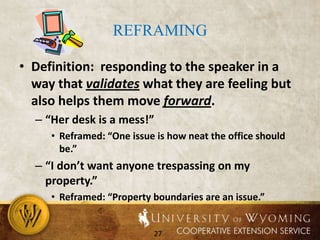
Reframing Definition:  responding to the speaker in a way that validates what they are feeling but also helps them move forward.“Her desk is a mess!” Reframed: “One issue is how neat the office should be.”“I don’t want anyone trespassing on my property.”Reframed: “Property boundaries are an issue.”
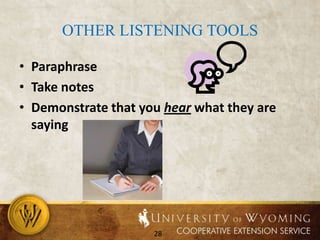
Other Listening ToolsParaphraseTake notes Demonstrate that you hear what they are saying
Hostile/abusive behavior“[H]ostile/abusive behavior [differs] from angry behavior [in that] hostile/abusive behavior is intended, consciously or unconsciously to have some or all of the following effects:Put you off balance.Manipulate and control you.Demean you in some way.Cause you to feel guilty.Intimidate you.
Twelve Steps for dealing with hostility Deal with feelings first.Avoid coming across as bureaucratic.Recognize that each situation is different.Strive to control the interaction.Begin defusing early.Be assertive, not aggressive or passive.If you lose control of yourself, you lose, period.What you focus on, you get more of.
Twelve Steps for dealing with hostility (Cont.)Don’t supply ammunition.Don’t ask questions you don’t want to hear answers to.Avoid inadvertent errors.Avoid high risk, high gain behavior.
Conflict resolution styles worksheet* Worksheet: Conflict Resolution Styles; 5 minutes
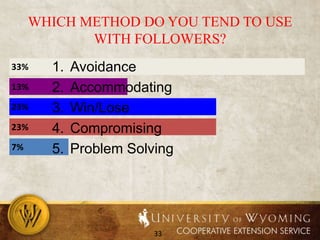
Which method do you tend to use with followers?AvoidanceAccommodatingWin/LoseCompromisingProblem Solving
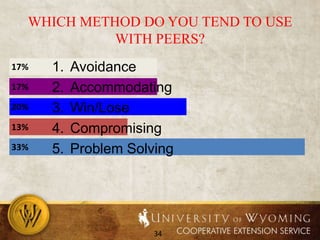
Which method do you tend to use with peers?AvoidanceAccommodatingWin/LoseCompromisingProblem Solving
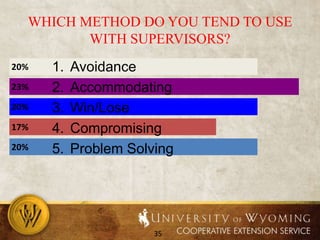
Which method do you tend to use with supervisors?AvoidanceAccommodatingWin/LoseCompromisingProblem Solving
CARPC: ControlA: AcknowledgeR: RefocusP: Problem Solve
Step 1:  Initiating and Taking ControlFirst impressions:Eye contactPay attentionPosturePositive and friendly tone of voiceGreeting (if other party does the initiating)Keep it shortDevelop rapportGet and use their name
Step 2:  AcknowledgeAsk what happened.Address their apparent emotions: Acknowledgement.Empathy.Collect information (use active listening).Give an apology if the facts warrant (but don’t give ammunition).
Step 3:  Refocus the conversationThink about the language you use initiallyUse cooperative rather than competitive language (but don’t make unintended promises).Use “we” (except where it makes no sense).Use appropriate tone and word stressAvoid repeating hot words and phrases.Replace some statements (“We can’t…”) with questions (“How do you see us doing this under our existing rules?”).
Step 3: Refocus the Conversation (CONT.)Use verbal self-defense to re-establish control:Use surprise (in tone and content).Ask a “when” question (move speaker from the general to the specific).Use a neutral (mechanical) tone (generalize and paraphrase without comment or agreement).Engage in a topic-grab, taking something neutral the speaker says (e.g. number of children) and comment on it or ask a question.
Step 3: Refocus the Conversation (CONT.)Physically move to their side (dance of conflict)Now you are facing the problem togetherAct like a broken record (repeating one or two short sentences until the angry person starts to hear you).Be silent.Say “you’re right”—find something in the tirade you can agree to (but again, do not give ammunition).
Step 4:  Problem SolveGive options.This allows subjects to feel they are in charge of their question.In “teaching you, they may teach themselves”—by letting them generate options subject to both sides’ interests and requirements, subjects gain a better perspective on why they have received a “no” so far. The subject and you may create an option that satisfies both sides.
Dealing with the public * Handout: Diffusing Public Anger; review; 5 minutes
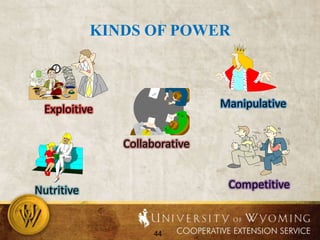
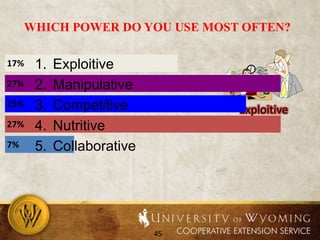
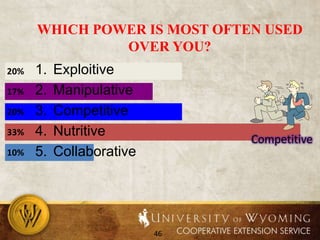
Kinds of PowerExploitiveManipulativeCompetitiveNutritiveCollaborative
Which power do you use most often?ExploitiveManipulativeCompetitiveNutritiveCollaborativeExploitive
Which power is most often used over you?ExploitiveManipulativeCompetitiveNutritiveCollaborativeCompetitive
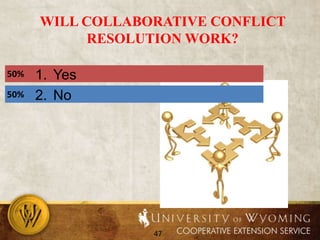
Will collaborative conflict resolution work?YesNo
Collaborative Processes may work if…Issues can be easily defined
The dispute is not over constitutional rights or societal values
There are enough diverse issues to provide opportunities for trade-offs
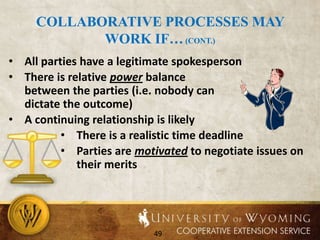
The parties are readily identifiableCollaborative Processes may work if… (cont.)All parties have a legitimate spokesperson
There is relative power balance between the parties (i.e. nobody can dictate the outcome)
A continuing relationship is likely
There is a realistic time deadline
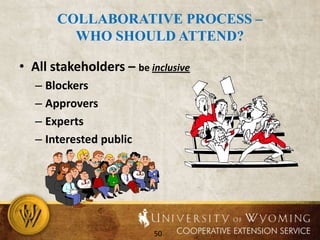
Parties are motivated to negotiate issues on their meritsCollaborative Process –Who should attend?All stakeholders – be inclusiveBlockersApproversExpertsInterested public
Collaborative process Do’s and Don’tsDon’t react to outbursts
Do use only “I” statements, not “you” statements
Do use symbolic gestures to show your sincerity – hand shake, call, card, etc.
Do put yourself in their shoes – (What are they feeling?  Why? What are their needs?)
Don’t deduce their intention from your fears
Don’t blame them for your problem
Do discuss each other’s perceptionsCollaborative process Do’s and Don’ts (cont.)Do look for chances to act inconsistently with their perception of you
Don’t reveal statements made in confidence to the facilitator – the neutral party
Don’t use names or derogatory personal statements
Do have everyone participate actively
Do allow each person to speak
Do give spokesmen authority to speak for their groups
Don’t put out media releases without consensusPrinciples of Effective Dispute ManagementHow to Get to “Yes”Separate the people from the problem
Focus on interests, not positions
Invent options for mutual gain
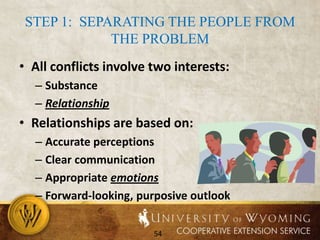
Insist on using objective criteriaStep 1:  Separating the People from the ProblemAll conflicts involve two interests:SubstanceRelationshipRelationships are based on: Accurate perceptionsClear communicationAppropriate emotionsForward-looking, purposive outlook
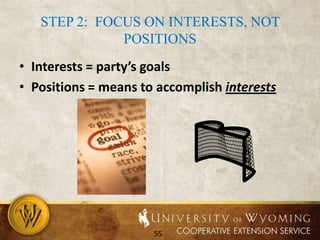
Step 2:  Focus on Interests, Not Positions Interests = party’s goalsPositions = means to accomplish interests
Positions“There will be no pets in this house”“He wants $100,000 for the house but I won’t pay a penny more than $95,000.”“We won’t negotiate until the protests stop.”
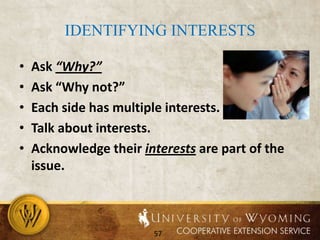
Identifying InterestsAsk “Why?”Ask “Why not?”Each side has multiple interests.Talk about interests.Acknowledge their interests are part of the issue.
Discuss Issues, InterestsAddress the problem before the answer.Look forward, not back.Be concrete on facts, interests, issuesBe flexible on position.Be hard on the problem – soft on people
Handling problem people* Handout: Handling Problem People; review; 5 minutesReferences: Coping With Difficult People by Bramson			 Difficult Conversations by Stone, Patton, Heen
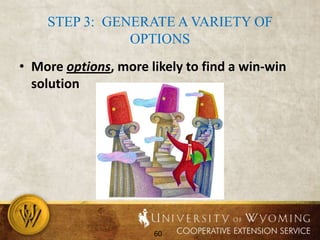
Step 3:  Generate a variety of optionsMore options, more likely to find a win-win solution
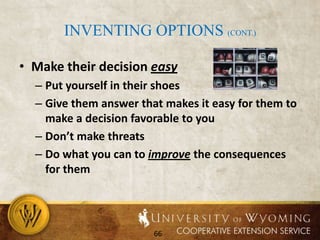
Inventing Options4 obstaclesPremature judgmentSearching for the single answerAssumption of a fixed pie“Solving their problem is their problem.”
Inventing Options (cont.)Separate inventing from decidingUse brainstorming to produce many ideasBefore brainstormingDefine your purposeChoose a few participants or break into small groupsChange the environmentDesign informal atmosphereChoose facilitator

Conflict Management

  • 1.
    Conflict ManagementPresented by:BillTaylorUniversity of Wyoming Cooperative Extension ServiceNortheast Area Community Development Educator
  • 2.
    What are yourattitudes towards conflict?Worksheet: What Are Your Attitudes on Conflict?; 8 minutesDo worksheet, then read suggested answers
  • 3.
    Conflict is natural,inevitable and necessary ! Conflict creates tensionand pressurefor changeandall change createssome conflict.
  • 4.
    What happens duringa conflict?Emotions rise.Communication decreases and becomes more indirect (triangulation)Opponents are demonizedSides are taken; camps are formed in the organizationIssues become blurred and new issues added
  • 5.
    What happens duringa conflict? (cont.)Differences are magnified; similarities minimizedCompetitive processes (including rigid commitments and dirty tricks) are increasingly employedStop helping, attempt to avoid the situation
  • 6.
    Benefits to Conflict Identify problems that need to be solvedBring about changeChange the way we think about thingsHelp clarify our purpose, what’s important to us or the organization.
  • 7.
    Benefits to Conflict(cont.)Personal and group leadership developmentOrganizational/interpersonal growth and commitmentCreative decision makingOthers?
  • 8.
    What percentage ofconflict, in your experience, has resulted in a positive outcome?75-100%50-75%25-50%0-25%
  • 9.
    Continuum of Approachesto ConflictNonviolent ActionAdministrativeArbitrationInactionFacilitationJudicialNegotiationMediationLegislativeViolenceIncreasing Formality & 3rd Party Influence
  • 10.
    Potential responses toconflictDo nothing: Yield (and change their beliefs)Yield (and retain their beliefs)Stonewall/AvoidanceExit (flight)
  • 11.
    Potential responses toconflict (cont.)Fight (exercise power):Guerrilla warfare: Looks like doing nothing, but isn'tOpen warfare
  • 12.
    Potential responses toconflict (cont.)Negotiate: Contend. Try to win; defeat the other sideCompromise. Split the difference; find the middleProblem Solve. Look for new solutions which address the concerns of all parties
  • 13.
    Potential responses toconflict (cont.)Seek Assisted Negotiation: Use a third party to aid in finding a mutually agreeable solution to a shared problem MediationFact finderOmbudsman
  • 14.
    Potential responses toconflict (cont.)Rely on a third party decision maker SupervisorArbitrator Court
  • 15.
    Social Transformation ofConflictPersonal AntagonismShift from non-personal, external disagreement to the other person being seen as the problem
  • 16.
    Social Transformation ofConflictIssue Proliferation“I don’t like your horse either !”“You slighted me back in 1975?”Antagonism moves from specific to general
  • 17.
    Social Transformation ofConflictTriangulationProblemTalk about, not with
  • 18.
    Did you saywhat I heard?
  • 19.
    Barriers to CommunicationandAgreementPersonal discomfort
  • 20.
    Overly protective ordefensive emotional responses by self or others
  • 21.
    Emotionalor hostile environmentToolsto reduce environmental issues Move meeting to neutral & comfortable locationTurn off cell phonesModify seating arrangementsProvide alternative ways to participateOthers?
  • 22.
    Tools to reducestructural factorsSimplify the messageCombine messages and show linkagesActive listeningAsk speaker to restate message in different wordsAsk open-ended questionsPut unrelated messages “in the bin”Others?
  • 23.
    Emotions in ConflictSituationsWhen emotions are understood…Differences may be negotiated without becoming too personal
  • 24.
    Participants may notget upset as quicklyEmotional or Hostile EnvironmentsPeople are most comfortable in the “emotional zone” they are accustomed to.Those who grew up in hostile settings tend to explode or implode.
  • 25.
    Those who grewup in nurturing environments may interpret explosiveness as hostility and recoil from a hostile person
  • 26.
    They may speakpast each otherTools to reduce emotional factors Separate the people from the problemUse active listeningParaphrasingMirroringReframingOthers?
  • 27.
    Tools to reducesocial factorsAwarenessEncourage collaborative behaviorAddress stereotypes Draw silent parties outSpeak directly with decision-makerProvide neutral data sourceMake base line explicit Others?
  • 28.
    Open QuestionsExamples:Probing questions: Ask for more infoClarifying: Sharpen your understanding of what has been saidJustifying: ask for evidence for the view they’ve expressedConsequential: reality testing, ask about potential solutions or look at potential consequences
  • 29.
    Reframing Definition: responding to the speaker in a way that validates what they are feeling but also helps them move forward.“Her desk is a mess!” Reframed: “One issue is how neat the office should be.”“I don’t want anyone trespassing on my property.”Reframed: “Property boundaries are an issue.”
  • 30.
    Other Listening ToolsParaphraseTakenotes Demonstrate that you hear what they are saying
  • 31.
    Hostile/abusive behavior“[H]ostile/abusive behavior[differs] from angry behavior [in that] hostile/abusive behavior is intended, consciously or unconsciously to have some or all of the following effects:Put you off balance.Manipulate and control you.Demean you in some way.Cause you to feel guilty.Intimidate you.
  • 32.
    Twelve Steps fordealing with hostility Deal with feelings first.Avoid coming across as bureaucratic.Recognize that each situation is different.Strive to control the interaction.Begin defusing early.Be assertive, not aggressive or passive.If you lose control of yourself, you lose, period.What you focus on, you get more of.
  • 33.
    Twelve Steps fordealing with hostility (Cont.)Don’t supply ammunition.Don’t ask questions you don’t want to hear answers to.Avoid inadvertent errors.Avoid high risk, high gain behavior.
  • 34.
    Conflict resolution stylesworksheet* Worksheet: Conflict Resolution Styles; 5 minutes
  • 35.
    Which method doyou tend to use with followers?AvoidanceAccommodatingWin/LoseCompromisingProblem Solving
  • 36.
    Which method doyou tend to use with peers?AvoidanceAccommodatingWin/LoseCompromisingProblem Solving
  • 37.
    Which method doyou tend to use with supervisors?AvoidanceAccommodatingWin/LoseCompromisingProblem Solving
  • 38.
    CARPC: ControlA: AcknowledgeR:RefocusP: Problem Solve
  • 39.
    Step 1: Initiating and Taking ControlFirst impressions:Eye contactPay attentionPosturePositive and friendly tone of voiceGreeting (if other party does the initiating)Keep it shortDevelop rapportGet and use their name
  • 40.
    Step 2: AcknowledgeAsk what happened.Address their apparent emotions: Acknowledgement.Empathy.Collect information (use active listening).Give an apology if the facts warrant (but don’t give ammunition).
  • 41.
    Step 3: Refocus the conversationThink about the language you use initiallyUse cooperative rather than competitive language (but don’t make unintended promises).Use “we” (except where it makes no sense).Use appropriate tone and word stressAvoid repeating hot words and phrases.Replace some statements (“We can’t…”) with questions (“How do you see us doing this under our existing rules?”).
  • 42.
    Step 3: Refocusthe Conversation (CONT.)Use verbal self-defense to re-establish control:Use surprise (in tone and content).Ask a “when” question (move speaker from the general to the specific).Use a neutral (mechanical) tone (generalize and paraphrase without comment or agreement).Engage in a topic-grab, taking something neutral the speaker says (e.g. number of children) and comment on it or ask a question.
  • 43.
    Step 3: Refocusthe Conversation (CONT.)Physically move to their side (dance of conflict)Now you are facing the problem togetherAct like a broken record (repeating one or two short sentences until the angry person starts to hear you).Be silent.Say “you’re right”—find something in the tirade you can agree to (but again, do not give ammunition).
  • 44.
    Step 4: Problem SolveGive options.This allows subjects to feel they are in charge of their question.In “teaching you, they may teach themselves”—by letting them generate options subject to both sides’ interests and requirements, subjects gain a better perspective on why they have received a “no” so far. The subject and you may create an option that satisfies both sides.
  • 45.
    Dealing with thepublic * Handout: Diffusing Public Anger; review; 5 minutes
  • 46.
  • 47.
    Which power doyou use most often?ExploitiveManipulativeCompetitiveNutritiveCollaborativeExploitive
  • 48.
    Which power ismost often used over you?ExploitiveManipulativeCompetitiveNutritiveCollaborativeCompetitive
  • 49.
    Will collaborative conflictresolution work?YesNo
  • 50.
    Collaborative Processes maywork if…Issues can be easily defined
  • 51.
    The dispute isnot over constitutional rights or societal values
  • 52.
    There are enoughdiverse issues to provide opportunities for trade-offs
  • 53.
    The parties arereadily identifiableCollaborative Processes may work if… (cont.)All parties have a legitimate spokesperson
  • 54.
    There is relativepower balance between the parties (i.e. nobody can dictate the outcome)
  • 55.
  • 56.
    There is arealistic time deadline
  • 57.
    Parties are motivatedto negotiate issues on their meritsCollaborative Process –Who should attend?All stakeholders – be inclusiveBlockersApproversExpertsInterested public
  • 58.
    Collaborative process Do’sand Don’tsDon’t react to outbursts
  • 59.
    Do use only“I” statements, not “you” statements
  • 60.
    Do use symbolicgestures to show your sincerity – hand shake, call, card, etc.
  • 61.
    Do put yourselfin their shoes – (What are they feeling? Why? What are their needs?)
  • 62.
    Don’t deduce theirintention from your fears
  • 63.
    Don’t blame themfor your problem
  • 64.
    Do discuss eachother’s perceptionsCollaborative process Do’s and Don’ts (cont.)Do look for chances to act inconsistently with their perception of you
  • 65.
    Don’t reveal statementsmade in confidence to the facilitator – the neutral party
  • 66.
    Don’t use namesor derogatory personal statements
  • 67.
    Do have everyoneparticipate actively
  • 68.
    Do allow eachperson to speak
  • 69.
    Do give spokesmenauthority to speak for their groups
  • 70.
    Don’t put outmedia releases without consensusPrinciples of Effective Dispute ManagementHow to Get to “Yes”Separate the people from the problem
  • 71.
    Focus on interests,not positions
  • 72.
  • 73.
    Insist on usingobjective criteriaStep 1: Separating the People from the ProblemAll conflicts involve two interests:SubstanceRelationshipRelationships are based on: Accurate perceptionsClear communicationAppropriate emotionsForward-looking, purposive outlook
  • 74.
    Step 2: Focus on Interests, Not Positions Interests = party’s goalsPositions = means to accomplish interests
  • 75.
    Positions“There will beno pets in this house”“He wants $100,000 for the house but I won’t pay a penny more than $95,000.”“We won’t negotiate until the protests stop.”
  • 76.
    Identifying InterestsAsk “Why?”Ask“Why not?”Each side has multiple interests.Talk about interests.Acknowledge their interests are part of the issue.
  • 77.
    Discuss Issues, InterestsAddressthe problem before the answer.Look forward, not back.Be concrete on facts, interests, issuesBe flexible on position.Be hard on the problem – soft on people
  • 78.
    Handling problem people*Handout: Handling Problem People; review; 5 minutesReferences: Coping With Difficult People by Bramson Difficult Conversations by Stone, Patton, Heen
  • 79.
    Step 3: Generate a variety of optionsMore options, more likely to find a win-win solution
  • 80.
    Inventing Options4 obstaclesPrematurejudgmentSearching for the single answerAssumption of a fixed pie“Solving their problem is their problem.”
  • 81.
    Inventing Options (cont.)Separateinventing from decidingUse brainstorming to produce many ideasBefore brainstormingDefine your purposeChoose a few participants or break into small groupsChange the environmentDesign informal atmosphereChoose facilitator

Editor's Notes

  • #4 Therefore, we cannot move forward and grow without some conflict.The challenge is to manage conflict so that outcomes are positive.
  • #10 Inaction: Avoidance, decision by one party only. Win-Lose by defaultNegotiation: Private, informal decision making – only parties involved participate. Goal is “consensus” & “win-win”Facilitation: Private, informal decision making by only parties involved. Neutral 3rd party “facilitates discussion – tries to maximize communication & minimize conflict. Goal is “consensus” & “win-win”Mediation: Private, informal decision making by parties involved, but “mediator” helps create settlement. 3rd party actively works to resolve the conflict – may not be neutral on all issues. May still be “win-win”Arbitration: Private, but formal – 3rd party makes decision. Conflicting parties usually agree in advance to be bound by the decision.Administrative Decision: Private, but formal – 3rd party makes decision. Person(s) in authority make final decision – with or without input or agreement of conflicting parties.Judicial Decision: Public, formal, 3rd party decision making. Judge or jury makes binding decision based on law, evidence, precedent, etc.Legislative Decision: Public, formal, 3rd party decision making. Elected officials enact law to formalize societal policy, behavior, etc.Non-violent direct action: coerced decision making – public gathering to influence policy, action, etc.Violence: coercion through force or threat of force. Often a “lose-lose” result.
  • #23 Happiness – Fulfillment, Excitement & Contentment: All are positive emotions to foster, but… …they are all defined by individual standards……they may or may not result in positive action……hurt or resentment can follow if these emotions are not accepted or respectedF E A RCauses fight or flight responses…… lots of adrenalin… defensiveness… verbal or physical reactionWork to remove fear, if possible !Sadness – Emotional LossSome adults refuse to allow full expression of sadness because they think it may hamper work and/or make them appear unable to cope.Sadness can strongly influence conflict and problem solving.Anger - An Emotion of OffenseThis most volatile emotion is usually present in conflicts……can result when another moves too close to personal “tender spots,” pulls back too soon or doesn’t honor our vulnerability … …often results in insults, assaults or flight…Recognize,diminish,defuseOverly protective or defensive emotions tend to: …escalate more rapidly……become more intense……last longer……with each occurrence
  • #30 Persons engaged in hostile/abusive behavior may also intend to make you feel powerless (i.e., that neither your interests and concerns nor you count).Hostile behavior can be:Verbal.NonverbalIt is intended to cause you to act in a particular way to benefit the speaker/actor.
  • #45 Exploitive – “power upon”Manipulative - “Power Over”Competitive – “power against”Nutritive – “power for”Collaborative, coalescent or coalitional – “power with”
  • #51 Stakeholders are any parties who view themselves as deeply affected by this negotiation, project or decisionBlockers: Any person or group that can block implementation if they are unhappy with the decisionApprovers: Anyone whose approval will enable the project to proceedExperts: Anyone whose advice or assistance is valuable. Ex. Technical expertise