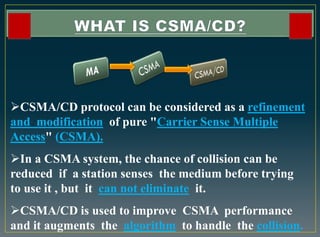
CSMA/CD protocol can be considered as a refinement
and modification of pure "Carrier Sense Multiple
Access" (CSMA).
In a CSMA system, the chance of collision can be
reduced if a station senses the medium before trying
to use it , but it can not eliminate it.
CSMA/CD is used to improve CSMA performance
and it augments the algorithm to handle the collision.
• CARRIER SENSE MULTIPLE ACCESS with
COLLISION DETECTION (CSMA/CD) is
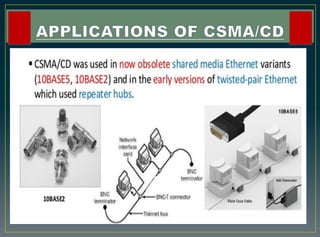
a MEDIA ACCESS CONTROL method used most
notably in early ETHERNET technology for LOCAL
AREA NETWORKING .
• This is used in combination with COLLISION
DETECTION in which a transmitting station detects
collisions by sensing transmissions from other
stations while it is transmitting a frame.
• When this collision condition is detected, the station
stops transmitting that frame, transmits a jam
signal, and then waits for a random time interval
before trying to resend the frame.
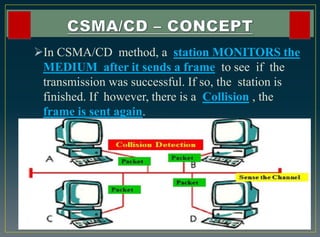
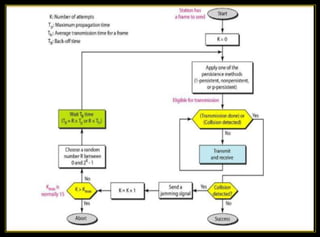
In CSMA/CD method, a station MONITORS the
MEDIUM after it sends a frame to see if the
transmission was successful. If so, the station is
finished. If however, there is a Collision , the
frame is sent again.
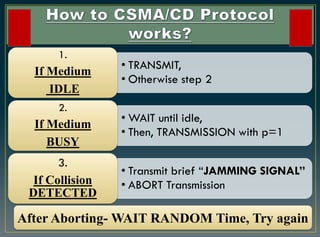
• TRANSMIT,
• Otherwise step 2
1.
If Medium
IDLE
• WAIT until idle,
• Then, TRANSMISSION with p=1
2.
If Medium
BUSY
• Transmit brief “JAMMING SIGNAL”
• ABORT Transmission
3.
If Collision
DETECTED
After Aborting- WAIT RANDOM Time, Try again
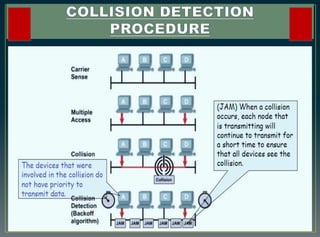
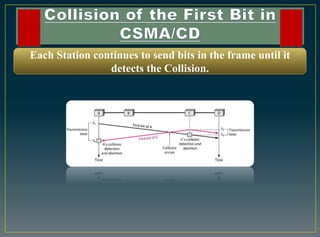
Each Station continues to send bits in the frame until it
detects the Collision.
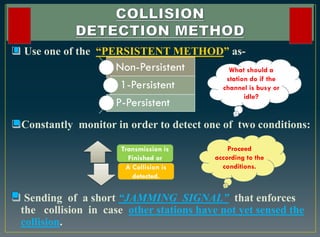
 Use one of the “PERSISTENT METHOD” as-
Constantly monitor in order to detect one of two conditions:
 Sending of a short “JAMMING SIGNAL” that enforces
the collision in case other stations have not yet sensed the
collision.
Non-Persistent
1-Persistent
P-Persistent
Proceed
according to the
conditions.
What should a
station do if the
channel is busy or
idle?
Transmission is
Finished or
A Collision is
detected.
OF CSMA/CD
 Level of Energy in a Channel can have three values :
• ZERO : Channel is Idle.
• NORMAL: A station has successfully captured the channel &
is sending its frame.
• ABNORMAL : There is a collision & the level of energy is
twice the normal level.
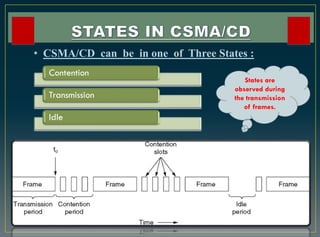
• CSMA/CD can be in one of Three States :
Contention
Transmission
Idle
States are
observed during
the transmission
of frames.
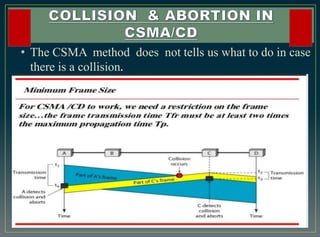
• The CSMA method does not tells us what to do in case
there is a collision.
Time to detect
collision <
2*maximum
propagation
delay.
Minimum
frame size
enough to
allow collision
detection prior
to end of
transmission.
The reaction
time in CSMA-
CD is 2tprop.
* The Throughput of
CSMA/CD is greater than that
of Pure or Slotted ALOHA.
* For 1-persistent method the
maximum throughput is around
50 % when G=1.
* For Non-persistent method, the
maximum throughput can go up to
90 % when G is between 3 and 8.
RELIABLE; Collisions are detected and
packets are , so no data is lost.
Relatively FAST; A computer does not
have to wait its "turn" to transmit data.
EFFECTIVE; handle data collisions.
LIMITED to 2500 meters/11/2
mile; The collision detection
mechanism restricts the length of
cable segment that can be used.
Inappropriate for LARGE/active
networks; The slowdown increases,
as the network grows larger.
CSMA /CD PPT ON SLIDESHARE

CSMA /CD PPT ON SLIDESHARE

  • 5.
    CSMA/CD protocol canbe considered as a refinement and modification of pure "Carrier Sense Multiple Access" (CSMA). In a CSMA system, the chance of collision can be reduced if a station senses the medium before trying to use it , but it can not eliminate it. CSMA/CD is used to improve CSMA performance and it augments the algorithm to handle the collision.
  • 6.
    • CARRIER SENSEMULTIPLE ACCESS with COLLISION DETECTION (CSMA/CD) is a MEDIA ACCESS CONTROL method used most notably in early ETHERNET technology for LOCAL AREA NETWORKING . • This is used in combination with COLLISION DETECTION in which a transmitting station detects collisions by sensing transmissions from other stations while it is transmitting a frame. • When this collision condition is detected, the station stops transmitting that frame, transmits a jam signal, and then waits for a random time interval before trying to resend the frame.
  • 7.
    In CSMA/CD method,a station MONITORS the MEDIUM after it sends a frame to see if the transmission was successful. If so, the station is finished. If however, there is a Collision , the frame is sent again.
  • 8.
    • TRANSMIT, • Otherwisestep 2 1. If Medium IDLE • WAIT until idle, • Then, TRANSMISSION with p=1 2. If Medium BUSY • Transmit brief “JAMMING SIGNAL” • ABORT Transmission 3. If Collision DETECTED After Aborting- WAIT RANDOM Time, Try again
  • 10.
    Each Station continuesto send bits in the frame until it detects the Collision.
  • 11.
     Use oneof the “PERSISTENT METHOD” as- Constantly monitor in order to detect one of two conditions:  Sending of a short “JAMMING SIGNAL” that enforces the collision in case other stations have not yet sensed the collision. Non-Persistent 1-Persistent P-Persistent Proceed according to the conditions. What should a station do if the channel is busy or idle? Transmission is Finished or A Collision is detected.
  • 12.
  • 14.
     Level ofEnergy in a Channel can have three values : • ZERO : Channel is Idle. • NORMAL: A station has successfully captured the channel & is sending its frame. • ABNORMAL : There is a collision & the level of energy is twice the normal level.
  • 15.
    • CSMA/CD canbe in one of Three States : Contention Transmission Idle States are observed during the transmission of frames.
  • 16.
    • The CSMAmethod does not tells us what to do in case there is a collision.
  • 17.
    Time to detect collision< 2*maximum propagation delay. Minimum frame size enough to allow collision detection prior to end of transmission. The reaction time in CSMA- CD is 2tprop.
  • 18.
    * The Throughputof CSMA/CD is greater than that of Pure or Slotted ALOHA. * For 1-persistent method the maximum throughput is around 50 % when G=1. * For Non-persistent method, the maximum throughput can go up to 90 % when G is between 3 and 8.
  • 19.
    RELIABLE; Collisions aredetected and packets are , so no data is lost. Relatively FAST; A computer does not have to wait its "turn" to transmit data. EFFECTIVE; handle data collisions.
  • 20.
    LIMITED to 2500meters/11/2 mile; The collision detection mechanism restricts the length of cable segment that can be used. Inappropriate for LARGE/active networks; The slowdown increases, as the network grows larger.