
- Asst. Prof. Meenakshi Paul
- G. N. Khalsa College
3.1 Introduction
3.1.1 What Is a Theory?
3.1.2 What Are the Goals of Theory?
3.2 Research Concepts, Constructs, Propositions, Variables, and Hypotheses
3.2.1 Research Concepts and Constructs
3.2.2 Research Propositions and Hypotheses
3.3 Understanding Theory
3.3.1 Verifying Theory
3.3.2 Theory Building
3.4 The Scientific Method
Content
 Theory building is the means by which basic researchers
hope to achieve this purpose
 Theories are simply generalizations that help us better
understand reality.
 If a theory does not hold true in practice, then that theory
holds no value.
 This chapter will provide a fundamental knowledge of
theory, theory development, and some terminology
regarding theory necessary for business researchers.
3.1 Introduction

There is nothing so practical
as a good theory.
—Kurt Lewin

 A theory is a formal, logical explanation of some
events that includes predictions of how things relate
to one another.
 Theories are simply models designed to help us
better understand reality and to understand the logic
behind things we observe.
3.1.1 What Is a Theory?

Theories are nets cast to catch what we call “the
world”: to rationalize, to explain, and to master
it. We endeavor to make the mesh ever finer and
finer.
-Karl R. Popper

 There are two primary goals of theory. The first is to
understand the relationships among various phenomena.
 A theory provides a picture of the linkages among
different concepts, allowing us to better comprehend how
they affect one another.
 The second goal is to predict.
 Once we have an understanding of the relationships
among concepts, we can then predict what will happen if
we change one factor.
 For example, if we understand the relationship between
advertising expenditures and retail sales, we can then
predict the impact of decreasing or increasing our
advertising expenditures
3.1.2 What Are the Goals of Theory?

3.2
Research Concepts, Constructs,
Propositions, Variables, and
Hypotheses

 A concept or construct is a generalized idea about a class of
objects, attributes, occurrences, or processes that has been
given a name.
 Leadership style, employee turnover, and customer
satisfaction are all concepts.
 Concepts express in words various events or objects.
 An abstraction of reality that is the basic unit for theory
development.
3.2.1 Research Concepts and
Constructs

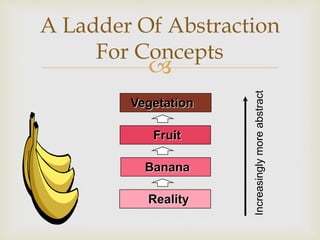
Vegetation
Fruit
Banana
Reality
Increasinglymoreabstract
A Ladder Of Abstraction
For Concepts
 Propositions are statements concerned with the relationships
among concepts.
 A proposition explains the logical linkage among certain concepts
by asserting a universal connection between concepts:
“Leadership style is related to employee turnover.”
 A hypothesis is a formal statement explaining some outcome
regarding variables of interest.
 Variables are the empirical reflection of a concept and a
hypothesis is a proposition stated in a testable format.
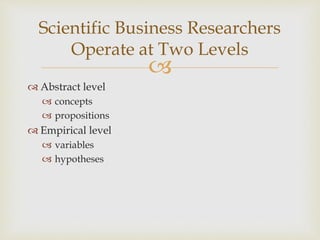
 So, concepts and propositions are at the abstract level, while
variables and hypotheses are at the empirical level.
3.2.2 Research Propositions and
Hypotheses

 Abstract level
 concepts
 propositions
 Empirical level
 variables
 hypotheses
Scientific Business Researchers
Operate at Two Levels

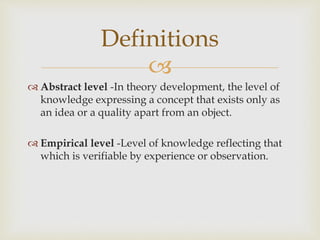
 Abstract level -In theory development, the level of
knowledge expressing a concept that exists only as
an idea or a quality apart from an object.
 Empirical level -Level of knowledge reflecting that
which is verifiable by experience or observation.
Definitions

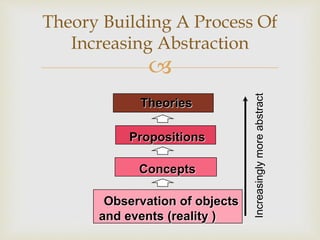
Theory Building A Process Of
Increasing Abstraction
Theories
Propositions
Concepts
Observation of objects
and events (reality )
Increasinglymoreabstract

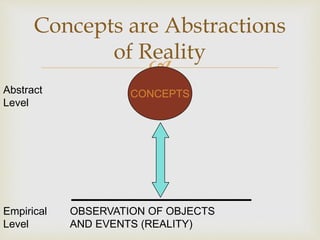
CONCEPTS
OBSERVATION OF OBJECTS
AND EVENTS (REALITY)
Empirical
Level
Abstract
Level
Concepts are Abstractions
of Reality

 Concepts abstract reality.
 Propositions are statements concerned with the
relationships among concepts.
Abstract Level
 A theory can be built through a process of reviewing
previous findings of similar studies or knowledge of
applicable theoretical areas.
 A theory may be developed with deductive reasoning by
going from a general statement to a specific assertion.
 Deductive reasoning is the logical process of deriving a
conclusion about a specific instance based on a known
general premise or something known to be true.
 Inductive reasoning is the logical process of establishing a
general proposition on the basis of observation of particular
facts.
3.3 Understanding Theory
 Theory Building is people making sense of the world around them.
 A theory may be developed with deductive reasoning by going from a
general statement to a specific assertion.
 Deductive reasoning is the logical process of deriving a conclusion about a
specific instance based on a known general premise or something known to
be true.
 For example, while you might occasionally have doubts, we know that all
business professors are human beings. If we also know that Barry Babin is a
business professor, then we can deduce that Barry Babin is a human being.
3.3.2 Theory Building

 At the empirical level, a theory may be developed with
inductive reasoning.
 Inductive reasoning is the logical process of establishing a
general proposition on the basis of observation of particular
facts.
 All business professors that have ever been seen are human
beings; therefore, all business professors are human beings.
3.3.2 Theory Building (contd..)

 The scientific method is a set of prescribed procedures for
establishing and connecting theoretical statements about
events, for analyzing empirical evidence, and for predicting
events yet unknown.
 It is useful to look at the analytic process of scientific theory
building as a series of stages.
 In sum, the scientific method guides us from the abstract
nature of concepts and propositions, to the empirical variables
and hypotheses, and to the testing and verification of theory.
3.4 The Scientific Method

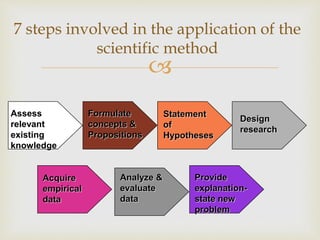
Assess
relevant
existing
knowledge
Formulate
concepts &
Propositions
Statement
of
Hypotheses
Design
research
Acquire
empirical
data
Analyze &
evaluate
data
Provide
explanation-
state new
problem
7 steps involved in the application of the
scientific method
Theory building

Theory building

  • 1.
    - Asst. Prof.Meenakshi Paul - G. N. Khalsa College
  • 2.
    3.1 Introduction 3.1.1 WhatIs a Theory? 3.1.2 What Are the Goals of Theory? 3.2 Research Concepts, Constructs, Propositions, Variables, and Hypotheses 3.2.1 Research Concepts and Constructs 3.2.2 Research Propositions and Hypotheses 3.3 Understanding Theory 3.3.1 Verifying Theory 3.3.2 Theory Building 3.4 The Scientific Method Content
  • 3.
     Theory buildingis the means by which basic researchers hope to achieve this purpose  Theories are simply generalizations that help us better understand reality.  If a theory does not hold true in practice, then that theory holds no value.  This chapter will provide a fundamental knowledge of theory, theory development, and some terminology regarding theory necessary for business researchers. 3.1 Introduction
  • 4.
     There is nothingso practical as a good theory. —Kurt Lewin
  • 5.
      A theoryis a formal, logical explanation of some events that includes predictions of how things relate to one another.  Theories are simply models designed to help us better understand reality and to understand the logic behind things we observe. 3.1.1 What Is a Theory?
  • 6.
     Theories are netscast to catch what we call “the world”: to rationalize, to explain, and to master it. We endeavor to make the mesh ever finer and finer. -Karl R. Popper
  • 7.
      There aretwo primary goals of theory. The first is to understand the relationships among various phenomena.  A theory provides a picture of the linkages among different concepts, allowing us to better comprehend how they affect one another.  The second goal is to predict.  Once we have an understanding of the relationships among concepts, we can then predict what will happen if we change one factor.  For example, if we understand the relationship between advertising expenditures and retail sales, we can then predict the impact of decreasing or increasing our advertising expenditures 3.1.2 What Are the Goals of Theory?
  • 8.
  • 9.
      A conceptor construct is a generalized idea about a class of objects, attributes, occurrences, or processes that has been given a name.  Leadership style, employee turnover, and customer satisfaction are all concepts.  Concepts express in words various events or objects.  An abstraction of reality that is the basic unit for theory development. 3.2.1 Research Concepts and Constructs
  • 10.
  • 11.
     Propositions arestatements concerned with the relationships among concepts.  A proposition explains the logical linkage among certain concepts by asserting a universal connection between concepts: “Leadership style is related to employee turnover.”  A hypothesis is a formal statement explaining some outcome regarding variables of interest.  Variables are the empirical reflection of a concept and a hypothesis is a proposition stated in a testable format.  So, concepts and propositions are at the abstract level, while variables and hypotheses are at the empirical level. 3.2.2 Research Propositions and Hypotheses
  • 12.
      Abstract level concepts  propositions  Empirical level  variables  hypotheses Scientific Business Researchers Operate at Two Levels
  • 13.
      Abstract level-In theory development, the level of knowledge expressing a concept that exists only as an idea or a quality apart from an object.  Empirical level -Level of knowledge reflecting that which is verifiable by experience or observation. Definitions
  • 14.
     Theory Building AProcess Of Increasing Abstraction Theories Propositions Concepts Observation of objects and events (reality ) Increasinglymoreabstract
  • 15.
     CONCEPTS OBSERVATION OF OBJECTS ANDEVENTS (REALITY) Empirical Level Abstract Level Concepts are Abstractions of Reality
  • 16.
      Concepts abstractreality.  Propositions are statements concerned with the relationships among concepts. Abstract Level
  • 17.
     A theorycan be built through a process of reviewing previous findings of similar studies or knowledge of applicable theoretical areas.  A theory may be developed with deductive reasoning by going from a general statement to a specific assertion.  Deductive reasoning is the logical process of deriving a conclusion about a specific instance based on a known general premise or something known to be true.  Inductive reasoning is the logical process of establishing a general proposition on the basis of observation of particular facts. 3.3 Understanding Theory
  • 18.
     Theory Buildingis people making sense of the world around them.  A theory may be developed with deductive reasoning by going from a general statement to a specific assertion.  Deductive reasoning is the logical process of deriving a conclusion about a specific instance based on a known general premise or something known to be true.  For example, while you might occasionally have doubts, we know that all business professors are human beings. If we also know that Barry Babin is a business professor, then we can deduce that Barry Babin is a human being. 3.3.2 Theory Building
  • 19.
      At theempirical level, a theory may be developed with inductive reasoning.  Inductive reasoning is the logical process of establishing a general proposition on the basis of observation of particular facts.  All business professors that have ever been seen are human beings; therefore, all business professors are human beings. 3.3.2 Theory Building (contd..)
  • 20.
      The scientificmethod is a set of prescribed procedures for establishing and connecting theoretical statements about events, for analyzing empirical evidence, and for predicting events yet unknown.  It is useful to look at the analytic process of scientific theory building as a series of stages.  In sum, the scientific method guides us from the abstract nature of concepts and propositions, to the empirical variables and hypotheses, and to the testing and verification of theory. 3.4 The Scientific Method
  • 21.