Hierarchical
Routing
NAME :- B UMAMAHRSESH
(237R5A7308)
AIML-B
Introduction to Hierarchical Routing
Hierarchical routing is a method used to
manage and organize routing within
large-scale networks.
It simplifies routing tables by dividing
the network into smaller, manageable
segments or regions.
This structure enhances scalability and
reduces the overhead associated with
traditional flat routing.
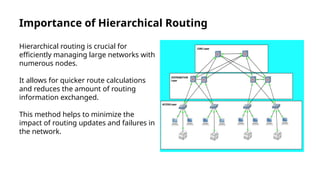
Importance of Hierarchical Routing
Hierarchical routing is crucial for
efficiently managing large networks with
numerous nodes.
It allows for quicker route calculations
and reduces the amount of routing
information exchanged.
This method helps to minimize the
impact of routing updates and failures in
the network.
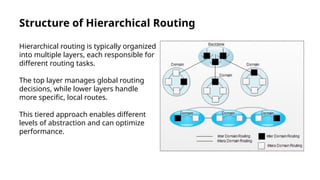
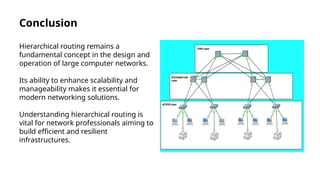
Structure of Hierarchical Routing
Hierarchical routing is typically organized
into multiple layers, each responsible for
different routing tasks.
The top layer manages global routing
decisions, while lower layers handle
more specific, local routes.
This tiered approach enables different
levels of abstraction and can optimize
performance.
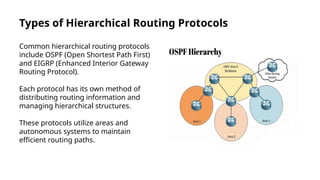
Types of Hierarchical Routing Protocols
Common hierarchical routing protocols
include OSPF (Open Shortest Path First)
and EIGRP (Enhanced Interior Gateway
Routing Protocol).
Each protocol has its own method of
distributing routing information and
managing hierarchical structures.
These protocols utilize areas and
autonomous systems to maintain
efficient routing paths.
Benefits of Hierarchical Routing
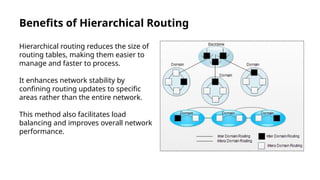
Hierarchical routing reduces the size of
routing tables, making them easier to
manage and faster to process.
It enhances network stability by
confining routing updates to specific
areas rather than the entire network.
This method also facilitates load
balancing and improves overall network
performance.
Challenges in Hierarchical Routing
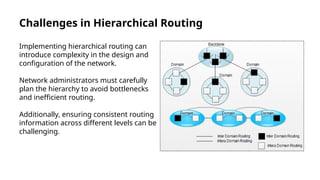
Implementing hierarchical routing can
introduce complexity in the design and
configuration of the network.
Network administrators must carefully
plan the hierarchy to avoid bottlenecks
and inefficient routing.
Additionally, ensuring consistent routing
information across different levels can be
challenging.
Applications of Hierarchical Routing
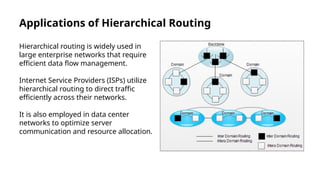
Hierarchical routing is widely used in
large enterprise networks that require
efficient data flow management.
Internet Service Providers (ISPs) utilize
hierarchical routing to direct traffic
efficiently across their networks.
It is also employed in data center
networks to optimize server
communication and resource allocation.
Case Study: OSPF in Hierarchical Routing
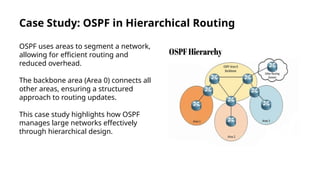
OSPF uses areas to segment a network,
allowing for efficient routing and
reduced overhead.
The backbone area (Area 0) connects all
other areas, ensuring a structured
approach to routing updates.
This case study highlights how OSPF
manages large networks effectively
through hierarchical design.
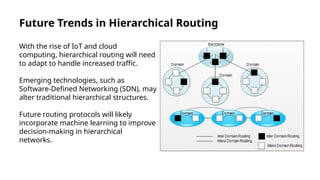
Future Trends in Hierarchical Routing
With the rise of IoT and cloud
computing, hierarchical routing will need
to adapt to handle increased traffic.
Emerging technologies, such as
Software-Defined Networking (SDN), may
alter traditional hierarchical structures.
Future routing protocols will likely
incorporate machine learning to improve
decision-making in hierarchical
networks.
Conclusion
Hierarchical routing remains a
fundamental concept in the design and
operation of large computer networks.
Its ability to enhance scalability and
manageability makes it essential for
modern networking solutions.
Understanding hierarchical routing is
vital for network professionals aiming to
build efficient and resilient
infrastructures.

Hierarchical Routing In Computer Networks.pptx

  • 1.
    Hierarchical Routing NAME :- BUMAMAHRSESH (237R5A7308) AIML-B
  • 2.
    Introduction to HierarchicalRouting Hierarchical routing is a method used to manage and organize routing within large-scale networks. It simplifies routing tables by dividing the network into smaller, manageable segments or regions. This structure enhances scalability and reduces the overhead associated with traditional flat routing.
  • 3.
    Importance of HierarchicalRouting Hierarchical routing is crucial for efficiently managing large networks with numerous nodes. It allows for quicker route calculations and reduces the amount of routing information exchanged. This method helps to minimize the impact of routing updates and failures in the network.
  • 4.
    Structure of HierarchicalRouting Hierarchical routing is typically organized into multiple layers, each responsible for different routing tasks. The top layer manages global routing decisions, while lower layers handle more specific, local routes. This tiered approach enables different levels of abstraction and can optimize performance.
  • 5.
    Types of HierarchicalRouting Protocols Common hierarchical routing protocols include OSPF (Open Shortest Path First) and EIGRP (Enhanced Interior Gateway Routing Protocol). Each protocol has its own method of distributing routing information and managing hierarchical structures. These protocols utilize areas and autonomous systems to maintain efficient routing paths.
  • 6.
    Benefits of HierarchicalRouting Hierarchical routing reduces the size of routing tables, making them easier to manage and faster to process. It enhances network stability by confining routing updates to specific areas rather than the entire network. This method also facilitates load balancing and improves overall network performance.
  • 7.
    Challenges in HierarchicalRouting Implementing hierarchical routing can introduce complexity in the design and configuration of the network. Network administrators must carefully plan the hierarchy to avoid bottlenecks and inefficient routing. Additionally, ensuring consistent routing information across different levels can be challenging.
  • 8.
    Applications of HierarchicalRouting Hierarchical routing is widely used in large enterprise networks that require efficient data flow management. Internet Service Providers (ISPs) utilize hierarchical routing to direct traffic efficiently across their networks. It is also employed in data center networks to optimize server communication and resource allocation.
  • 9.
    Case Study: OSPFin Hierarchical Routing OSPF uses areas to segment a network, allowing for efficient routing and reduced overhead. The backbone area (Area 0) connects all other areas, ensuring a structured approach to routing updates. This case study highlights how OSPF manages large networks effectively through hierarchical design.
  • 10.
    Future Trends inHierarchical Routing With the rise of IoT and cloud computing, hierarchical routing will need to adapt to handle increased traffic. Emerging technologies, such as Software-Defined Networking (SDN), may alter traditional hierarchical structures. Future routing protocols will likely incorporate machine learning to improve decision-making in hierarchical networks.
  • 11.
    Conclusion Hierarchical routing remainsa fundamental concept in the design and operation of large computer networks. Its ability to enhance scalability and manageability makes it essential for modern networking solutions. Understanding hierarchical routing is vital for network professionals aiming to build efficient and resilient infrastructures.

Editor's Notes

  • #2 Image source: http://ecomputernotes.com/computernetworkingnotes/routing/hierarchical-routing
  • #3 Image source: https://www.geeksforgeeks.org/hierarchical-network-design/
  • #4 Image source: http://ecomputernotes.com/computernetworkingnotes/routing/hierarchical-routing
  • #5 Image source: http://orhanergun.net/ospf-redistribution
  • #6 Image source: http://ecomputernotes.com/computernetworkingnotes/routing/hierarchical-routing
  • #7 Image source: http://ecomputernotes.com/computernetworkingnotes/routing/hierarchical-routing
  • #8 Image source: http://ecomputernotes.com/computernetworkingnotes/routing/hierarchical-routing
  • #9 Image source: http://orhanergun.net/ospf-redistribution
  • #10 Image source: http://ecomputernotes.com/computernetworkingnotes/routing/hierarchical-routing
  • #11 Image source: https://www.geeksforgeeks.org/hierarchical-network-design/