Chapter 16
Other Wireless Networks
- Asst. Prof. Meenakshi Paul
G. N. Khalsa College
Objective
16.1 WiMAX
16.1.1 Services
16.1.2 IEEE Project 802.16
16.1.3 Layers in Project 802.16
16.2 CELLULAR TELEPHONY
16.2.1 Operation
16.2.2 First Generation (1G)
16.2.3 Second Generation (2G)
16.2.4 Third Generation (3G)
16.2.5 Fourth Generation (4G)
16.3 SATELLITE NETWORKS
16.3.1 Operation
16.3.2 GEO Satellites
16.3.3 MEO Satellites
16.3.4 LEO Satellites
2
16.1.1 Services
• WiMAX stands for Worldwide Interoperability
for Microwave Access
• It provides the “last mile” broadband wireless
access.
• WiMAX provides two types of services to
subscribers:
▫ Fixed
▫ Mobile
3
16.1.1.1 Fixed WiMAX
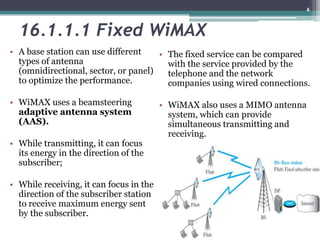
• A base station can use different
types of antenna
(omnidirectional, sector, or panel)
to optimize the performance.
• WiMAX uses a beamsteering
adaptive antenna system
(AAS).
• While transmitting, it can focus
its energy in the direction of the
subscriber;
• While receiving, it can focus in the
direction of the subscriber station
to receive maximum energy sent
by the subscriber.
• The fixed service can be compared
with the service provided by the
telephone and the network
companies using wired connections.
• WiMAX also uses a MIMO antenna
system, which can provide
simultaneous transmitting and
receiving.
4
16.1.1.2 Mobile WiMAX
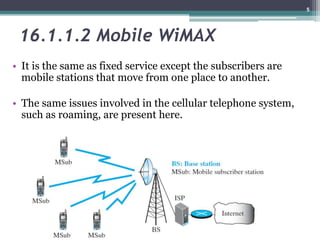
• It is the same as fixed service except the subscribers are
mobile stations that move from one place to another.
• The same issues involved in the cellular telephone system,
such as roaming, are present here.
5
16.1.2 IEEE Project 802.16
• WiMAX is the result of the IEEE 802.16 project, which
was an effort to standardize the proprietary broadband
wireless system in 2002.
• The standard is referred to as wireless local loop
• A later revision of IEEE 802.16 created two new standards
called
▫ IEEE 802.16d, which concentrates on the fixed WiMAX
▫ IEEE 802.16e, which defines the mobile WiMAX.
• The two new standards do not change the main idea behind
the original 802.16, but concentrate on the nature of two services
6
Difference between 802.16 and 802.11
IEEE 802.11 IEEE 802.16
• 802.11 is a standard for a
wireless LAN
• Range upto 100m
• 802.11 defines a
connectionless communication
• Indoor Coverage
• Hundred of users
• 54Mbps max speed
• 802.16 is a standard for a
wireless WAN (or MAN).
• Range upto 40km
• 802.16 defines a connection
oriented service.
• Outdoor coverage
• Thousand of users
• 10-100Mbps max speed
7
16.2 CELLULAR TELEPHONY
• Cellular telephony is designed to provide communications between
▫ Two moving units, called mobile stations (MSs), or
▫ between one mobile unit and one stationary unit, often called a
land unit.
• A service provider must be able to locate and track a caller, assign a
channel to the call, and transfer the channel from base station to base
station as the caller moves out of range.
• To make this tracking possible, each cellular service area is divided into
small regions called cells.
8
16.2 CELLULAR TELEPHONY contd..
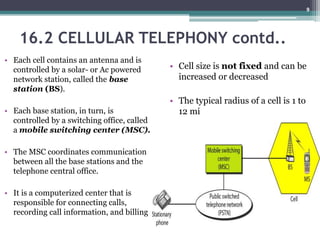
• Each cell contains an antenna and is
controlled by a solar- or Ac powered
network station, called the base
station (BS).
• Each base station, in turn, is
controlled by a switching office, called
a mobile switching center (MSC).
• The MSC coordinates communication
between all the base stations and the
telephone central office.
• It is a computerized center that is
responsible for connecting calls,
recording call information, and billing
• Cell size is not fixed and can be
increased or decreased
• The typical radius of a cell is 1 to
12 mi
9
16.2.2 First Generation (1G)
• Cellular telephony is now in its fourth generation.
• The first generation was designed for voice communication using analog signals.
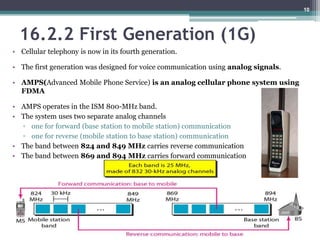
• AMPS(Advanced Mobile Phone Service) is an analog cellular phone system using
FDMA
• AMPS operates in the ISM 800-MHz band.
• The system uses two separate analog channels
▫ one for forward (base station to mobile station) communication
▫ one for reverse (mobile station to base station) communication
• The band between 824 and 849 MHz carries reverse communication
• The band between 869 and 894 MHz carries forward communication
10
16.2.3 Second Generation (2G)
• The second generation of wireless networks designed to
improve on analog with digital circuit-switched
solutions.
• It was commercially launched in 1991 as GSM standard in
Finland.
• As with 1G phones, 2G phones didn’t have any worldwide
standardizations.
• 2G systems were also known as personal communications
services (PCM).
11
Advantages of 2G over 1G
• It allows voice signals to be digitized and compressed. So, they
are more efficient on frequency spectrum than 1G.
• They introduced data services for mobile in form of SMS text
messaging.
• Data and voice signals are digitally encrypted. So, security
against eavesdropping and fraud increased manifold.
• Digital signals consume less battery power. And so mobile sets
are much more energy efficient than their 1G counterparts.
12
16.13
Second-generation cellular phone systems
Second-generation cellular phone
systems
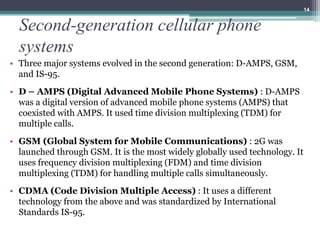
• Three major systems evolved in the second generation: D-AMPS, GSM,
and IS-95.
• D – AMPS (Digital Advanced Mobile Phone Systems) : D-AMPS
was a digital version of advanced mobile phone systems (AMPS) that
coexisted with AMPS. It used time division multiplexing (TDM) for
multiple calls.
• GSM (Global System for Mobile Communications) : 2G was
launched through GSM. It is the most widely globally used technology. It
uses frequency division multiplexing (FDM) and time division
multiplexing (TDM) for handling multiple calls simultaneously.
• CDMA (Code Division Multiple Access) : It uses a different
technology from the above and was standardized by International
Standards IS-95.
14
16.2.4 Third Generation (3G)
• The third generation of cellular telephony refers to a combination of technologies
that provide both digital data and voice communication.
• 3G systems comply with the International Mobile Telecommunications-2000
(IMT-2000) specifications by the International Telecommunication Union (ITU).
• The first 3G services were available in 1998.
• It provides high speed transmission having data transfer rate more than 0.2Mbps.
• Global roaming services are available for both voice and data.
• It offers advanced multimedia access like playing music, viewing videos,
television services etc.
• It provides access to all advanced Internet services, for example surfing
webpages with audio and video.
15
Specifications for 3G
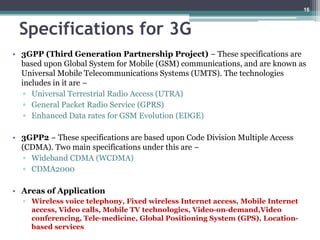
• 3GPP (Third Generation Partnership Project) − These specifications are
based upon Global System for Mobile (GSM) communications, and are known as
Universal Mobile Telecommunications Systems (UMTS). The technologies
includes in it are −
▫ Universal Terrestrial Radio Access (UTRA)
▫ General Packet Radio Service (GPRS)
▫ Enhanced Data rates for GSM Evolution (EDGE)
• 3GPP2 − These specifications are based upon Code Division Multiple Access
(CDMA). Two main specifications under this are −
▫ Wideband CDMA (WCDMA)
▫ CDMA2000
• Areas of Application
▫ Wireless voice telephony, Fixed wireless Internet access, Mobile Internet
access, Video calls, Mobile TV technologies, Video-on-demand,Video
conferencing, Tele-medicine, Global Positioning System (GPS), Location-
based services
16
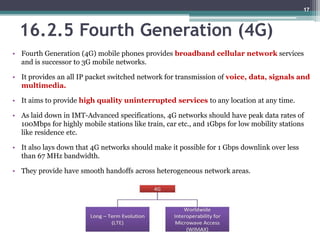
16.2.5 Fourth Generation (4G)
• Fourth Generation (4G) mobile phones provides broadband cellular network services
and is successor to 3G mobile networks.
• It provides an all IP packet switched network for transmission of voice, data, signals and
multimedia.
• It aims to provide high quality uninterrupted services to any location at any time.
• As laid down in IMT-Advanced specifications, 4G networks should have peak data rates of
100Mbps for highly mobile stations like train, car etc., and 1Gbps for low mobility stations
like residence etc.
• It also lays down that 4G networks should make it possible for 1 Gbps downlink over less
than 67 MHz bandwidth.
• They provide have smooth handoffs across heterogeneous network areas.
17
Categories
• Long – Term Evolution (LTE)
▫ Long – term evolution or LTE is an extension of the 3G technology.
▫ It is a standard for high-speed mobile communication, based upon
GSM/EDGE and UMTS/HSPA technologies.
▫ The peak data rate for download is 100 Mbps and upload is 50 Mbps.
▫ The LTE Advanced meets the specifications of IMT-Advanced standard
for 4G technology.
▫ Its peak data rates are 1000 Mbps for downlink and 500 Mbps for
uplink.
18
• Worldwide Interoperability for Microwave
Access (WIMAX)
▫ WiMAX is a mobile wireless broadband access (MWBA)
standard is sometimes branded 4G.
▫ It offers peak data rates of 128 Mbps for downlink and
56 Mbps for uplink over 20 MHz wide channels.
▫ The latest version of WIMAX is not compatible to the
earlier versions and instead is compatible with LTE.
19
Application Areas of 4G
• Advanced mobile web access
• IP telephony
• High-resolution high-speed gaming services
• Streamed multimedia and data
• High-definition mobile TV
• Video conferencing
• 3D television
20
16.3 SATELLITE NETWORKS
• A satellite network is a combination of nodes, some of
which are satellites, that provides communication from one
point on the Earth to another.
• A node in the network can be a satellite, an Earth station,
or an end-user terminal or telephone.
• Satellite networks are like cellular networks in that they
divide the planet into cells.
• Satellites can provide transmission capability to and from
any location on Earth,
21
16.3.1 Operation
• Let us first discuss some general issues related to the
operation of satellites.
▫ Orbits
▫ Footprint
▫ Frequency Bands for Satellite Communication
22
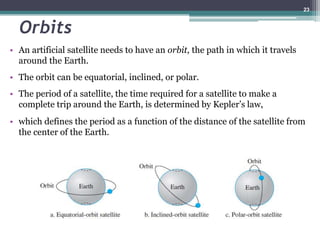
Orbits
• An artificial satellite needs to have an orbit, the path in which it travels
around the Earth.
• The orbit can be equatorial, inclined, or polar.
• The period of a satellite, the time required for a satellite to make a
complete trip around the Earth, is determined by Kepler’s law,
• which defines the period as a function of the distance of the satellite from
the center of the Earth.
23
Footprint
• Satellites process microwaves with bidirectional antennas (line-of-
sight).
• Therefore, the signal from a satellite is normally aimed at a specific
area called the footprint.
• The signal power at the center of the footprint is maximum.
• The power decreases as we move out from the footprint center.
• The boundary of the footprint is the location where the power level is
at a predefined threshold.
24
Frequency Bands for Satellite Communication
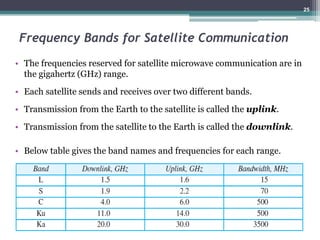
• The frequencies reserved for satellite microwave communication are in
the gigahertz (GHz) range.
• Each satellite sends and receives over two different bands.
• Transmission from the Earth to the satellite is called the uplink.
• Transmission from the satellite to the Earth is called the downlink.
• Below table gives the band names and frequencies for each range.
25
Three Categories of Satellites
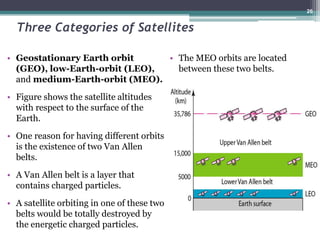
• Geostationary Earth orbit
(GEO), low-Earth-orbit (LEO),
and medium-Earth-orbit (MEO).
• Figure shows the satellite altitudes
with respect to the surface of the
Earth.
• One reason for having different orbits
is the existence of two Van Allen
belts.
• A Van Allen belt is a layer that
contains charged particles.
• A satellite orbiting in one of these two
belts would be totally destroyed by
the energetic charged particles.
• The MEO orbits are located
between these two belts.
26
Earth
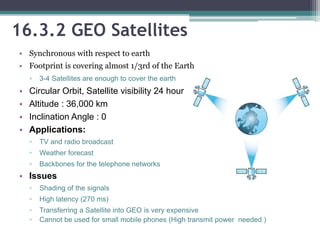
• Synchronous with respect to earth
• Footprint is covering almost 1/3rd of the Earth
▫ 3-4 Satellites are enough to cover the earth
• Circular Orbit, Satellite visibility 24 hour
• Altitude : 36,000 km
• Inclination Angle : 0
• Applications:
▫ TV and radio broadcast
▫ Weather forecast
▫ Backbones for the telephone networks
• Issues
▫ Shading of the signals
▫ High latency (270 ms)
▫ Transferring a Satellite into GEO is very expensive
▫ Cannot be used for small mobile phones (High transmit power needed )
16.3.2 GEO Satellites
16.3.3 MEO Satellites
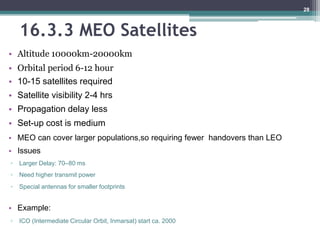
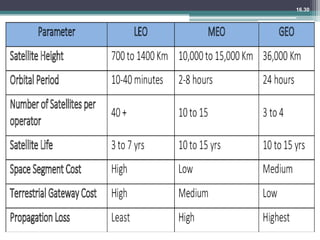
• Altitude 10000km-20000km
• Orbital period 6-12 hour
• 10-15 satellites required
• Satellite visibility 2-4 hrs
• Propagation delay less
• Set-up cost is medium
• MEO can cover larger populations,so requiring fewer handovers than LEO
• Issues
◦ Larger Delay: 70–80 ms
◦ Need higher transmit power
◦ Special antennas for smaller footprints
• Example:
◦ ICO (Intermediate Circular Orbit, Inmarsat) start ca. 2000
28
16.3.4 LEO Satellites
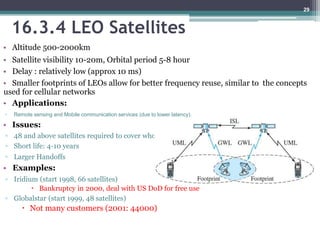
• Altitude 500-2000km
• Satellite visibility 10-20m, Orbital period 5-8 hour
• Delay : relatively low (approx 10 ms)
• Smaller footprints of LEOs allow for better frequency reuse, similar to the concepts
used for cellular networks
• Applications:
◦ Remote sensing and Mobile communication services (due to lower latency).
• Issues:
◦ 48 and above satellites required to cover whole earth
◦ Short life: 4-10 years
◦ Larger Handoffs
• Examples:
◦ Iridium (start 1998, 66 satellites)
 Bankruptcy in 2000, deal with US DoD for free use
◦ Globalstar (start 1999, 48 satellites)
 Not many customers (2001: 44000)
29
16.30

Other Wireless Networks

  • 1.
    Chapter 16 Other WirelessNetworks - Asst. Prof. Meenakshi Paul G. N. Khalsa College
  • 2.
    Objective 16.1 WiMAX 16.1.1 Services 16.1.2IEEE Project 802.16 16.1.3 Layers in Project 802.16 16.2 CELLULAR TELEPHONY 16.2.1 Operation 16.2.2 First Generation (1G) 16.2.3 Second Generation (2G) 16.2.4 Third Generation (3G) 16.2.5 Fourth Generation (4G) 16.3 SATELLITE NETWORKS 16.3.1 Operation 16.3.2 GEO Satellites 16.3.3 MEO Satellites 16.3.4 LEO Satellites 2
  • 3.
    16.1.1 Services • WiMAXstands for Worldwide Interoperability for Microwave Access • It provides the “last mile” broadband wireless access. • WiMAX provides two types of services to subscribers: ▫ Fixed ▫ Mobile 3
  • 4.
    16.1.1.1 Fixed WiMAX •A base station can use different types of antenna (omnidirectional, sector, or panel) to optimize the performance. • WiMAX uses a beamsteering adaptive antenna system (AAS). • While transmitting, it can focus its energy in the direction of the subscriber; • While receiving, it can focus in the direction of the subscriber station to receive maximum energy sent by the subscriber. • The fixed service can be compared with the service provided by the telephone and the network companies using wired connections. • WiMAX also uses a MIMO antenna system, which can provide simultaneous transmitting and receiving. 4
  • 5.
    16.1.1.2 Mobile WiMAX •It is the same as fixed service except the subscribers are mobile stations that move from one place to another. • The same issues involved in the cellular telephone system, such as roaming, are present here. 5
  • 6.
    16.1.2 IEEE Project802.16 • WiMAX is the result of the IEEE 802.16 project, which was an effort to standardize the proprietary broadband wireless system in 2002. • The standard is referred to as wireless local loop • A later revision of IEEE 802.16 created two new standards called ▫ IEEE 802.16d, which concentrates on the fixed WiMAX ▫ IEEE 802.16e, which defines the mobile WiMAX. • The two new standards do not change the main idea behind the original 802.16, but concentrate on the nature of two services 6
  • 7.
    Difference between 802.16and 802.11 IEEE 802.11 IEEE 802.16 • 802.11 is a standard for a wireless LAN • Range upto 100m • 802.11 defines a connectionless communication • Indoor Coverage • Hundred of users • 54Mbps max speed • 802.16 is a standard for a wireless WAN (or MAN). • Range upto 40km • 802.16 defines a connection oriented service. • Outdoor coverage • Thousand of users • 10-100Mbps max speed 7
  • 8.
    16.2 CELLULAR TELEPHONY •Cellular telephony is designed to provide communications between ▫ Two moving units, called mobile stations (MSs), or ▫ between one mobile unit and one stationary unit, often called a land unit. • A service provider must be able to locate and track a caller, assign a channel to the call, and transfer the channel from base station to base station as the caller moves out of range. • To make this tracking possible, each cellular service area is divided into small regions called cells. 8
  • 9.
    16.2 CELLULAR TELEPHONYcontd.. • Each cell contains an antenna and is controlled by a solar- or Ac powered network station, called the base station (BS). • Each base station, in turn, is controlled by a switching office, called a mobile switching center (MSC). • The MSC coordinates communication between all the base stations and the telephone central office. • It is a computerized center that is responsible for connecting calls, recording call information, and billing • Cell size is not fixed and can be increased or decreased • The typical radius of a cell is 1 to 12 mi 9
  • 10.
    16.2.2 First Generation(1G) • Cellular telephony is now in its fourth generation. • The first generation was designed for voice communication using analog signals. • AMPS(Advanced Mobile Phone Service) is an analog cellular phone system using FDMA • AMPS operates in the ISM 800-MHz band. • The system uses two separate analog channels ▫ one for forward (base station to mobile station) communication ▫ one for reverse (mobile station to base station) communication • The band between 824 and 849 MHz carries reverse communication • The band between 869 and 894 MHz carries forward communication 10
  • 11.
    16.2.3 Second Generation(2G) • The second generation of wireless networks designed to improve on analog with digital circuit-switched solutions. • It was commercially launched in 1991 as GSM standard in Finland. • As with 1G phones, 2G phones didn’t have any worldwide standardizations. • 2G systems were also known as personal communications services (PCM). 11
  • 12.
    Advantages of 2Gover 1G • It allows voice signals to be digitized and compressed. So, they are more efficient on frequency spectrum than 1G. • They introduced data services for mobile in form of SMS text messaging. • Data and voice signals are digitally encrypted. So, security against eavesdropping and fraud increased manifold. • Digital signals consume less battery power. And so mobile sets are much more energy efficient than their 1G counterparts. 12
  • 13.
  • 14.
    Second-generation cellular phone systems •Three major systems evolved in the second generation: D-AMPS, GSM, and IS-95. • D – AMPS (Digital Advanced Mobile Phone Systems) : D-AMPS was a digital version of advanced mobile phone systems (AMPS) that coexisted with AMPS. It used time division multiplexing (TDM) for multiple calls. • GSM (Global System for Mobile Communications) : 2G was launched through GSM. It is the most widely globally used technology. It uses frequency division multiplexing (FDM) and time division multiplexing (TDM) for handling multiple calls simultaneously. • CDMA (Code Division Multiple Access) : It uses a different technology from the above and was standardized by International Standards IS-95. 14
  • 15.
    16.2.4 Third Generation(3G) • The third generation of cellular telephony refers to a combination of technologies that provide both digital data and voice communication. • 3G systems comply with the International Mobile Telecommunications-2000 (IMT-2000) specifications by the International Telecommunication Union (ITU). • The first 3G services were available in 1998. • It provides high speed transmission having data transfer rate more than 0.2Mbps. • Global roaming services are available for both voice and data. • It offers advanced multimedia access like playing music, viewing videos, television services etc. • It provides access to all advanced Internet services, for example surfing webpages with audio and video. 15
  • 16.
    Specifications for 3G •3GPP (Third Generation Partnership Project) − These specifications are based upon Global System for Mobile (GSM) communications, and are known as Universal Mobile Telecommunications Systems (UMTS). The technologies includes in it are − ▫ Universal Terrestrial Radio Access (UTRA) ▫ General Packet Radio Service (GPRS) ▫ Enhanced Data rates for GSM Evolution (EDGE) • 3GPP2 − These specifications are based upon Code Division Multiple Access (CDMA). Two main specifications under this are − ▫ Wideband CDMA (WCDMA) ▫ CDMA2000 • Areas of Application ▫ Wireless voice telephony, Fixed wireless Internet access, Mobile Internet access, Video calls, Mobile TV technologies, Video-on-demand,Video conferencing, Tele-medicine, Global Positioning System (GPS), Location- based services 16
  • 17.
    16.2.5 Fourth Generation(4G) • Fourth Generation (4G) mobile phones provides broadband cellular network services and is successor to 3G mobile networks. • It provides an all IP packet switched network for transmission of voice, data, signals and multimedia. • It aims to provide high quality uninterrupted services to any location at any time. • As laid down in IMT-Advanced specifications, 4G networks should have peak data rates of 100Mbps for highly mobile stations like train, car etc., and 1Gbps for low mobility stations like residence etc. • It also lays down that 4G networks should make it possible for 1 Gbps downlink over less than 67 MHz bandwidth. • They provide have smooth handoffs across heterogeneous network areas. 17
  • 18.
    Categories • Long –Term Evolution (LTE) ▫ Long – term evolution or LTE is an extension of the 3G technology. ▫ It is a standard for high-speed mobile communication, based upon GSM/EDGE and UMTS/HSPA technologies. ▫ The peak data rate for download is 100 Mbps and upload is 50 Mbps. ▫ The LTE Advanced meets the specifications of IMT-Advanced standard for 4G technology. ▫ Its peak data rates are 1000 Mbps for downlink and 500 Mbps for uplink. 18
  • 19.
    • Worldwide Interoperabilityfor Microwave Access (WIMAX) ▫ WiMAX is a mobile wireless broadband access (MWBA) standard is sometimes branded 4G. ▫ It offers peak data rates of 128 Mbps for downlink and 56 Mbps for uplink over 20 MHz wide channels. ▫ The latest version of WIMAX is not compatible to the earlier versions and instead is compatible with LTE. 19
  • 20.
    Application Areas of4G • Advanced mobile web access • IP telephony • High-resolution high-speed gaming services • Streamed multimedia and data • High-definition mobile TV • Video conferencing • 3D television 20
  • 21.
    16.3 SATELLITE NETWORKS •A satellite network is a combination of nodes, some of which are satellites, that provides communication from one point on the Earth to another. • A node in the network can be a satellite, an Earth station, or an end-user terminal or telephone. • Satellite networks are like cellular networks in that they divide the planet into cells. • Satellites can provide transmission capability to and from any location on Earth, 21
  • 22.
    16.3.1 Operation • Letus first discuss some general issues related to the operation of satellites. ▫ Orbits ▫ Footprint ▫ Frequency Bands for Satellite Communication 22
  • 23.
    Orbits • An artificialsatellite needs to have an orbit, the path in which it travels around the Earth. • The orbit can be equatorial, inclined, or polar. • The period of a satellite, the time required for a satellite to make a complete trip around the Earth, is determined by Kepler’s law, • which defines the period as a function of the distance of the satellite from the center of the Earth. 23
  • 24.
    Footprint • Satellites processmicrowaves with bidirectional antennas (line-of- sight). • Therefore, the signal from a satellite is normally aimed at a specific area called the footprint. • The signal power at the center of the footprint is maximum. • The power decreases as we move out from the footprint center. • The boundary of the footprint is the location where the power level is at a predefined threshold. 24
  • 25.
    Frequency Bands forSatellite Communication • The frequencies reserved for satellite microwave communication are in the gigahertz (GHz) range. • Each satellite sends and receives over two different bands. • Transmission from the Earth to the satellite is called the uplink. • Transmission from the satellite to the Earth is called the downlink. • Below table gives the band names and frequencies for each range. 25
  • 26.
    Three Categories ofSatellites • Geostationary Earth orbit (GEO), low-Earth-orbit (LEO), and medium-Earth-orbit (MEO). • Figure shows the satellite altitudes with respect to the surface of the Earth. • One reason for having different orbits is the existence of two Van Allen belts. • A Van Allen belt is a layer that contains charged particles. • A satellite orbiting in one of these two belts would be totally destroyed by the energetic charged particles. • The MEO orbits are located between these two belts. 26 Earth
  • 27.
    • Synchronous withrespect to earth • Footprint is covering almost 1/3rd of the Earth ▫ 3-4 Satellites are enough to cover the earth • Circular Orbit, Satellite visibility 24 hour • Altitude : 36,000 km • Inclination Angle : 0 • Applications: ▫ TV and radio broadcast ▫ Weather forecast ▫ Backbones for the telephone networks • Issues ▫ Shading of the signals ▫ High latency (270 ms) ▫ Transferring a Satellite into GEO is very expensive ▫ Cannot be used for small mobile phones (High transmit power needed ) 16.3.2 GEO Satellites
  • 28.
    16.3.3 MEO Satellites •Altitude 10000km-20000km • Orbital period 6-12 hour • 10-15 satellites required • Satellite visibility 2-4 hrs • Propagation delay less • Set-up cost is medium • MEO can cover larger populations,so requiring fewer handovers than LEO • Issues ◦ Larger Delay: 70–80 ms ◦ Need higher transmit power ◦ Special antennas for smaller footprints • Example: ◦ ICO (Intermediate Circular Orbit, Inmarsat) start ca. 2000 28
  • 29.
    16.3.4 LEO Satellites •Altitude 500-2000km • Satellite visibility 10-20m, Orbital period 5-8 hour • Delay : relatively low (approx 10 ms) • Smaller footprints of LEOs allow for better frequency reuse, similar to the concepts used for cellular networks • Applications: ◦ Remote sensing and Mobile communication services (due to lower latency). • Issues: ◦ 48 and above satellites required to cover whole earth ◦ Short life: 4-10 years ◦ Larger Handoffs • Examples: ◦ Iridium (start 1998, 66 satellites)  Bankruptcy in 2000, deal with US DoD for free use ◦ Globalstar (start 1999, 48 satellites)  Not many customers (2001: 44000) 29
  • 30.