CAPNOGRAPHY
       DR. PRIYANKA
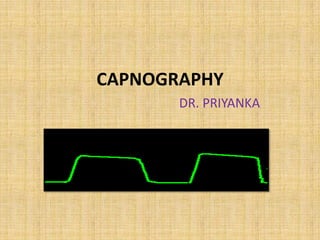
CAPNOGRAPHY
• Measurment of CO2 in respiratory gases.
• Integral part of anesthesia monitoring.
• Luft 1943 developed it from knowledge that
  co2 is absorbs infrared radiation of particular
  wavelength.
• Collier – value of rapid IR CO2 analysis
• Value of end tidal sample – Ramwell
• 1978 Holland – first country to adopt
  capnography as standard monitoring in
  anesthesia
GUIDELINES
• ASA included capnography in its standrads for
  basic monitoring.

• ISA designated it as ‘desirable’ monitor in
  anesthesia.

• ISA – “Anesthesia monitoring standards
  recommended in India” for basic monitering
  from 1999.
Terminology
• Capnography: display of instanteneous CO2
  conc. Vs time (time capnogran) or expired
  volume (volume capnogram)

• Capnograph: Machine that generates
  waveform.

• Capnogram: Actual waveform
Terminology
• Capnometry: Measurment & numerical
  display

• Capnometer: Device that performs the
  measurement & display readings

• Breath to breath waveform needs to be
  displayed for continuous monitoring
Methods used for measurement
• Raman spectometry – scatering

• Gas sample is illuminated by high intensity
  monochromatic Argon laser beam.
• Light is absorbed by molecules which is then
  excited to unstable vibrational & rotational
  energy states, called as ‘Raman scattering’

• Used to identify molecules in gas phase
  including CO2 & inhalational agents
Methods used for measurement
• Mass spectrometry

• Photoacoustic gas measurement

• Colorimetric method
Types of capnograph
SIDE STREAM     MAIN STREAM
TYPES OF CAPNOGRAPH
         SIDE STREAM                         MAIN STREAM
•   CO2 sensor located in main       •   Cuvette containing CO2 sensor
    monitor                              inserted between breathing
•   Tiny pump aspirates gas from         circuit & ETT.
    patients airway                  •   IR rays detector
•   Transferred by 6 ft long         •   No need of sampling &
    capillary tube in to main unit       scavenging.
•   Rate 50 – 200 ml/min             •   To prevent condensation of
•   Contamination of FGF                 water vapour, heated to 40°C
•   Water trap                       •   Skin burns
•   Gas should be retrieved &        •   Kinking of tube
    reinjected                       •   False reading if not clean
•   Spontaneous respiration          •   Better in children
CALIBRATION
• Capnographs must be calibrated periodically
• At least daily acc to manufacturers for main
  stream
• Automatic Zeroing – side stream moniter
• Main stream calibration sample cell sealed
  with mixtures of CO2 & N2
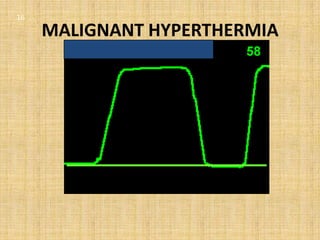
• Range is up to 100mmHg which is useful in
  rare cases like malignant hyperthermia,
  hypoventilation.
NORMAL CAPNOGRAM
NORMAL TIME CAPNOGRAM


   I II   III   IV
PHYSIOLOGY
•   EXPIRATION
•   PHASE I – Dead space gas exaled, no CO2
•   PHASE II – Mixing of alveolar gas with dead space
•   PHASE III - Alveolar Plateau, CO2 reach
•   INSPIRATION
•   PHASE IV – Inspiration starts CO2 becomes zero
•    α angle – PHASE II & PHASE III 1OO° V/Q
•    β angle – PHASE III & PHASE IV 90° REBREATHING
NORMAL VOLUME CAPNOGRAM
VOLUME CAPNOGRAPHY
VOLUME CAPNOGRM
TYPE OF CAPNOGRAMS
TIME CAPNOGRAM   VOLUME CAPNOGRAM
CLINICAL USES
• NORMAL VALUE: 35 – 45 mmHg
• Metabolism
• Increased with increase in metabolism
• Increased temp, shivering, convulsions,excess
  catecholamine, blood & bicabonate
  administration, release of torniquet with
  reperfusion, glucose containing iv fluids
• Laproscopy, thoracoscopy.
How to interpret capnogram?
• Respiratory Rate (speed of paper to be
  known)

• Height of capnogram ( value of max exp &
  inspiratory conc of CO2)

• Shape ( altered in abnormal states)

• Baseline of capnogram (rebreathing)
13
     HYPERMETABOLISM
16

     MALIGNANT HYPERTHERMIA
HYPOTHERMIA
5
    REBREATHING
4
    REBREATHING
1
    REBREATHING
TORNIQUET RELEASE
CIRCULATION
• Reduced with reduction in cardiac output if
  ventilation is normal.
• Reduced blood flow to lungs reduces as in
  thoracic surgery, manipulation to heart.
• Rapid reduction in ETCO2 in absence of
  changes in BP, HR, CVP indicates pulmonary
  embolism.
• Large embolism - reduce CO further reduction
  in CO2
Cardiac output relation
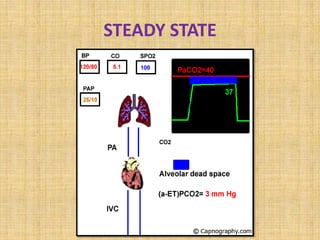
STEADY STATE
AIR EMBOLISM
SMALL PULMONARY EMBOLISM
18
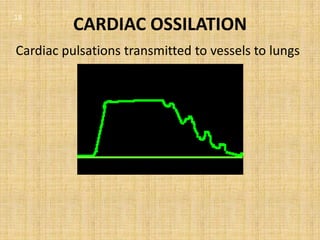
          CARDIAC OSSILATION
Cardiac pulsations transmitted to vessels to lungs
RESPIRATORY
•   Intubation verification
•   Blind nasal intubation
•   Awake fiberoptic intubation
•   Cricothyroidectomy
•   Jet ventilation
•   Double lumen tube
•   Monitoring of respiratory rate
•   Partial airway obstruction
HYPOVENTILATION

Gradual increase in CO2 with 0 baseline
3              BRONCHOSPASM
    Increased α angle, obstruction to expiration
OESOPHAGEAL INTUBATION
10
     OESOPHAGEAL INTUBATION
      Carbonated products in stomach
DVT & PULMONARY EMBOLISM
KHYPHOSCOLIOSIS
Anesthesia
•   Disconnection
•   Partial paralysis
•   Minute ventilation
•   Circuit leak
•   Total occlusion
•   In partial rebreathing circuit & low flow
    anesthesia
11
     DISCONNECTION
     Sudden fall to zero
6
              CURARE CLEFT
    cleft in phase III due to spontaneous breath
SPONTANEOUS BREATHS IN BETWEEN
Shape change of spontaneous & mechanical
ventilation
ENDOBRONCHIAL TUBE
INSPIRATORY VALVE NOT CLOSED
EXPIRTORY VALVE DYSFUNCTION
• Expiratory valve stuck
• Increased inspiratory co2
PROMBLEMS IN SAMPLE LINE
LOW SAMPLING RATE   CONTAMINATION BY
                    FGF
AIR DILUTION FGF
LEAK IN SAMPLE LINE WITH IPPV
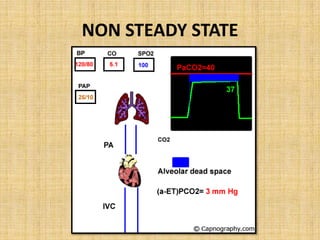
RELATION TO PaCO2
NON STEADY STATE
LMA & ETT
TAKE HOME MESSAGES
• Capnography included as standard of basic
  monitoring.
• Side stream & main stream advantages &
  disadvantages.
• Helpful in monitoring of respiratory rate, ETCO2,
  rebreathing, prediction of PaCO2
• Shapes of capnogram help in diagnosis of
  abnormal conditions.
• Must be calibrated periodically.
• Must be cleaned or disposed to prevent cross
  infection.
THANK YOU

Capnography

  • 1.
    CAPNOGRAPHY DR. PRIYANKA
  • 2.
    CAPNOGRAPHY • Measurment ofCO2 in respiratory gases. • Integral part of anesthesia monitoring. • Luft 1943 developed it from knowledge that co2 is absorbs infrared radiation of particular wavelength. • Collier – value of rapid IR CO2 analysis • Value of end tidal sample – Ramwell • 1978 Holland – first country to adopt capnography as standard monitoring in anesthesia
  • 3.
    GUIDELINES • ASA includedcapnography in its standrads for basic monitoring. • ISA designated it as ‘desirable’ monitor in anesthesia. • ISA – “Anesthesia monitoring standards recommended in India” for basic monitering from 1999.
  • 4.
    Terminology • Capnography: displayof instanteneous CO2 conc. Vs time (time capnogran) or expired volume (volume capnogram) • Capnograph: Machine that generates waveform. • Capnogram: Actual waveform
  • 5.
    Terminology • Capnometry: Measurment& numerical display • Capnometer: Device that performs the measurement & display readings • Breath to breath waveform needs to be displayed for continuous monitoring
  • 6.
    Methods used formeasurement • Raman spectometry – scatering • Gas sample is illuminated by high intensity monochromatic Argon laser beam. • Light is absorbed by molecules which is then excited to unstable vibrational & rotational energy states, called as ‘Raman scattering’ • Used to identify molecules in gas phase including CO2 & inhalational agents
  • 7.
    Methods used formeasurement • Mass spectrometry • Photoacoustic gas measurement • Colorimetric method
  • 8.
    Types of capnograph SIDESTREAM MAIN STREAM
  • 9.
    TYPES OF CAPNOGRAPH SIDE STREAM MAIN STREAM • CO2 sensor located in main • Cuvette containing CO2 sensor monitor inserted between breathing • Tiny pump aspirates gas from circuit & ETT. patients airway • IR rays detector • Transferred by 6 ft long • No need of sampling & capillary tube in to main unit scavenging. • Rate 50 – 200 ml/min • To prevent condensation of • Contamination of FGF water vapour, heated to 40°C • Water trap • Skin burns • Gas should be retrieved & • Kinking of tube reinjected • False reading if not clean • Spontaneous respiration • Better in children
  • 11.
    CALIBRATION • Capnographs mustbe calibrated periodically • At least daily acc to manufacturers for main stream • Automatic Zeroing – side stream moniter • Main stream calibration sample cell sealed with mixtures of CO2 & N2 • Range is up to 100mmHg which is useful in rare cases like malignant hyperthermia, hypoventilation.
  • 12.
  • 13.
  • 14.
    PHYSIOLOGY • EXPIRATION • PHASE I – Dead space gas exaled, no CO2 • PHASE II – Mixing of alveolar gas with dead space • PHASE III - Alveolar Plateau, CO2 reach • INSPIRATION • PHASE IV – Inspiration starts CO2 becomes zero • α angle – PHASE II & PHASE III 1OO° V/Q • β angle – PHASE III & PHASE IV 90° REBREATHING
  • 15.
  • 16.
  • 17.
  • 18.
    TYPE OF CAPNOGRAMS TIMECAPNOGRAM VOLUME CAPNOGRAM
  • 19.
    CLINICAL USES • NORMALVALUE: 35 – 45 mmHg • Metabolism • Increased with increase in metabolism • Increased temp, shivering, convulsions,excess catecholamine, blood & bicabonate administration, release of torniquet with reperfusion, glucose containing iv fluids • Laproscopy, thoracoscopy.
  • 20.
    How to interpretcapnogram? • Respiratory Rate (speed of paper to be known) • Height of capnogram ( value of max exp & inspiratory conc of CO2) • Shape ( altered in abnormal states) • Baseline of capnogram (rebreathing)
  • 21.
    13 HYPERMETABOLISM
  • 22.
    16 MALIGNANT HYPERTHERMIA
  • 23.
  • 24.
    5 REBREATHING
  • 25.
    4 REBREATHING
  • 26.
    1 REBREATHING
  • 27.
  • 28.
    CIRCULATION • Reduced withreduction in cardiac output if ventilation is normal. • Reduced blood flow to lungs reduces as in thoracic surgery, manipulation to heart. • Rapid reduction in ETCO2 in absence of changes in BP, HR, CVP indicates pulmonary embolism. • Large embolism - reduce CO further reduction in CO2
  • 29.
  • 30.
  • 31.
  • 32.
  • 33.
    18 CARDIAC OSSILATION Cardiac pulsations transmitted to vessels to lungs
  • 34.
    RESPIRATORY • Intubation verification • Blind nasal intubation • Awake fiberoptic intubation • Cricothyroidectomy • Jet ventilation • Double lumen tube • Monitoring of respiratory rate • Partial airway obstruction
  • 35.
  • 36.
    3 BRONCHOSPASM Increased α angle, obstruction to expiration
  • 37.
  • 38.
    10 OESOPHAGEAL INTUBATION Carbonated products in stomach
  • 39.
  • 40.
  • 41.
    Anesthesia • Disconnection • Partial paralysis • Minute ventilation • Circuit leak • Total occlusion • In partial rebreathing circuit & low flow anesthesia
  • 42.
    11 DISCONNECTION Sudden fall to zero
  • 43.
    6 CURARE CLEFT cleft in phase III due to spontaneous breath
  • 44.
    SPONTANEOUS BREATHS INBETWEEN Shape change of spontaneous & mechanical ventilation
  • 45.
  • 46.
  • 47.
    EXPIRTORY VALVE DYSFUNCTION •Expiratory valve stuck • Increased inspiratory co2
  • 48.
    PROMBLEMS IN SAMPLELINE LOW SAMPLING RATE CONTAMINATION BY FGF
  • 49.
  • 50.
    LEAK IN SAMPLELINE WITH IPPV
  • 51.
  • 52.
  • 53.
  • 54.
    TAKE HOME MESSAGES •Capnography included as standard of basic monitoring. • Side stream & main stream advantages & disadvantages. • Helpful in monitoring of respiratory rate, ETCO2, rebreathing, prediction of PaCO2 • Shapes of capnogram help in diagnosis of abnormal conditions. • Must be calibrated periodically. • Must be cleaned or disposed to prevent cross infection.
  • 55.