Mechanical Ventilation – 4
Fakhir Raza Haidri
SIUT
Monitoring Respiratory
Mechanics
Acute Respiratory Distress
Syndrome
Monitoring Respiratory Mechanics
• Two-Component Model
• the resistive component
• the elastic component
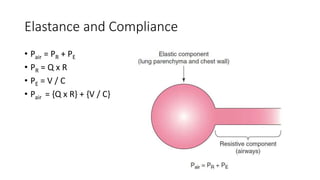
Elastance and Compliance
• Pair = PR + PE
• PR = Q x R
• PE = V / C
• Pair = {Q x R} + {V / C}
Peak Pressure
• It is the maximum pressure that is achieved in the respiratory cycle
• It is affected by the airway resistance, flow, volume and lung
parenchyma elastance (stuffiness)
• The more the airway resistance, flow, volume or elastance, the more
the Peak Pressure
• To know the pressure caused by elastance we must stop the
inspiration, it will nullify the effect of resistance and flow
Plateau Pressure
• It is the measure of lung parenchymal properties at a given volume
• Measure of maximum alveolar pressure during respiratory cycle
• Measured by inspiratory pause maneuver
• Higher with increased tidal volume and decreased respiratory system
compliance
Decreased peak pressure
• Decreased peak pressure during VCV
• In the setting of patient inspiratory efforts
• An endotracheal tube cuff leak
Reasons of cuff leak
• Cuff underinflation
• Cephalad migration of the endotracheal tube,
• Inadvertent intratracheal placement of a gastric tube
• A Defective endotracheal tube cuff
Compliance
• The compliance of a system is defined as the change in volume that
occurs per unit change in the pressure of the system
• Lung Compliance (C) = Change in Lung Volume (V) / Change in
Transpulmonary Pressure {Alveolar Pressure (Palv) – Pleural Pressure
(Ppl)}
Static Compliance
• It is the measure of compliance when the flow is hold (zero flow)
• It nullify the effect of resistance of airways and gives us the true
picture of state of lung parenchyma
• Cstat = Tidal Volume / {Pleatue – PEEP}
• Normal Static Compliance = 60 – 100ml /cm of H2O
• Decreased by Pneumonia, edema, atelectasis, pneumothorax,
restrictive lung disease
Dynamic Compliance
• Cdyn = Tidal Volume / {Peak Pressure – PEEP}
• Normal Static Compliance is 50-80ml / cm of H2O
• It is decreased in bronchospasm, mucus plugging, kinked tube or
decreased static compliance

Mechanical ventilation 4

  • 1.
    Mechanical Ventilation –4 Fakhir Raza Haidri SIUT
  • 2.
  • 3.
    Monitoring Respiratory Mechanics •Two-Component Model • the resistive component • the elastic component
  • 4.
    Elastance and Compliance •Pair = PR + PE • PR = Q x R • PE = V / C • Pair = {Q x R} + {V / C}
  • 5.
    Peak Pressure • Itis the maximum pressure that is achieved in the respiratory cycle • It is affected by the airway resistance, flow, volume and lung parenchyma elastance (stuffiness) • The more the airway resistance, flow, volume or elastance, the more the Peak Pressure • To know the pressure caused by elastance we must stop the inspiration, it will nullify the effect of resistance and flow
  • 6.
    Plateau Pressure • Itis the measure of lung parenchymal properties at a given volume • Measure of maximum alveolar pressure during respiratory cycle • Measured by inspiratory pause maneuver • Higher with increased tidal volume and decreased respiratory system compliance
  • 10.
    Decreased peak pressure •Decreased peak pressure during VCV • In the setting of patient inspiratory efforts • An endotracheal tube cuff leak Reasons of cuff leak • Cuff underinflation • Cephalad migration of the endotracheal tube, • Inadvertent intratracheal placement of a gastric tube • A Defective endotracheal tube cuff
  • 11.
    Compliance • The complianceof a system is defined as the change in volume that occurs per unit change in the pressure of the system • Lung Compliance (C) = Change in Lung Volume (V) / Change in Transpulmonary Pressure {Alveolar Pressure (Palv) – Pleural Pressure (Ppl)}
  • 12.
    Static Compliance • Itis the measure of compliance when the flow is hold (zero flow) • It nullify the effect of resistance of airways and gives us the true picture of state of lung parenchyma • Cstat = Tidal Volume / {Pleatue – PEEP} • Normal Static Compliance = 60 – 100ml /cm of H2O • Decreased by Pneumonia, edema, atelectasis, pneumothorax, restrictive lung disease
  • 13.
    Dynamic Compliance • Cdyn= Tidal Volume / {Peak Pressure – PEEP} • Normal Static Compliance is 50-80ml / cm of H2O • It is decreased in bronchospasm, mucus plugging, kinked tube or decreased static compliance

Editor's Notes

  • #4 The resistive component is determined by the airways, which are comprised of the endotracheal tube and the patient’s own airways. The elastic component is determined by the lung parenchyma and the chest wall.
  • #5 Elastance, the inverse of compliance, is a measure of stiffness. The ventilator must provide adequate airway pressure to push air through the resistive component (creating flow), an action analogous to blowing air through a tube. The ventilator must also provide adequate airway pressure to inflate the elastic component (filling with volume), an action analogous to inflating a balloon. Therefore, proximal airway pressure is equal to the sum of pressure arising from the resistive component and pressure arising from the elastic component The resistive component of proximal airway pressure (PR) is equal to the product of flow (Q) and resistance (R), a relationship analogous to Ohm’s law, as described in Chap. 1. Increasing either flow through the tube or increasing resistance of the tube will increase airway pressure: The elastic component of proximal airway pressure (PE) is equal to volume (V) in the lungs divided by compliance (C) of the respiratory system. Increasing tidal volume or decreasing compliance (increasing stiffness) will increase airway pressure:
  • #10 Pressure waveforms with inspiratory pause maneuver. (a) Normal peak and plateau pressure. (b) Elevated peak pressure but normal plateau pressure. The increased peak pressure is due to elevation in the resistive component of proximal airway pressure (PR). (c) Elevated peak pressure and elevated plateau pressure. The increased peak pressure is due to an elevation in the elastic component of proximal airway pressure (PE). PE elastic component of proximal airway pressure; Ppeak peak airway pressure; Pplat plateau pressure; PR resistive component of proximal airway pressure Peak and plateau pressures, as measured during VCV, can provide information about a patient’s respiratory mechanics (Fig. 4.3). Elevated peak pressure is the result of elevated pressure from the resistive component, an elevated pressure from the elastic component, or both. To determine the etiology of elevated peak pressure, an inspiratory pause should be performed to measure plateau pressure. If plateau pressure is normal, the elevated peak pressure is due to increased airway resistance (Fig. 4.3b). Common causes of increased airway resistance include biting of the endotracheal tube, secretions in the airway, and bronchoconstriction. If plateau pressure is elevated, the elevated peak pressure is due to decreased respiratory system compliance or to increased lung volume (Fig. 4.3c). Common causes of decreased respiratory system compliance include pulmonary edema, pulmonary fibrosis, ascites, obesity, and pregnancy. Pneumothorax and atelectasis increase plateau pressure because the set tidal volume from VCV has less lung available to enter. Gas trapping, as explained in Chap. 6, also increases plateau pressure by increasing the end-expiratory lung volume and pressure—the addition of a set tidal volume to an elevated end-expiratory lung volume and pressure will result in elevated plateau pressure.
  • #11 . Because flow in VCV is set, patient inspiratory efforts will not alter flow but will reduce proximal airway pressure. Apposition of the endotracheal tube cuff to the trachea seals the upper airway, allowing for pressurization of the respiratory system during inspiration. If the cuff does not form an adequate seal, air can leak outward, reducing peak airway pressure. Cuff leaks can occur because of cuff underinflation, cephalad migration of the endotracheal tube, inadvertent intratracheal placement of a gastric tube, or a defective endotracheal tube cuff (Fig. 4.4).