Basic respiratory mechanics
relevant for mechanical vnetilation
Peter C. Rimensberger
Pediatric and Neonatal ICU
Department of Pediatrics
University Hospital of Geneva
Geneva, Switzerland
Volume Change
Time
Gas Flow
Pressure Difference
Basics of respiratory mechanics
important to mechanical ventilation
Volume
Pressure
D V
D P
C =
D V
D P
Compliance
“The Feature of the Tube”
Airway Resistance
Pressure Difference = Flow Rate x Resistance of the Tube
Resistance is the amount of pressure required to deliver a given
flow of gas and is expressed in terms of a change in pressure
divided by flow.
R =
D P
Flow
P1 P2
Mechanical response to
positive pressure application
Active inspiration
Passive exhalation
R = ∆P / V (cmH2O/L/s)
Equation of motion: P = ( 1 / Crs ) V + Rrs V
.
.
Mechanical response to
positive pressure application
Compliance: pressure - volume
Resistance: pressure - flow
C = V / P (L/cmH2O)
Pressure – Flow – Time - Volume
Time constant: T = Crs x Rrs
Volume change requires time to take place.
When a step change in pressure is applied, the instantaneous change in
volume follows an exponential curve, which means that, formerly faster, it
slows down progressively while it approaches the new equilibrium.
P = ( 1 / Crs ) x V + Rrs x V
.
Time constant: T = Crs x Rrs
Pressure – Flow – Time - Volume
Will pressure equilibrium
be reached in the lungs?
A: Crs = 1, R = 1
B: Crs = 2
(T = R x 2C)
C: Crs = 0.5
(T = R x 1/2C)
(reduced inspiratory
capacity to 0.5)
D: R = 0.5
(T = 1/2R x C)
E: R = 2
(T = 2R x C)
Effect of varying time constants on the change
in lung volume over time
(with constant inflating pressure at the airway opening)
A: Crs = 1, R = 1
C: Crs = 0.5
(T = R x 1/2C)
(reduced inspiratory
capacity to 0.5)
E: R = 2
(T = 2R x C)
Ventilators deliver gas to
the lungs using positive
pressure at a certain rate.
The amount of gas
delivered can be limited
by time, pressure or
volume.
The duration can be cycled
by time, pressure or flow.
Volume Change
Time
Gas Flow
Pressure Difference
Nunn JF Applied respiratory physiology 1987:397
time
flow
insuflation
exhalation
0
auto-PEEP
Premature flow termination during
expiration = “gas trapping” =
deadspace (Vd/Vt) will increase
Expiratory flow waveform:
normal vs pathologic
Flow termination and
auto-PEEP detection
PEEPi
Trapped
volume
Dhand, Respir Care 2005; 50:246
Correction for Auto-PEEP
- Bronchodilator
Analysing time settings of the respiratory cycle
1) Too short Te  intrinsic PEEP 1) Correct Te
2) Unnecessary long Ti 2) Too short Ti
Appropriate inspiratory time
Optimizing tidal volume delivery at set D-pressure
Lucangelo U, Bernabe F, and Blanch L Respir Care 2005;50(1):55– 65
Vt 120 ml
Vt 160 ml
Vt 137 ml
Progressive increase in inspiratory time
Lucangelo U, Bernabe F, and Blanch L Respir Care 2005;50(1):55– 65
CAVE: you have to set Frequency and Ti (Control) or Ti and Te (TCPL)
Too short Te will not allow
to deliver max. possible
Vt at given P
 will induce PEEPi
 increases the risk for
hemodynamic instability
Too short Ti will
reduce delivered Vt
 unneccessary high
PIP will be applied
 unnecessary high
intrathoracic pressures
The patient respiratory mechanics dictate the maximal respiratory frequency
Proximal Airway Pressure
Alveolar Pressure
Look at the flow – time curve !
P
V
.
Cave! Ti settings in presence of an
endotracheal tube leak
Flow
Leak
Time
The only solution in presence
of an important leak:
Look how the thorax moves
Time
Volume
Leak Vex < Vinsp
Who’s Watching the Patient?
Pierson, IN: Tobin, Principles and Practice of Critical Care Monitoring
Volume
Pressure
Pressure
Volume
Pressure Ventilation Volume Ventilation
Decreased Tidal Volume Increased Pressure
Compliance 
Compliance

Decreased Pressure
Increased Tidal Volume
and do not forget, the time constant (T = Crs x Rrs) will change too!
Compliance decrease
Lucangelo U, Bernabe F, and Blanch L Respir Care 2005;50(1):55– 65
0.4 (s) 0.35 (s)
0.65 (s) 0.5 (s)
52 cmH2O
33 cmH2O
Change in compliance after surfactant =
change in time constant after surfactant
PEEP PIP PEEP PIP
pre post
Volume
Pressure
Kelly E Pediatr Pulmonol 1993;15:225-30
Volume Guarantee: New Approaches in Volume Controlled Ventilation for Neonates.
Ahluwalia J, Morley C, Wahle G. Dräger Medizintechnik GmbH. ISBN 3-926762-42-X
Time constant: T = Crs x Rrs
To measure compliance and
resistance - is it in the clinical
setting important ?
Use the flow curve for decision making
about the settings for respiratory rate and
duty cycle in the mechanical ventilator
The saying “we ventilate at 40/min” or “with a Ti of 0.3”
is a testimony of no understanding !
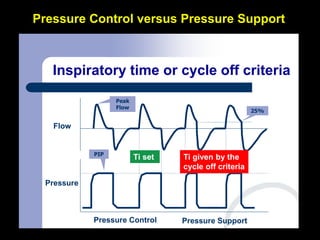
Pressure Ventilation - Waveforms
Flow
Pressure
Tinsp.
PIP
Peak
Flow
25%
Pressure Control Pressure Support
Inspiratory time or cycle off criteria
Ti given by the
cycle off criteria
Pressure Control versus Pressure Support
Ti set
The non synchronized patient during Pressure-Support
(inappropriate end-inspiratory flow termination criteria)
Nilsestuen J Respir Care 2005;50:202–232.
Pressure-Support and flow termination criteria
Increase in RR, reduction in VT, increase in WOB
Nilsestuen J
Respir Care 2005
Termination Sensitivity = Cycle-off Criteria
Flow
Peak Flow (100%)
TS 5%
Tinsp. (eff.)
Leak
Set (max)
Tinsp.
Time
TS 30%
What do airway pressures mean?
Palv = Ppl + Ptp
Where Ptp is transpulmonary pressure, Palv is alveolar pressure, and Ppl is pleural pressure
Ptp = Palv - Ppl
PPl = Paw x [E CW / (E L + E cw)]
Ptp = Paw x [E L / (E L + E cw)]
when airway resistance is nil (static condition)
Palv = PPl + Ptp Etot = EL + Ecw
Pairways (cmH2O)
Ppleural (cmH2O)
Ptranspulmonary (cmH2O)
PPl = Paw x [E CW / (E L + E cw)]
Ptp = Paw x [E L / (E L + E cw)]
when airway resistance is nil (static condition)
Paw = PPl + Ptp
Etot = EL + Ecw
Gattinoni L
Critical Care 2004,
8:350-355
soft stiff
In normal condition: EL = Ecw
Ecw/ Etot = 0.5 and EL/ Etot = 0.5
PTP ~ 50% of Paw applied
In primary ARDS: EL > Ecw (EL / Etot > 0.5)
Stiff lung, soft thorax PTP > 50 % of Paw applied
In secondary ARDS: EL < Ecw (EL / Etot < 0.5)
Soft lung, stiff thorax PTP < 50 % of Paw applied
In ARDS: PTP ~ 20 to 80% of Paw applied
Ptp = Paw x [E L / (E L + E cw)]
Grasso S Anesthesiology 2002; 96:795–802
22 ARDS-patients: Vt 6 ml/kg, PEEP and FiO2 to obtain SO2 90–95%
RM: CPAP to 40 cm H2O for 40 s
Respiratory mechanics influence the efficiency of RM
transpulmonary pressure
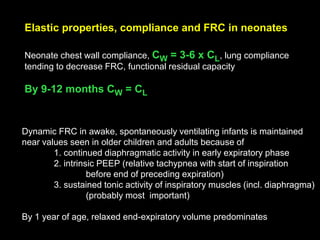
Elastic properties, compliance and FRC in neonates
Neonate chest wall compliance, CW = 3-6 x CL, lung compliance
tending to decrease FRC, functional residual capacity
By 9-12 months CW = CL
In infant RDS (HMD): EL >>> Ecw (EL / Etot >>> 0.5)
Stiff lung, very soft thorax PTP >>> 50 % of Paw applied
Elastic properties, compliance and FRC in neonates
Neonate chest wall compliance, CW = 3-6 x CL, lung compliance
tending to decrease FRC, functional residual capacity
By 9-12 months CW = CL
Dynamic FRC in awake, spontaneously ventilating infants is maintained
near values seen in older children and adults because of
1. continued diaphragmatic activity in early expiratory phase
2. intrinsic PEEP (relative tachypnea with start of inspiration
before end of preceding expiration)
3. sustained tonic activity of inspiratory muscles (incl. diaphragma)
(probably most important)
By 1 year of age, relaxed end-expiratory volume predominates
Pplat 30 cm H2O
transpulmonary
pressure = 15 cm H2O
Pplat = Palv;
Pplat = Transpulmonary Pressure ?
+15 cm H2O
Stiff chest wall
PCV 20 cm H2O,
PEEP 10 cm
H2O; Pplat 30
cm H2O
-15 cm H2O
transpulmonary
pressure = 45 cm H2O
Active inspiratory effort
Pplat = Palv;
Pplat = Transpulmonary Pressure ?
Pplat 30 cm H2O,
PCV
Pplat 30 cm H2O,
PCV (PSV)
Active inspiratory effort
Pplat 30 cm H2O,
PCV
Pplat = Palv;
Pplat = Transpulmonary Pressure?
Risk of VILI may be different with the same Pplat
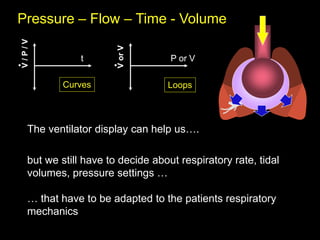
Pressure – Flow – Time - Volume
.V
or
V
P or V
Loops
V
/
P
/
V
.
t
Curves
but we still have to decide about respiratory rate, tidal
volumes, pressure settings …
… that have to be adapted to the patients respiratory
mechanics
The ventilator display can help us….
Alveolar
Pressure
Airway
Pressure
Residual Flows
Avoid ventilation out of control !

1) Basics on mechanical ventilation (1).ppt

  • 1.
    Basic respiratory mechanics relevantfor mechanical vnetilation Peter C. Rimensberger Pediatric and Neonatal ICU Department of Pediatrics University Hospital of Geneva Geneva, Switzerland
  • 2.
    Volume Change Time Gas Flow PressureDifference Basics of respiratory mechanics important to mechanical ventilation
  • 3.
    Volume Pressure D V D P C= D V D P Compliance
  • 4.
    “The Feature ofthe Tube” Airway Resistance Pressure Difference = Flow Rate x Resistance of the Tube Resistance is the amount of pressure required to deliver a given flow of gas and is expressed in terms of a change in pressure divided by flow. R = D P Flow P1 P2
  • 5.
    Mechanical response to positivepressure application Active inspiration Passive exhalation
  • 6.
    R = ∆P/ V (cmH2O/L/s) Equation of motion: P = ( 1 / Crs ) V + Rrs V . . Mechanical response to positive pressure application Compliance: pressure - volume Resistance: pressure - flow C = V / P (L/cmH2O)
  • 7.
    Pressure – Flow– Time - Volume Time constant: T = Crs x Rrs Volume change requires time to take place. When a step change in pressure is applied, the instantaneous change in volume follows an exponential curve, which means that, formerly faster, it slows down progressively while it approaches the new equilibrium. P = ( 1 / Crs ) x V + Rrs x V .
  • 8.
    Time constant: T= Crs x Rrs Pressure – Flow – Time - Volume Will pressure equilibrium be reached in the lungs?
  • 9.
    A: Crs =1, R = 1 B: Crs = 2 (T = R x 2C) C: Crs = 0.5 (T = R x 1/2C) (reduced inspiratory capacity to 0.5) D: R = 0.5 (T = 1/2R x C) E: R = 2 (T = 2R x C) Effect of varying time constants on the change in lung volume over time (with constant inflating pressure at the airway opening) A: Crs = 1, R = 1 C: Crs = 0.5 (T = R x 1/2C) (reduced inspiratory capacity to 0.5) E: R = 2 (T = 2R x C)
  • 10.
    Ventilators deliver gasto the lungs using positive pressure at a certain rate. The amount of gas delivered can be limited by time, pressure or volume. The duration can be cycled by time, pressure or flow. Volume Change Time Gas Flow Pressure Difference
  • 11.
    Nunn JF Appliedrespiratory physiology 1987:397
  • 12.
    time flow insuflation exhalation 0 auto-PEEP Premature flow terminationduring expiration = “gas trapping” = deadspace (Vd/Vt) will increase Expiratory flow waveform: normal vs pathologic
  • 13.
    Flow termination and auto-PEEPdetection PEEPi Trapped volume
  • 14.
    Dhand, Respir Care2005; 50:246 Correction for Auto-PEEP - Bronchodilator
  • 15.
    Analysing time settingsof the respiratory cycle 1) Too short Te  intrinsic PEEP 1) Correct Te 2) Unnecessary long Ti 2) Too short Ti
  • 16.
  • 17.
    Optimizing tidal volumedelivery at set D-pressure Lucangelo U, Bernabe F, and Blanch L Respir Care 2005;50(1):55– 65
  • 18.
  • 19.
  • 20.
  • 23.
    Progressive increase ininspiratory time Lucangelo U, Bernabe F, and Blanch L Respir Care 2005;50(1):55– 65 CAVE: you have to set Frequency and Ti (Control) or Ti and Te (TCPL)
  • 24.
    Too short Tewill not allow to deliver max. possible Vt at given P  will induce PEEPi  increases the risk for hemodynamic instability Too short Ti will reduce delivered Vt  unneccessary high PIP will be applied  unnecessary high intrathoracic pressures The patient respiratory mechanics dictate the maximal respiratory frequency
  • 25.
    Proximal Airway Pressure AlveolarPressure Look at the flow – time curve ! P V .
  • 26.
    Cave! Ti settingsin presence of an endotracheal tube leak Flow Leak Time The only solution in presence of an important leak: Look how the thorax moves Time Volume Leak Vex < Vinsp
  • 27.
    Who’s Watching thePatient? Pierson, IN: Tobin, Principles and Practice of Critical Care Monitoring
  • 28.
    Volume Pressure Pressure Volume Pressure Ventilation VolumeVentilation Decreased Tidal Volume Increased Pressure Compliance  Compliance  Decreased Pressure Increased Tidal Volume and do not forget, the time constant (T = Crs x Rrs) will change too!
  • 29.
    Compliance decrease Lucangelo U,Bernabe F, and Blanch L Respir Care 2005;50(1):55– 65 0.4 (s) 0.35 (s) 0.65 (s) 0.5 (s) 52 cmH2O 33 cmH2O
  • 30.
    Change in complianceafter surfactant = change in time constant after surfactant PEEP PIP PEEP PIP pre post Volume Pressure Kelly E Pediatr Pulmonol 1993;15:225-30
  • 31.
    Volume Guarantee: NewApproaches in Volume Controlled Ventilation for Neonates. Ahluwalia J, Morley C, Wahle G. Dräger Medizintechnik GmbH. ISBN 3-926762-42-X
  • 32.
    Time constant: T= Crs x Rrs To measure compliance and resistance - is it in the clinical setting important ? Use the flow curve for decision making about the settings for respiratory rate and duty cycle in the mechanical ventilator The saying “we ventilate at 40/min” or “with a Ti of 0.3” is a testimony of no understanding !
  • 33.
    Pressure Ventilation -Waveforms Flow Pressure Tinsp. PIP Peak Flow 25% Pressure Control Pressure Support Inspiratory time or cycle off criteria Ti given by the cycle off criteria Pressure Control versus Pressure Support Ti set
  • 34.
    The non synchronizedpatient during Pressure-Support (inappropriate end-inspiratory flow termination criteria) Nilsestuen J Respir Care 2005;50:202–232. Pressure-Support and flow termination criteria
  • 35.
    Pressure-Support and flowtermination criteria Increase in RR, reduction in VT, increase in WOB Nilsestuen J Respir Care 2005
  • 36.
    Termination Sensitivity =Cycle-off Criteria Flow Peak Flow (100%) TS 5% Tinsp. (eff.) Leak Set (max) Tinsp. Time TS 30%
  • 41.
    What do airwaypressures mean? Palv = Ppl + Ptp Where Ptp is transpulmonary pressure, Palv is alveolar pressure, and Ppl is pleural pressure Ptp = Palv - Ppl
  • 42.
    PPl = Pawx [E CW / (E L + E cw)] Ptp = Paw x [E L / (E L + E cw)] when airway resistance is nil (static condition) Palv = PPl + Ptp Etot = EL + Ecw Pairways (cmH2O) Ppleural (cmH2O) Ptranspulmonary (cmH2O)
  • 43.
    PPl = Pawx [E CW / (E L + E cw)] Ptp = Paw x [E L / (E L + E cw)] when airway resistance is nil (static condition) Paw = PPl + Ptp Etot = EL + Ecw Gattinoni L Critical Care 2004, 8:350-355 soft stiff
  • 44.
    In normal condition:EL = Ecw Ecw/ Etot = 0.5 and EL/ Etot = 0.5 PTP ~ 50% of Paw applied In primary ARDS: EL > Ecw (EL / Etot > 0.5) Stiff lung, soft thorax PTP > 50 % of Paw applied In secondary ARDS: EL < Ecw (EL / Etot < 0.5) Soft lung, stiff thorax PTP < 50 % of Paw applied In ARDS: PTP ~ 20 to 80% of Paw applied Ptp = Paw x [E L / (E L + E cw)]
  • 45.
    Grasso S Anesthesiology2002; 96:795–802 22 ARDS-patients: Vt 6 ml/kg, PEEP and FiO2 to obtain SO2 90–95% RM: CPAP to 40 cm H2O for 40 s Respiratory mechanics influence the efficiency of RM transpulmonary pressure
  • 46.
    Elastic properties, complianceand FRC in neonates Neonate chest wall compliance, CW = 3-6 x CL, lung compliance tending to decrease FRC, functional residual capacity By 9-12 months CW = CL In infant RDS (HMD): EL >>> Ecw (EL / Etot >>> 0.5) Stiff lung, very soft thorax PTP >>> 50 % of Paw applied
  • 47.
    Elastic properties, complianceand FRC in neonates Neonate chest wall compliance, CW = 3-6 x CL, lung compliance tending to decrease FRC, functional residual capacity By 9-12 months CW = CL Dynamic FRC in awake, spontaneously ventilating infants is maintained near values seen in older children and adults because of 1. continued diaphragmatic activity in early expiratory phase 2. intrinsic PEEP (relative tachypnea with start of inspiration before end of preceding expiration) 3. sustained tonic activity of inspiratory muscles (incl. diaphragma) (probably most important) By 1 year of age, relaxed end-expiratory volume predominates
  • 48.
    Pplat 30 cmH2O transpulmonary pressure = 15 cm H2O Pplat = Palv; Pplat = Transpulmonary Pressure ? +15 cm H2O Stiff chest wall
  • 49.
    PCV 20 cmH2O, PEEP 10 cm H2O; Pplat 30 cm H2O -15 cm H2O transpulmonary pressure = 45 cm H2O Active inspiratory effort Pplat = Palv; Pplat = Transpulmonary Pressure ?
  • 50.
    Pplat 30 cmH2O, PCV Pplat 30 cm H2O, PCV (PSV) Active inspiratory effort Pplat 30 cm H2O, PCV Pplat = Palv; Pplat = Transpulmonary Pressure? Risk of VILI may be different with the same Pplat
  • 51.
    Pressure – Flow– Time - Volume .V or V P or V Loops V / P / V . t Curves but we still have to decide about respiratory rate, tidal volumes, pressure settings … … that have to be adapted to the patients respiratory mechanics The ventilator display can help us….
  • 52.