CAPNOMETRY AND PULSE OXIMETRY
CAPNOGRAPHIC DEVICES Infrared Absorption Photometry Molecular Correlation Spectrography Colorimetric Devices Mass Spectrometry Raman Scattering
INFRARED First developed in 1859 Based on the Beer-Lambert law, which describes the absorption of infrared light by CO2 The higher the CO2 concentration, the higher the absorption N2O, H2O, and CO can also absorb infrared light at the wavelength used Two types:  mainstream and side stream More compact and less expensive than the other types of capnometers Requires sampling gas flow of ~150ml/min thru the unit
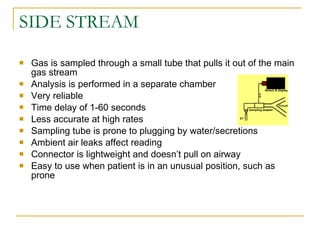
SIDE STREAM Gas is sampled through a small tube that pulls it out of the main gas stream Analysis is performed in a separate chamber Very reliable Time delay of 1-60 seconds Less accurate at high rates Sampling tube is prone to plugging by water/secretions Ambient air leaks affect reading Connector is lightweight and doesn’t pull on airway Easy to use when patient is in an unusual position, such as prone
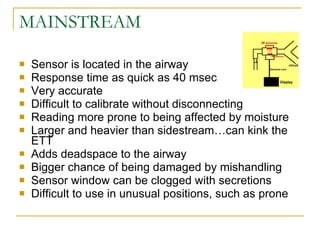
MAINSTREAM Sensor is located in the airway Response time as quick as 40 msec Very accurate Difficult to calibrate without disconnecting Reading more prone to being affected by moisture Larger and heavier than sidestream…can kink the ETT Adds deadspace to the airway Bigger chance of being damaged by mishandling Sensor window can be clogged with secretions Difficult to use in unusual positions, such as prone
Molecular Correlation Spectrography Uses an infrared emission that precisely matches the absorption spectrum of CO2 Allows for the use of very small samples at very low flow rates Samples are measured every 25 msecs and uses a flowrate of 50 ml/min
COLORIMETRIC Contains a pH sensitive dye which undergoes a color change in the presence of CO2 The dye is usually metacresol purple and it changes to yellow in the presence of CO2 Portable and lightweight Low false positive rate…higher false negative rate Acidic solutions (eg-lidocaine, epi, atropine) will permanently change the color Deadspace high for a neonate – can’t use for long
 
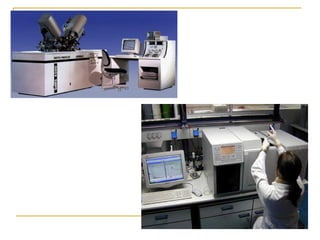
MASS SPECTROMETRY Separates and counts ionized molecules to determine the concentration of gas A gas sample is aspirated into a vacuum chamber when an electron beam ionizes and fragments the components of the sample The ions are accelerated into a final chamber which has a magnetic field that allows for determination of the components of the gas and the concentration of each component Very expensive and bulky, but have the advantage of being able to monitor multiple patients at a time (eg-OR)
 
RAMAN SCATTERING Raman scattering occurs when light hits a molecule and it scatters the light…most of the scattered light is the same wavelength as the laser source, but a small amount of light scattered is at a different wavelength The different wavelength produced gives information about the molecule An argon laser is shone through a gas sample and the CO2 in the sample will scatter it…the amount of scattering is related to the CO2 level
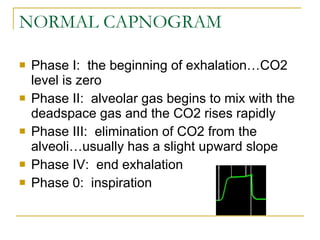
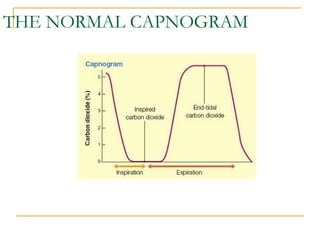
NORMAL CAPNOGRAM Phase I:  the beginning of exhalation…CO2 level is zero Phase II:  alveolar gas begins to mix with the deadspace gas and the CO2 rises rapidly Phase III:  elimination of CO2 from the alveoli…usually has a slight upward slope Phase IV:  end exhalation Phase 0:  inspiration
THE NORMAL CAPNOGRAM
ABNORMALITIES Increased Phase 3 slope: Obstructive lung dx Phase 3 dip: Spont resp Curare cleft Horizontal Phase 3 with large ET-art gradient: Pulm. Embolism Decreased CO hypovolemia Sudden decrease to 0 Ventilator malfunction ETT disconnect ET obstruction Extubation Sudden decrease Partial obstruction Air leak Exponential decrease Severe hyperventilation CP event
ABNORMALITIES Gradual decrease Hyperventilation Decreased T Gradual decrease in volume Sudden increase Bicarb administration Release of limb tourniquet Gradual increase Fever Hypoventilation Increased baseline Rebreathing CO2 Exhaused CO2 absorber
PaCO2-PetCO2 GRADIENT Usually <6 mm Hg PetCO2 is usually less than arterial Difference depends on the number of underperfused alveoli Tend to mirror each other if the slope of Phase 3 is horizontal or minimal Decreased CO will increase the gradient
LIMITATIONS Critically ill patients often have rapidly changing deadspace and V/Q mismatch Higher rates and small Vt can increase the amount of deadspace ventilation High mean airway pressures and PEEP restrict alveolar perfusion leading to falsely decreased readings Low CO will decrease the reading
USES Metabolic Assess energy expenditure Cardiovascular Monitor trend in cardiac output Can use as an indirect Fick method Measure of effectiveness in CPR Diagnosis of pulmonary embolism:  measure the gradient
PULMONARY USES Effectiveness of bronchodilator therapy Monitor gradient Worsening indicated by rising Phase 3 w/o plateau Find optimal PEEP by following the gradient …should be lowest at optimal PEEP level Can predict successful extubation…Vd/Vt > 0.6 predicts failure Limited pulm usefulness if CV unstable
CAPNOMETRY Measures and displays a numerical value of the CO2 level 30-43 mm Hg 4.0-5.6%
ESOPHAGEAL INTUBATION/ DISCONNECTION FROM VENTILATOR/TOTALLY OBSTRUCTED ETT
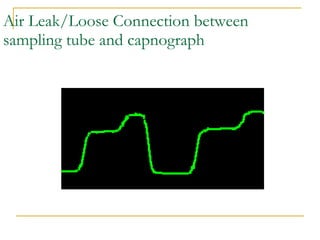
Air Leak/Loose Connection between sampling tube and capnograph
Increasing Temperature/Metabolism
Hypothermia/Reduced Metabolism/ Hyperventilation/Decreased CO Cause a gradual decrese in end-tidal CO2
Cardiac Oscillations
Bronchospasm/COPD/obstructed ETT Slanting and prolonged phase 2 and increased slope of phase 3 Sometimes there’s a reverse phase 3 slope seen in patients with emphysema
Ventilator IMV breath during spontaneous ventilation
Sticking Inspiratory Valve
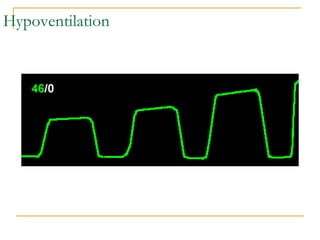
Hypoventilation
Leak/Partial Disconnect in Circuit/ETT too high
Pulmonary Embolism/Pneumonia/ Hypovolemia/ Hyperventilation
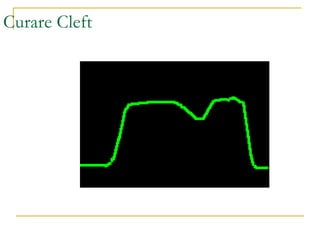
Curare Cleft
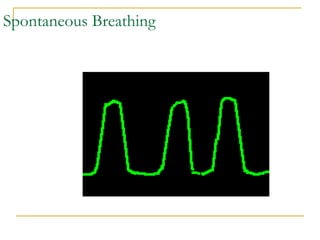
Spontaneous Breathing
Rebreathing of CO2
CAUSES OF INCREASED PetCO2 Increased CO2 production and delivery to the lungs Fever Sepsis Bicarb administration Increased metabolic rate Seizures Decreased alveolar ventilation Respiratory center depression Muscular paralysis Hypoventilation COPD Equipment malfunction Rebreathing Exhausted CO2 absorber Leak in ventilator circuit
CAUSES OF DECREASED PetCO2 Decreased CO2 production and delivery to the lungs Hypothermia Pulmonary hypoperfusion Cardiac arrest Hemorrhage Hypotension Increased alveolar deadspace Decreased CO Pulmonary embolism High PEEP levels Increased alveolar ventilation Hyperventilation Equipment malfunction Ventilator disconnect Esophageal intubation Complete airway obstruction Poor sampling Leak around ETT cuff Water in sampling line Air entrainment into sampling line Inadequate tidal volume
CAUSES OF INCREASED P(a-et)CO2 Pulmonary hypoperfusion Pulmonary embolism Cardiac arrest Positive pressure ventilation, especially with PEEP High rate/low tidal volume ventilation
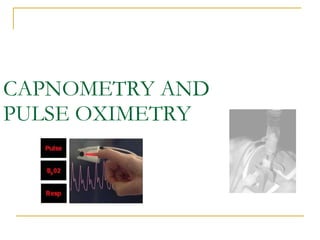
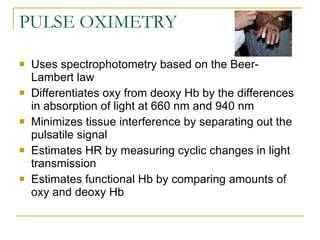
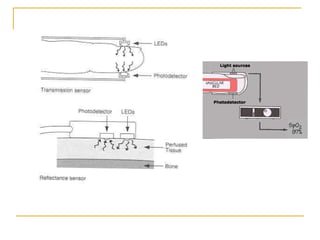
PULSE OXIMETRY Uses spectrophotometry based on the Beer-Lambert law Differentiates oxy from deoxy Hb by the differences in absorption of light at 660 nm and 940 nm Minimizes tissue interference by separating out the pulsatile signal Estimates HR by measuring cyclic changes in light transmission Estimates functional Hb by comparing amounts of oxy and deoxy Hb
 
SOURCES OF ERROR Sensitive to motion Sats below 85% have increased error Calibration is performed by company on normal patients breathing various gas mixtures, so cal is accurate only down to 80% Low perfusion state increases error Ambient light interferes with reading Delay in reading of about 12 seconds
SOURCES OF ERROR Skin pigmentation Darker color may make the reading more variable due to optical shunting Dark nail polish has the same effect, especially black, blue, and green…red is OK Hyperbilirubinemia has no effect Methylene blue and indigo carmine (dyes) cause underestimation of the saturation
SOURCES OF ERROR Dysfunctional hemoglobin Carboxyhemoglobin leads to overestimation of sats because it absorbs at 660 nm like oxyHb does MetHb can mask the true saturation because it absorbs at both wavelengths used…sats are overestimated

08 capnometry and pulse oximetry

  • 1.
  • 2.
    CAPNOGRAPHIC DEVICES InfraredAbsorption Photometry Molecular Correlation Spectrography Colorimetric Devices Mass Spectrometry Raman Scattering
  • 3.
    INFRARED First developedin 1859 Based on the Beer-Lambert law, which describes the absorption of infrared light by CO2 The higher the CO2 concentration, the higher the absorption N2O, H2O, and CO can also absorb infrared light at the wavelength used Two types: mainstream and side stream More compact and less expensive than the other types of capnometers Requires sampling gas flow of ~150ml/min thru the unit
  • 4.
    SIDE STREAM Gasis sampled through a small tube that pulls it out of the main gas stream Analysis is performed in a separate chamber Very reliable Time delay of 1-60 seconds Less accurate at high rates Sampling tube is prone to plugging by water/secretions Ambient air leaks affect reading Connector is lightweight and doesn’t pull on airway Easy to use when patient is in an unusual position, such as prone
  • 5.
    MAINSTREAM Sensor islocated in the airway Response time as quick as 40 msec Very accurate Difficult to calibrate without disconnecting Reading more prone to being affected by moisture Larger and heavier than sidestream…can kink the ETT Adds deadspace to the airway Bigger chance of being damaged by mishandling Sensor window can be clogged with secretions Difficult to use in unusual positions, such as prone
  • 6.
    Molecular Correlation SpectrographyUses an infrared emission that precisely matches the absorption spectrum of CO2 Allows for the use of very small samples at very low flow rates Samples are measured every 25 msecs and uses a flowrate of 50 ml/min
  • 7.
    COLORIMETRIC Contains apH sensitive dye which undergoes a color change in the presence of CO2 The dye is usually metacresol purple and it changes to yellow in the presence of CO2 Portable and lightweight Low false positive rate…higher false negative rate Acidic solutions (eg-lidocaine, epi, atropine) will permanently change the color Deadspace high for a neonate – can’t use for long
  • 8.
  • 9.
    MASS SPECTROMETRY Separatesand counts ionized molecules to determine the concentration of gas A gas sample is aspirated into a vacuum chamber when an electron beam ionizes and fragments the components of the sample The ions are accelerated into a final chamber which has a magnetic field that allows for determination of the components of the gas and the concentration of each component Very expensive and bulky, but have the advantage of being able to monitor multiple patients at a time (eg-OR)
  • 10.
  • 11.
    RAMAN SCATTERING Ramanscattering occurs when light hits a molecule and it scatters the light…most of the scattered light is the same wavelength as the laser source, but a small amount of light scattered is at a different wavelength The different wavelength produced gives information about the molecule An argon laser is shone through a gas sample and the CO2 in the sample will scatter it…the amount of scattering is related to the CO2 level
  • 12.
    NORMAL CAPNOGRAM PhaseI: the beginning of exhalation…CO2 level is zero Phase II: alveolar gas begins to mix with the deadspace gas and the CO2 rises rapidly Phase III: elimination of CO2 from the alveoli…usually has a slight upward slope Phase IV: end exhalation Phase 0: inspiration
  • 13.
  • 14.
    ABNORMALITIES Increased Phase3 slope: Obstructive lung dx Phase 3 dip: Spont resp Curare cleft Horizontal Phase 3 with large ET-art gradient: Pulm. Embolism Decreased CO hypovolemia Sudden decrease to 0 Ventilator malfunction ETT disconnect ET obstruction Extubation Sudden decrease Partial obstruction Air leak Exponential decrease Severe hyperventilation CP event
  • 15.
    ABNORMALITIES Gradual decreaseHyperventilation Decreased T Gradual decrease in volume Sudden increase Bicarb administration Release of limb tourniquet Gradual increase Fever Hypoventilation Increased baseline Rebreathing CO2 Exhaused CO2 absorber
  • 16.
    PaCO2-PetCO2 GRADIENT Usually<6 mm Hg PetCO2 is usually less than arterial Difference depends on the number of underperfused alveoli Tend to mirror each other if the slope of Phase 3 is horizontal or minimal Decreased CO will increase the gradient
  • 17.
    LIMITATIONS Critically illpatients often have rapidly changing deadspace and V/Q mismatch Higher rates and small Vt can increase the amount of deadspace ventilation High mean airway pressures and PEEP restrict alveolar perfusion leading to falsely decreased readings Low CO will decrease the reading
  • 18.
    USES Metabolic Assessenergy expenditure Cardiovascular Monitor trend in cardiac output Can use as an indirect Fick method Measure of effectiveness in CPR Diagnosis of pulmonary embolism: measure the gradient
  • 19.
    PULMONARY USES Effectivenessof bronchodilator therapy Monitor gradient Worsening indicated by rising Phase 3 w/o plateau Find optimal PEEP by following the gradient …should be lowest at optimal PEEP level Can predict successful extubation…Vd/Vt > 0.6 predicts failure Limited pulm usefulness if CV unstable
  • 20.
    CAPNOMETRY Measures anddisplays a numerical value of the CO2 level 30-43 mm Hg 4.0-5.6%
  • 21.
    ESOPHAGEAL INTUBATION/ DISCONNECTIONFROM VENTILATOR/TOTALLY OBSTRUCTED ETT
  • 22.
    Air Leak/Loose Connectionbetween sampling tube and capnograph
  • 23.
  • 24.
    Hypothermia/Reduced Metabolism/ Hyperventilation/DecreasedCO Cause a gradual decrese in end-tidal CO2
  • 25.
  • 26.
    Bronchospasm/COPD/obstructed ETT Slantingand prolonged phase 2 and increased slope of phase 3 Sometimes there’s a reverse phase 3 slope seen in patients with emphysema
  • 27.
    Ventilator IMV breathduring spontaneous ventilation
  • 28.
  • 29.
  • 30.
    Leak/Partial Disconnect inCircuit/ETT too high
  • 31.
  • 32.
  • 33.
  • 34.
  • 35.
    CAUSES OF INCREASEDPetCO2 Increased CO2 production and delivery to the lungs Fever Sepsis Bicarb administration Increased metabolic rate Seizures Decreased alveolar ventilation Respiratory center depression Muscular paralysis Hypoventilation COPD Equipment malfunction Rebreathing Exhausted CO2 absorber Leak in ventilator circuit
  • 36.
    CAUSES OF DECREASEDPetCO2 Decreased CO2 production and delivery to the lungs Hypothermia Pulmonary hypoperfusion Cardiac arrest Hemorrhage Hypotension Increased alveolar deadspace Decreased CO Pulmonary embolism High PEEP levels Increased alveolar ventilation Hyperventilation Equipment malfunction Ventilator disconnect Esophageal intubation Complete airway obstruction Poor sampling Leak around ETT cuff Water in sampling line Air entrainment into sampling line Inadequate tidal volume
  • 37.
    CAUSES OF INCREASEDP(a-et)CO2 Pulmonary hypoperfusion Pulmonary embolism Cardiac arrest Positive pressure ventilation, especially with PEEP High rate/low tidal volume ventilation
  • 38.
    PULSE OXIMETRY Usesspectrophotometry based on the Beer-Lambert law Differentiates oxy from deoxy Hb by the differences in absorption of light at 660 nm and 940 nm Minimizes tissue interference by separating out the pulsatile signal Estimates HR by measuring cyclic changes in light transmission Estimates functional Hb by comparing amounts of oxy and deoxy Hb
  • 39.
  • 40.
    SOURCES OF ERRORSensitive to motion Sats below 85% have increased error Calibration is performed by company on normal patients breathing various gas mixtures, so cal is accurate only down to 80% Low perfusion state increases error Ambient light interferes with reading Delay in reading of about 12 seconds
  • 41.
    SOURCES OF ERRORSkin pigmentation Darker color may make the reading more variable due to optical shunting Dark nail polish has the same effect, especially black, blue, and green…red is OK Hyperbilirubinemia has no effect Methylene blue and indigo carmine (dyes) cause underestimation of the saturation
  • 42.
    SOURCES OF ERRORDysfunctional hemoglobin Carboxyhemoglobin leads to overestimation of sats because it absorbs at 660 nm like oxyHb does MetHb can mask the true saturation because it absorbs at both wavelengths used…sats are overestimated