Mechanical Ventilation -3
Fakhir Raza Haidri
SIUT
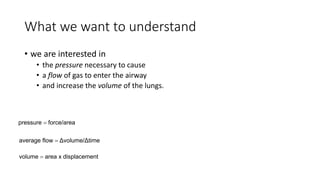
What we want to understand
• we are interested in
• the pressure necessary to cause
• a flow of gas to enter the airway
• and increase the volume of the lungs.
pressure = force/area
volume = area x displacement
average flow = Δvolume/Δtime
Modes of Ventilation
• Volume-controlled ventilation (VCV)
• Pressure-controlled ventilation (PCV)
• Pressure support ventilation (PSV)
Volume-controlled ventilation (VCV)
• The trigger variable for VCV is assist-control
Volume-controlled ventilation (VCV)
• The target variable is flow
Volume-controlled ventilation (VCV)
• The cycle variable is volume
Volume-controlled ventilation (VCV)
• VCV = flow-targeted, volume-cycled
• Pressure wave form is determined by the {resp system, pt effort}
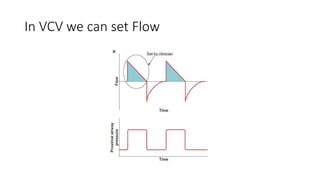
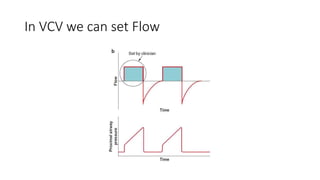
In VCV we can set Flow
Pressure-Controlled Ventilation
• The trigger variable for PCV is assist-control
Pressure-Controlled Ventilation
• The target variable is pressure
Pressure-Controlled Ventilation
• The cycle variable is time
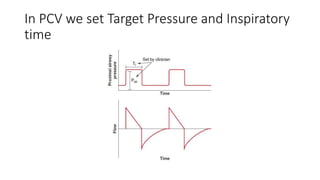
In PCV we set Target Pressure and Inspiratory
time
Pressure-Controlled Ventilation
• PCV = pressure-targeted, time-cycled
• The flow waveform is determined by {resp system and pt resp effort}
Pressure Support Ventilation
• The trigger variable for PSV consists of only the patient (assist) trigger
Pressure Support Ventilation
• The target variable is pressure
Pressure Support Ventilation
• The cycle variable is flow
Pressure Support Ventilation (PSV)
• the inspiratory time in PSV can vary
Pressure Support Ventilation (PSV)
Pressure Support Ventilation
• PSV = pressure-targeted, flow-cycled
• Flow wave form is determined by set variables and the respiratory
system
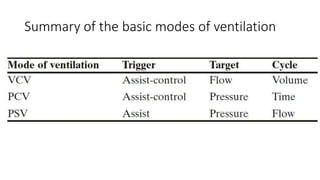
Summary of the basic modes of ventilation
Volume-Controlled Ventilation Vs. Pressure-
Controlled Ventilation

Mechanical ventilation 3

Editor's Notes

  • #5 The trigger variable for VCV is assist-control, a hybrid between a patient trigger and a ventilator trigger. The patient-triggered (assist) component of the trigger can utilize either a pressure or flow trigger. The ventilator-triggered (control) component of the trigger is set by selecting the respiratory rate, which dictates the time between control breaths (rate = 1/time).
  • #6 The target variable is flow. Both the flow rate and the flow waveform pattern are selected on the ventilator. The most commonly used flow waveform patterns are the constant flow and the decelerating ramp
  • #7 The cycle variable is volume. Tidal volume is selected on the ventilator. Because flow is set, setting tidal volume will also determine inspiratory time (time = volume/flow); therefore, inspiratory time cannot be altered by patient respiratory effort or by changes in the respiratory system
  • #8 VCV is a flow-targeted, volume-cycled mode of ventilation in which the ventilator delivers a set flow waveform pattern to achieve a set tidal volume. The pressure waveform will vary depending on characteristics of the respiratory system and patient respiratory effortVCV = flow-targeted, volume-cycled
  • #9 Flow and pressure waveforms in VCV. The target variable for VCV is flow. Both decelerating ramp (a) and constant flow (b) waveforms are demonstrated. The cycle variable for VCV is volume, which equals the area under the flow waveform curve (shaded region). The inspiratory flow waveform is set by the clinician. The pressure waveform is a result of the interaction between the set variables (flow-targeted and volume-cycled) and the respiratory system. VCV volume-controlled ventilation
  • #10 Flow and pressure waveforms in VCV. The target variable for VCV is flow. Both decelerating ramp (a) and constant flow (b) waveforms are demonstrated. The cycle variable for VCV is volume, which equals the area under the flow waveform curve (shaded region). The inspiratory flow waveform is set by the clinician. The pressure waveform is a result of the interaction between the set variables (flow-targeted and volume-cycled) and the respiratory system. VCV volume-controlled ventilation
  • #11 The trigger variable for PCV is assist-control, exactly the same as VCV.
  • #12 The target variable is pressure. Proximal airway pressure is selected on the ventilator. Flow is delivered by the ventilator to quickly achieve and maintain the set proximal airway pressure. As described in Chap. 2, a constant airway pressure during inspiration produces a decelerating ramp flow waveform.
  • #13 The cycle variable is time. The inspiratory time is selected on the ventilator. Inspiration will end after the set inspiratory time has elapsed. Similar to VCV, inspiratory time cannot be altered by patient respiratory effort or by changes in the respiratory system.
  • #14 Flow and pressure waveforms in PCV. The target variable for PCV is pressure. The cycle variable for PCV is time. Proximal airway pressure and inspiratory time are set by the clinician. The flow waveform is a result of the interaction between the set variables (pressure-targeted and time-cycled) and the respiratory system. The resultant flow waveform in PCV is a decelerating ramp. Pair proximal airway pressure; PCV pressure-controlled ventilation; TI inspiratory time
  • #15 In summary, PCV is a pressure-targeted, time-cycled mode of ventilation, in which the ventilator delivers flow to quickly achieve and maintain a set proximal airway pressure for a set amount of time. The flow waveform will vary depending on characteristics of the respiratory system and patient respiratory effort
  • #16 The trigger variable for PSV consists of only the patient (assist) trigger. As with the assist component of the assist-control trigger for both VCV and PCV, the trigger can be set as either a flow or a pressure trigger. There are no time-triggered, control breaths; therefore, this mode of ventilation can only be used if the patient initiates a sufficient number of breaths per minute.
  • #17 The target variable is pressure. Just like with PCV, proximal airway pressure is selected on the ventilator. Flow is delivered by the ventilator to quickly achieve and maintain the set proximal airway pressure. The constant airway pressure during inspiration produces a decelerating ramp flow waveform, similar to that seen with PCV.
  • #18 The cycle variable is flow. The ventilator is set to terminate the breath once flow diminishes to a specified percentage of peak inspiratory flow (e.g., 25%). This cycling mechanism utilizes the fact that a constant proximal airway pressure during inspiration produces a decelerating ramp flow waveform, in which flow is highest at the beginning of the breath and then decreases as the inspiratory phase proceeds.
  • #19 While the inspiratory time in VCV and PCV is predetermined and does not change from breath to breath, the inspiratory time in PSV can vary. Inspiratory time in PSV is not constrained because breath cycling in this mode depends on the depreciation of flow. Flow in pressure-targeted modes, as discussed in Chap. 2, varies with changes in respiratory system resistance and compliance, as well as patient respiratory effort. Thus, patients can regulate inspiratory time with PSV by adjusting their respiratory effort, resulting in greater patient comfort and less patient-ventilator dyssynchrony.
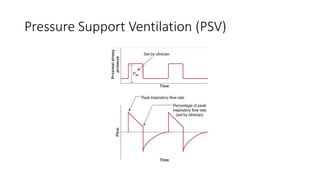
  • #20 Flow and pressure waveforms in PSV. The target variable for PSV is pressure. The cycle variable for PSV is flow. Proximal airway pressure and the percentage of peak inspiratory flow for cycling are set by the clinician. The flow waveform is a result of the interaction between the set variables (pressure-targeted and flow-cycled) and the respiratory system. Similar to PCV, the resultant flow waveform in PSV is a decelerating ramp. With flow-cycling, the breath terminates once flow depreciates to a set percentage of the peak flow, in this case 25%. Pair proximal airway pressure; PSV pressure support ventilation