20ME602 -
DESIGN OF TRANSMISSION
SYSTEMS
• UNIT I - DESIGN OF FLEXIBLE ELEMENTS
• UNIT II - DESIGN OF SPUR GEARS AND
PARALLEL AXIS HELICAL GEARS
• UNIT III – DESIGN OF BEVEL, WORM AND
CROSS HELICAL GEARS
• UNIT IV – DESIGN OF GEAR BOXES
• UNIT V - DESIGN OF CLUTCHES AND BRAKES
UNIT I - DESIGN OF FLEXIBLE
ELEMENTS
• Design of Flat belts and pulleys
• Selection of V belts and pulleys
• Selection of hoisting wire ropes and pulleys
• Design of Transmission chains and Sprockets.
BELTS
• The belts or ropes are used to transmit power
from one shaft to another by means of pulleys
which rotate at the same speed or at different
speeds.
Selection of a Belt Drive
Following are the various important factors upon
which the selection of a belt drive depends:
1. Speed of the driving and driven shafts,
2. Speed reduction ratio,
3. Power to be transmitted,
4. Centre distance between the shafts,
5. Positive drive requirements,
6. Shafts layout,
7. Space available, and
8. Service conditions
Types of Belt Drives
The belt drives are usually classified into the
following three groups:
1. Light drives. These are used to transmit small
powers at belt speeds upto about 10 m/s as in
agricultural machines and small machine tools.
2. Medium drives. These are used to transmit medium
powers at belt speeds over 10 m/s but up to 22 m/s,
as in machine tools.
3. Heavy drives. These are used to transmit large
powers at belt speeds above 22 m/s as in
compressors and generators.
Types of Belts
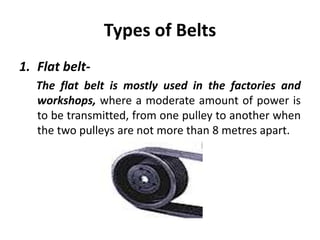
1. Flat belt-
The flat belt is mostly used in the factories and
workshops, where a moderate amount of power is
to be transmitted, from one pulley to another when
the two pulleys are not more than 8 metres apart.
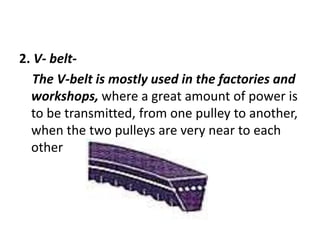
2. V- belt-
The V-belt is mostly used in the factories and
workshops, where a great amount of power is
to be transmitted, from one pulley to another,
when the two pulleys are very near to each
other
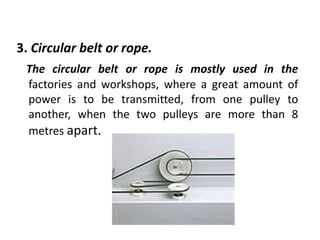
3. Circular belt or rope.
The circular belt or rope is mostly used in the
factories and workshops, where a great amount of
power is to be transmitted, from one pulley to
another, when the two pulleys are more than 8
metres apart.
Material used for Belts
• Leather belts
• Cotton or fabric belts
• Rubber belts
• Balata belts
Types of Flat Belt Drives
1. Open belt drive
• The open belt drive is used with shafts
arranged parallel and rotating in the same
direction.
2.Crossed or twist belt drive.
The crossed or twist belt drive is used with
shafts arranged parallel and rotating in the
opposite directions.
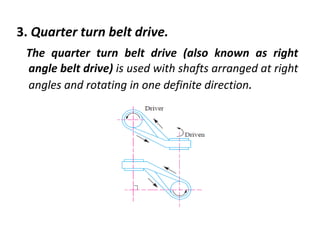
3. Quarter turn belt drive.
The quarter turn belt drive (also known as right
angle belt drive) is used with shafts arranged at right
angles and rotating in one definite direction.
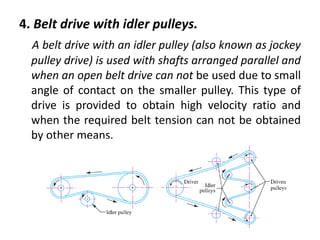
4. Belt drive with idler pulleys.
A belt drive with an idler pulley (also known as jockey
pulley drive) is used with shafts arranged parallel and
when an open belt drive can not be used due to small
angle of contact on the smaller pulley. This type of
drive is provided to obtain high velocity ratio and
when the required belt tension can not be obtained
by other means.
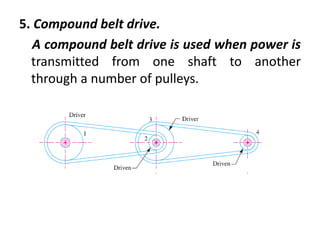
5. Compound belt drive.
A compound belt drive is used when power is
transmitted from one shaft to another
through a number of pulleys.
6. Stepped or cone pulley drive.
A stepped or cone pulley drive, is used for changing
the speed of the driven shaft while the main or
driving shaft runs at constant speed. This is
accomplished by shifting the belt from one part of
the steps to the other.
7. Fast and loose pulley drive.
A fast and loose pulley drive is used when the driven or machine shaft is to
be started or stopped whenever desired without interferring with the
driving shaft. A pulley which is keyed to the machine shaft is called fast
pulley and runs at the same speed as that of machine shaft. A loose pulley
runs freely over the machine shaft and is incapable of transmitting any
power. When the driven shaft is required to be stopped, the belt is pushed
on to the loose pulley by means of sliding bar having belt forks.
Velocity Ratio of a Belt Drive
It is the ratio between the velocities of the driver and
the follower or driven.
Let d1 or D = Diameter of the driver,
d2 or d = Diameter of the follower,
N1 = Speed of the driver in r.p.m.,
N2 = Speed of the follower in r.p.m.
Slip of the Belt
• Slip is defined as the relative motion between the
belt and the pulley. The difference between the
linear speeds of the pulley rim and the belt is the
measure of slip.
• The presence of slip reduces the velocity ratio of the
drive. It is denoted by “S”
Creep of Belt
• When the belt passes from the slack side to the tight side, a certain
portion of the belt extends and it contracts again when the belt passes
from the tight side to the slack side. Due to these changes of length, there
is a relative motion between the belt and the pulley surfaces. This relative
motion is termed as creep.
• The total effect of creep is to reduce slightly the speed of the driven pulley
or follower. Considering creep, the velocity ratio is given by
• Since the effect of creep is very small, therefore it is generally neglected

UNIT-I DTS.pptx

  • 1.
    20ME602 - DESIGN OFTRANSMISSION SYSTEMS
  • 2.
    • UNIT I- DESIGN OF FLEXIBLE ELEMENTS • UNIT II - DESIGN OF SPUR GEARS AND PARALLEL AXIS HELICAL GEARS • UNIT III – DESIGN OF BEVEL, WORM AND CROSS HELICAL GEARS • UNIT IV – DESIGN OF GEAR BOXES • UNIT V - DESIGN OF CLUTCHES AND BRAKES
  • 3.
    UNIT I -DESIGN OF FLEXIBLE ELEMENTS • Design of Flat belts and pulleys • Selection of V belts and pulleys • Selection of hoisting wire ropes and pulleys • Design of Transmission chains and Sprockets.
  • 4.
    BELTS • The beltsor ropes are used to transmit power from one shaft to another by means of pulleys which rotate at the same speed or at different speeds.
  • 5.
    Selection of aBelt Drive Following are the various important factors upon which the selection of a belt drive depends: 1. Speed of the driving and driven shafts, 2. Speed reduction ratio, 3. Power to be transmitted, 4. Centre distance between the shafts, 5. Positive drive requirements, 6. Shafts layout, 7. Space available, and 8. Service conditions
  • 6.
    Types of BeltDrives The belt drives are usually classified into the following three groups: 1. Light drives. These are used to transmit small powers at belt speeds upto about 10 m/s as in agricultural machines and small machine tools. 2. Medium drives. These are used to transmit medium powers at belt speeds over 10 m/s but up to 22 m/s, as in machine tools. 3. Heavy drives. These are used to transmit large powers at belt speeds above 22 m/s as in compressors and generators.
  • 7.
    Types of Belts 1.Flat belt- The flat belt is mostly used in the factories and workshops, where a moderate amount of power is to be transmitted, from one pulley to another when the two pulleys are not more than 8 metres apart.
  • 8.
    2. V- belt- TheV-belt is mostly used in the factories and workshops, where a great amount of power is to be transmitted, from one pulley to another, when the two pulleys are very near to each other
  • 9.
    3. Circular beltor rope. The circular belt or rope is mostly used in the factories and workshops, where a great amount of power is to be transmitted, from one pulley to another, when the two pulleys are more than 8 metres apart.
  • 10.
    Material used forBelts • Leather belts • Cotton or fabric belts • Rubber belts • Balata belts
  • 11.
    Types of FlatBelt Drives 1. Open belt drive • The open belt drive is used with shafts arranged parallel and rotating in the same direction.
  • 12.
    2.Crossed or twistbelt drive. The crossed or twist belt drive is used with shafts arranged parallel and rotating in the opposite directions.
  • 13.
    3. Quarter turnbelt drive. The quarter turn belt drive (also known as right angle belt drive) is used with shafts arranged at right angles and rotating in one definite direction.
  • 14.
    4. Belt drivewith idler pulleys. A belt drive with an idler pulley (also known as jockey pulley drive) is used with shafts arranged parallel and when an open belt drive can not be used due to small angle of contact on the smaller pulley. This type of drive is provided to obtain high velocity ratio and when the required belt tension can not be obtained by other means.
  • 15.
    5. Compound beltdrive. A compound belt drive is used when power is transmitted from one shaft to another through a number of pulleys.
  • 16.
    6. Stepped orcone pulley drive. A stepped or cone pulley drive, is used for changing the speed of the driven shaft while the main or driving shaft runs at constant speed. This is accomplished by shifting the belt from one part of the steps to the other.
  • 17.
    7. Fast andloose pulley drive. A fast and loose pulley drive is used when the driven or machine shaft is to be started or stopped whenever desired without interferring with the driving shaft. A pulley which is keyed to the machine shaft is called fast pulley and runs at the same speed as that of machine shaft. A loose pulley runs freely over the machine shaft and is incapable of transmitting any power. When the driven shaft is required to be stopped, the belt is pushed on to the loose pulley by means of sliding bar having belt forks.
  • 18.
    Velocity Ratio ofa Belt Drive It is the ratio between the velocities of the driver and the follower or driven. Let d1 or D = Diameter of the driver, d2 or d = Diameter of the follower, N1 = Speed of the driver in r.p.m., N2 = Speed of the follower in r.p.m.
  • 19.
    Slip of theBelt • Slip is defined as the relative motion between the belt and the pulley. The difference between the linear speeds of the pulley rim and the belt is the measure of slip. • The presence of slip reduces the velocity ratio of the drive. It is denoted by “S”
  • 20.
    Creep of Belt •When the belt passes from the slack side to the tight side, a certain portion of the belt extends and it contracts again when the belt passes from the tight side to the slack side. Due to these changes of length, there is a relative motion between the belt and the pulley surfaces. This relative motion is termed as creep. • The total effect of creep is to reduce slightly the speed of the driven pulley or follower. Considering creep, the velocity ratio is given by • Since the effect of creep is very small, therefore it is generally neglected