INTRODUCTION TO
MEASUREMENT AND
METROLOGY
(Sub: Measurement and Metrology
Code: BMEC0003)
Instructor
Mr. Gaurav Bharadwaj
Assistant Prof.
Department of ME
GLA University
BASICS OF MEASUREMENT
Anything in this universe exist in some amount like:
• Mass is in some amount
• Temperature is in some amount and many more quantities.
These quantities have to be measured and have different
units like meter for length, kg for mass, etc.
Example : if you want to compare two lengths, so both the
length has to be measured.
These units must be universally accepted.
BASICS OF MEASUREMENT
Standard: The physical representation of universally accepted units are called as
standards.
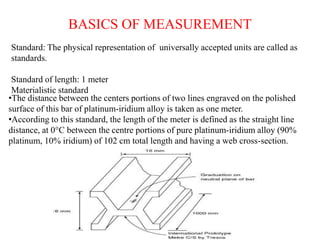
Standard of length: 1 meter
Materialistic standard
•The distance between the centers portions of two lines engraved on the polished
surface of this bar of platinum-iridium alloy is taken as one meter.
•According to this standard, the length of the meter is defined as the straight line
distance, at 0°C between the centre portions of pure platinum-iridium alloy (90%
platinum, 10% iridium) of 102 cm total length and having a web cross-section.
BASICS OF MEASUREMENT
Standard of length: 1 meter
Wavelength standard
• Distance travelled by light in vacuum in 1/299792458 seconds is termed as 1
meter.
Standard of Time: 1 Second
• Time taken by Cesium 138 atom for no. of vibration 9,192,631, 770 is termed as
1 second.
Standard of Current: 1 Ampere
• Amount of current passed through parallel conductor in vacuum having cross
section area dA tending to zero and force per meter length is 2 × 10E-7 N/m.
Standard of Temperature: Kelvin
•Temperature of water at triple point i.e. 273.15 K.
Measurement Definition
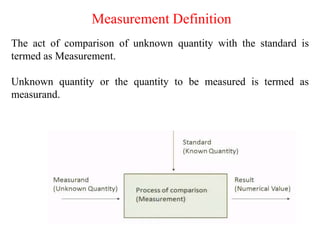
The act of comparison of unknown quantity with the standard is
termed as Measurement.
Unknown quantity or the quantity to be measured is termed as
measurand.
Types of Standards
Depending upon the degree of accuracy required for the work, the standards are
subdivided into following four categories or grades:
1. Primary Standards (Reference Standards).
2. Secondary Standards (Calibration Standards).
3. Tertiary Standards (Inspection Standards).
4. Working Standards (Workshop Measuring Standards).
1. Primary Standards (Master Standards):
•The primary standard is also known as Master Standard, and is preserved under
the most careful conditions.
•These standards are not commonly in use. They are used only after long
internals.
•They solely used for comparing the secondary standards.
• Sometimes it is also called Reference Standards.
• They are kept in International Bureau of Weights and Measures (BIPM)
Types of Standards
•2. Secondary Standards (Calibration Standards):
•The secondary standard is more or less similar to the primary standard.
•They are nearly close in accuracy with primary standards. The secondary standard
is compared at regular intervals with primary Stands and records their deviation.
•3. Tertiary Standards (Inspection Standards):
•The Tertiary standard is the first standard to be used for reference purpose in
workshops and laboratories.
•They are used for comparing the working standards. These are not used as
frequently and commonly as the working standards but more frequency than
secondary standards.
•Tertiary standards should also be maintained as a reference for comparison at
intervals for working standards.
•4. Working Standards (Workshop Measuring Standards):
•The working standard is used for actual measurement in workshop or laboratories
by the workers.
•These standards should also be as accurate as possible to the tertiary standard.
Need of Measurement
•Measurement provides the fundamental basis for research and
development.
•Development is the final stage of design procedure involving the
measurements of various quantities pertaining to operations and
performance of the developed object.
•It also helps in controlling of process.
Examples:
• In a power plant measurement of temperature, pressure, etc is
necessary for proper functioning of the plant.
Methods of Measurement
There are two methods of measurement:
1. Direct measurement
2. Indirect measurement
Direct Measurement:
• In this method the quantity being measured is directly compared with the
standard quantity.
• No mathematical calculation is required to get the result.
• It is not very accurate method as it depends upon the judgement of human
being.
Example: Measurement of weight by beam balance, etc.
Indirect Measurement:
• In this method several parameters are measured directly and the final value is
determined by mathematical relationship.
Example: Measurement of density by measuring mass and volume, measurement
of angle using sinebar.
Levels of Measurement
There are three levels of measurement:
1. Primary measurement
2. Secondary measurement
3. Tertiary measurement
Primary measurement:
• It involves direct observation.
• No translation of signal.
Examples: matching of two lengths.
matching of two colors.
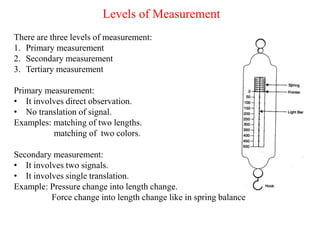
Secondary measurement:
• It involves two signals.
• It involves single translation.
Example: Pressure change into length change.
Force change into length change like in spring balance
Levels of Measurement
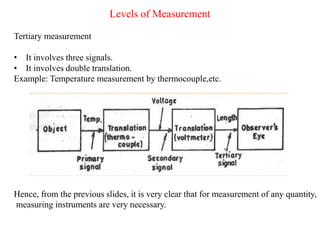
Tertiary measurement
• It involves three signals.
• It involves double translation.
Example: Temperature measurement by thermocouple,etc.
Hence, from the previous slides, it is very clear that for measurement of any quantity,
measuring instruments are very necessary.
Classification of Measuring instruments
1. Null and Deflection instruments:
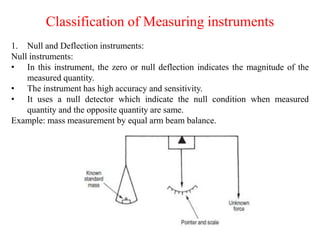
Null instruments:
• In this instrument, the zero or null deflection indicates the magnitude of the
measured quantity.
• The instrument has high accuracy and sensitivity.
• It uses a null detector which indicate the null condition when measured
quantity and the opposite quantity are same.
Example: mass measurement by equal arm beam balance.
Classification of Measuring instruments
1. Null and Deflection instruments:
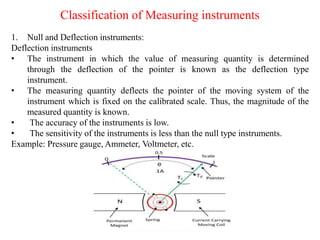
Deflection instruments
• The instrument in which the value of measuring quantity is determined
through the deflection of the pointer is known as the deflection type
instrument.
• The measuring quantity deflects the pointer of the moving system of the
instrument which is fixed on the calibrated scale. Thus, the magnitude of the
measured quantity is known.
• The accuracy of the instruments is low.
• The sensitivity of the instruments is less than the null type instruments.
Example: Pressure gauge, Ammeter, Voltmeter, etc.
Classification of Measuring instruments
2. Analog and Digital instruments
Analog Instruments
• The instrument whose output is the continuous function of time, and they
have a constant relation to the input.
• The physicals quantity like voltage, current, power and energy are measured
through the analog instruments.
• Low accuracy and high sensitivity.
Example: Voltmeter, ammeter, etc.
Digital Instruments:
• The digital instrument gives the output in the numeric form.
• The instrument is more accurate as compared to the analogue instrument
because no human error occurs in the reading.
• High accuracy and less sensitivity.
Example: digital weight machine, digital thermometer.
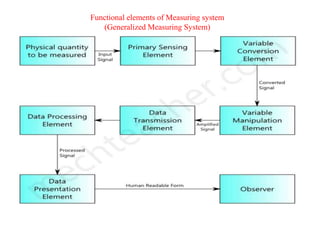
Functional elements of Measuring system
(Generalized Measuring System)
There are five functional elements of any measuring system:
1. Primary sensing element
2. Primary conversion element
3. Primary manipulation element
4. Data transmission element
5. Data presentation element
1. Primary sensing element:
• The primary sensing element receives signal of the physical quantity to be
measured as input.
• It is such type that it makes very less or negligible disturbance.
Example: Bulb of thermometer, platform of weight machine, etc.
2. Primary conversion element
• Variable conversion element converts the output of the primary sensing
element to a more suitable form.
• It is used only if necessary.
• It should maintain the original nature of signal.
Examples: Spring of spring balance.
Functional elements of Measuring system
(Generalized Measuring System)
3. Primary manipulation element
• Variable manipulation element manipulates and amplifies the output of the
variable conversion element.
• It does not changes the nature of the signal.
Example : Angle remains angle, displacement remain displacement, etc.
4. Data transmission element
• Data Transmission System is simply used for transmitting data from one element
to another.
•It acts as a communication link between different elements of the measurement
system.
• It does not changes the nature of the signal.
Examples: cables, wireless antennae, telemetry systems etc.
5. Data presentation element
• It is used to present the measured physical quantity in a human readable form to
the observer.
Examples: Scale and pointers, LED display, etc.
Functional elements of Measuring system
(Generalized Measuring System)
Line Diagram
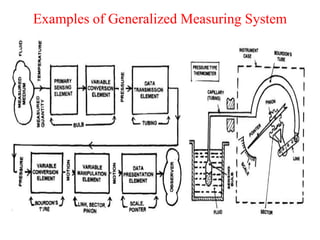
Examples of Generalized Measuring System
Metrology
• Field of knowledge concerned with measurement and it includes both theoretical
and practical problem related to measurement.
• Process of making precise measurement.
• It concerned with the establishment, reproduction and transfer of units of
measurement and their standards.
There are three types of metrology:
1. Scientific metrology
2. Industrial metrology
3. Legal metrology
Metrology
1. Scientific metrology
• This form of metrology deals with the organization and development of
measurement standards and with their maintenance.
• Scientific metrology is deeply involved with research and new technologies for
industries concerning government, healthcare, and research for commercial
products.
2. Industrial Metrology
• Industrial metrology’s purpose is to ensure that instruments, used in a wide
variety of industries, are functioning properly.
• An example of this type of metrology might be seen in the production of
products for the commercial industry, the testing and designing of aircraft, the
functioning of large machinery.
3. Legal Metrology
• It regulate, advise, supervise and control the manufacturing and calibration of
measuring instruments.
• Legal metrology focuses on the buying and selling of materials for economic
studies.
Elements of metrology
There are five elements of metrology:
1. Standards
2. Work piece
3. Instruments
4. Person
5. Environment
Need of Inspection
1. To ensure that the part, material or a component conforms to the
established standard.
2. To meet the interchangeability of manufacture.
3. To maintain customer relation by ensuring that no faulty product
reaches the customers.
4. To determine problem areas.
5. To judge possibility of rework of defective parts.
6. It also helps to purchase good quality of raw materials, tools,
equipment which governs the quality of the finished products.

Introduction to measurement

  • 1.
    INTRODUCTION TO MEASUREMENT AND METROLOGY (Sub:Measurement and Metrology Code: BMEC0003) Instructor Mr. Gaurav Bharadwaj Assistant Prof. Department of ME GLA University
  • 2.
    BASICS OF MEASUREMENT Anythingin this universe exist in some amount like: • Mass is in some amount • Temperature is in some amount and many more quantities. These quantities have to be measured and have different units like meter for length, kg for mass, etc. Example : if you want to compare two lengths, so both the length has to be measured. These units must be universally accepted.
  • 3.
    BASICS OF MEASUREMENT Standard:The physical representation of universally accepted units are called as standards. Standard of length: 1 meter Materialistic standard •The distance between the centers portions of two lines engraved on the polished surface of this bar of platinum-iridium alloy is taken as one meter. •According to this standard, the length of the meter is defined as the straight line distance, at 0°C between the centre portions of pure platinum-iridium alloy (90% platinum, 10% iridium) of 102 cm total length and having a web cross-section.
  • 4.
    BASICS OF MEASUREMENT Standardof length: 1 meter Wavelength standard • Distance travelled by light in vacuum in 1/299792458 seconds is termed as 1 meter. Standard of Time: 1 Second • Time taken by Cesium 138 atom for no. of vibration 9,192,631, 770 is termed as 1 second. Standard of Current: 1 Ampere • Amount of current passed through parallel conductor in vacuum having cross section area dA tending to zero and force per meter length is 2 × 10E-7 N/m. Standard of Temperature: Kelvin •Temperature of water at triple point i.e. 273.15 K.
  • 5.
    Measurement Definition The actof comparison of unknown quantity with the standard is termed as Measurement. Unknown quantity or the quantity to be measured is termed as measurand.
  • 6.
    Types of Standards Dependingupon the degree of accuracy required for the work, the standards are subdivided into following four categories or grades: 1. Primary Standards (Reference Standards). 2. Secondary Standards (Calibration Standards). 3. Tertiary Standards (Inspection Standards). 4. Working Standards (Workshop Measuring Standards). 1. Primary Standards (Master Standards): •The primary standard is also known as Master Standard, and is preserved under the most careful conditions. •These standards are not commonly in use. They are used only after long internals. •They solely used for comparing the secondary standards. • Sometimes it is also called Reference Standards. • They are kept in International Bureau of Weights and Measures (BIPM)
  • 7.
    Types of Standards •2.Secondary Standards (Calibration Standards): •The secondary standard is more or less similar to the primary standard. •They are nearly close in accuracy with primary standards. The secondary standard is compared at regular intervals with primary Stands and records their deviation. •3. Tertiary Standards (Inspection Standards): •The Tertiary standard is the first standard to be used for reference purpose in workshops and laboratories. •They are used for comparing the working standards. These are not used as frequently and commonly as the working standards but more frequency than secondary standards. •Tertiary standards should also be maintained as a reference for comparison at intervals for working standards. •4. Working Standards (Workshop Measuring Standards): •The working standard is used for actual measurement in workshop or laboratories by the workers. •These standards should also be as accurate as possible to the tertiary standard.
  • 8.
    Need of Measurement •Measurementprovides the fundamental basis for research and development. •Development is the final stage of design procedure involving the measurements of various quantities pertaining to operations and performance of the developed object. •It also helps in controlling of process. Examples: • In a power plant measurement of temperature, pressure, etc is necessary for proper functioning of the plant.
  • 9.
    Methods of Measurement Thereare two methods of measurement: 1. Direct measurement 2. Indirect measurement Direct Measurement: • In this method the quantity being measured is directly compared with the standard quantity. • No mathematical calculation is required to get the result. • It is not very accurate method as it depends upon the judgement of human being. Example: Measurement of weight by beam balance, etc. Indirect Measurement: • In this method several parameters are measured directly and the final value is determined by mathematical relationship. Example: Measurement of density by measuring mass and volume, measurement of angle using sinebar.
  • 10.
    Levels of Measurement Thereare three levels of measurement: 1. Primary measurement 2. Secondary measurement 3. Tertiary measurement Primary measurement: • It involves direct observation. • No translation of signal. Examples: matching of two lengths. matching of two colors. Secondary measurement: • It involves two signals. • It involves single translation. Example: Pressure change into length change. Force change into length change like in spring balance
  • 11.
    Levels of Measurement Tertiarymeasurement • It involves three signals. • It involves double translation. Example: Temperature measurement by thermocouple,etc. Hence, from the previous slides, it is very clear that for measurement of any quantity, measuring instruments are very necessary.
  • 12.
    Classification of Measuringinstruments 1. Null and Deflection instruments: Null instruments: • In this instrument, the zero or null deflection indicates the magnitude of the measured quantity. • The instrument has high accuracy and sensitivity. • It uses a null detector which indicate the null condition when measured quantity and the opposite quantity are same. Example: mass measurement by equal arm beam balance.
  • 13.
    Classification of Measuringinstruments 1. Null and Deflection instruments: Deflection instruments • The instrument in which the value of measuring quantity is determined through the deflection of the pointer is known as the deflection type instrument. • The measuring quantity deflects the pointer of the moving system of the instrument which is fixed on the calibrated scale. Thus, the magnitude of the measured quantity is known. • The accuracy of the instruments is low. • The sensitivity of the instruments is less than the null type instruments. Example: Pressure gauge, Ammeter, Voltmeter, etc.
  • 14.
    Classification of Measuringinstruments 2. Analog and Digital instruments Analog Instruments • The instrument whose output is the continuous function of time, and they have a constant relation to the input. • The physicals quantity like voltage, current, power and energy are measured through the analog instruments. • Low accuracy and high sensitivity. Example: Voltmeter, ammeter, etc. Digital Instruments: • The digital instrument gives the output in the numeric form. • The instrument is more accurate as compared to the analogue instrument because no human error occurs in the reading. • High accuracy and less sensitivity. Example: digital weight machine, digital thermometer.
  • 15.
    Functional elements ofMeasuring system (Generalized Measuring System) There are five functional elements of any measuring system: 1. Primary sensing element 2. Primary conversion element 3. Primary manipulation element 4. Data transmission element 5. Data presentation element 1. Primary sensing element: • The primary sensing element receives signal of the physical quantity to be measured as input. • It is such type that it makes very less or negligible disturbance. Example: Bulb of thermometer, platform of weight machine, etc. 2. Primary conversion element • Variable conversion element converts the output of the primary sensing element to a more suitable form. • It is used only if necessary. • It should maintain the original nature of signal. Examples: Spring of spring balance.
  • 16.
    Functional elements ofMeasuring system (Generalized Measuring System) 3. Primary manipulation element • Variable manipulation element manipulates and amplifies the output of the variable conversion element. • It does not changes the nature of the signal. Example : Angle remains angle, displacement remain displacement, etc. 4. Data transmission element • Data Transmission System is simply used for transmitting data from one element to another. •It acts as a communication link between different elements of the measurement system. • It does not changes the nature of the signal. Examples: cables, wireless antennae, telemetry systems etc. 5. Data presentation element • It is used to present the measured physical quantity in a human readable form to the observer. Examples: Scale and pointers, LED display, etc.
  • 17.
    Functional elements ofMeasuring system (Generalized Measuring System) Line Diagram
  • 18.
    Examples of GeneralizedMeasuring System
  • 19.
    Metrology • Field ofknowledge concerned with measurement and it includes both theoretical and practical problem related to measurement. • Process of making precise measurement. • It concerned with the establishment, reproduction and transfer of units of measurement and their standards. There are three types of metrology: 1. Scientific metrology 2. Industrial metrology 3. Legal metrology
  • 20.
    Metrology 1. Scientific metrology •This form of metrology deals with the organization and development of measurement standards and with their maintenance. • Scientific metrology is deeply involved with research and new technologies for industries concerning government, healthcare, and research for commercial products. 2. Industrial Metrology • Industrial metrology’s purpose is to ensure that instruments, used in a wide variety of industries, are functioning properly. • An example of this type of metrology might be seen in the production of products for the commercial industry, the testing and designing of aircraft, the functioning of large machinery. 3. Legal Metrology • It regulate, advise, supervise and control the manufacturing and calibration of measuring instruments. • Legal metrology focuses on the buying and selling of materials for economic studies.
  • 21.
    Elements of metrology Thereare five elements of metrology: 1. Standards 2. Work piece 3. Instruments 4. Person 5. Environment
  • 22.
    Need of Inspection 1.To ensure that the part, material or a component conforms to the established standard. 2. To meet the interchangeability of manufacture. 3. To maintain customer relation by ensuring that no faulty product reaches the customers. 4. To determine problem areas. 5. To judge possibility of rework of defective parts. 6. It also helps to purchase good quality of raw materials, tools, equipment which governs the quality of the finished products.